36Kr Grandly Unveils the East Forward 2026 Global Expansion Series Roster

"The World Is Flat."
Over two decades ago, Thomas Friedman pointed out in *The World Is Flat* that the Internet, communication technologies and global supply chains are continuously weakening the restrictions of geographical distance, connecting enterprises, markets and individuals in unprecedented ways.
Today, the global market is still vast, but the global environment faced by enterprises has become far more complex.
The rapid development of AI and digital technologies is further lowering the threshold for cross-border connection and collaboration, and accelerating the flow of technology, information, products and services across different markets.
At the same time, factors such as tariffs, geopolitics, trade barriers and data compliance are increasingly being taken into account in enterprises' business decision-making. Overseas markets are no longer just an incremental space that can be simply added.
From the perspective of Chinese enterprises, this change is particularly obvious.
The latest McKinsey report shows that in the first half of 2026, China's exports increased by 18% year on year, among which exports of intermediate goods increased by 27%, accounting for about three quarters of the total export increment in the same period. In addition, trade between China and Asian economies such as South Korea and Vietnam has further grown, and new changes are taking place in the regional connections of the global industrial chain.
For Chinese enterprises today, "going global" is evolving from a market expansion issue to a global operation issue. Figuring out how to enter a market is only the first step.
What is more important is how to understand local users, build local supply chains and channels, adapt to local rules, build organizational and service capabilities, and finally make the business truly stay and operate continuously.
This is also the core issue that the East Forward 2026 Globalization Series Directory aims to observe.
This selection targets Chinese enterprises and service institutions in the process of globalization, and finally forms three major directories: "Globalization Pilot Enterprises", "Globalization Innovation Pioneers" and "Globalization Infrastructure Builders".
From the application materials of hundreds of declared enterprises, 36Kr has found that the globalization of Chinese enterprises is presenting a number of new trends.

"Born Global" is becoming a strategic choice
For many enterprises, going global used to be the next step after their domestic business was successfully validated. But according to the enterprises that applied for this selection, overseas markets are being included in the planning in advance by more and more enterprises.
From the perspective of establishment time and overseas expansion time, the applying enterprises started their overseas business about 6 years after their establishment on average, and 64.4% of the enterprises entered the overseas market between 2019 and 2025.
The survey also found that 31% of the applying enterprises chose to "go global right after establishment", and this trend is particularly obvious in emerging fields such as AI, software, smart hardware and robots.
For the new generation of enterprises, the domestic market is no longer the only product verification field. Global consumers, global customers and the global industrial chain are variables that need to be considered in product R&D.
However, "going global earlier" does not mean that "globalization is easier".
On the contrary, the earlier an enterprise enters overseas markets, the more it needs to face problems such as product adaptation, channel construction, talent recruitment, legal compliance and local operation in advance.
In other words, "being born global" is becoming a strategic choice, rather than a natural result after the business develops to a certain stage.
For many new enterprises, the overseas market is no longer a question of "whether to do it later", but a question of "how to do it from the very beginning".

Apart from product exports, capabilities are also going global
From the perspective of the globalization model of the applying enterprises, the way enterprises participate in globalization is extending from product exports to more links such as services, technology and supply chains.
Survey data shows that 35.6% of the enterprises take product exports as their main globalization mode, 37.8% of the enterprises provide localized supporting services for global enterprises; in addition, digital businesses such as overseas Apps, software, independent websites and e-commerce platforms also account for a considerable proportion.
As overseas business gradually deepens, capabilities in supply chain, technology, operation, marketing and services have also become an important part of the globalization of Chinese enterprises.
Especially in fields such as software, AI and cross-border services, digital products and services are becoming new carriers for enterprises to enter the global market. Enterprises can quickly reach overseas users without relying on large-scale physical asset investment.
After an enterprise truly enters the overseas market, a large number of subsequent professional service demands will emerge, including payment, logistics, marketing, recruitment, SaaS, taxation and compliance.
When more and more enterprises enter the overseas market, these demands that were originally scattered in different links have gradually spawned a more professional service system.

Globalization no longer bets on a single market
From the perspective of market layout of the applying enterprises, North America and Southeast Asia are still the most concerned regions, with a coverage rate of 73.3% each; Europe accounts for 60%, and Northeast Asia and the Middle East both reach 46.7%.
At the same time, 36Kr's survey found that more and more enterprises are starting to enter multiple regions at the same time, instead of betting their overseas growth on a single market.
Behind this change, on the one hand, enterprises are looking for new growth space, and on the other hand, it is also related to the changes of the global industrial chain and trade environment.
When the demands, supply chains and policy environments of different markets are constantly changing, enterprises also need to disperse the operational risks brought by a single market and reserve more adjustment space for their global business.
Therefore, the multi-market layout not only brings an increase in the number of overseas markets, but also means that enterprises need to reallocate resources such as R&D, production, channels, supply chains and organizations.

The real difficulty lies in localization
When enterprises go from "going out" to deeper overseas markets, the problem that really needs to be solved changes from "selling products out" to "how to stay in the market".
Among the applying enterprises, 55.6% of them believe that the lack of key local contacts and channel resources overseas is the biggest internal challenge at present; from the perspective of external environment, local laws, regulations and data compliance, accounting for 57.8%, has become the primary challenge faced by enterprises, and geopolitics and trade barriers also account for 44.4%.
This shows that after entering the overseas market, enterprises are no longer just facing sales problems.
Products that have been verified in the domestic market cannot be directly replicated overseas.
Consumers in different countries have different habits, different channel structures, different payment methods, different regulatory requirements, and even the pricing, marketing and service methods of the same product in different markets may be completely different.
Therefore, what localization really tests is not just "whether there is a local team", but whether the enterprise can let the local team participate in product, operation and decision-making processes.
When the overseas business reaches a certain scale, the problem that enterprises finally need to solve is how to form an effective collaboration mechanism between the headquarters and the local market.

The new generation of global enterprises are opening up the global market with technology
If the last round of enterprises going global relied more on manufacturing capabilities and supply chain advantages, the new generation of global enterprises are adding a new bargaining chip — technology.
Among the new generation of applying enterprises (established for less than 5 years), 75% of them have R&D expenses accounting for more than 20% of their revenue; at the same time, 83.4% of the enterprises expect the overseas business growth rate to reach more than 50% in the next 1-2 years, of which 41.7% expect the growth rate to exceed 100%.
The simultaneous emergence of high R&D investment and high growth expectation corresponds to a group of new global enterprises.
They may not have a mature overseas organization or a huge channel network, but they usually have products or technologies that can be replicated across markets.
For such enterprises, globalization does not mean looking for overseas increment after the enterprise develops to a certain stage, but facing the global demand from the very beginning of technology and product definition.
This also means that globalization is gradually becoming part of product innovation, rather than a result of enterprise development.

From "entering the market" to "becoming part of the market"
There is another set of data worthy of attention.
Among the applying enterprises, 31.6% have established an ESG committee and released reports regularly; at the same time, 84.2% of the enterprises carried out no more than 2 CSR or public welfare activities overseas in 2025, and 57.9% of the enterprises have not yet started carbon emission management in overseas markets.
This also shows to a certain extent that the globalization capabilities of Chinese enterprises are improving rapidly, but there is still much room for improvement in aspects such as ESG, sustainable governance and local social responsibility.
This is also a new problem that enterprises need to face after entering different markets and shifting from short-term business to long-term operation.
When an enterprise first enters a market, what it cares most about is often customers and revenue. But when the enterprise starts to invest, build factories, recruit staff, conduct R&D and operate locally, its relationship with the local market will change accordingly.
At this time, global enterprises need to consider not only business issues, but also how to build a longer-term relationship with the local society? How to form a more stable connection between its own growth and the local market?
Shifting from "entering the market" to "becoming part of the market" may be the most important change in the next stage of globalization of Chinese enterprises.
As overseas business continues to deepen, the global competition faced by enterprises is also extending from simple products and business models to enterprise governance and long-term operation capabilities.
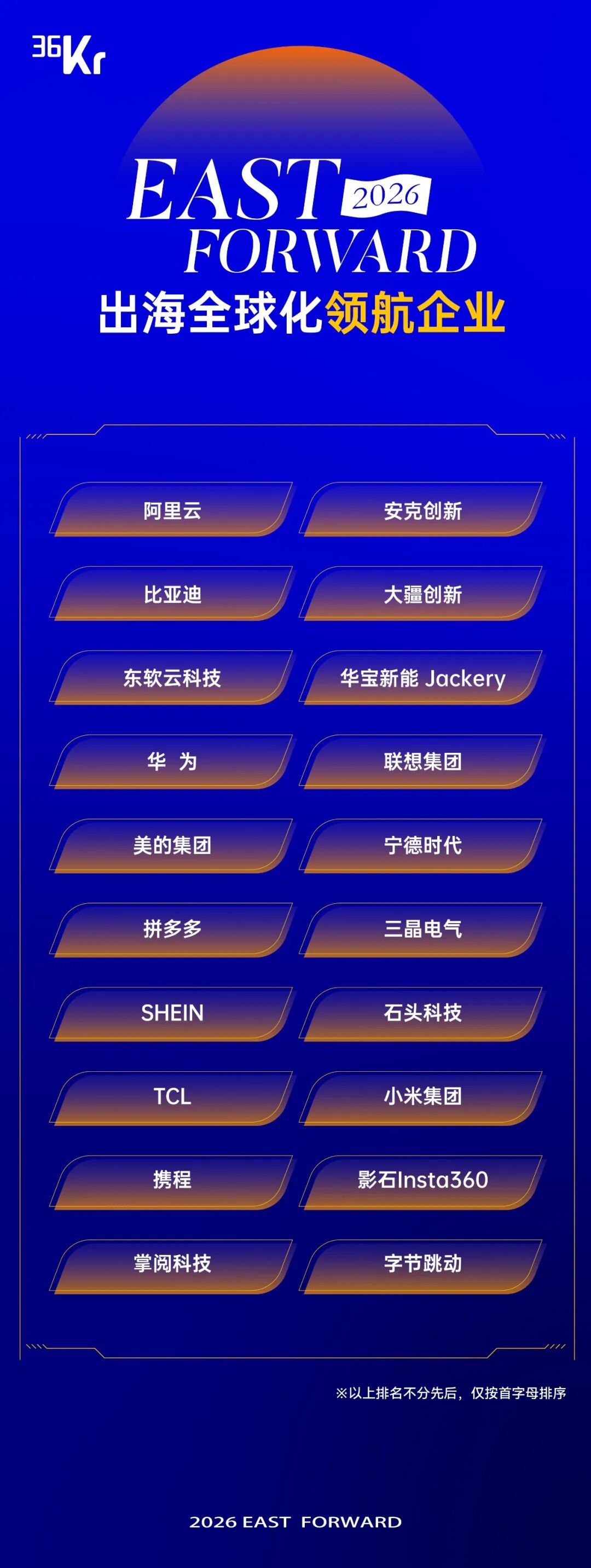
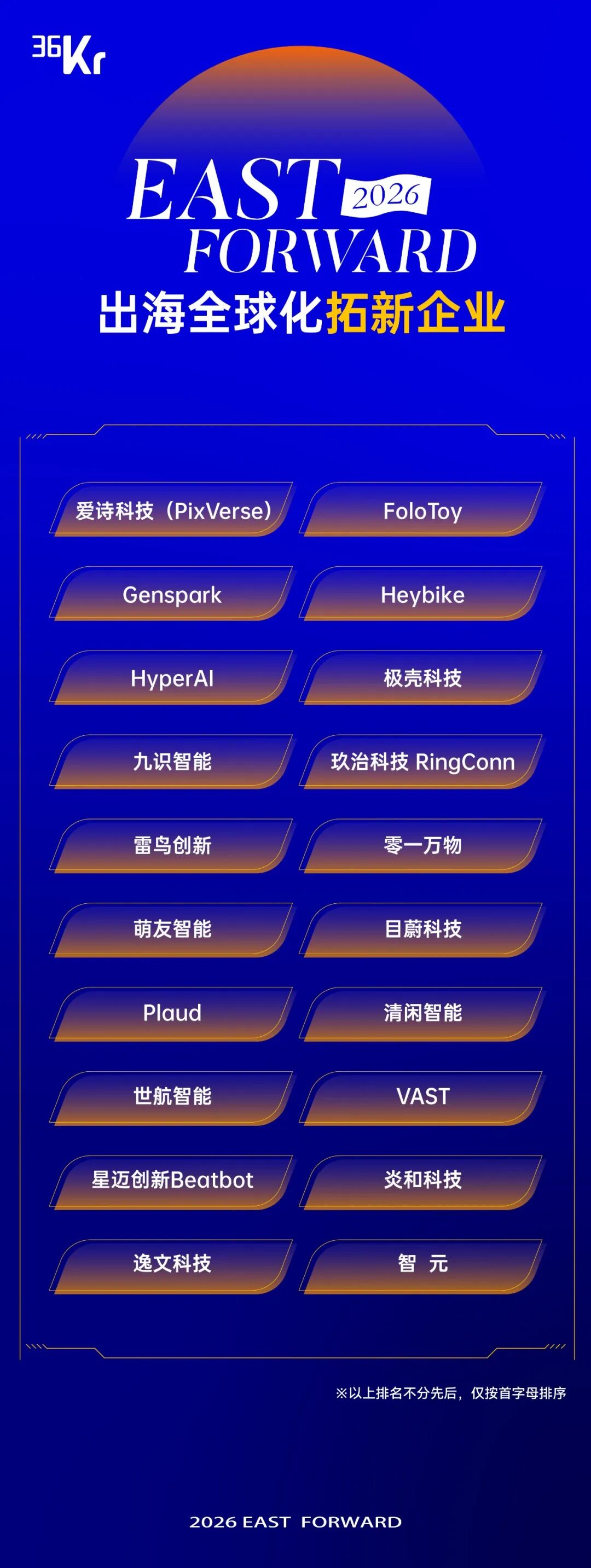
The following is the full list of the "East Forward 2026 Globalization Series Directory"
East Forward 2026 Globalization Pilot Enterprises
East Forward 2026 Globalization Innovation Pioneers
East Forward 2026 Globalization Infrastructure Builders
