Historic leap forward of China's innovative drug industry
On the afternoon of September 15 Seoul time, a special session themed "Breakthrough Immunotherapy for Advanced Non-Small Cell Lung Cancer" was held as scheduled at the COEX Convention & Exhibition Center.
When Zhou Caicun stepped onto the podium, he held two identities: President of the International Association for the Study of Lung Cancer (IASLC), and the principal investigator of the HARMONi-2 study. What he was about to report was a figure that many people had been waiting for more than three years.
The complete results of this large randomized controlled study were finally unveiled: the median survival time of patients treated with Akeso's Ivonescimab was 30.8 months, while that of patients treated with the control drug was 22.6 months.
A difference of more than eight months.
As a high-standard phase III randomized controlled clinical study, HARMONi-2 directly set the "gold standard" for global lung cancer treatment, Pembrolizumab (Keytruda®), as the control group. It is worth noting that Keytruda has long ranked first in global anti-tumor drug sales, with global sales reaching 31.6 billion US dollars in 2025. It is a blockbuster product in the oncology field in the past decade, and also the ultimate reference benchmark for the initiation and clinical comparison of new immunotherapies worldwide.
Prior to this, no single drug in the world had ever head-to-head beaten Keytruda to achieve a significant OS benefit in a phase III randomized controlled study.
And Ivonescimab broke this situation.
Moreover, this year's World Conference on Lung Cancer (WCLC) held in Seoul, South Korea, witnessed a qualitative breakthrough of Chinese innovative drugs. The results intensively delivered by Chinese enterprises in the four days from September 12 to 15 almost covered the current mainstream technical routes of lung cancer treatment.
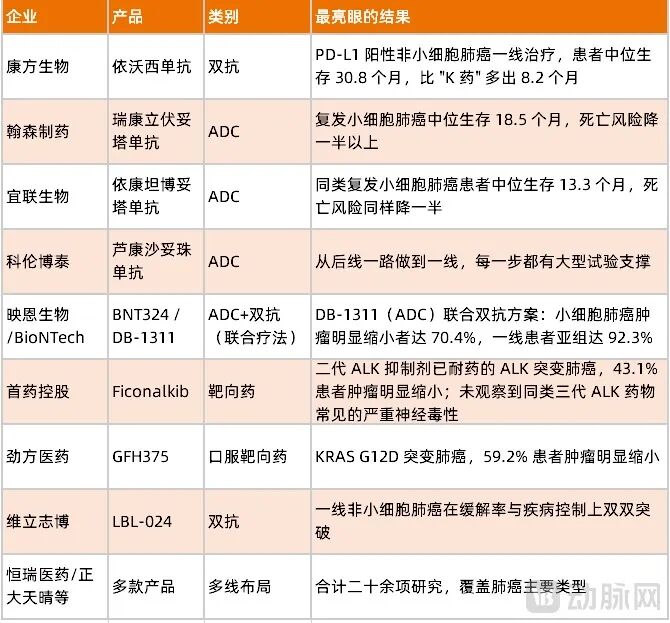
Summary of Achievements of Chinese Innovative Drugs at WCLC 2026 (Source: Arranged by VCBeat)
Beneath the noisy highlights, what is truly worth analyzing are three key breakthroughs at this conference that are enough to reshape the pattern of China's domestic innovative drug industry.
Historic First Victory
The most milestone-breaking breakthrough at this WCLC comes from Akeso's Ivonescimab.
The complete data shows: under the strict observation cycle with a median follow-up of up to 36 months, the median overall survival (OS) of patients in the Ivonescimab group reached 30.8 months, far exceeding 22.6 months in the Keytruda control group, winning more than 8 months of survival for patients; the risk of death was significantly reduced by 27%, with a clear and significant statistical difference.
This is also the world's first innovative therapy that has obtained positive OS benefit compared with Keytruda in a randomized double-blind controlled phase III clinical trial, officially achieving the historic first victory of China's bispecific antibody track against the world's top drugs.
Beneath the highlight data, the rational judgment of the international academic community is more valuable for reference. During the conference review session, Mariana Brandão, a leading expert from the Jules Bordet Institute in Belgium, gave a restrained and professional evaluation, explicitly stating that the existing clinical practice will not be adjusted immediately.
The core reason is that the survival benefit of this drug does not cover all populations, with clear population differences: the core benefit is concentrated in the PD-L1 high expression population (HR=0.58) and the squamous cell carcinoma population (HR=0.65), with a significant reduction in the risk of death; while the PD-L1 low expression population (HR=0.85) and non-squamous cell carcinoma population (HR=0.79) do not meet the statistically confirmed standard, and it cannot be proved that these two types of patients can obtain clear survival benefits.
This means that the breakthrough of Ivonescimab is a victory in precise segmented scenarios, not an all-round advantage over all populations, and the implementation of its clinical value needs to rely on precise patient stratification.
Two Domestic B7-H3 ADCs Reach the Top
While the bispecific antibody track has achieved a historic breakthrough, this WCLC has staged another remarkable moment belonging to Chinese innovative drugs: two domestic B7-H3 targeted ADC drugs were presented at the highest-specification Presidential Symposium of the conference on the same day. This is also the first time since the launch of WCLC that two domestic phase III landmark studies of the same target have appeared on the same stage, marking that China's R&D strength in the cutting-edge ADC track has firmly ranked in the global first tier.
The two drugs presented on the same stage are HS-20093 (RC88-ADC) from Hansoh Pharmaceutical and YL201 (Icotarotamab) from YL Biologics. Both studies target relapsed small cell lung cancer with extremely poor prognosis and scarce clinical treatment options, and use the traditional standard therapy topotecan as control, delivering solid phase III survival data.
The ARTEMIS-008 study of Hansoh Pharmaceutical, led by Professor Wang Jie, enrolled 461 patients with relapsed small cell lung cancer, and the final data amazed the whole audience: the median OS of patients in the treatment group reached 18.5 months, a significant increase compared with 10.3 months in the control group, the risk of death was reduced by as high as 54% (HR=0.46), setting a new global record for the longest survival in second-line treatment of small cell lung cancer.
More notably, this drug has universal benefit for all populations.
No matter the patients are platinum-resistant or not, have brain metastases or not, or have received immunotherapy before, they can obtain stable survival benefits.
Its safety is significantly better than traditional chemotherapy, the incidence of severe adverse reactions is greatly reduced, only the risk of interstitial lung disease is slightly increased, and the overall benefit-risk profile is excellent.
Shortly afterwards, the TAISHAN-302 study of YL Biologics led by Professor Zhang Li, covering 85 centers across China, released data. The clinical results of 451 enrolled patients showed that the median OS of the Icotarotamab group was 13.3 months, with significant benefit compared with 9.4 months in the control group, the risk of death was also reduced by 54% (HR=0.46).
The completely identical risk reduction value of the two studies has become the most concerned hot detail of this conference, but it is also the most easily misinterpreted key point.
It must be made clear that the same HR never means the same efficacy. The absolute difference in median OS between the two drugs reaches 5.2 months, and there are significant differences in the median follow-up duration of the study, baseline characteristics of patients, stratification design, and analysis time points. Direct comparison of efficacy across studies does not have a scientific basis.
The real industry value is that the two studies are perfectly complementary: Hansoh HS-20093 verifies the stable benefit ability for the whole population, while YL Biologics YL201 focuses on high-risk refractory populations to complete efficacy verification.
The two sets of data, one covering a wider population and the other focusing on precise groups, jointly consolidate China's global leading position in the B7-H3 ADC track, and have made substantial breakthroughs in the druggability verification of the B7-H3 target.
From Developing a Single Molecule to Building a Complete System
If Ivonescimab proves the possibility of single-point breakthrough, and RC88-ADC proves another ability — to truly push a target that has long lacked confirmatory evidence to the end, then what is more worth recording at this conference is the common foundation behind these two events: Chinese innovative drugs are no longer just "developing a single molecule", but are capable of "building a complete clinical development system".
Sitravatamab from Kelun-Biotech provides the most complete evidence chain. This ADC, which has been licensed to Merck, has successively conducted a randomized controlled study in the third-line, second-line and first-line settings respectively, with valid data at every step: compared with docetaxel in the third-line setting, the median survival of patients was extended from 13.5 months to 20.0 months; compared with platinum-containing chemotherapy in the second-line setting, it also showed prominent survival benefits; the regimen of combined use with Keytruda in the first-line setting was significantly better than Keytruda monotherapy in head-to-head studies, reducing the risk of disease progression or death by about 65%.
A drug that moves all the way from later-line treatment to first-line treatment, with large-scale trials supporting every step, is itself proof of capability. Professor Zhou Caicun put forward the judgment at the joint forum that the status of chemotherapy may be further moved back, and new ADCs will be moved forward to first-line treatment. The domestically developed Sitravatamab from China is expected to become the first such drug.
If Kelun-Biotech proves the full-process development capability of "advancing all the way from later-line to first-line", then the layouts of other Chinese enterprises at this conference correspond to different links of this system respectively: some have completed target druggability verification, some are exploring combination regimens, some are betting on cutting-edge technical routes, and they jointly constitute the breadth and depth of the clinical development system of Chinese innovative drugs.
The third-generation ALK inhibitor from SYOS Therapeutics made the tumors of 43.1% of 153 patients who were resistant to second-generation drugs significantly shrink, and the intracranial lesion response rate reached 65.0%. No investigator-assessed neurotoxic adverse events were observed in the study, while neurotoxicity is exactly the most distressing side effect of the already marketed similar third-generation drugs for patients.
The oral KRAS G12D inhibitor from GenFleet Therapeutics achieved a 59.2% response rate in 71 treated patients, and has entered the advanced clinical development stage.
The drug co-developed by ImmuneOncia and BioNTech, combined with another bispecific antibody, significantly shrank the tumors of 70.4% of evaluable small cell lung cancer patients, and the proportion reached 92.3% in first-line patients. However, this is only early-stage data with a limited sample size.
Jiangsu Hengrui Medicine brought more than a dozen lung cancer studies to the conference, Chia Tai Tianqing released 11 achievements at one time, and the pipelines of Livzon Mabpharm and Baili Tianheng were also presented at the meeting. The number of studies itself does not constitute persuasion, but what constitutes persuasion is that the complete chain from early exploration to registrational phase III is taking shape in the hands of the same group of companies.
The transfer of academic discourse power has also left clear marks at this conference.
Statistics show that 19 oral reports and 45 mini oral reports of new Chinese drugs were selected for this conference, setting a new record in quantity.
In addition, from the leadership setting of the academic association to the design of special sessions, the rising status of Chinese forces in the global lung cancer academic system can also be seen: Professor Zhou Caicun became the first Chinese president in the history of the International Association for the Study of Lung Cancer (IASLC); and the special session co-hosted by IASLC, CAALC and CSCO was directly themed "ADCs, Bispecific Antibodies and AI Agents in Lung Cancer: China-Led Innovation and Global Translation", which focused on showing China's original breakthroughs and global translation paths in the three major directions of ADCs, bispecific antibodies and AI diagnosis and treatment.
From quantity to seats, from topics to rules, Chinese innovative drugs are changing from the objects being discussed to the initiators of topics.
In addition to the gains in clinical research, the field of humanistic diagnosis and treatment has also received international recognition: the multidisciplinary team led by Professor Lu You from West China Hospital of Sichuan University won the IASLC Team Science Award, which is also the only Asian team to receive this honor at this conference. This award is nominated by patients, and measures patient education, empathy, shared decision-making and rehabilitation support, rather than survival data; the winning case is a patient with advanced lung cancer who was managed by the team for ten years, who had an unexpected pregnancy during targeted therapy and finally gave birth smoothly.
When Chinese teams can not only set new records in data, but also become the only Asian winner in patient-nominated awards, the improvement of China's discourse power in the global lung cancer field has a complete footnote.
However, under the prosperous highlights, rational examination must still be maintained. The successive landmark data emerging at this WCLC confirms the great progress of China's domestic innovative drug clinical development capability, but there are also realistic boundaries behind the outstanding achievements.
The clinical benefits of many drugs do not cover all patients, and their advantages are more concentrated in specific tumor subtypes and biomarker populations; even if excellent results are obtained in Asian populations, the therapeutic value in patients of different races overseas needs to be further verified by larger-scale global multi-center studies. Just as the benefit of Ivonescimab in PD-L1 low expression and non-squamous cell carcinoma populations is still unclear, its long-term survival data in Western populations still needs further follow-up. In the face of the outstanding conference data, an objective evaluation should be maintained, and the real value of a drug needs to be continuously consolidated by more clinical evidence.
At present, the New Drug Application of Ivonescimab in the US FDA has been officially accepted, and the final review decision will be ushered in on November 14, 2026. This New York time point is not only a globalization report card of a single drug, but also a key major test for Chinese innovative drugs to move from "domestic leading" to "globally recognized".
This article is from the WeChat official account "VCBeat" (ID: vcbeat), written by Wang Lutai, and authorized for release by 36Kr.