Behind ZARA's entry into the platform, a wave of fashion brands are flocking to JD.com.
A new trend is sweeping across the fashion apparel sector.
On September 16, ZARA launched on JD.com, with its full product range available and new arrivals synchronized globally. This is not an isolated case. In the past few years, luxury brands, international fashion groups, influencer-operated stores, designer brands and other players have successively settled in JD.com, and ZARA is the latest milestone on this expansion curve.
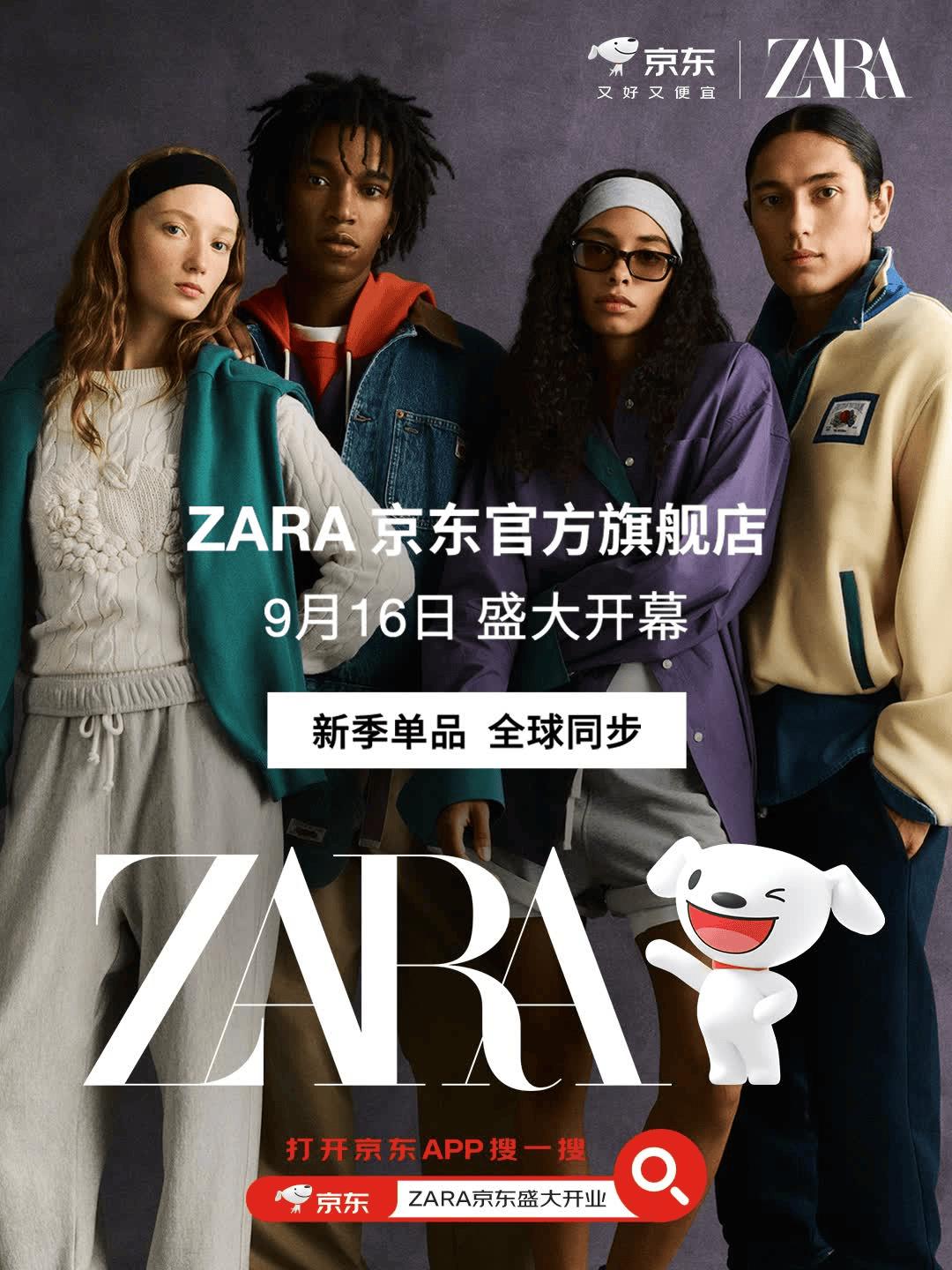
Fashion brands of vastly different scales and demands have made choices pointing in the same direction, and a collective migration is underway.
The starting point of this migration lies in the fundamental changes of the apparel business itself. Consumers are paying increasing attention to fabric and craftsmanship when buying clothes, with fabric count, weight and composition content factored into their purchase decisions. For brands expanding channels, what they pursue is no longer just a one-off sales surge, but a fertile ground for long-term sustainable growth driven by brand accumulation.
On one hand are consumers in pursuit of certainty, on the other hand are operation methods that enable brands to grow. JD.com's years of accumulation and efforts in the apparel sector have precisely matched the demands of both sides. As brands select platforms with new standards, the competitive coordinates of apparel e-commerce are also shifting.
Fashion Brands Are Accelerating Their Migration to JD.com
ZARA's entry into JD.com is a microcosm of international fashion brands adjusting their channel strategies in the past two years.
Facing the changing environment of slowing traffic dividends and rising customer acquisition costs year by year, apparel brands' understanding of channels has also changed significantly. For brands, pouring budgets into a single transaction spike is far less valuable than owning a sustainably operating business. Their criteria for selecting platforms are also changing accordingly: traffic scale is no longer the only consideration, and the certainty of growth has come to the forefront. Accuracy of consumer insight, stability of daily sales, and reliable fulfillment capacity have become new hard indicators.
International fashion brands' responses to these changes are reflected in their actions. In the past, their standard channel configuration consisted of offline flagship stores plus self-operated e-commerce, supplemented by one or two third-party platforms, which worked smoothly in the incremental era. Nowadays, audiences and the market are becoming increasingly segmented, with different consumer groups behind different platforms, and the old configuration is no longer effective. UNIQLO integrated its official mini-program into JD.com in 2025, launching its international designer co-branded series exclusively here; Massimo Dutti under Inditex had settled in earlier, and now ZARA has entered the platform with its full product line.
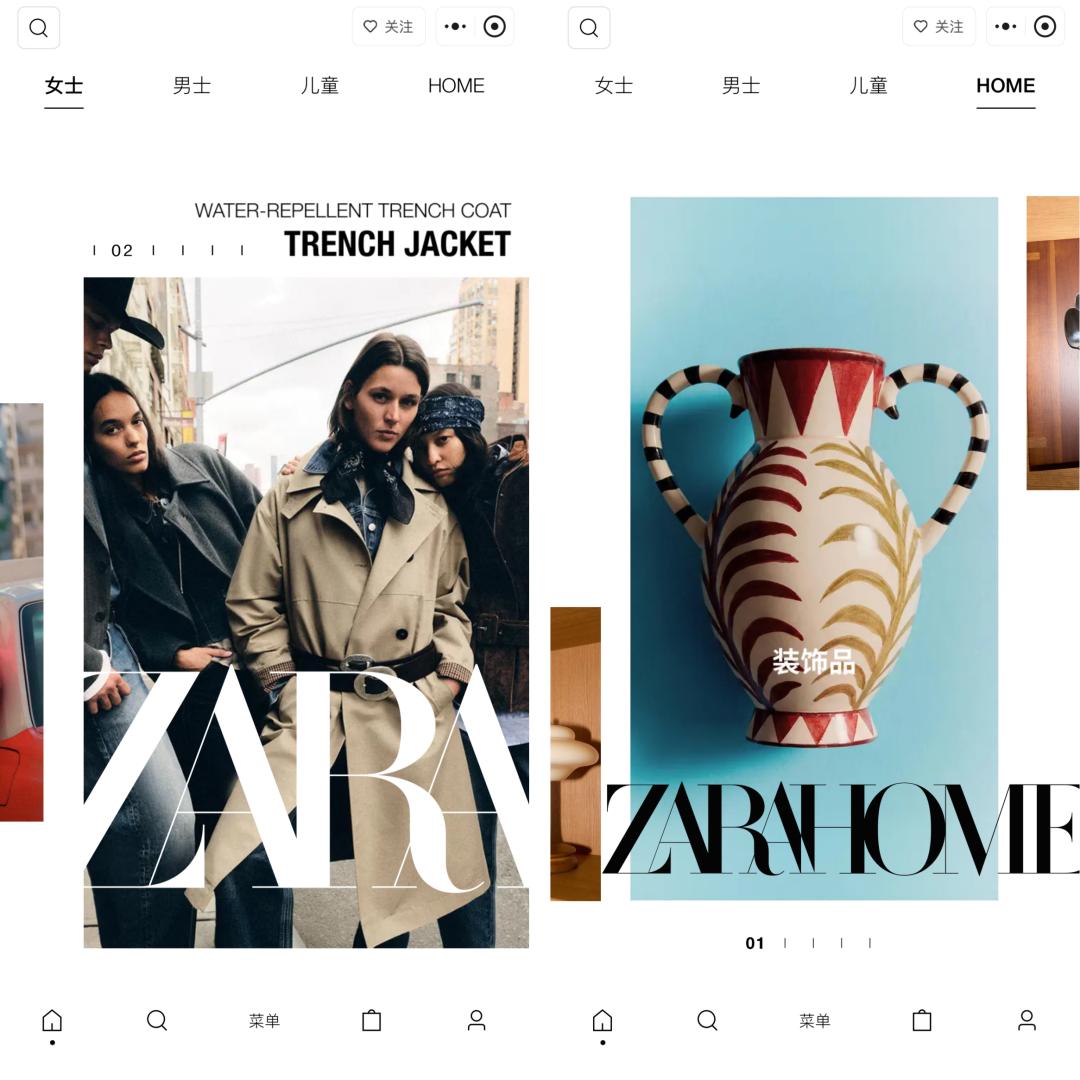
Screenshot of JD.com store
What ZARA values is precisely the "dual certainty" represented by JD.com and its user base. The head of JD.com Apparel told 36Kr that before ZARA officially settled in, millions of users had actively searched for ZARA on JD.com every year, and this number is expected to exceed 10 million after the entry.
Active search implies clear demand, and behind these millions of searches is a market that exists prior to supply. JD.com has over 740 million annual active users, who have long developed shopping habits of clear purpose, high emphasis on quality and service in the consumption of 3C products, home appliances and daily necessities. These are users who shop with clear goals rather than on impulse.
In terms of operation, this translates to higher conversion rate and average order value for the same brand on JD.com: clear demand leads to short decision-making paths, and the public perception of authentic products and quality services lowers the threshold for purchasing high-ticket items. For ZARA, this is not a new market that needs to be educated from scratch, but a business with obvious, guaranteed certainty.
Apart from the international big names represented by ZARA, emerging brands are also speeding up their pace of moving to JD.com.
In 2025, the number of new merchants that settled in JD.com's apparel and beauty categories increased by 89% year on year; in the first half of 2026, the transaction value of new merchants doubled year on year, with nearly 900 emerging apparel brands and over 1000 emerging sports brands recording doubled transaction value.
Influencer-operated stores, content IPs, niche brands... representatives of every type of emerging brand can be found in JD.com's settlement list. MARIUS started from sharing personal styling content and has become a highly representative brand in high-end commuter women's wear; BLACKNINI, which also runs influencer-led businesses, has achieved monthly sales exceeding 100 million yuan with apparel of average order value over 3000 yuan; STORMCREW under Storm Vision is backed by a content IP with over 30 million fans across all platforms; there are also aromatherapy brand FullAroma that received strategic investment from Yintong Holdings, MSQ that has become the new top player in the men's makeup track, and many others.
The common point of these brands is that they have no shortage of traffic entry points. Influencer stores build trust through their founders, content IPs complete cold start with fans, and niche brands rely on highly sticky loyal customers. However, traffic can drive up short-term sales, but it does not necessarily support the long-term development of a brand.
What MARIUS needs to cross is the threshold from an influencer store to an enduring brand. After entering the new user field, consumers began to recognize MARIUS through its fabric, cut and clothing quality, rather than only through the reputation of its founder. MARIUS also got rid of the cut-throat promotion competition, and shifted its business focus to service and efficiency. The data responded quickly: during the "Elite Wardrobe" campaign in September 2025, its transaction value on JD.com increased by 20 times month on month, and its sales during the Double 11 event that year increased by 10 times month on month.
STORMCREW is crossing the same threshold. In the past, its sales were tied to Tim, the founder of Storm Vision; after entering JD.com, with the help of JD.com's category-penetrating operation strategy, it upgraded its core hit product "Cooling" T-shirt. After the launch of the 2.0 version, its sales in the first seven days exceeded that of the previous version, expanding its market from fan circles to the mass market.
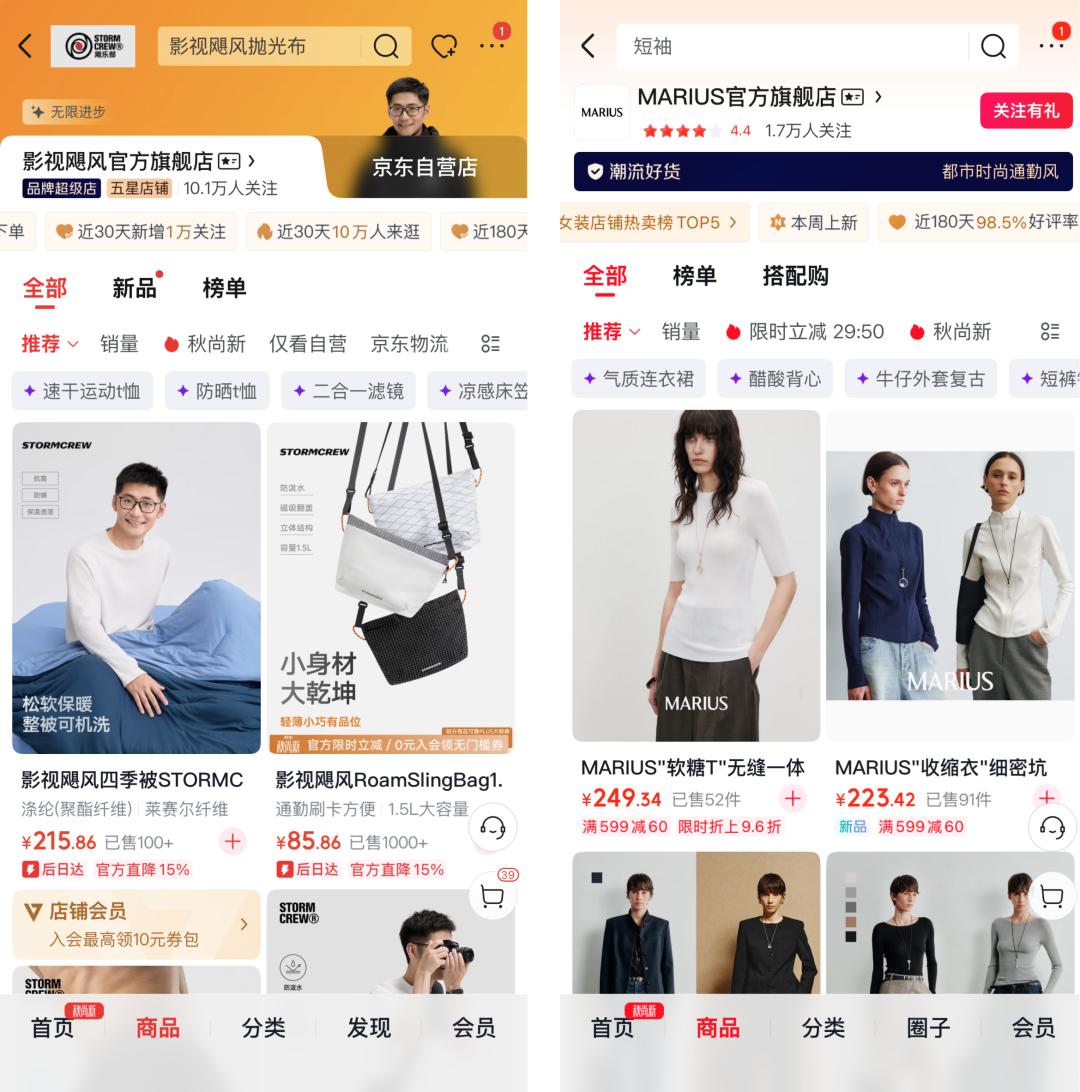
Screenshot of JD.com store
For brands like MARIUS and STORMCREW, entering JD.com means gaining an additional market for independent growth: turning the "fan-dependent" business into stable operation that does not rely on any single exposure event.
International big names come to JD.com to supplement the increment in their channel map; emerging brands come to JD.com to cross the threshold from traffic dependence to brand building. One brand's settlement may be just its own choice, but when the trend gradually takes shape, it is the answer given by the whole industry.
JD.com Has Its Own Solution for the Apparel Sector
The reason behind this brand migration can be seen by reviewing JD.com's moves in the apparel sector in recent years — JD.com has always been developing fashion business in a way completely different from the traffic logic, not betting on a single explosive growth, but focusing on consolidating the certainty of operation.
The premise of this approach is a fact often ignored in the industry: fashion apparel has never been a single unified track. Women's wear relies on style and new arrival speed, sportswear emphasizes function and scenarios, and underwear, footwear and bags all have their own unique consumption cycles.
Within each category, brands face vastly different situations. Mature brands like ZARA already have high public awareness and mature supply chains, what they lack is new user groups and methods to deepen newly opened channels. Emerging brands that have just completed cold start lack the methodology to grow from single-product explosion to stable operation. Facing different challenges, JD.com provides answers with a complete set of systematic strategies.
First of all, for the question of "what to sell and to whom to sell", JD.com's solution is called "category penetration".
When it comes to apparel operation, most platforms focus on traffic management, with shelves arranged by category, and transactions driven by paid traffic and big promotion events. In contrast, JD.com focuses on the products themselves. It breaks down the footwear and apparel categories into extremely fine granularity, and further divides them into nearly a thousand "quality × price" grids according to price, style, material, color, regional preference and other dimensions under each major category. For example, for a men's T-shirt, JD.com will split it into hundreds of grids based on fabric, craftsmanship and collar type, each corresponding to a specific group of people and a specific cost structure. Where there is unmet demand, and where the competition is too fierce to enter, can be seen at a glance in the grid system.
Down jacket brand Tambor has experienced the power of this mechanism. In the past, it made annual plans based on experience, betting that the products would become hits, but if the bet failed, the products would turn into inventory. In the second year of cooperation with JD.com, the platform's grid data showed that among the two conventional down jacket categories, the conversion rate of puffer jackets was significantly higher than that of quilted down jackets. This feedback prompted Tambor to shift its development focus to puffer jackets, launching its signature hit Puff series, and then extended a full product line along the scenarios of sports, light outdoor activities and streetwear. Nowadays, this series has gained widespread popularity across all channels.
Behind this are two completely different platform roles — on traffic-dominant platforms, brands buy exposure from the platform, and one paid traffic investment is exchanged for one transaction. On JD.com, what brands and the platform discuss together is how to develop the next batch of products. Exposure expires once the purchase ends, but products verified by data can sell well for a long time. The gravitational force that attracts brands to migrate lies right here.
On top of the grid system, JD.com also provides tiered support for brands under the "3×500 Brand" initiative: leading brands can get support for creating million-selling hit products and accelerating new product promotion; emerging brands can get resource inclination as well as operation guidance from JD.com's procurement team; authorized brands can enjoy lower operation thresholds. For daily operation, a complete "Merchant Growth PLUS" methodology is also matched, which connects product range planning, stable daily sales and brand growth into a complete path, supplemented by generous exclusive incentive policies for new merchants, so that brands and merchants at every development stage can find corresponding solutions.
This strategy has been verified by a group of brands that have found their own positioning. UNIQLO, which settled in last September, took part in JD.com's Double 11 event for the first time and topped the apparel brand sales ranking, with over 50 SKUs selling more than 10,000 units in the full cycle, the classic fleece jacket selling over 30,000 units, and the popular trend hit curved-leg pants selling over 25,000 units. New Chinese-style women's wear brand Sanji Heihua has locked in the segmented track, its "Gold and Silver Everywhere" series of dresses has become the top product in its category, with its transaction value in the first half of this year increasing by more than 3 times year on year. Xiahu Family, a brand originated from OEM factories, applied its years of quality control experience to basic apparel products, turning 100-count cotton T-shirts from short-term items into long-term classic products, expanding from third-party stores to self-operated stores, and its performance has multiplied. With different tracks and different scales, all of them can find their own growth space in this grid system.
The "category penetration" strategy helps brands answer the question of "what to sell and to whom to sell", but there is a more difficult problem in the apparel business — across the screen, why should consumers trust the quality of a piece of clothing?
This is an old pain point in the industry. The problem that "pictures are for reference only" and fabric descriptions are completely unsubstantiated leads to high trust cost and high return rate, which is a "nightmare" for most apparel brands.
JD.com's solution is to endorse brands with its platform reputation, reduce burdens for users with platform screening, and let consumers "buy without second thought": by building industry standards from scratch, and adopting more scientific and strict platform checks, so that consumers no longer only buy products, but buy the certainty guaranteed by the platform's screening.
The "JD FASHION" quality label launched in September 2025, in cooperation with national quality inspection institutions, carries out quantitative grading on fabric, craftsmanship and function, and each labeled product comes with a quality inspection report. After that, JD.com joined hands with China United Quality Inspection, Bureau Veritas, SGS and other authoritative institutions to establish the Apparel Quality Alliance, realizing full-link quality control. At this year's China International Fashion Week, JD.com presented five major fabrics including cotton, linen, acetate, silk and functional fabric on the T stage, and the transaction value of labeled apparel products doubled month on month. So far, more than 3000 labeled SKUs on JD.com have achieved annual sales exceeding 1 million yuan.
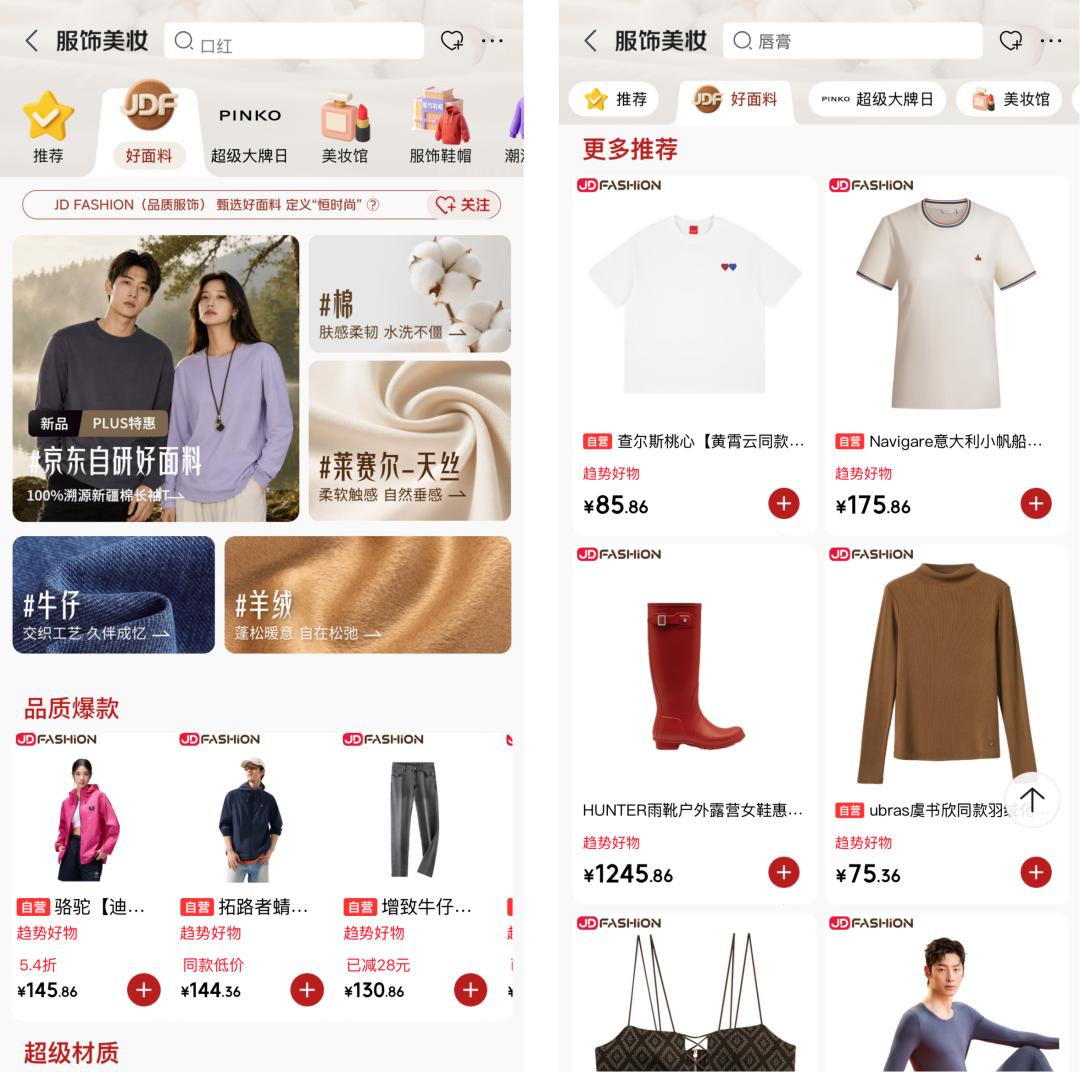
Screenshot of JD.com store
For consumers, this set of standards saves their decision-making cost, and for the first time, the fabric count, weight and composition of clothing have platform endorsement. For brands, it provides something more scarce: quality can now be quantified and verified. Brands that focus on product quality no longer need to compete for the same trust with products that do not match their descriptions.
A positive cycle has thus formed: quality standards screen out good products, good products retain users who are willing to pay for quality, and user assets in turn attract more good brands to enter. From global groups like ZARA to just-founded founder-led brands, what JD.com has truly built in recent years is not just a longer list of recruited fashion brands, but a set of effective methodologies applicable to brands of all levels.
As the apparel industry shifts from traffic competition to operation competition, what brands need is a platform that can help them build their brands and achieve long-term growth. JD.com has responded to brands' demands with its own methods, more and more brands have entered the platform, and changes have taken place. The upcoming Double 11 event will be a centralized test of these efforts.
With Double 11 Approaching, the Apparel Game is Being Reset
The launch date of ZARA on JD.com is a statement in itself — it settled in on September 16, less than two months before Double 11. According to 36Kr, this timing was jointly decided by ZARA and JD.com.
For an international brand of this scale, settling in a new platform is far more than simply moving products online. The configuration of product range, user operation matching, inventory preparation, and fulfillment experience optimization all take months of work. Entering in September leaves a complete run-in cycle. The product range construction and user accumulation are completed during the season change period, so that the sales can be directly scaled up when Double 11 kicks off.
On the other side of the game, JD.com has also made full preparations in advance. From August to September this year, JD.com invested a lot of resources in search and recommendation, new product IPs and advertisements for new seasonal products, driving the overall sales of new products to increase by more than 50% year on year. The ongoing "Genuine 50% Off Apparel