Luo Fuli also followed Lei Jun's example to do live streaming. The training of Xiaomi's new model was publicly disclosed for the first time, burning through 200,000 yuan in just one hour.
Just now, the Xiaomi MiMo team announced its latest progress.
Luo Fuli, Head of Xiaomi MiMo, posted on the X platform that the team has been conducting research around one single question for nearly half a year: To what extent can Reinforcement Learning (RL) be further scaled?
She disclosed that MiMo-V2.6 is currently in the RL training process, and the team is expanding the scale in three dimensions, including computing resources, training environment and task system, as well as the reward evaluation mechanism. In the coming weeks, the Xiaomi MiMo team will release more technical details successively.
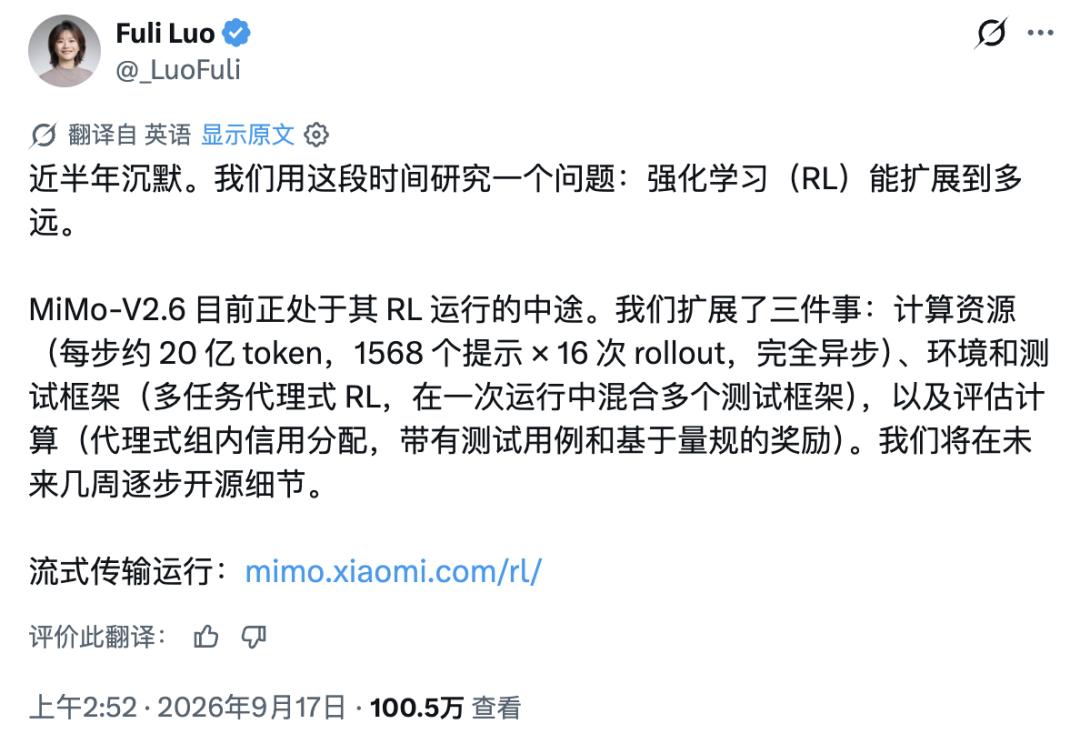
Live stream link https://mimo.xiaomi.com/rl/#overview
At the same time, Luo Fuli also shared the real-time training page of MiMo-V2.6, allowing the public to see part of the training status of this generation of models in the reinforcement learning phase for the first time.
According to the training page released by Luo Fuli, MiMo-V2.6 is currently undergoing a large-scale Agent reinforcement learning experiment. The page displays the model training progress, Token consumption, training cost, number of samples and changes of multiple internal indicators.
The current training page contains two versions, namely MiMo-V2.6-Pro and MiMo-V2.6-Flash.
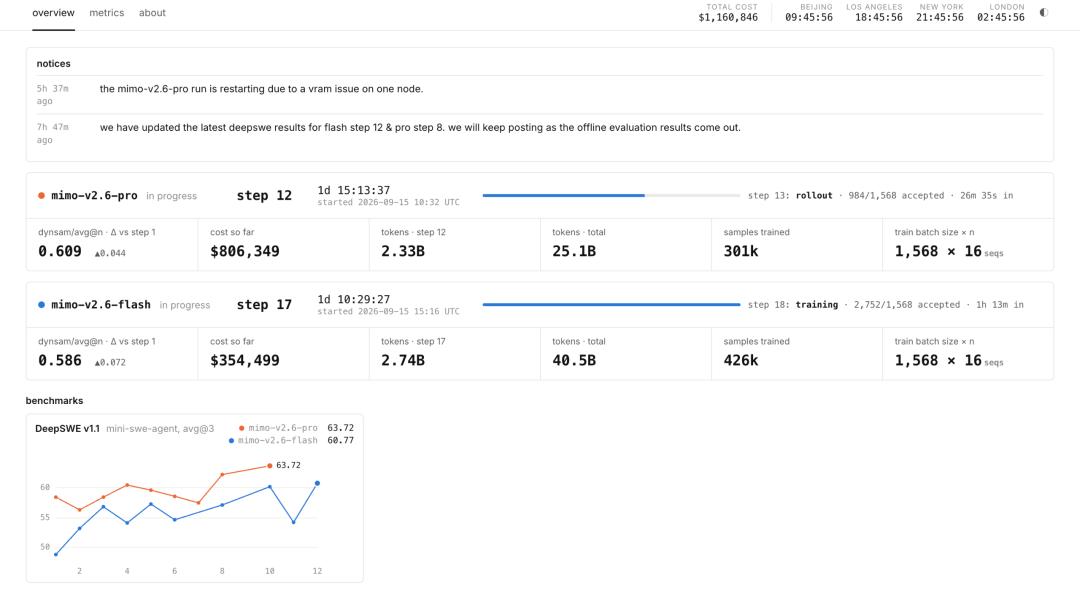
Among them, MiMo-V2.6-Pro is currently at step 12, with a cumulative training sample of about 301K, a training cost of about 806,349 US dollars, and a cumulative Token consumption of 25.1B.
MiMo-V2.6-Flash is currently at step 17, with a cumulative training sample of about 426K, a training cost of about 354,499 US dollars, and a cumulative Token consumption of 40.5B.
The total cumulative training cost of the two versions has exceeded 1.16 million US dollars, with an average hourly computing cost of about 30,900 US dollars (equivalent to 207,200 RMB). However, according to the data on the training panel, the focus of Xiaomi's public disclosure this time is not the cost, but to demonstrate how the model continuously improves its capabilities through large-scale task interaction during the RL training process.
MiMo-V2.6 is challenging the scaling boundary of RL
Luo Fuli mentioned on X that this round of reinforcement learning training of MiMo-V2.6 focuses on expanding in three directions.
The first direction is computing scale.
She stated that the team has increased the scale of a single training step to about 2B tokens, adopted a training method of 1568 prompts × 16 rollouts, and used fully async training.
Calculated according to this configuration, a single training step will theoretically generate about 25,000 model attempts, which is equivalent to allowing the AI to explore a large number of different solution paths at the same time.
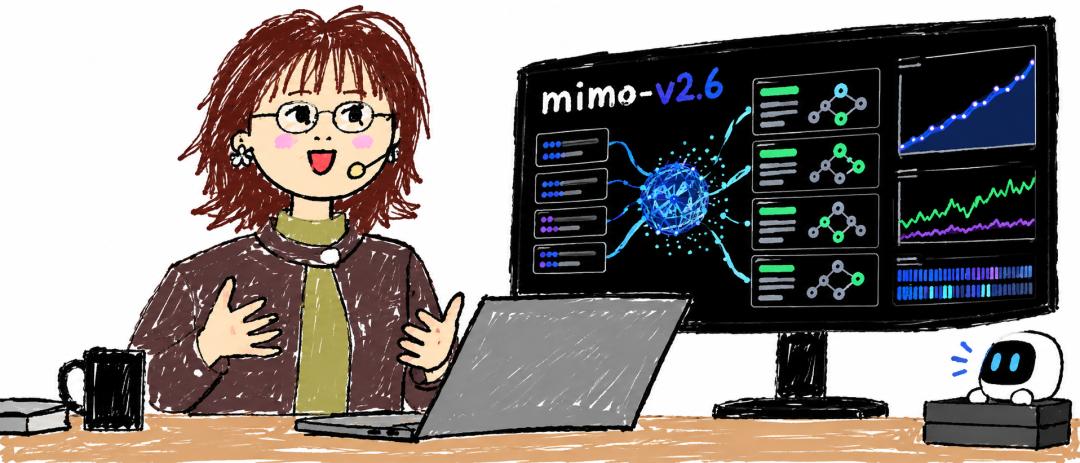
Under this training method, when facing a task, the model will not only generate one answer, but try multiple solutions at the same time, and then judge which paths are more effective according to the reward feedback.
For Agent models, the large-scale exploration capability is very critical. In the past, large models mostly acquired knowledge through pre-training, and then adjusted their output methods through supervised fine-tuning.
However, when AI starts to take on complex tasks such as programming, office work, and data analysis, what the model needs is not only to answer questions, but also to plan steps, call tools, and verify results.
The value of reinforcement learning lies in enabling the model to gradually form a more effective task execution strategy through a large number of attempts and feedback.
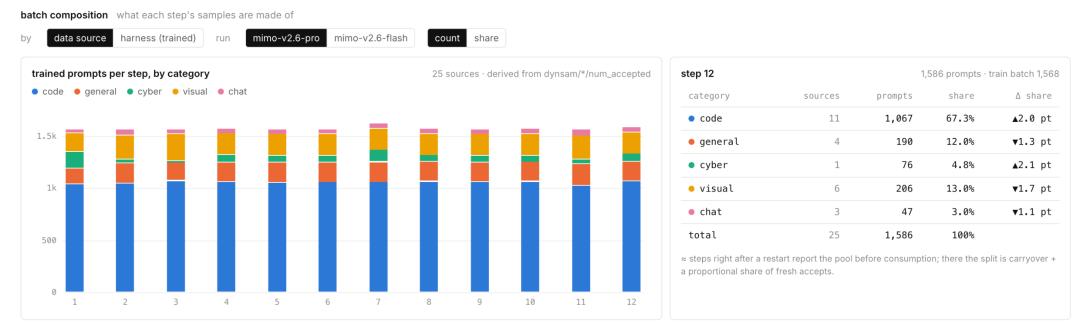
The second direction is the training environment. Luo Fuli said that the team has expanded environments and harnesses, introduced multi-task agentic RL, and mixed multiple task environments into one training process.
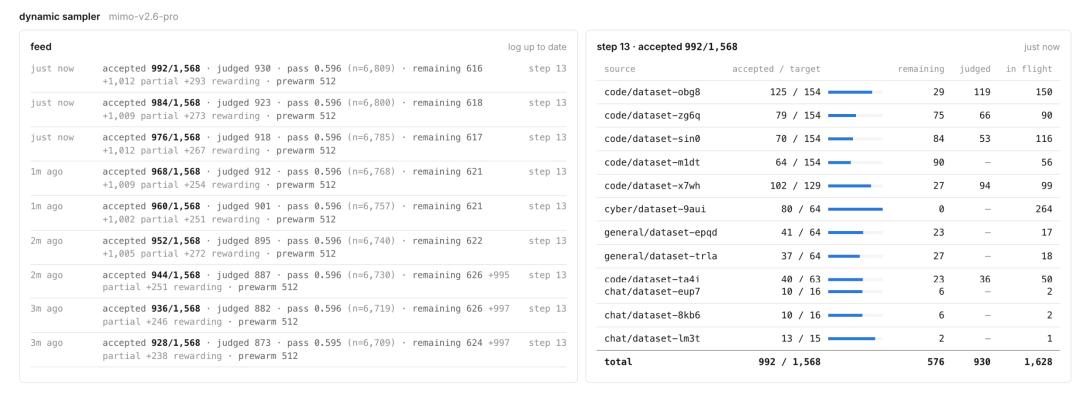
According to the data displayed on the MiMo-V2.6 real-time monitoring panel, the current training tasks cover vision, code, general tasks and chat tasks.
You can see visual datasets such as visual/dataset-jz3d, visual/dataset-gtaV, visual/dataset-vs3e on the page, as well as code tasks such as code/dataset-4qn, and general and chat datasets.
This means that MiMo-V2.6 does not only optimize a certain capability, but tries to make the model adapt to different types of Agent scenarios at the same time.
The third direction is to increase the computing investment of the evaluation system.
Luo Fuli mentioned that the team introduced agentic in-group credit assignment, combined with test-case and rubric-based rewards.
Complex Agent tasks usually include multiple execution steps.
The model may need to search for information first, then formulate a plan, and then call tools to complete the task.
Luo Fuli mentioned that the team adopts agent-style in-group contribution attribution, and combines test cases and scoring rules to provide rewards. Facing multiple tasks and multiple execution trajectories, the evaluation system needs to provide differentiated feedback to help the model learn more effective task execution strategies from different attempts.
A more detailed reward allocation mechanism can help the model learn more effective execution paths.
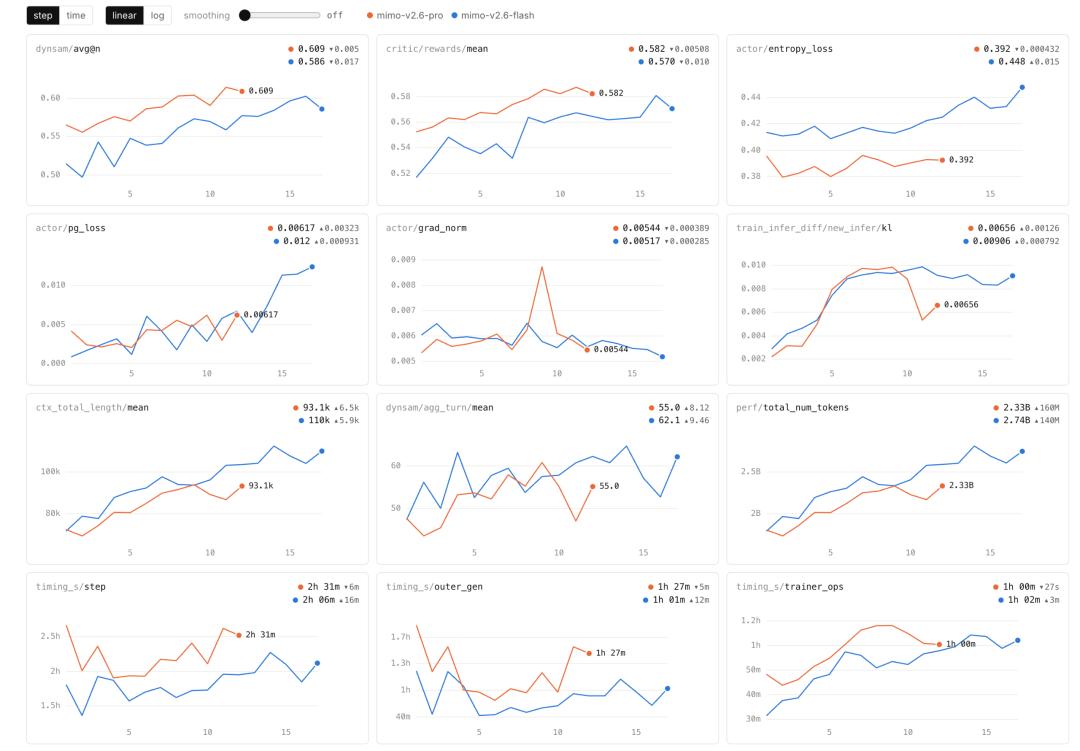
Judging from the changes of indicators on the page, the reward-related indicators of MiMo-V2.6 are improving as training progresses.
For example, from the critic/rewards/mean curve, the average reward of Pro has increased from about 0.55 in the early stage of training to 0.582, and that of Flash has increased from about 0.52 to 0.570. Both curves show an overall upward trend amid fluctuations.
Signals revealed by the training page: Xiaomi is betting on the Agent era
In addition to demonstrating the training process, the training page released by Luo Fuli also reveals the current capability changes of MiMo-V2.6.
As of press time, according to the data on the training panel, MiMo-V2.6-Pro currently scores 63.72 on the DeepSWE v1.1 benchmark, and MiMo-V2.6-Flash scores 60.77.
DeepSWE is mainly used to test the software engineering capabilities of the model, including code understanding, modification and complex development task processing.
At the same time, the context length indicator in the training page also continues to grow. Among them, the ctx_total_length data shows that the current average context length of MiMo-V2.6-Pro is close to 100,000 Tokens, and the Flash version also exceeds this scale.
For Agent models, long context capability means that the model can continuously remember previous operation steps, tool feedback and task status, which is also the basis for completing complex work.

It is worth noting that what Xiaomi disclosed this time is the training process, not the final model performance.
In the past, large model companies usually only announced parameters, benchmark scores and application cases when the model was released, and the training process was often in a black box state. This time, Luo Fuli shared the real-time training page, allowing the public to see the computing scale, task composition and capability changes during model training.
At present, the training of Pro and Flash is still ongoing.
As the curves extend, we will be able to continuously track three relationships: the relationship between computing investment and capability improvement, the relationship between execution length and task effect, and the relationship between environment diversity and model adaptability.
The question "how far can reinforcement learning be scaled" raised by Luo Fuli will also be gradually answered through these relationships: whether the increased computing power can enable the model to complete complex tasks more stably and efficiently in more environments.
This article is from the WeChat official account "APPSO", written by Discover Tomorrow's Products, and published by 36Kr with authorization.