Roundtable: Advanced Manufacturing: Equip the World Factory with an AI Brain | 36Kr 2026 Industry Future Conference
In 2026, industrial investment has entered a deep-water zone, where capital, technology and industry are accelerating their integration. The old investment logic no longer applies, and a new consensus is taking shape. The 2026 Industrial Future Conference focuses on opportunities in the new cycle, and jointly explores the future of the industry and the birth of the "Light of China". From September 9 to 10, the 2026 Industrial Future Conference hosted by 36Kr was held in Yizhuang, Beijing under the theme of "Resonance and New Birth Above the Deep Water". Participants from state-owned capital platforms, industrial investment funds, corporate CVCs, innovative enterprises, experts and scholars gathered to focus on the industrialization of future industries such as quantum technology. The conference conducted in-depth discussions on the current cutting-edge technology and industrial perspectives, focused on demonstrating breakthroughs in technical routes such as superconductivity, photonic quantum and ion trap, and shared a large number of specific industrial scenarios, industrial system construction, and the prospects of heterogeneous computing, to jointly discuss the future of sci-tech industrial investment.
The following dialogue is organized and edited by 36Kr:
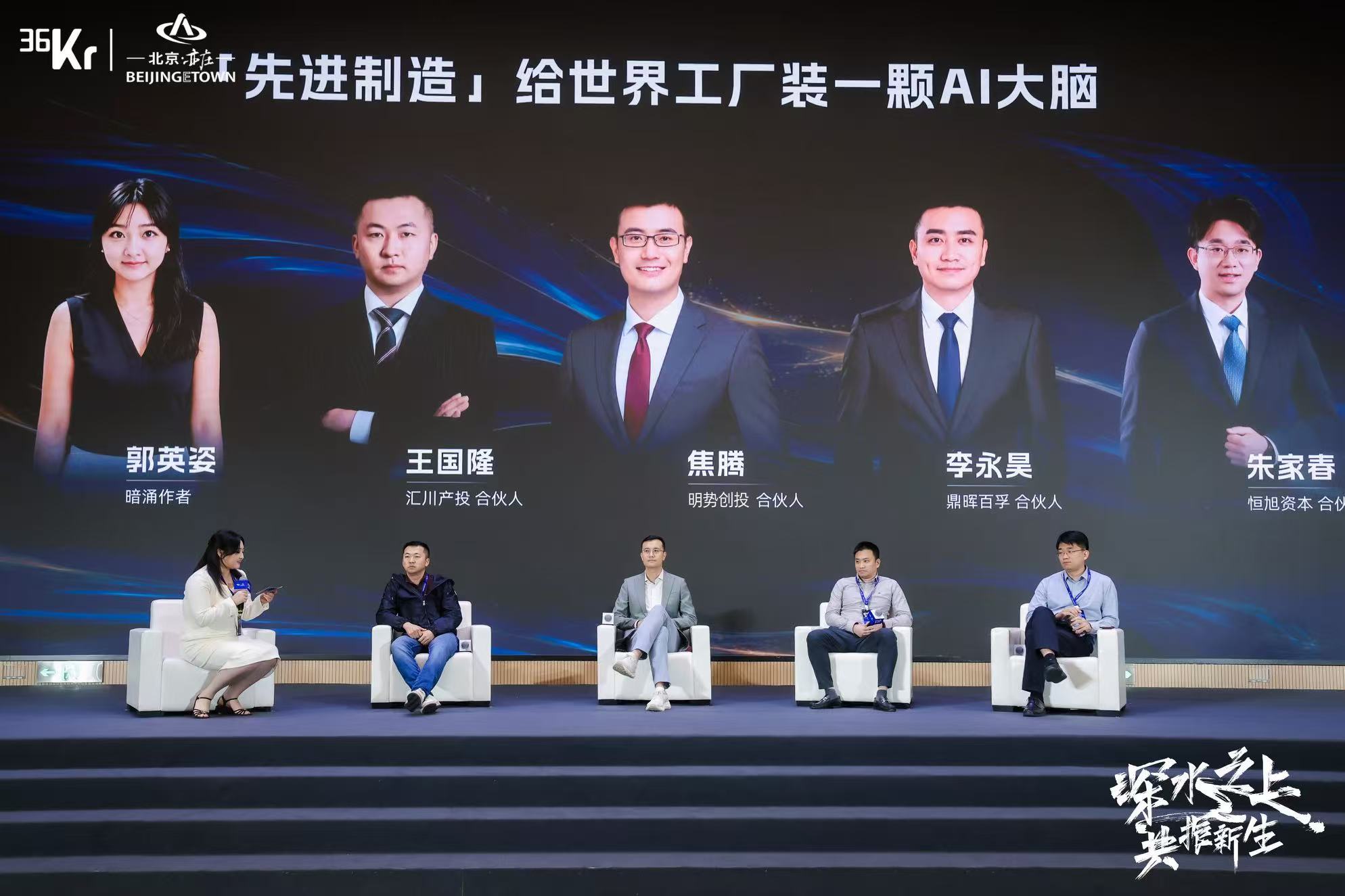
Guo Yingzi | Author of Dark Surge (Host)
Wang Guolong | Partner, Inovance Industrial Investment
Jiao Teng | Partner, Mingshi Venture Capital
Li Yonghao | Partner, CDH Foresight Capital
Zhu Jiachun | Partner, Hengxu Capital
Guo Yingzi: Hello to all friends on site and online! I am Guo Yingzi, a reporter from 36Kr, and I am very glad to be the host of this roundtable.
In the second half of 2026, when we talk about "AI +" manufacturing, in a nutshell, there has never been so much capital pouring into the track, but the landing of related projects has never been so difficult. Today we are fortunate to have four investors who focus on advanced manufacturing and hard technology to talk about what the whole process of AI entering factories will experience.
First of all, please introduce yourselves respectively, and talk about what ecological positions you are in the advanced manufacturing industry.
Jiao Teng: Hello everyone! I am Jiao Teng, partner of Mingshi Venture Capital. Our institution was founded in 2014, and it has been 12 years up to now. Since its establishment, we have been focusing on the technology track, especially in the fields of AI and manufacturing, and our development can be roughly divided into three stages.
In the first stage, we invested a large number of AI+ enterprises in the fields of machine tools, cutting tools, robots and vehicles. We were the exclusive first-round angel investor of Li Auto, and have continuously invested in seven rounds, including two rounds of investment in Niu Technologies. All these are cases of the gradual combination of traditional manufacturing and AI.
In the second stage, we invested in a lot of embodied intelligence enterprises, such as Ex Dynamics and Wujin Technology, all of which are unicorns with a valuation of more than 10 billion yuan, and we are their angel investor, including Mega Robotics, an AI+ robot enterprise that is about to go public.
In the third stage, we invested in AI for Science enterprises at the angel round, enabling AI to fully cut into manufacturing and update the manufacturing paradigm.
Wang Guolong: Hello everyone, I am Wang Guolong from Inovance Industrial Investment. Inovance Technology was founded in 2003 and listed in 2010. Its main business covers industrial automation and digitalization, new energy vehicle power systems, intelligent robots and digital energy, etc.
Inovance Industrial Investment is the only CVC investment platform under the group. Its investment direction not only centers on the group's strategy, but also continues to lay out cutting-edge technologies. In the advanced manufacturing industry, Inovance is at the central nerve of the industrial chain. Therefore, from the perspective of investment direction, it basically covers all key links. From the perspective of investment layout, it includes upstream devices and downstream equipment of Inovance, new materials and automobile industrial chain, AI and industrial software, cutting-edge technologies, etc.
Li Yonghao: Hello everyone, I am Li Yonghao from CDH Foresight Capital. CDH Investments has a development history of more than 20 years. In the field of advanced manufacturing, we focus on the two major directions of "high-end and general-purpose" for layout. What is high-end and general-purpose? Different from investors with industrial background like Mr. Wang and Mr. Zhu, we focus on equipment with high value, "stuck neck" attributes and strong versatility in factory scenarios. Special equipment such as lithography machines is certainly critical, but its application scenarios are limited and not all factories have demand for it, which is also the difference of our core investment logic.
The high-end general-purpose equipment we focus on mainly includes: material-reducing equipment, such as industrial mother machines and laser equipment; material-adding equipment, that is, 3D printing; industrial automation and industrial robots, as well as high-end scientific instruments. Such equipment belongs to the common infrastructure of various types of factories.
On this basis, we also extend our investment to the upstream, which is divided into two major sectors. The first is industrial software. In the production and R&D links, all kinds of manufacturing enterprises are inseparable from the support of industrial software. The second is key materials. The industry often says that a generation of equipment is matched with a generation of materials, and the performance of materials is the core element that determines the upper limit of equipment capability.
In the direction of AI, our layout idea also follows the above main line, focusing on the two tracks of AI + industrial software and AI + materials.
Zhu Jiachun: Thanks for the invitation from 36Kr. I am Zhu Jiachun from Hengxu Capital. Founded in 2019, Hengxu Capital is a market-oriented investment institution supported by industrial background. We are mainly engaged in equity investment and asset investment, with a management scale of more than 40 billion yuan. Equity investment covers the manufacturing technology and health consumption tracks. In the past, we have made a lot of layouts in the automobile industrial chain, artificial intelligence, robots, commercial aerospace, and consumer pension, and we hope to have more cooperation with all parties.
Our business foundation comes from the automobile industrial chain. Starting from the automobile industrial chain, we have invested a large number of enterprises in batteries, intelligent driving, chassis, cockpit and thermal management, and further made in-depth layouts in semiconductors, artificial intelligence, commercial aerospace, health consumption and other fields.
In terms of the industry status, we believe that the combination of AI and industry and manufacturing in the future will definitely be very strong. The earliest AI empowerment in the field of materials and partial digital fields, for example, AI empowers chip design, AI empowers material discovery and material structure design. On the other more hardware-oriented side, we will focus on the links that traditional mechanical arms and robots cannot replace in the embodied intelligence field.
Guo Yingzi: Thank you. Today our discussion is about the AI+ manufacturing industry. I noticed that there is a relatively fragmented phenomenon in the AI+ manufacturing industry. In 2026, China's policy has launched a special action for artificial intelligence + manufacturing, which plans to launch 500 typical industrial AI scenarios by 2027. However, some studies show that the failure rate of industrial AI projects is generally more than 70%. To sum up this situation in one sentence, a lot of capital has poured in, but the landing of industrial AI is very difficult. I am very confused and want to ask you all, what is the landing status of industrial AI you felt this year? And which links of AI empowering industrialization will you be more optimistic about?
Wang Guolong: I will talk about it from several perspectives.
First, from the intuitive feeling, to judge the large-scale landing of industrial AI according to the requirements of value closed loop, it may still take a certain amount of time at present.
Second, as a practitioner in the field of industrial AI, Inovance has been continuously empowering customers and realizing product landing from the perspective of real industrial demand. For example, PLC develops intelligent agents, which are not only used for code generation, but also solve customers' secondary development problems in industrial sites. At the same time, for the HMI screen in the industrial site as an interactive interface, Inovance is also using the end-side model to solve daily interactive problems, which is the landing point we see that can create value for customers.
As for which link the industrial AI landing mentioned by the host is in, in our opinion, industry covers research, production, supply, marketing and service, and it is difficult to say which specific link it falls on. Take the invested enterprises of Inovance as an example, for example, Deep Intelligent Control, its downstream customers are strongly related to AI, such as data centers and other popular industries. The main problem it solves is power consumption reduction, and it provides system energy saving for air conditioners and air compressors. Such products have very rigid demand for industries with large energy consumption.
For another example, Zhejiang Zhongzhida, in which Inovance invested in 2025, is basically downstream in the process industry, including petrochemical, electric power and other fields. Compared with AI, the prosperity cycle of the process industry is not so high. However, in terms of customer selection, Zhongzhida focuses on high-value head customers and continues to make products, so it has achieved large-scale growth.
In addition, we recently invested an enterprise in the field of embodied intelligence. Its customer group is mainly for the German and European markets. The entry barrier of such markets is relatively high, so customers will give opportunities to our invested enterprises to realize a real value closed loop from POC to large-scale landing.
Therefore, industrial AI depends more on which specific downstream and customer side it lands on, rather than which link.
Guo Yingzi: It mainly depends on customers rather than links.
Wang Guolong: Downstream customers and industries are more important, and it is difficult to draw a conclusion on which specific link it lands on.
Jiao Teng: In the past at least two to three years, AI and manufacturing have made great progress respectively. Especially in the manufacturing industry, we have all seen that China's new energy vehicles sold 16 million units last year, and it is estimated that more than 20 million units can be sold this year. This number is more than twice the total sales volume of all other countries in the world except China. Our domestic automakers are generally facing fierce competition, including battery factories, photovoltaic factories and other new energy-related enterprises. The situation of photovoltaic is more obvious. At present, China's production and sales volume of photovoltaic accounts for 70% to 80% of the global total, the whole industry is losing money, and every enterprise sells products below the cost price. I think this is the core reason why "AI+ manufacturing" is in a difficult situation: the manufacturing enterprises are doing well, but their customers are not making profits, so it is difficult for AI companies to make profits either. In particular, AI companies are stuck in the payment collection link, so everyone is under great pressure.
We have also done a lot of things. I divide the process of AI entering the manufacturing industry into several stages:
The first stage is to provide some suggestions and decision-making support.
The second stage is to provide new materials and new production methods, such as logistics robots, quality inspection, etc., to enter a single point link.
The third stage is that AI reshapes the existing production process.
We focus more on the third stage, and rarely focus on single-point scenarios such as quality inspection, logistics, and AI for production scheduling. I think these only improve efficiency at a single point for enterprises, and the significance is not that great. For example, Mega Robotics, in which we invested at the angel round, is a company in the field of biomanufacturing, providing life science services, life manufacturing, new drug R&D, strain production, etc. to the whole world. This industry has not seen efficiency improvement for maybe 50 years around the world. The company has accumulated a large amount of data, models and algorithms through the cloud and the digital world, and a large number of robots in the physical world are connected together. In the past, life scientists, pharmaceutical R&D engineers and doctoral students spent a lot of time on "shaking bottles", culturing cells, viruses and bacteria. Now all these work are done by robots in Mega Robotics, which has increased the efficiency of the whole industry by dozens or even hundreds of times, and has been growing at a high speed in recent years.
Including Li Auto, Niu Technologies, and eVTOL enterprise Volocopter, a large amount of AI is used to improve production efficiency in the operation process, AI is used to develop new materials, improve the energy density of batteries, and calculate the new material composition of perovskite, etc. All these are being carried out continuously. We have invested more enterprises in the second stage, but now we pay more attention to the progress of the third stage, that AI goes deep into the whole production process and reshapes the whole workflow, which will bring greater opportunities.
Li Yonghao: It is difficult to simply determine which link should be given priority to layout. In my opinion, the core direction is to give priority to the scenarios with sufficient data accumulation. Take AI quality inspection as an example, why did this field develop slowly in the early years? The main reason is that in recent years, both 2D vision and 3D vision solutions have advanced rapidly, and enterprises such as Mech-Mind have emerged, accumulating a large number of industrial sample data. With high-quality samples, the AI model can achieve more reliable detection results.
Looking at AI production scheduling, this is not a new concept. As early as the beginning of 2000, there was an APS optimized production scheduling tool. At that time, there was no AI boom, and it mainly relied on operations research algorithms to solve problems. But at that stage, the landing value was limited, and the core short board was the lack of industrial data. At that time, most domestic enterprises could already run the ERP system with difficulty, and industrial software and hardware such as MES and PLC were not yet popular, so there was a lot of missing data on the manufacturing side. In recent years, a large number of enterprises have promoted the construction of smart factories, and accumulated sufficient production data, so AI production scheduling has the foundation of landing application.
However, at this stage, domestic enterprises are not short of data. The same is true in the field of embodied intelligence. What is really scarce is high-quality data. Many factories deploy a large number of sensors to generate massive industrial data every day; the difficulty lies in how to do a good job in data cleaning and combine data with the mechanism model, which is the key.
Therefore, the choice of layout track largely depends on the data quality that the scenario can produce. The higher the data quality, the more effectively AI can play its value.
Zhu Jiachun: I agree with the views of the previous guests. I will talk about it from another angle. AI may first be applied in the digital field at the beginning. Now that the language model has reached a usable level, some enterprises are also using AI interaction mode in after-sales or maintenance links to reduce the number of after-sales personnel, especially for overseas business, some problems can be basically solved by uploading pictures.
I think it is developing step by step. For example, after the language model matures, it is changing some things, including some Agents that are now used, which can also reduce some administrative and internal costs of the company. The next step may be more in the design field, especially with the development of AI for science. As mentioned earlier, AI can help reduce the number of engineers in the material field or propose innovative materials, which will also empower manufacturing with the progress of AI.
It starts to change from the digital world, covering administration, design, R&D, and finally, the real physical AI and embodied intelligence will change the whole production and manufacturing line. Maybe the future production line will be rearranged according to the capability and form of embodied intelligence. The deployment of embodied intelligence on the old production line is a mutual process, which is also the process of development from the digital world to the physical world.
Guo Yingzi: After listening to the sharing of the four guests, I think we can reach a consensus. When I searched for relevant materials before, the term "AI+ manufacturing" was mentioned very often, putting AI in the front and manufacturing in the back. But when I communicated with an investor off the stage just now, he said that it should not be AI+ manufacturing, but AI empowers the manufacturing industry. The manufacturing industry itself is the core, and AI only plays an empowering role. AI that empowers the manufacturing industry cannot form an independent industry on its own in this process.
However, there is a general trend now that everything is "AI+", and various manufacturing enterprises are also promoting that they are very intelligent and AI-driven. I am curious about what hard indicators you investors will use to distinguish whether a manufacturing enterprise is really intelligent or just pasting an intelligent label during due diligence.
In the past, when AI empowered the traditional manufacturing industry, we only needed to look at orders and costs. Now after adding the term AI empowerment, it may involve models or data. What indicators can we use to define intelligence and distinguish whether it is real