What are the current generation of middle class thinking by enjoying sumptuous meals in economy class?
01
Some time ago, I took a Hainan Airlines flight back to Beijing. While I was waiting for the cabin crew to push the food cart over to ask whether I preferred chicken rice or beef rice, the young lady sitting next to me already had white porcelain tableware neatly placed on her foldable tray table in advance.
Shortly afterwards, the cabin crew served her a plate of pan-seared steak drizzled with red wine mushroom sauce, and the fruits were also placed in a separate porcelain dish. The girl picked up her phone and took a flurry of photos, which left me completely stunned, and I wondered if I was still sitting in economy class.
Then I looked down at the empty tray table in front of me, and could not help asking her where she had ordered the meal.
She told me that I could select the paid meal in advance on the Hainan Airlines app after purchasing the flight ticket.
After landing and getting access to the internet, I specifically did some research and found that premium paid meals in domestic economy class have long been quietly gaining popularity on social platforms.
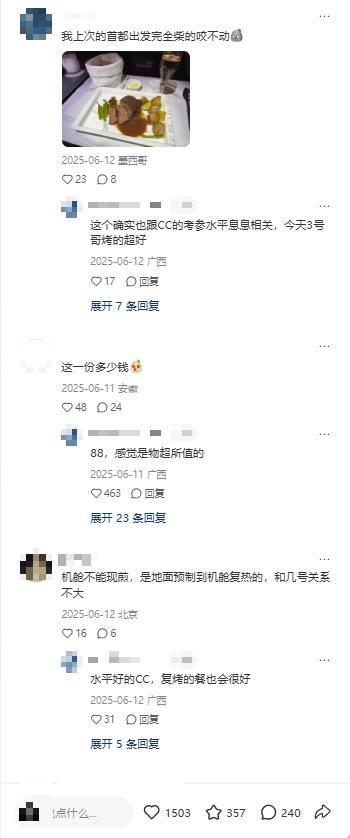
Take this very popular meal option from Hainan Airlines as an example: it can be fully selected in advance before takeoff. The original price of the pan-seared steak with red wine mushroom sauce is 106 yuan, and the discounted price is 96 yuan. Passengers who purchase paid meals will be served first, and the regular free economy class meals will also be delivered at the same time, so there is no need to worry about not getting enough to eat.
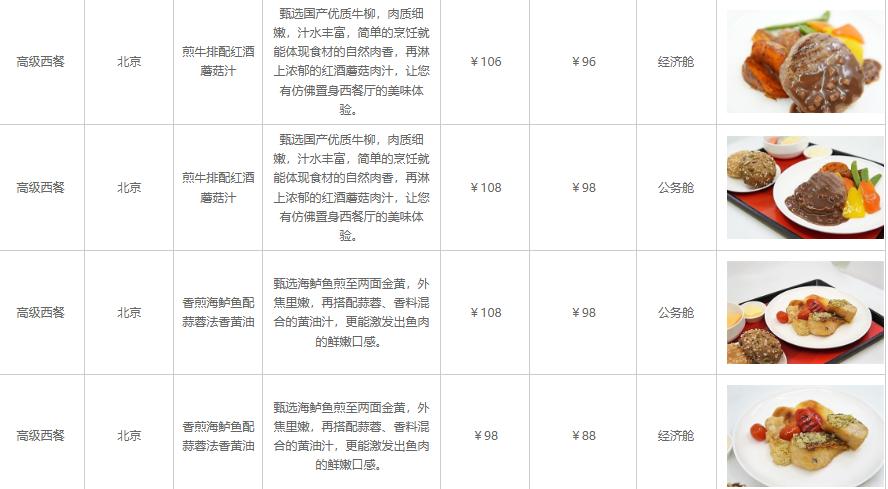
Source: Official website of Hainan Airlines
On Xiaohongshu, some users posted photos of steak served with white porcelain plates, saying that for less than 100 yuan, they can finally enjoy a proper formal meal on the plane. But some other users commented that the taste is mediocre after trying it, and apart from the delicate presentation, it still falls short of the premium meal they expected.
People have mixed opinions on the taste of Hainan Airlines' steak, but this does not stop other domestic airlines from launching their signature dishes one after another.
In the past two years, the in-flight meals of Sichuan Airlines have always been widely praised. They brought spicy maocai (Sichuan-style hot pot dish) into the cabin. The 58-yuan paid set meal looks very appetizing as soon as the lid is opened, with a perfect blend of spicy, numbing, fresh and savory flavors.
On social media, some passengers said that when they watched Sichuan Airlines cabin crew lay out the tableware and hand over hot towels, they even suspected that a full kitchen was hidden on the plane. In the comment section, many users quickly recommended Sichuan Airlines' twice-cooked pork rice, just like sharing hidden local street restaurants in Chengdu.
China Southern Airlines, which is headquartered in Guangzhou, is also not to be outdone. It has started selling cured meat clay pot rice on some routes, and has also cooperated with China Hotel to launch barbecued pork and soy sauce chicken rice.
China Eastern Airlines focuses on affordable and friendly services. On some flights departing from Xi'an, passengers can buy a sandwich for 19 yuan, or a teriyaki chicken burger for 29 yuan. If they prefer light food, salad is also available, which is positioned as a low-fat light option, and its price is almost the same as that of cafes outside the airport.
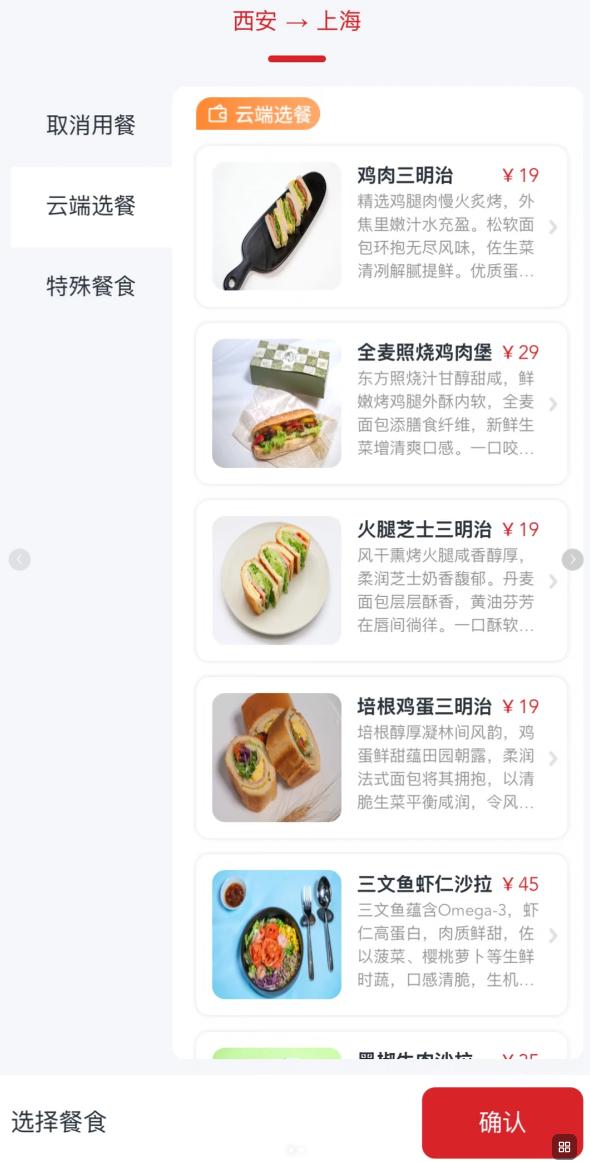
Source: Official website of China Eastern Airlines
After airlines suddenly started to put serious effort into their in-flight meals, the reactions of many onlooking netizens are quite subtle.
Many people are surprised that airlines can also make decent-looking meals on the plane, which means they simply did not want to make good meals before. More people are worried that as the paid menu becomes richer, the free in-flight meals will gradually turn into perfunctory low-quality offerings.
Speaking of which, economy class passengers rarely spent time researching what they would eat before boarding in the past. All they cared about were the ticket price, departure time and whether the flight would be delayed, and they only expected to get enough to eat.
Now, watching the passengers next to them enjoying rich food, even those who used to be very casual about in-flight meals are starting to consider spending dozens of yuan to give their stomachs a small "upgrade".
02
What exactly are the middle-class passengers who pay to upgrade their meals in economy class thinking about?
Judging from the sentiments shared on social media, the desire to try new things is a very important factor.
Steak is not a rare dish in urban restaurants, and it is also a standard offering in business class. But after being served in economy class, it creates a strong contrast effect. As soon as the white porcelain plate is placed on the small tray table, the eyes of the passengers in the adjacent seats will usually turn to it first.
As long as you are not socially anxious, taking a casual photo and posting it on social media will usually spark a highly curious and lively discussion.
It is worth mentioning that many middle-class people are still very sensitive to the total price of air tickets. They will compare prices on multiple platforms when buying tickets, and will not spend thousands of extra yuan to upgrade to business class if they can take economy class.
But the money they save does not stop them from spending dozens of yuan to replace the low-quality chicken rice that most likely tastes bad, and experience a delicate lifestyle in economy class.
In fact, some passengers do have very picky appetites. They would rather select their familiar meals in advance. For parents traveling with children, when their children are not used to the standard in-flight meals, apart from the dedicated children's meals, they will also look for good options in the paid meal list.
Even if the taste is not amazing, at least they avoid the awkward situation of feeling disgusted at the sight of the meal right after opening the lunch box.
Theoretically, the premium paid meals in domestic economy class are very close to the increasingly popular unbundled consumption concept in the global civil aviation industry nowadays.
At present, the business class of most domestic flights is mainly equipped with non-flat "dental chair" seats, which are not very comfortable to sit on. If passengers can keep the low economy class ticket price, and only improve a few consumption links such as in-flight meals separately, it is a very smart consumption choice.
From the perspective of current consumption trends, spending money cautiously does not mean making do with everything.
Large expenses such as cars and houses require repeated careful consideration, but the small sense of satisfaction brought by dozens of yuan is very easy to retain. Paid in-flight meals are exactly in this consumption range: the cost will not affect the travel budget, and the sense of gain can be realized immediately when the meal is served on the table.
Airlines have naturally captured the consumption sentiment of the middle class.
In June this year, the International Air Transport Association lowered its 2026 global aviation industry net profit forecast to 23 billion US dollars. The persistently high jet fuel price continues to squeeze profit margins. In the first half of this year alone, the three major Chinese airlines reported a combined loss of more than 8 billion yuan, so it is extremely urgent to open up new ancillary revenue streams.
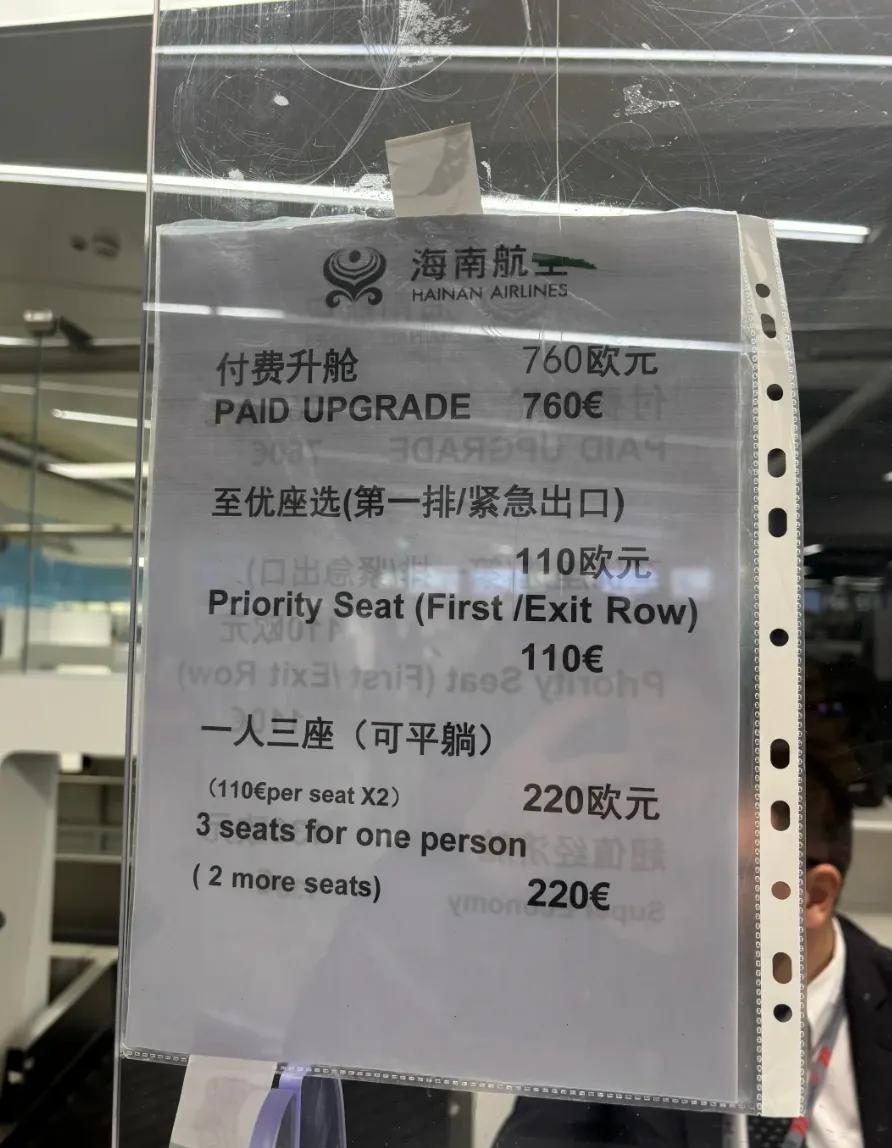
Travel Daily previously exclusively reported that airlines including Hainan Airlines have started to sell connected empty seats in economy class on long-haul international flights as a package. Now behind the re-pricing of in-flight meals, the business logic is very similar: airlines are looking for other experience items that can be sold separately beyond the basic air ticket.
After all, most of the operating costs have already been incurred once the plane takes off, and there is a hard upper limit on the number of seats that can be sold in the cabin. If airlines want to earn more revenue on the same flight, they can only continue to tap the consumption potential of passengers who are already sitting in the cabin.
Compared with refitting seats or upgrading in-flight entertainment systems, adjusting the in-flight meal menu is much easier to implement. Airlines do not need to modify the cabin layout at all. As long as they add an entrance on the ticket booking page, the in-flight meals that used to be distributed uniformly can be turned into commodities sold according to different individual needs.
What surprised airlines is that after steak and spicy maocai are served on the small tray tables, even if only a limited number of passengers pay for them for the time being, as long as the related photos keep appearing on social platforms, it is equivalent to getting a free brand promotion effortlessly.
03
It is quite interesting that while domestic airlines are launching various new creative paid meal options, they have also begun to encourage some passengers to give up their in-flight meals in exchange for bonus points.
Just yesterday, I flew back to Beijing from Hangzhou. Before distributing the meals, an Air China cabin crew member bent down and whispered to a lady sitting next to me: "You have opted out of the meal service, right?"
The lady nodded, and the cabin crew confirmed her seat number and left. When the passengers around opened their lunch boxes one after another, her tray table was always empty, with only a glass of water served to her.
According to the rules announced by Air China, if passengers apply for opting out of meal service in advance and do not collect the main meal on the flight, the mileage reward will be credited to their account within 5 working days after the flight is completed.
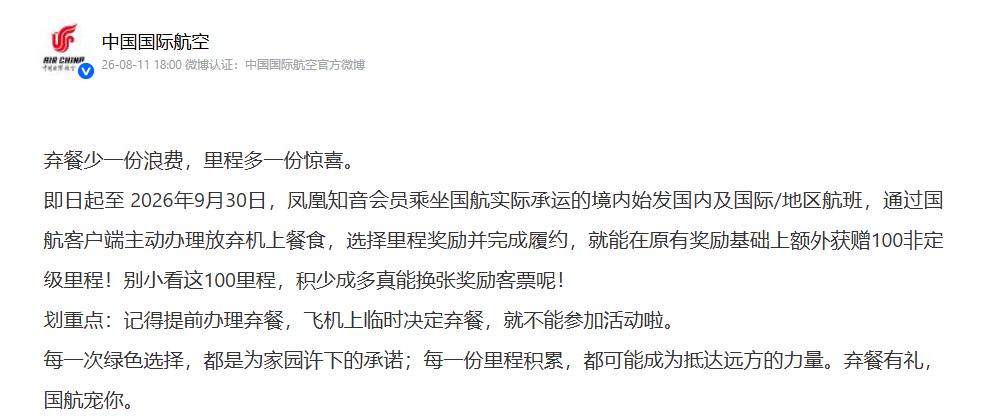
It is not difficult to see that the in-flight meal service on domestic routes is moving towards two completely opposite extremes.
It is totally acceptable if you are willing to spend nearly 100 yuan on a steak. If you think in-flight meals are not necessary at all, you can simply exchange your meal for bonus points. For airlines, reducing the number of unwanted meals can also cut down food waste.
This seems quite perfect, but some civil aviation industry insiders question its actual marketing effect.
Old Xu, the person in charge of a private domestic airline, told me in a private chat that paid meal is an interesting attempt, but it is difficult to develop into a big business. The reason is that most domestic flights only last two or three hours, passengers already have a large number of catering options at the airport, and frequent flyers have even had their fill in the gold member lounge long before boarding.
At the same time, there is a natural price ceiling for in-flight meals.
There is no full commercial kitchen on the plane. The meals need to be prepared on the ground, then transported under refrigeration and heated on the plane. Even if the steak looks very exquisite in photos, the eating experience can hardly match that of urban restaurants. Once the price exceeds 100 yuan, passengers will naturally compare it with the formal meals they can get after landing.
In fact, the richer the in-flight menu is, the higher the corresponding execution cost for airlines will increase simultaneously.
Old Xu believes that the implementation of paid meal selection actually brings extra burden to the cabin crew. Because on domestic routes, the time reserved for cabin service is very limited. After completing the safety check, the crew has to prepare drinks and regular meals very soon, and for paid meals, they also need to verify the names and seat numbers separately and heat the meals according to different requirements.
If passengers change their seats after boarding, things will become even more troublesome. The cabin crew can only look for the corresponding passenger again with the list. Sometimes right after they finish delivering all the paid meals, the regular food cart is supposed to be pushed out for distribution.
Old Xu said that when only two or three passengers in the whole cabin buy the paid meal, the existing workflow can barely handle it. But as the number of orders increases, every additional meal option will further erode the already limited service time for other passengers.
As for giving up meals in exchange for points, Old Xu even thinks it only treats the symptoms but not the root cause.
In his opinion, domestic flights with a duration of less than 3 hours can fully learn from the practices of routes within the European Union and the United States, gradually cancel the default complimentary meal service, give the choice of whether to eat on the plane or not to passengers in advance, and use the saved manpower and cost to improve the quality of in-flight meals on long-haul international routes.
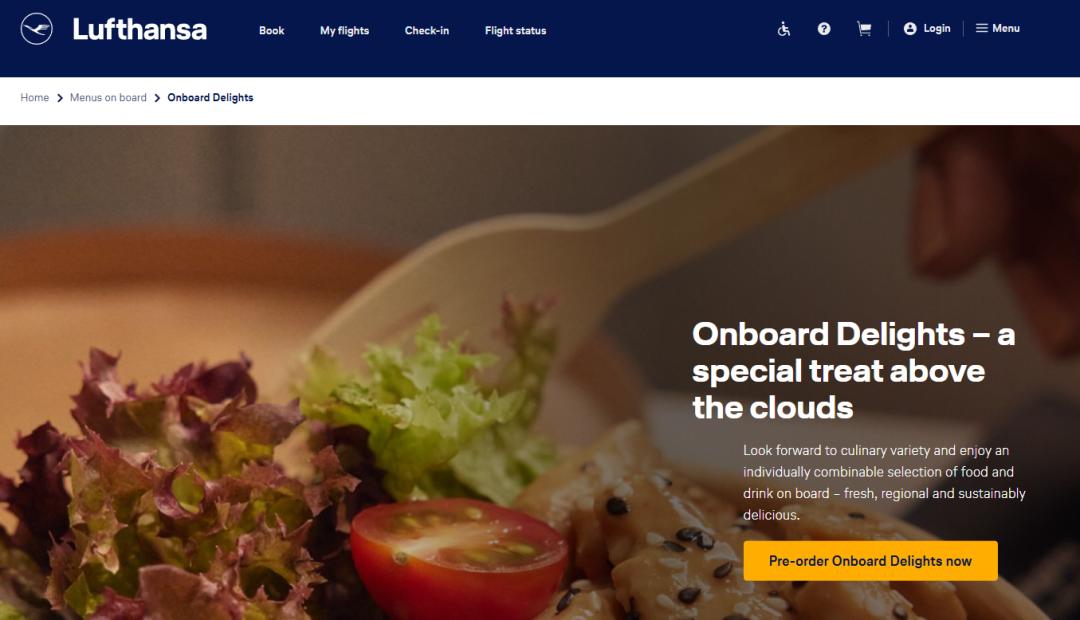
For Lufthansa, hot meals on flights longer than 2 hours are only available for pre-order in advance
All in all, adding a few more dish options on the mobile booking page is not complicated at all. The key challenge is how to ease the operational pressure on the cabin crew.
At the end of our conversation, Old Xu asked me back: if airlines do not hire more staff, but expect the cabin crew to work more and more like restaurant waiters within two hours, how delicate can this hastily served fancy meal really be?
There is no standard answer to his question.
But when manpower, time and order fulfillment costs are all taken into account in the accounting, this seemingly very profitable business may not be as attractive as it looks on the small tray table.
This article is from the WeChat official account "Travel Daily", author: Theodore Xishao, published with authorization from 36Kr.