Hai Robotics has refiled for IPO: it ranks first in the world in market share, yet its losses are far from over.
On September 13, Shenzhen HAIROBOTICS Intelligent Technology Group Co., Ltd. (hereinafter referred to as "HAIROBOTICS") resubmitted its listing application to the Hong Kong Stock Exchange, with Goldman Sachs and CITIC Securities as joint sponsors.
This submission was made only seven months after the previous one. The first application filed on February 13 this year was automatically invalidated on August 13 as the hearing was not completed within six months; one month later, the application materials were re-uploaded to the HKEX official website.
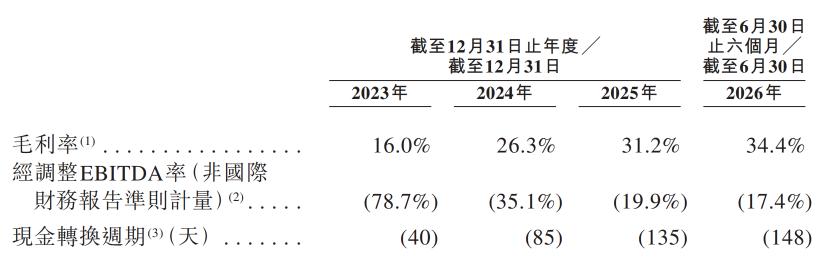
Its revenue growth curve is extremely steep. In 2025, HAIROBOTICS recorded a revenue of RMB 2.017 billion, representing a year-on-year increase of 48.3%; in the first half of 2026, its revenue reached RMB 1.118 billion, up 70.2% year-on-year; its gross margin rose from 16.0% in 2023 to 31.2% in 2025, and further climbed to 34.4% in the first half of 2026.
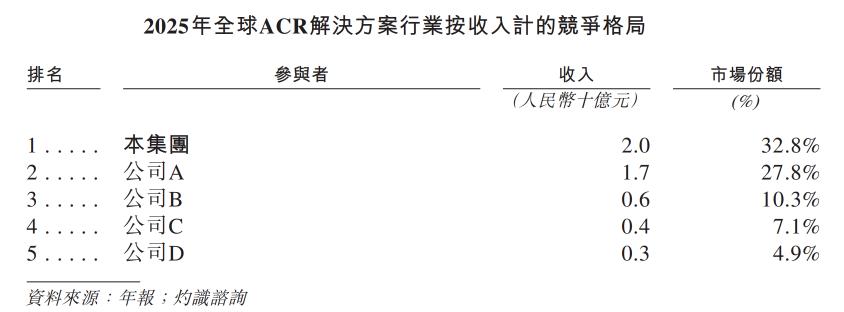
Data from CIC shows that in terms of 2025 revenue, HAIROBOTICS ranks first in the global Automated Case Retrieval (ACR) market with a 32.8% market share.
However, its loss curve is equally steep. From 2023 to the first half of 2026, the company recorded a cumulative loss of RMB 3.523 billion. The net cash outflow from operating activities in the first half of 2026 was RMB 360 million, higher than the RMB 289 million in the same period of 2025. As of June 30, 2026, its net liabilities stood at RMB 4.371 billion, and net current liabilities at RMB 4.378 billion.
The market window for this round of submission is not unfavorable. In the first eight months of 2026, a total of 108 new stocks were listed on the Hong Kong stock market, raising HKD 364.176 billion, representing a year-on-year increase of over 160%. Robots, embodied intelligence and semiconductor equipment form the main body of this wave of listings.
On the other side of the crowded track, investors are starting to differentiate their pricing for the "high growth plus high loss" narrative.
Thus several specific questions arise: HAIROBOTICS, which has secured the top global market share in its niche segment, why did it lose over RMB 3.5 billion in three and a half years? Its gross margin has more than doubled, why has the loss not narrowed synchronously? Its orders are still growing at a rate of nearly 50%, why is cash burning faster instead?
I. Selling Vertical Warehouses: How Does This Business Make Profit?
The ACR (Automated Case Retrieval) segment was first proposed by HAIROBOTICS in 2016.
Traditional warehouse automation follows the "rack-to-person" model, where AGV or AMR moves entire racks to the workstation. The racks are heavy, the aisles are wide, and the storage height is limited by the picking range of human workers.
ACR works the other way around: the robot climbs the high-level rack on its own, picks up a single bin and delivers it to the workstation, so workers stay stationary and the space is utilized vertically.
HAIROBOTICS's solution consists of three parts: the HaiPick/HaiClimber robot body, the HaiStation workstation, and the HaiQ intelligent management platform, supplemented with racks, charging piles and latent robots.
The company's profit logic is a typical project-based model. Customers (warehouse departments of clothing enterprises, third-party logistics providers, e-commerce platforms and manufacturing enterprises) make a one-time investment to purchase the entire system, and HAIROBOTICS is responsible for design, delivery, installation and commissioning, and recognizes revenue after customer acceptance; subsequent revenue comes from maintenance, spare parts, software subscription and production capacity expansion. The revenue recognition node is completely tied to customer acceptance, a detail we will conduct in-depth analysis later in this article.
In fact, there are two core variables in this business: unit project price and regional structure.
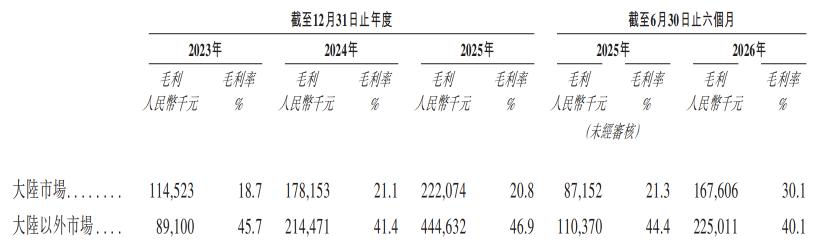
The unit price and gross margin of the company's overseas projects are significantly higher than those in the Chinese mainland. In 2025, the gross margin of markets outside the Chinese mainland was 46.9%, while that of the Chinese mainland market was only 20.8%. Therefore, HAIROBOTICS's strategy in the past two years is very clear: to scale up high-margin overseas businesses and large customer projects, and reduce the proportion of low-margin projects in the Chinese mainland.
HAIROBOTICS has a very smooth financing path. Starting from the angel round in 2017, it went all the way to the Pre-IPO II round in April 2026, with Pre-A, A, Pre-B, B, C, D1, D2, D+, E, E+, E++, E+++ and Pre-IPO I rounds in between. The Pre-IPO I round was led by General Atlantic with USD 150 million in November 2025.
Before listing, HAIROBOTICS's shareholding structure is as follows: 5Y Capital holds a total of 14.53%, General Atlantic 12.06%, entities under Source Code Capital hold a total of 10.85%, Capital Today holds about 10%, and the employee shareholding platform "Hairuo Weizheng" holds 8.97%; the three founders also hold a high proportion of shares, CEO Chen Yuqi directly holds 7.92%, CTO Xu Shengdong and COO Fang Bing each hold 2.87%.
There is a non-negligible design here: Chen Yuqi holds Class A common shares, with far more voting rights per share than Class B shares. Therefore, he controls 63.23% of the voting rights of HAIROBOTICS with only 7.92% of the economic equity.
The resources brought by shareholders are substantial. Capital Today's accumulated customer network in the consumer and retail sector, the layout of 5Y Capital and Source Code Capital in the hard technology supply chain, General Atlantic's global channels, plus industrial investors such as Best Logistics that invested in the early stage, have provided practical help for HAIROBOTICS to acquire clothing and 3PL customers and expand its overseas business.
The prospectus discloses that in terms of 2025 revenue, 7 of the world's top 10 fashion companies and 7 of the world's top 10 3PL companies are HAIROBOTICS's customers.
From the perspective of product structure, HAIROBOTICS completed a rapid gear shift in the past three years.
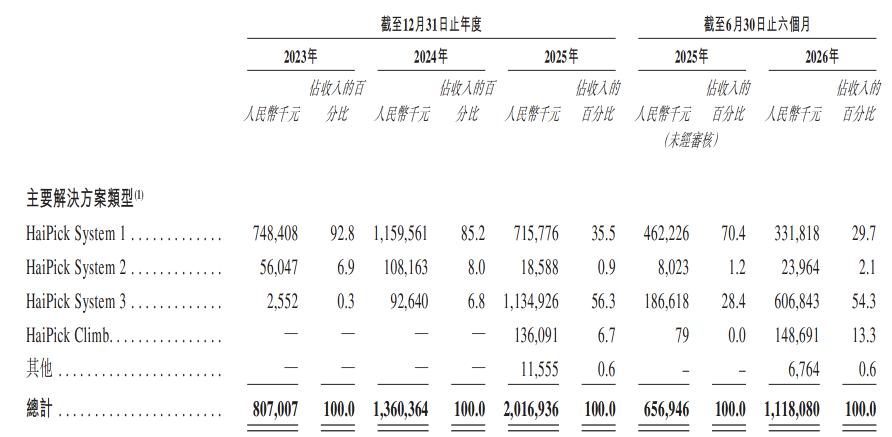
HPS1 contributed RMB 748 million in revenue, accounting for 92.8% of total revenue in 2023; it generated RMB 1.16 billion, accounting for 85.2% in 2024; its revenue dropped to RMB 716 million, accounting for 35.5% in 2025, and further fell to RMB 332 million, accounting for 29.7% in the first half of 2026.
Its successor HPS3 recorded revenue of RMB 1.135 billion in 2025, accounting for 56.3% of total revenue, and RMB 607 million in the first half of 2026, accounting for 54.3%.
The Climb series, officially launched in 2025, is the world's first large-scale commercial single-side climbing ACR system that supports a storage height of 15 meters. It generated revenue of RMB 136 million in 2025, accounting for 6.7%, and RMB 149 million in the first half of 2026, accounting for 13.3%.
HPS2 is under pressure. This series generated revenue of RMB 108 million in 2024, accounting for 8.0%, dropped to RMB 19 million in 2025, accounting for 1.0%, and recorded RMB 24 million in the first half of 2026, accounting for 2.1%.
Broken down by application field, circulation (clothing, e-commerce, 3PL) is the absolute main force, whose revenue increased from RMB 463 million in 2023 to RMB 1.693 billion in 2025, with its proportion rising from 57.5% to 83.8%.
Revenue in the manufacturing sector has remained almost stagnant: RMB 343 million in 2023, RMB 374 million in 2024, RMB 326 million in 2025, down 12.9% year-on-year; revenue in the first half of 2026 was RMB 169 million, higher than the RMB 149 million in the same period of 2025, but its gross profit of RMB 62 million was flat with the same period of the previous year, and the gross margin dropped from 41.8% to 36.4%.
The manufacturing sector is exactly the scenario with the highest gross margin for the company, reaching 41.4% in 2025, higher than the 31.4% of the circulation sector, and 1.5 percentage points higher than the latter in the first half of this year.
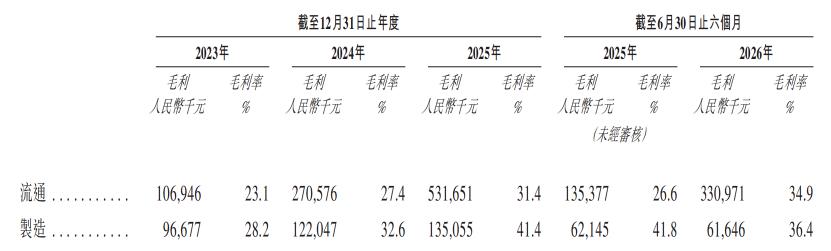
In one sentence, HAIROBOTICS's current revenue structure is: the engine is the circulation sector, the trump cards are HPS3 and overseas markets; the high-margin manufacturing business has not grown in revenue scale for three years, and even its gross margin started to decline in the first half of 2026.
II. Mixed Operating Fundamentals: Where Is the Problem?
First talk about the improving part. HAIROBOTICS's gross margin rose from 16.0% in 2023 to 34.4% in the first half of 2026, which mainly comes from three sources: product upgrade from HPS1 to higher-priced HPS3 and Climb; the proportion of overseas revenue rose from 24.2% in 2023 to 50.2% in the first half of 2026; cost dilution brought by larger project scale, the average value of a single project was RMB 7.9 million in 2025, and RMB 10.2 million in the first half of 2026, 3.1 times of the RMB 3.3 million in 2023.
The improvement on the expense side is more obvious. The company's sales and marketing expense ratio dropped from 52.7% in 2023 to 29.9% in the first half of 2026, the administrative expense ratio dropped from 23.7% to 10.1%, and the R&D expense ratio dropped from 38.3% to 22.3%. The adjusted EBITDA ratio narrowed from -78.7% in 2023 to -17.4% in the first half of 2026.
Working capital is the structural advantage of this business. Customers need to pay deposits in advance, and the company has credit terms with suppliers. In the first half of 2026, HAIROBOTICS's cash conversion cycle was -148 days, and the trade payable turnover days was 193 days, far higher than the turnover days of inventory and receivables. Its inventory turnover days dropped from 311 days in 2023 to 241 days in 2025 and 207 days in the first half of 2026; the net cash outflow from operating activities narrowed from RMB 482 million in 2023 to RMB 34 million in 2025.
In addition, the procurement proportion of HAIROBOTICS's top five suppliers is only 5.0%, 4.1%, 3.1%, 2.4% and 1.9% respectively. The supply chain is highly dispersed, and the company has certain discourse power on credit terms with upstream suppliers.
However, the problem is that these improvements have not been smoothly transmitted to the bottom of the income statement, and there was a reverse trend in the first half of 2026.
First, the inflection point of loss has not yet come, and the company itself also expects so.
The prospectus clearly states that HAIROBOTICS is expected to record a net loss for the full year 2026, and the cash outflow from operating activities will increase.
The numbers have confirmed half of this expectation: the company recorded a net loss of RMB 431 million in the first half of 2026, compared with RMB 441 million in the same period of 2025, the loss only narrowed by 2.4% even with a 70.2% year-on-year revenue growth. The net operating cash outflow expanded from RMB 289 million to RMB 360 million; cash and cash equivalents dropped from RMB 2.015 billion at the end of 2025 to RMB 1.417 billion at the end of June 2026, decreasing by RMB 552 million in half a year.
The company's cash position looked good in 2025 because the net inflow from financing activities reached RMB 1.254 billion that year, but in the first half of 2026, the company's financing activities have turned to a net outflow of RMB 36 million.
Second, the gap on the balance sheet is larger than that on the income statement.
As of the end of June 2026, the company's redemption liabilities amounted to RMB 5.254 billion, which are liabilities formed by the preferred share repurchase obligations attached to previous rounds of financing. The interest accrued for this part was RMB 294 million in 2025 and RMB 198 million in the first half of 2026, equivalent to 17.7% of the revenue in the same period.
This part of liabilities will be converted into equity after listing, and the net liabilities of RMB 4.371 billion will be greatly narrowed at that time. But before the share conversion, it will continuously erode profits, which also explains why