Enterprise Case Sharing: Kunyu Quantum | 36Kr 2026 Industry Future Conference
In 2026, industrial investment has entered a deep-water zone, where capital, technology and industry are accelerating their integration. The old investment logic no longer applies, while new consensus is taking shape. The 2026 Industrial Future Conference focuses on opportunities in the new cycle, and jointly explores the future of the industry and the birth of the "Light of China". From September 9 to 10, the 2026 Industrial Future Conference hosted by 36Kr was held in Yizhuang, Beijing, with the theme of "Above the Deep Water, Resonate for New Birth". Representatives from state-owned capital platforms, industrial investment funds, corporate CVCs, innovative enterprises, and experts and scholars gathered to focus on the industrialization of future industries such as quantum technology. The conference conducted in-depth discussions on current cutting-edge technologies and industrial perspectives, intensively demonstrated breakthroughs in technical routes such as superconductivity, photonic quantum, and ion trap, and shared a large number of specific industrial scenarios, industrial system construction, and the prospects of heterogeneous computing, to jointly explore the future of technology industrial investment.
The following dialogue is sorted and edited by 36Kr:
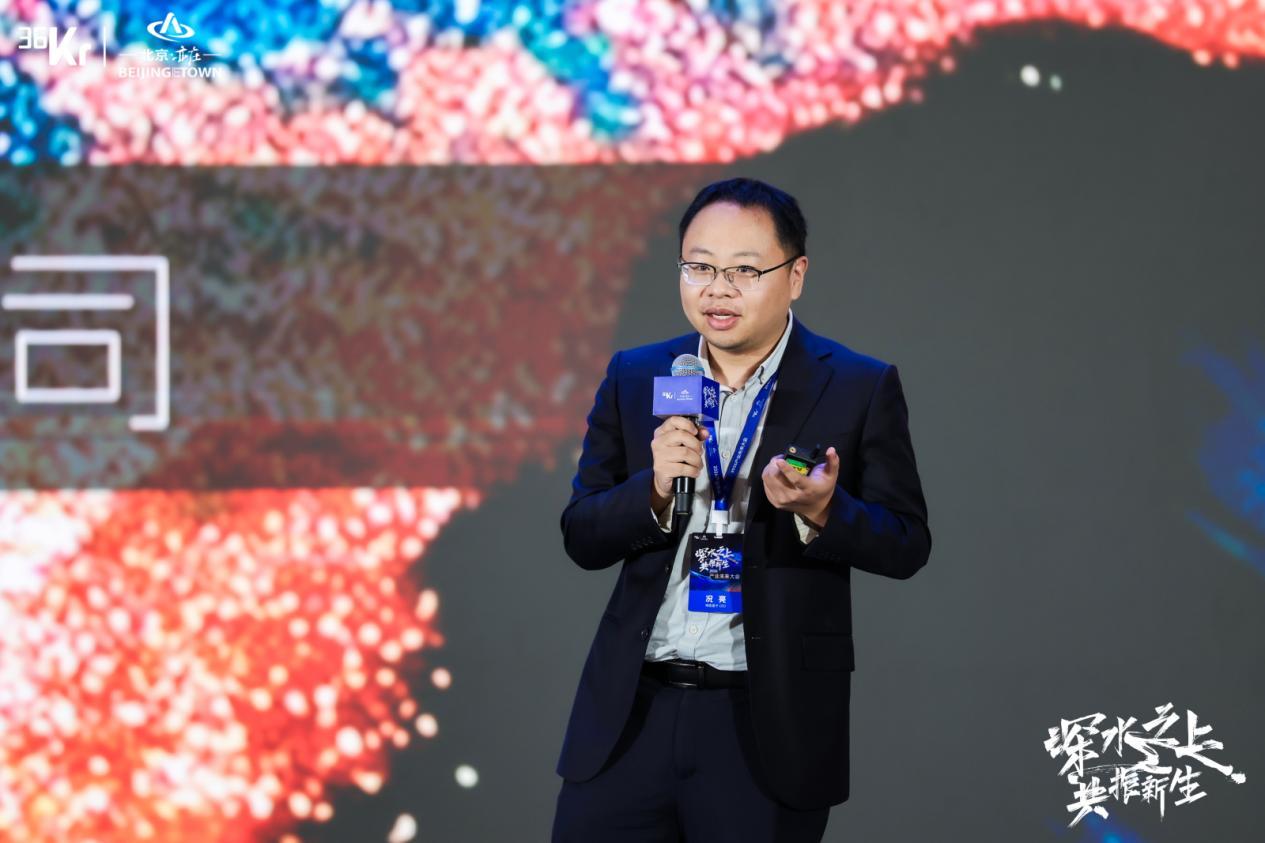
Speaker: KUANG Liang, CEO of Kunyu Quantum
KUANG Liang: Hello everyone! Today we would like to share about quantum imaging lidar. In the current imaging or optical vision field, there are two very interesting phenomena. For example, in daily life, we use cameras to take photos and videos; in many dynamic interaction scenarios, such as in automobiles, robots and drones, lidar or millimeter wave radar is used. But in most cases, these two types of devices work together based on separate optical path transceivers. We were thinking that if all information acquisition is based on optics, according to the first principle, can we complete all information acquisition with only one light field? That is where quantum imaging lidar comes into play.
When quantum correlation is used to realize quantum imaging lidar, more novel phenomena will appear. First, it can further break through the boundaries that are difficult for traditional technologies to overcome. For example, in aerial exploration, when encountering rain, snow, fog or extremely dark weather, it is very difficult to obtain visual information, but quantum imaging lidar can still work effectively in such scenarios.
Our development route is highly consistent with the theme of today's conference — "Above the Deep Water, Resonate for New Birth".
For quantum imaging lidar, the first direction is to go underwater. We are currently cooperating with BOE Group to apply quantum imaging lidar to underwater scenarios, especially in turbid water and extremely dark water, to detect the information inside. The second direction is to cooperate with Aerospace Science and Technology Group to address low-altitude safety needs, and figure out how to obtain visual information under foggy, bad weather and other extremely harsh conditions.
For "Resonate for New Birth", we are conducting cross-domain resonance, and working with all partners to promote the industrialization of quantum imaging lidar, which will not only enter the semiconductor industry, but also be applied to all kinds of perception terminals.
A vivid metaphor for our quantum imaging lidar is a pair of "quantum eyes". In addition to strong penetration, it also has excellent anti-interference performance: it can not only penetrate smoke, fog and turbid water, but also output two pieces of information (depth information and distance information) through one single light field. This breaks the traditional route: there is no need to use "camera + lidar" or "millimeter wave radar + end-side computing power" for multi-modal fusion, and then call servers and large models to finally output the field of view information. Our solution is more aligned with the first principle: it directly outputs the 3D field of view information of the target.
We are also gradually expanding its application scenarios. It can be integrated with various fields such as embodied intelligence, autonomous driving, automatic security, and medical equipment. Visual sensors are designed for various fields from the very beginning. After the arrival of the quantum era, visual information remains very important sensing information. Through further complex regulation of the light field, quantum visual sensing can correlate more information. In addition to the current depth and distance information, in the future, it may also integrate hyperspectral information, speed information, angle information and other types of information into the quantum sensor, and can also achieve deep integration with the world model to help us perceive the physical world more accurately. What we are developing is a more underlying and more end-side technology.
Taking autonomous driving as an example, multiple devices are involved to complete the same task. This "multi-step" strategy is restricted by some physical boundaries. For example, cameras are troubled by bad weather, and sometimes they may face glare scenarios and dark scenarios. When the lidar point cloud generated by another light field and another space-time sequence is combined with the camera, the alignment, annotation, calculation, and algorithm invocation of the two will consume a large amount of end-side computing power of the vehicle. Moreover, the final results generated by the large model cannot be 100% trusted in terms of safety performance. Especially for safety-related issues, if there is only 1% security vulnerability, we cannot consider the front-end perception of autonomous driving to be sufficiently safe.
If quantum imaging can generate the image of all points in the same field of view, it is physically integrated at the natural level, which provides a safety architecture from the underlying logic. It does not require external computing power, nor does it need to approximate results through models, and can realize 3D sensing directly through measurement methods.
We also compared the principles of these two routes. For traditional optics, no matter how complex the module is, the most essential part is the corresponding relationship between the image and the object. We use the optical phase to convert it into an electrical signal to achieve object recognition. However, in the process of multiple light transmission, all devices work passively: they passively receive various signals and then integrate them into the information we need. If we can realize active regulation, in the relevant space-time, we can not only regulate the phase information of the volatility of light, but also regulate the intensity information through the particle property of light. By using various semiconductor devices and processes to deeply integrate quantum correlation calculation, quantum optical architecture and quantum random number with the classic semiconductor process, we can get quantum imaging lidar.
It has many advantages over traditional optics. It not only features strong anti-interference and 3D imaging, but also is free from the restriction of focal length. When tracking dynamic targets, there is no need to focus, and it will not be troubled by defocusing and over-focusing problems. It can also realize undefined imaging, and obtain the entire field of view without single-pixel scanning.
This technology originates from the Department of Physics of Tsinghua University. Its unique contribution in this field is solving the problem of computing power consumption. For a long time, quantum imaging has been limited to laboratory scenarios, and the biggest bottleneck is to realize real-time 3D video, which requires a much more complex light field regulation scheme than other devices. Therefore, it has long been unable to get rid of the dependence on servers.
The team from the Department of Physics of Tsinghua University has gone through ten years of painstaking research, completely breaking away from this computing power architecture and developing a brand-new technical route. Now it can realize real-time 3D clear quantum imaging completely with board-level hardware.
At the algorithm level, we have modified the standard quantum imaging algorithm, changing the computing architecture from the "storage first, process later" architecture to a streaming processing architecture. It no longer requires storage computing power, and directly extracts all the main features of the image, discards data while calculating, and realizes direct imaging. It can achieve very stable imaging under strong light and weak light, and can also obtain large-screen color imaging. We have completed the circuit board-level prototype, and also finished the engineering prototype in advance. On September 11, we will officially release our "Yujian No.1" quantum imaging lidar at the Beijing Fair for Trade in Services, which is the first model that can be used for low-altitude safety and underwater detection.
I fully agree with the idea of the previous speaker. A very important key milestone for the implementation of quantum technology is to be deeply integrated into the current semiconductor process. The semiconductor process features more intensiveness, higher integration, higher efficiency, smaller size and lower power consumption, and can be applied to a wider range of end-side scenarios. Our next important iteration work is to integrate all components of the quantum imaging lidar into a single chip, making it as small as a camera, so that it can truly enter various mobile end-side scenarios around the world as we expect.
Compared with traditional technologies, we are the first to enter an uncharted territory. In scenarios where anti-interference performance is required, where imaging and ranging integration needs to be realized, including harsh environments and water bodies, and where all-weather and all-time operation is required, all these are tough battles we are going to fight together with the industry chain.
We also pay special attention to the "stuck neck" problem, so we investigated the domestic supply chain and found that it has performed very well. Although its performance may not reach 100% of our ideal state, it can fully support the needs of our development.
We are also conducting deep interaction with the new energy vehicle industry and many other fields. Our technology is developed by the team led by LONG Guilu and LI Junlin from the Department of Physics of Tsinghua University.
In terms of application fields:
First, the low-altitude safety field. At present, drones, whether in military use or in the low-altitude economy, have occupied a core position. No matter the Russia-Ukraine conflict, the US-Israel-Iran war, or some security incidents, it shows that a lot of research work still needs to be done in the low-altitude safety field. In this field, we have also applied for relevant projects with the Aerospace Science and Technology Group.
Our quantum system can empower this field with two major advantages:
1. It can effectively deal with the "low, slow and small" target problem.
2. It realizes the integration of imaging and ranging. The quantum imaging lidar can perform two tasks at the same time: it can identify the target and immediately obtain its position, so that we can compress the response time of the data link between different devices.
Second, the underwater vision field. We are currently cooperating with BOE Group. Underwater vision has always been a field that we are eager to explore but restricted by the lack of technical means. For example, sonar is often used to detect underwater situations. Realizing the transformation of underwater detection from "being heard" to "being seen" is a major step forward for the industry. It can be used to inspect dam cracks, detect underwater explosives and suspicious targets, and empower the digital fishery industry, so that digital fishery can use brand-new digital means just like land animal husbandry, to monitor the growth status of organisms in real time.
After the full chip-based iteration, the size and power consumption will be relatively small, so that it can be applied to robots and vehicles, because these two scenarios are relatively similar from the perspective of our quantum imaging lidar. There is a saying in the industry: A robot is a car without wheels. The overall performance improvement of both cars and robots will definitely rely on front-end perception. At present, dexterous hands and manipulators are developing very rapidly with many dimensions, but the performance of robots is still not completely satisfactory. We very much hope that robots can go deep into our production and life to complete some delicate work, including precise production and precise life services. If quantum imaging lidar can provide it with underlying and precise perception, so that the vision and tactile sensing of the robot can be fully coordinated, the humanoid robot will perform extremely well.
Finally, all kinds of data ends can be connected to the world large model, to empower the upgrading of AI models from the physical underlying level. We are Kunyu Quantum, a company transformed from Tsinghua University. The chairman is LI Jiaqiang, former dean of the Institute for Advanced Study of Tsinghua University. Considering the interdisciplinary characteristics of quantum imaging, the chairman has also established a high-standard advisory committee. The development of quantum imaging requires the joint efforts of all industries, to empower the growth of quantum imaging lidar in various fields in different interdisciplinary directions.
In general, for the industrialization of quantum imaging technology, we need to continuously polish the technology to make it high-precision and cutting-edge, and also realize ecological co-construction through cooperation and linkage with all partners.