With generally limited spending capacity, why are college students lavished with VIP status by hotels?
As the new semester season arrives, domestic hotels have collectively launched a "student-centric preferential mode".
Students can enjoy 20% to 30% off room rates after identity verification, with complimentary breakfast and late check-out; hotels go to universities to hold campus music festivals, and cooperate with e-sports events to launch exclusive membership benefits.
Interestingly, college students are not traditionally high-spending hotel guests, with limited disposable funds and relatively low frequency of repeat stays. However, hotel groups including Hilton, InterContinental, Huazhu, and BTG Homeinns have voluntarily lowered their marketing thresholds and launched a variety of exclusive offers for students.
Many netizens joke that college students are almost spoiled into the "top VIPs" of hotels.
In the golden autumn of September, back-to-school related topics have gained massive views on social platforms. Behind this wave of popularity, there is not only the short-term housing demand brought by students returning to campus, but also major hotels competing for the group of nearly 40 million on-campus college students, launching a long-term customer source competition.
Are hotels stepping up their strategies to attract college students in all-round ways?
The traffic dividend of the new semester season is no longer a short-term marketing node that the hotel industry rushes to make use of at the last minute.
Different from the discount activities that were hastily launched only when September approached in the past, the "war for talent" of major hotel groups for college students has now gone beyond the short-term promotion mindset, with a longer time cycle, richer strategies, more diverse scenarios, and more engaging content expression.
The first strategy is to extend the timeline in advance, transforming node marketing into full-cycle user accumulation.
For example, InterContinental Hotels took the lead in advancing the "new semester season dividend" and extended it to summer travel and graduation trips. Relying on its hotel layout in China, it launched 8 travel routes covering popular urban agglomerations and destinations including Xi'an, Chengdu, Chongqing, Xiamen, Beijing, Qingdao to cater to the summer consumption boom.
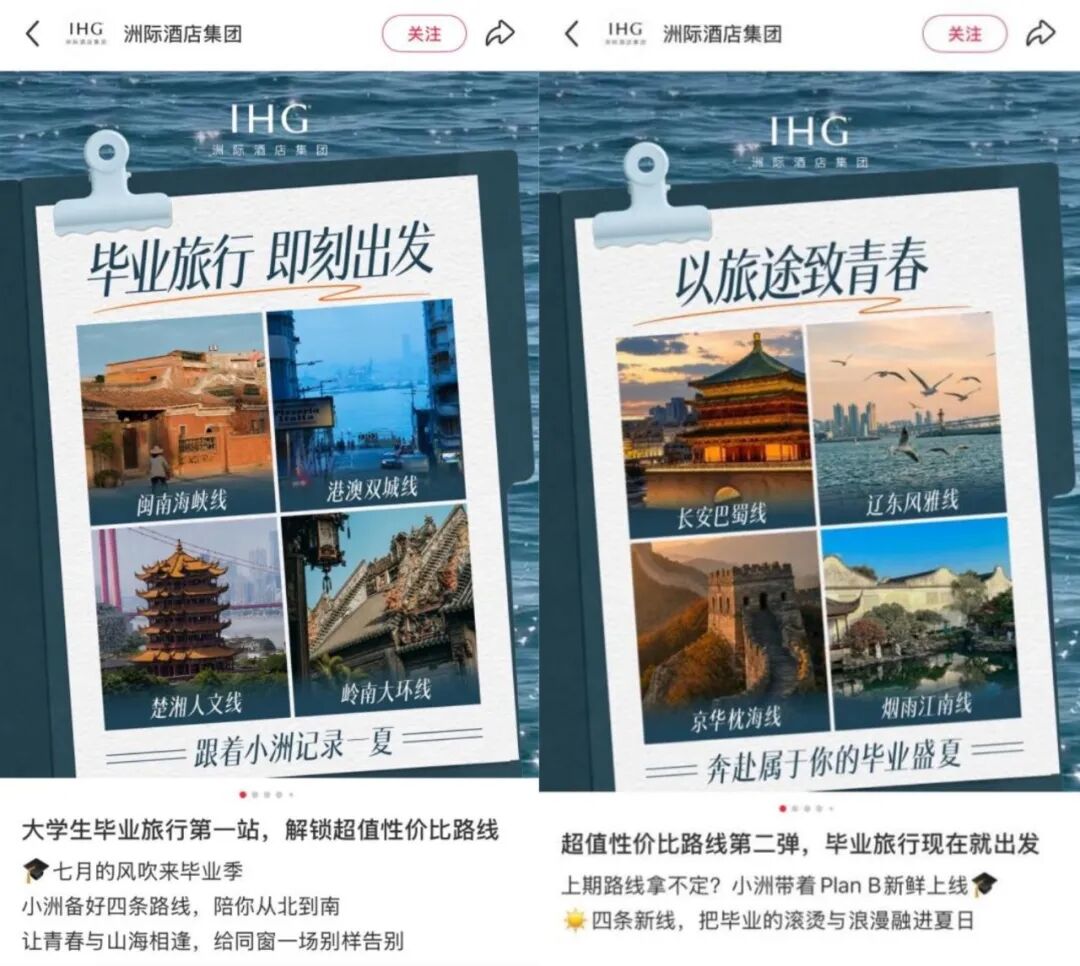
Source: Xiaohongshu
By extending the activity window period through this way of preheating in advance, it directly covers and seamlessly connects the two scenarios of summer travel and back-to-school. Through pre-complete identity verification and point benefits, even if users have not confirmed their return trip, the brand can lock in user rights and interests in advance.
The second strategy is that benefits are no longer limited to discounts, and exclusive physical welfare is opened to match membership treatment.
As users have more and more choices, hotel groups no longer only rely on single promotion methods such as "direct price reduction, discount, and preferential treatment". Instead, while combining these methods, they begin to use emotional value to deeply resonate with college students.
The "Youth Card" launched by BTG Homeinns directly offers benefits without redundant procedures. After completing student verification, users can enjoy 26% off room booking, late check-out, free breakfast and other rights. They can even use the hotel's gym and laundry room for free during non-stay periods.
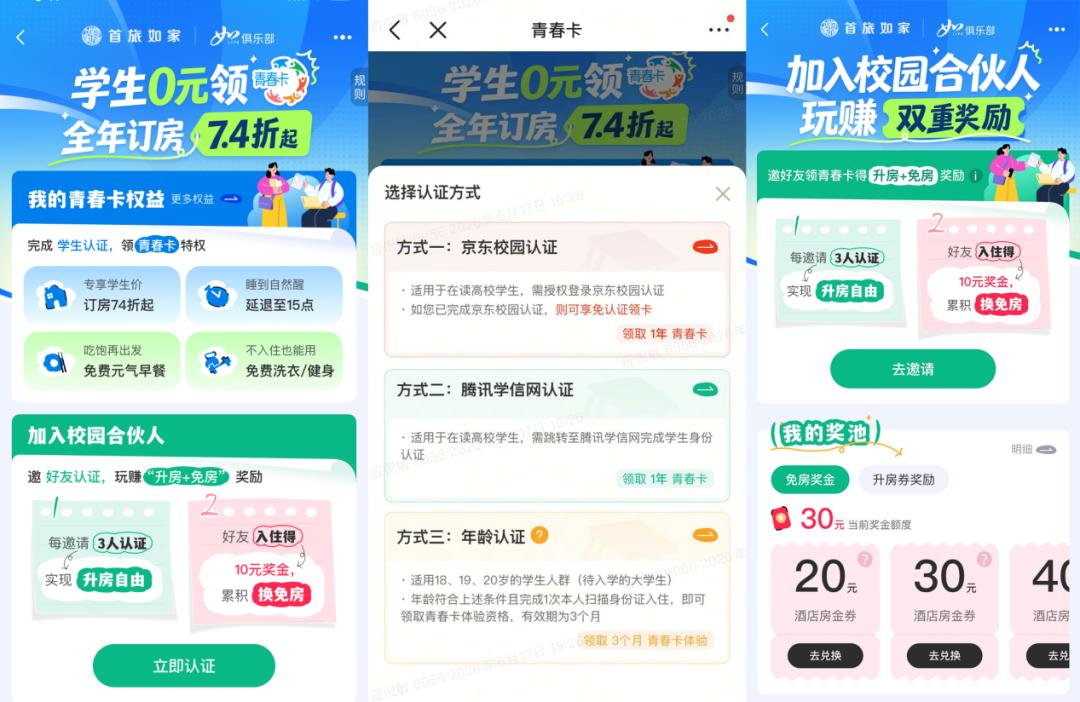
BTG Homeinns Youth Card Source: BTG Homeinns
In addition, the "Crazy Campus Music Party" initiated by BTG Homeinns targets college students, starting from Shanghai Ocean University and covering 10 cities and 13 universities. In July, it created the "Youth Summer" theme event at Chengdu Happy Valley, through immersive check-in points simulating hotel bathrooms, gyms and other scenarios, to naturally connect experience and brand interaction, further enhancing the perceived sense and sense of participation among the audience group.

Crazy Campus Music Party Source: BTG Homeinns
Hilton Hotels & Resorts also launched targeted measures. It has set up a special student page on its official website for college students, where students can directly book rooms at 20% off the rack rate, with complimentary daily double breakfast, free extra bed and late check-out rights, with treatment close to that of gold card members.
The third strategy is to cooperate with entertainment IP to complete user mind penetration through content.
While extending the timeline, InterContinental Hotels Group makes efforts on two fronts. IHG One Rewards has in-depth cooperation with KPL King Pro League, and members can enjoy exclusive viewing benefits, which skillfully translates preferential benefits into an entertaining context. This is the first time that the hotel industry has formally incorporated e-sports culture into the membership rights system.

Source: InterContinental Hotels Group
After student verification, guests of Huazhu and Atour Hotel Groups can enjoy a maximum of 25% off. Brands including Ji Hotel, Hanting, Vienna, Lavande... Student verification discounts and exclusive offers for admission notices seem to have become the "appetizer" for hotel groups to show their capabilities, releasing the commercial potential of the new semester season in all directions through the promotion of various welfare and emotional value.
With limited budgets, why are hotels scrambling for college students?
Youth cards, exclusive student pages, summer travel offers, back-to-school discounts... Faced with the successive temptation of benefits, people can't help but ask: can I have the lifelong access to the student card privileges?
However, the lively new semester marketing is only the appearance. What hotel groups aim at is never just the short dozens of days in September, but the huge college student market as a whole.
Data shows that the number of on-campus college students in China is close to 40 million now.
What does this mean? Converted, 40 million people is equivalent to the population size of a medium-sized country.
In other words, what hotel groups are really competing for is not just the stay choice and node competition in the few weeks of the new semester season, but the first choice of brand for college students and even the entire young group in the process of travel, social interaction, and consumption habits.
When it comes to the consumption track for college students, most people's first reaction is catering, milk tea, entertainment, education and training, etc. But at the same time, few people notice that behind more than 150 university towns and more than 3,000 universities across the country, a treasure market that has long been ignored has been nurtured —— university town hotels.
Speaking of which, you may wonder: college students have limited budgets, low unit profit, occasional travel, and the repurchase rate is not top-tier. Why are a large number of high-end hotels and chain giants willing to lower their stance, voluntarily give up profits, and almost "dote on" college students?
These seemingly loss-making welfare and time-consuming youth-oriented marketing are not temporary charitable concessions from brands, but a long-term layout of the hotel industry focusing on the future.
In this regard, we first clarify a misunderstanding: some people's perception of university town hotels still stays in the stereotype that "students only value convenience", but the relevant data is completely opposite to this inherent impression: in contemporary college students' accommodation consumption, 30% value cost-effectiveness, and 70% value experience.
This means that college students are willing to pay a premium for e-sports rooms and study rooms, and they will also pay for clean bedding and thoughtful details. Even theme rooms that cost 500 yuan per night can be sold out immediately after being launched during exam season and graduation season.
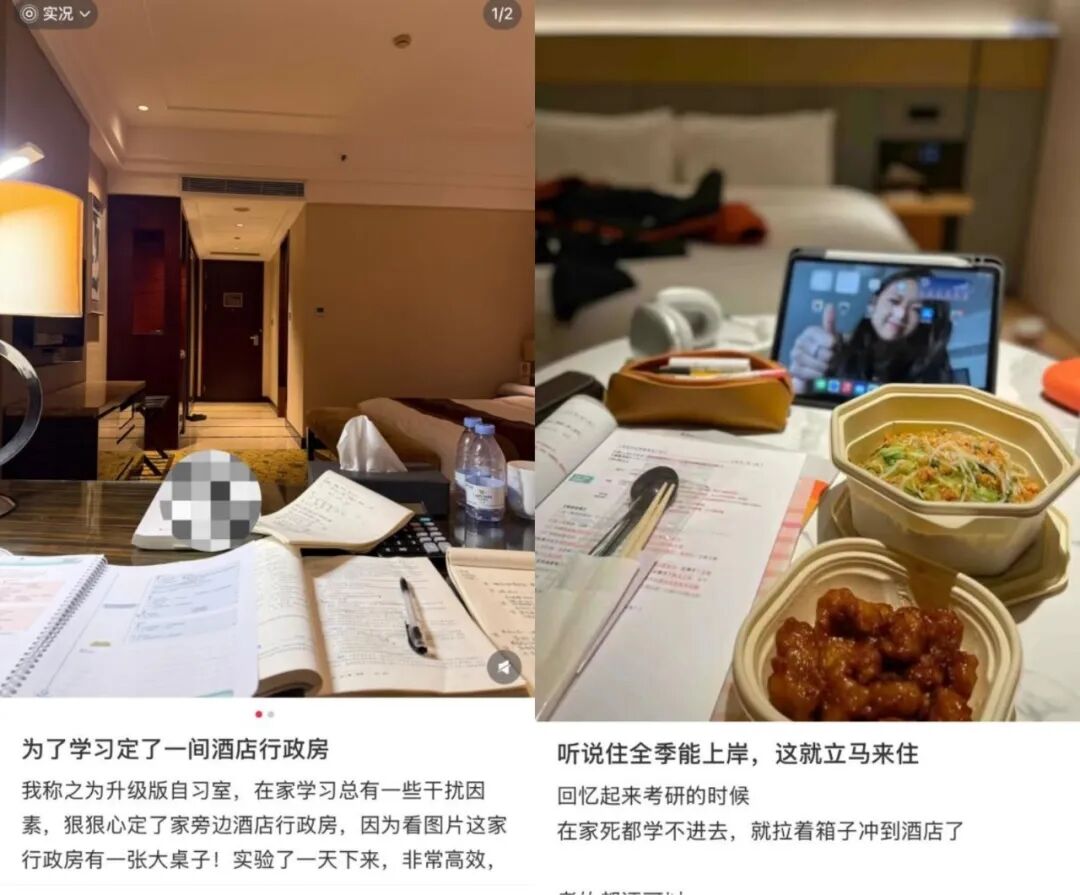
Source: Xiaohongshu
After clarifying this misunderstanding, analyzing the underlying motivation of hotel groups can reveal that the various preferential treatments hotel groups give to college students is actually a typical "user cultivation" positioning.
Behind the 40 million college students in university towns lies the most stable business code for hotels in the next ten years. Current college students may not be the high-consumption customer group of hotels, nor the target of senior VIPs, but this huge group is the absolute main force of the cultural tourism accommodation market for many years in the future.
At present, hotel groups take root in campuses in advance, and seize the minds of college students early with low-price welfare, thoughtful services and interesting content. Compared with spending a lot of money on marketing to seize mature customers after they grow up, the brand habits and goodwill cultivated at low cost in the campus era are relatively more sticky and have higher conversion rates.
Secondly, college students can be said to be a treasure customer group with extremely high traffic.
In the new media environment, the saying "whoever gains college students gains the world" is not an empty word. They are active on Xiaohongshu, Douyin and various communities, keen on checking in, and willing to share recommendations.
For hotels, they do not need large-scale advertising investment, and can achieve organic viral spread through student circles, efficiently shaping a young and approachable brand image.
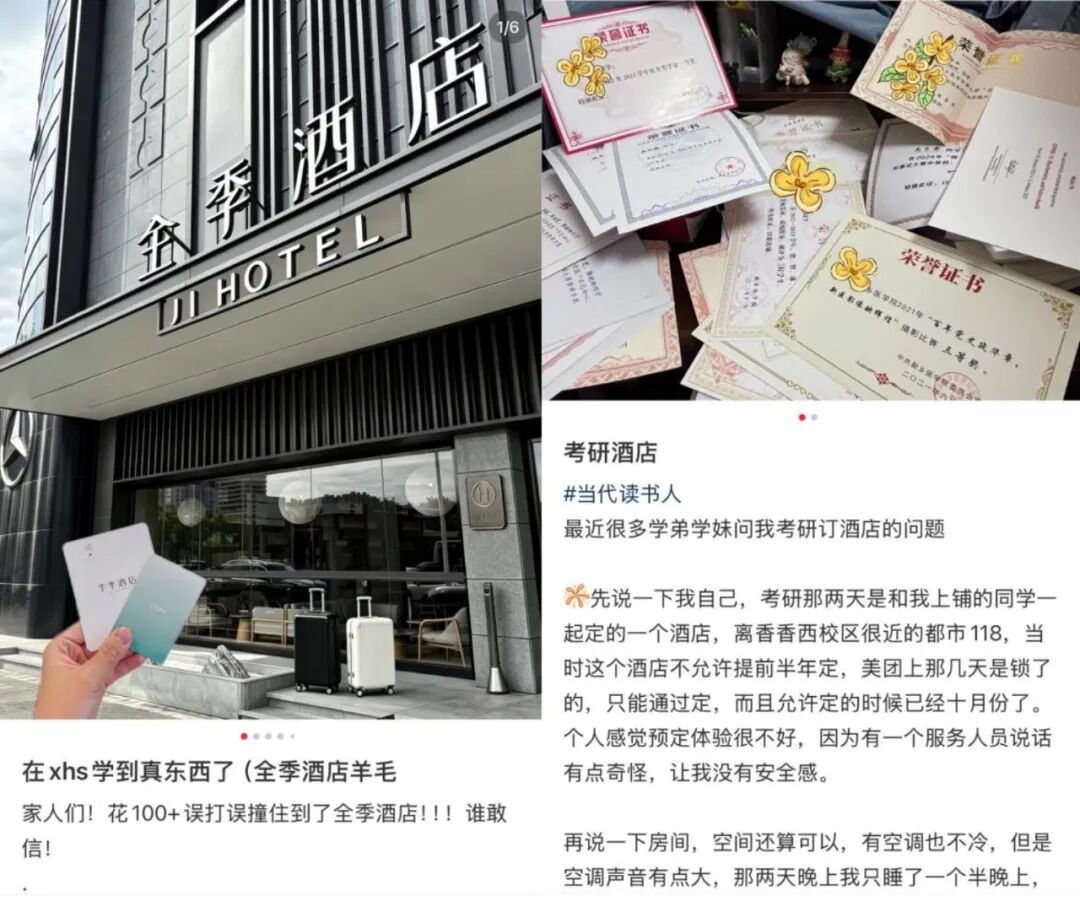
Source: Xiaohongshu
Of course, more critically, under the intensifying competition in the stock market, the college student market can be regarded as one of the few incremental blue oceans. Now, business hotels in first- and second-tier cities have become saturated, competition in the business travel market is heating up, and price wars are becoming more and more fierce, and the continuous compression of industry profits has become the norm.
But at the same time, there are still a large number of gaps in the university market and the young consumer market. Back-to-school, holiday outings, long-distance travel during winter and summer vacations, student accommodation demand continues to explode.
International luxury hotels such as InterContinental and Hilton, or national chain brands such as Homeinns and Atour, are in urgent need of new growth breakthroughs. College students with huge volume and continuously iterating demands naturally become the preferred choice to break the deadlock.
Behind the crazy preferential treatments: the hidden worries of student marketing
Behind the hotel groups' rush for customers, they meet the rigid consumption demands of college students in the short term and achieve both brand and performance growth. But looking at this "doting-style" marketing over a longer period, there are non-negligible variables.
This kind of preferential treatment often leads to two completely different results: one is to cultivate a close customer group with extremely high emotional stickiness due to deep recognition, and the other is to get "hollow people" who only pursue discounts without recognition and loyalty.
The college student market seems to be huge and full of opportunities, but it is not a market where you can easily win just by entering blindly. While major hotel groups are scrambling for customers, they must also face the hidden worries and tests that inevitably exist in this youth-oriented competition.
For example, Generation Z, who grew up in an environment of information explosion, have long been accustomed to all kinds of ubiquitous preferential treatments, and the establishment of brand loyalty is not easy. They always seem to pursue freshness and "benefits". Some brands mistakenly believe that they can lock in student users through several new semester discounts or several activities, but in fact, this is only a short-term retention effect brought by short-term marketing.
Moreover, contemporary college students are extremely rational in consumption. Today they will choose Ji Hotel because of its higher cost-effectiveness, tomorrow they will choose Hanting because of its better welfare, and the day after tomorrow they may switch to Atour because of its more novel experience.
Once the welfare disappears, the speed of user loss will far exceed expectations.
But pursuing benefits is only one side of the story. College students also fear bad experiences and trust the good stay experiences they have had before. Loyalty in the new consumption era is never blindly favoring a certain brand, but following solutions that can meet their own needs.
To capture this group of users, the answer is not complicated: stable service quality, unique brand tonality, and refined operation that fits the needs of students.
It is not difficult for hotels to get students' first stay through discounts, but after the welfare fades, product, service and brand power are the fundamentals to retain users.
However, there are already some alarming phenomena in reality: some hotels' student rights and interests look generous, but in fact they are only limited to a small number of room types, cannot be booked in peak seasons, and the exclusive inventory for students is extremely small, which has become a mere marketing gimmick.
If low-price preferential treatment is at the cost of reducing service quality, it will be "suicidal low-price". Young people spread negative comments extremely fast on social platforms. One bad stay review can offset the brand reputation accumulated by dozens of marketing promotions.
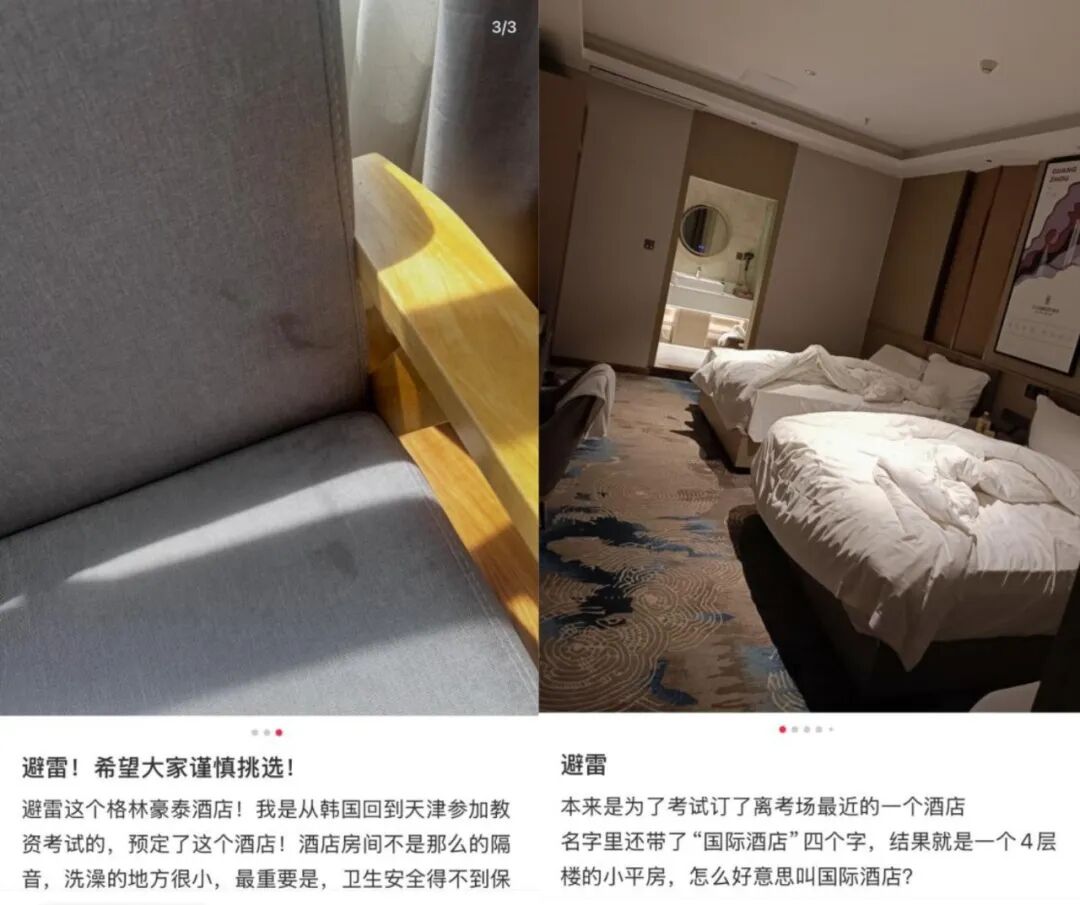
Source: Xiaohongshu
In short, the college student market is a long-term track, not a seasonal business that ends after a wave of popularity.
When the lively preferential treatment boom of the new semester season fades, how to retain customers, precipitate reputation, and complete long-term user conversion is the real decisive factor in this youth-oriented battle.
The bustle of the new semester season will eventually end, and the test of the 40 million college student market has just begun.
For hotel groups, obtaining student traffic is only the first step. How to convert users who only pursue benefits into customers who truly recognize the brand is the key to the victory of this youth-oriented battle.
Whether this competition will evolve into a fleeting marketing trend or truly precipitate long-term users remains to be observed by the market.