It only takes a few days to make a demo, yet mass production takes several years: Jixian Technology has secured tens of millions of yuan in Series A financing by leveraging the "shovel seller" logic.
"Shovels Seller" of Edge-side AI Jixian Technology Completes Tens of Millions of Yuan in Series A Financing to Accelerate Large-scale Implementation of AI Hardware
By integrating large models into a toy, developers can produce a chat-enabled demo in just a few days. However, the real challenges emerge when the product enters the mass production phase of 10,000 or 100,000 units: whether the device can clearly capture the user's voice in noisy environments, respond normally under unstable network conditions, sustain sufficient battery life, and synchronize updates across all devices after model upgrades.
These issues, which are usually absent from product demonstrations, determine whether an AI hardware product can truly enter the market.
Recently, Shenzhen Jixian Technology Co., Ltd. announced that it has completed a Series A financing of tens of millions of yuan. This round of financing was jointly invested by Hangzhou Jintou Dingrong Equity Investment Fund Partnership (Limited Partnership) under Zhejiang Venture Capital Group Co., Ltd. and Coral Capital. The raised funds will be mainly used for R&D of AI Agent, edge-side AI interaction and embedded development technologies, upgrading of the MarsGate AIoT platform, as well as expansion of AI companionship, robotics, AI home appliances and overseas markets.
Founded in 2013, Jixian Technology positions itself as a "shovels seller" for the AI hardware industry, providing brand owners and hardware enterprises with integrated support ranging from AI capability access, terminal engineering development to large-scale mass production.
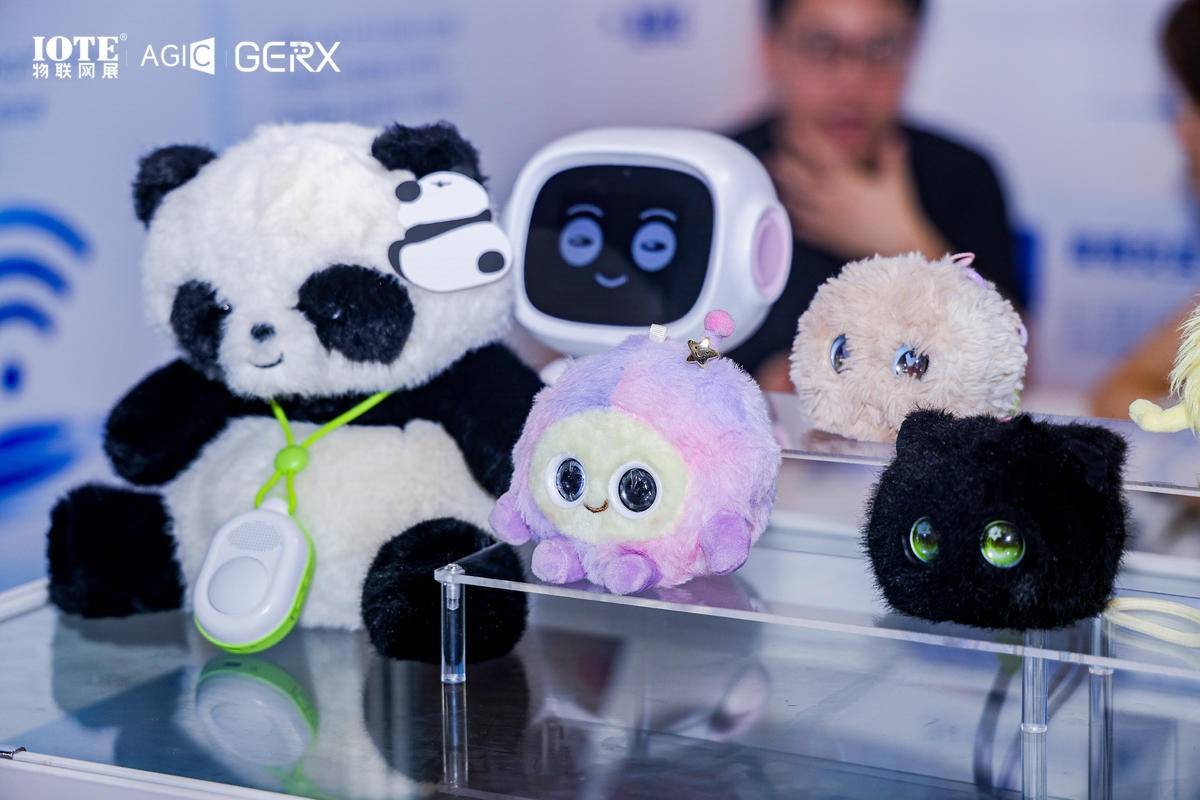
AI Companion Toy Product
The Real Threshold of AI Hardware Lies in the Stage After Demo
AI is expanding from smartphones and computers to more physical terminals.
In the toy industry, products that originally could only play fixed audio are now attempting free conversations, user information memory and multi-modal interaction; in the home appliance industry, users no longer need to accurately say "turn on the third gear of wind", but can directly express "I feel a little hot", and the device needs to make judgments based on its own status and user habits.
However, integrating large model capabilities into terminals does not mean that the product is ready for mass production.
The iteration speed of models is usually calculated in months, while the development, certification and sales cycle of hardware products may last for several years. Terminals are also restricted by conditions such as chip computing power, memory, cost, power consumption, acoustic structure and network environment. A prototype that runs smoothly in the office may encounter problems such as reduced far-field recognition performance, mutual interference when multiple people speak, slow response under weak network, audio distortion and insufficient battery life after being placed in real households.
These problems often restrict each other. Increasing local computing can reduce response time, but may lead to higher power consumption; adjusting the microphone structure can improve far-field recognition, but may also affect the cost of molds and the whole device; after the model performance is improved, hardware resources may not be upgraded synchronously.
"AI hardware is not just adding a chat function to a product," said Wu Kaihua, founder and president of Jixian Technology. "Consumers do not care which model the product calls, what they finally perceive is whether it can understand them, respond fast enough, not drop connections frequently, and remain stable after months of use."
In his view, a new industrial gap is emerging in the AI hardware industry: large model enterprises have algorithm capabilities, but are still far from terminal mass production; traditional hardware enterprises have supply chain and manufacturing capabilities, but lack experience in AI system engineering.
Implement AI Capabilities on Chips and Devices
Over the past decade, Jixian Technology has been engaged in the R&D of smart device connectivity, embedded software and hardware, and IoT platforms, experiencing multiple rounds of technological iterations including Wi-Fi, Bluetooth, Zigbee, cellular communication and Matter. After the rise of large models, the company began to combine these capabilities with AI Agent, voice interaction and long-term memory.
At present, Jixian Technology's solutions mainly consist of three parts.
The first part is the terminal-scenario-oriented AI Agent framework, which supports interaction capabilities such as voice, vision, touch and memory. Taking AI companion products as an example, after the user issues an instruction, the system needs to complete speech recognition, intent judgment, content retrieval, model call and speech synthesis; if device actions are involved, it also needs to convert natural language instructions into control commands that hardware can execute.
The second part is the embedded development framework. Jixian Technology has made reusable components for common capabilities such as audio, display, camera, communication, AI recognition, OTA and production line testing. For relatively standardized products, part of the code can be generated and compiled through parameter configuration, allowing engineers to focus more on hardware adaptation and differentiated functions.
The third part is the MarsGate AIoT full-stack technology platform, which is mainly responsible for device management and operation after shipment. The platform covers links including device access, status management, data analysis, OTA upgrade and fault diagnosis, and supports concurrent management of millions of devices.
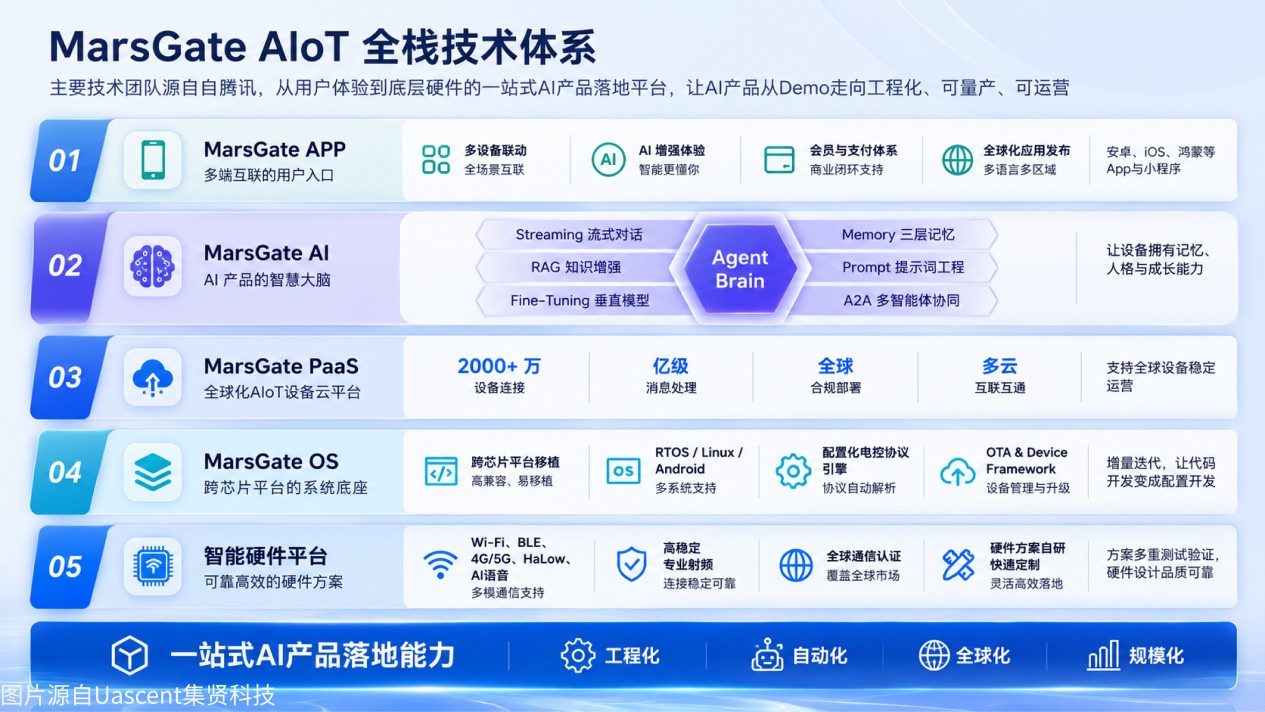
MarsGate AIoT Full-stack Technology Platform
For AI hardware enterprises, product shipment does not mean the end of the project. Model calls, character content, long-term memory, version upgrades and device operations will continue to occur. Therefore, Jixian Technology's business has gradually extended from one-time project development and hardware delivery to software platforms, AI capability calls and continuous operation services.
Start from AI Companion Toys and Expand to More Terminal Scenarios
Up to now, Jixian Technology has served more than 200 brand customers in total, with the cumulative shipment of smart devices and platform access volume exceeding 20 million units. The company currently has about 170 employees, of whom R&D personnel account for about 70%. It has applied for more than 70 domestic invention patents in total and owns 54 software copyrights.
In the first half of 2026, the company's overall shipment volume nearly doubled year-on-year, and the revenue of AI-related businesses maintained high growth for four consecutive quarters.
AI companionship is one of the key scenarios that Jixian Technology is currently focusing on implementing. The company has participated in the R&D and mass production of multiple toys and companion products, with relevant capabilities including free conversation, long-term memory, character management, visual recognition and multi-modal interaction, and some products have entered domestic and overseas e-commerce channels.
In the field of AI home appliances, Jixian Technology is helping devices shift from executing fixed instructions to understanding user expressions, reading device status and making simple decisions. For example, when a user says "I feel a little hot" to a fan, the system needs to judge whether it is necessary to adjust the air volume based on the current gear, environmental status and user habits, instead of mechanically increasing the air volume by one gear.
For home appliance enterprises with a large number of product lines, if each model is developed with a new set of AI capabilities, the cost and maintenance pressure will rise rapidly. The ability to reuse across chips and product categories will become the key to the success of platform-based solutions.
State-owned Capital and Industrial Capital Jointly Bet on AI Hardware Implementation
This round of financing was jointly invested by Hangzhou Jintou Dingrong Equity Investment Fund Partnership (Limited Partnership) under Zhejiang Venture Capital Group Co., Ltd. and Coral Capital.
The relevant person in charge of Zhejiang Innovation Venture Capital said that Jixian Technology has both AI Agent R&D capabilities and hardware mass production delivery capabilities, which can further implement AI capabilities on terminal devices and real application scenarios.
The Coral Capital side stated that it will rely on the Yangtze River Delta intelligent manufacturing and supply chain resources to help Jixian Technology promote capacity expansion and industrial collaboration.
After completing this round of financing, Jixian Technology will continue to increase investment in AI Agent, edge-side interaction, embedded development tools and global device operation systems, and expand terminal scenarios such as AI companionship, AI home appliances and robotics.
Wu Kaihua said: "When AI expands from the cloud to the physical world, it must finally face the challenges of cost, power consumption, network and mass production. We hope to encapsulate these complex issues, so that our customers can focus more on the products and end users themselves."