It does not manufacture TVs, nor develop automotive businesses, and entered the foldable smartphone market 7 years behind its peers. What lies behind this is Apple's rigorous strategic discipline.
Apple's true moat is not a single technology, not a single product, but a set of product culture and strategic discipline that has remained unchanged for decades and penetrated deep into the organization's marrow.
At 10 a.m. on September 9, 2026, Apple's autumn launch event was held as scheduled at the Steve Jobs Theater in Apple Park, Cupertino, California, USA. Titled "Surprise and Shine", this event marks the debut of new CEO John Ternus after he officially took office on September 1, and is also hailed by the outside world as Apple's "most important launch event in a decade".
The design of the opening video is meaningful: the camera first follows Tim Cook, and everyone thought it was still Cook's stage, but Cook smiled and waved his hand, "No, not me, that's your guy." Then the camera turned to Apple's new CEO John Ternus.
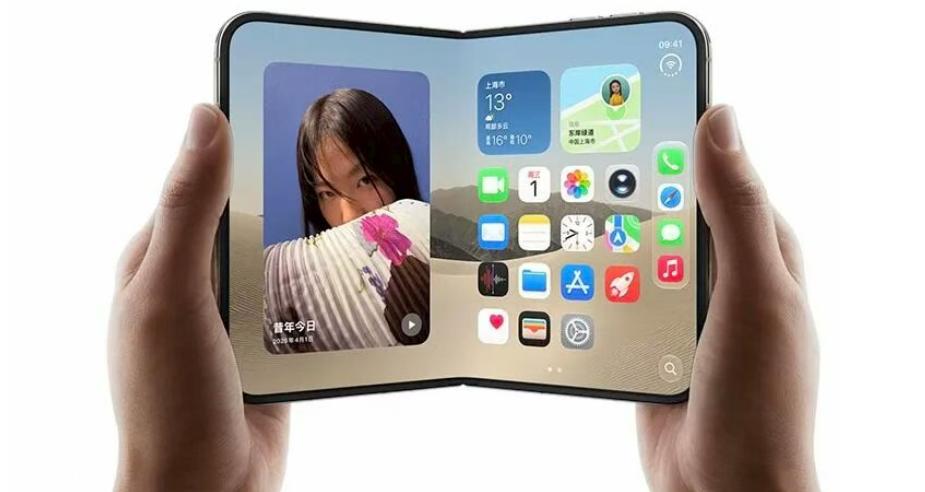
The biggest highlight of this Apple launch event, apart from John Ternus's first appearance as CEO, is the iPhone Duo, a foldable phone that Apple has polished for nearly a decade. This product, which adopts a horizontal inward-folding "passport" form, has a 5.4-inch outer screen and a 7.6-inch inner screen when unfolded, making it the iPhone with the largest screen in Apple's history. The starting price for the Chinese mainland version is 15,999 yuan, and the top configuration is priced at 26,499 yuan.
After watching the launch event, there is a question lingering in my mind: why did Apple launch its first foldable phone nearly 7 years after the industry launched such products?
2019 is known as the "first year of foldable phones". In February of that year, Samsung and Huawei successively released their first-generation foldable phones Galaxy Fold and Mate X, followed by Motorola's Razr at the end of the year. However, Apple did not launch its first foldable phone until 2026, a full seven years later. It is worth noting that with Apple's technical reserves, supply chain control capabilities and ecosystem capabilities, it would not have been very difficult to launch a product that surpasses almost all foldable phones on the market in 2019. According to the disclosure of Mark Gurman, a reporter from Bloomberg, as early as February 2019 when Samsung Galaxy Fold came out, Apple had already started to lay out related technologies for foldable screens.
Having the strength to arrive early, but choosing to be seven years late. Why did Apple do this? Behind this question lies the most underlying business code of Apple, which is also worthy of serious consideration by China's business community that is currently trapped in the involution dilemma.
The Seven-year Itch of the Foldable Phone Market
To understand Apple's lateness, we must first see clearly the path that the global foldable phone market has taken in the past seven years.
The first batch of foldable phones seven years ago were more of concept verification than finished products. Samsung Galaxy Fold was originally scheduled to be launched in April 2019, but the media test machines successively encountered problems such as screen flashing, screen breaking and black screen, forcing it to be postponed for four months before being hastily launched to the market. Looking at the form of that generation of products: thick, fragile, expensive, and there is no necessary reason for folding. The Xiaomi MIX FOLD released in 2021 is a typical example, with an outer screen ratio of 27:9, a thickness of 17.2mm in the folded state, and a weight of 317g. It was nicknamed "remote control" by users because it was too bulky to hold with one hand. Such products are more of semi-finished products pushed to the market by the industrial chain than flagship products.
After seven years of iteration, the progress of hardware is huge. Taking Honor Magic V6 released in early 2026 as an example, the thinnest part in the folded state has reached 8.75mm, and the minimum weight is 219g, which is no different from a traditional straight-screen flagship. The reliability of flexible screens, precision hinges and high-frequency opening and closing has been verified by Samsung and Huawei to be suitable for mass manufacturing.
However, another set of data exposed the embarrassment of this category. Data from IDC shows that from 2020 to 2025, the shipment of foldable screen phones in China increased from 470,000 units to 10.01 million units, with a compound annual growth rate as high as 84.36%, which seems to be advancing triumphantly; but until 2025, the proportion of foldable screens in China's total smartphone market was only 3.52%. Globally, the data from Counterpoint shows the same trend: the global shipment of foldable phones in 2025 was about 19.6 million units, a year-on-year increase of 18%, but it only accounted for about 1.6% of the global smartphone shipment. Over the past seven years, foldable phones have always been a niche category that "earns praise but not sales", and have never really entered the mass market.
Where is the problem? Lu Weibing, President of Xiaomi Group, told the truth at the 2026 IFA exhibition in Germany: "In the end, large foldable phones are designed with the outer screen as a straight-screen phone, and in 80% to 90% of scenarios, users only use the outer screen." Behind this sentence is the deadlock that the Android camp has never been able to solve: the fragmentation of the ecosystem makes the vast majority of applications never make real adaptation for the inner screen. The large screen that users spend tens of thousands of yuan to buy, when unfolded, often only shows a simply enlarged mobile phone interface, and the experience is even worse than that of the outer screen. The hardware is folded, but the software is not, and the ecosystem is not either. The foldable screen industry has thus fallen into a strange circle: the form has long been mature, but the experience has stagnated.
With this background clarified, we can see the first layer of logic behind Apple's seven-year lateness: for a category where the experience standard has not yet been established, the industrial chain is not yet mature, and the software ecosystem is not yet in place, no matter how early Apple acts, it can only launch the "best in the industry" foldable phone, but cannot make the "most ultimate" foldable phone.
Not Unable to Do It, But Unwilling to Do It: The Essential Difference Between "Best in the Industry" and "Most Ultimate"
The difference between the two terms "best in the industry" and "most ultimate" is exactly the key to understanding Apple's product philosophy.
"Best in the industry" refers to a relative lead within the existing experience framework, with a slightly shallower crease, a smoother hinge, and a more competitive price than competitors, winning advantages on the parameter comparison table. "Most ultimate" refers to an absolute lead that redefines the experience standard: it is not just better than others, but makes the reference system of "others" invalid, so that the user understands the moment they pick it up that this is what this category should have been like in the first place. The former is competition thinking, while the latter is creation thinking.
Apple never participates in the former kind of game. Cook has publicly elaborated on Apple's core strategy on many occasions: "We never aim to be the first, but to make the product the best. We only want to make the best products." Duan Yongping also said a sentence with the same essence: "All masters dare to be the last to act, but only do better than others." "Dare to be the last to act" is not conservatism, but an extremely harsh strategic discipline: rather than missing the trend, it will not deliver semi-finished products.
Looking through Apple's history, you will find that almost all of the company's great products are not the pioneers of their categories. Before the birth of the iPod, there were countless MP3 players on the market; before the iPhone was launched, Nokia, Motorola and Palm had already begun to explore touch-screen mobile phones; before the iPad was released, there were also a variety of tablet computers. But the reason why iPod, iPhone and iPad became epoch-making products is not that they arrived first, but that they pushed the experience of the category to an ultimate position of "unimaginable before and unavoidable after" at one time. No matter how subsequent competitors catch up, they can only make articles within this standard redefined by Apple.
Therefore, Apple in 2019 was fully capable of launching a foldable phone, but what kind of product would that be? The crease is clearly visible, the hinge takes up space, the weight exceeds 250g, the application ecosystem has no adaptation, and the core experience of iOS is forced to compromise for the large screen. It may be able to achieve "best in the industry" by virtue of Apple's brand and craftsmanship, but it is a whole era behind the "most ultimate" in Apple's standards. Apple is well aware that a product that is "best in the industry" but not ultimate will do far more harm than good to Apple: it cannot shake the foundation of the Android camp, cannot support Apple's pricing system, and will instead dilute users' belief in Apple's products.
So Apple chose to wait, waiting for three things to happen at the same time: the physical presence of the crease is reduced to the point where it is almost imperceptible to the naked eye; the thickness and weight of the whole machine are aligned with the straight-screen flagship; the iOS software ecosystem can fully take over the unfolded large screen. These three things correspond to screen materials and hinge technology, the limit of structural engineering, and the adaptation of the developer ecosystem respectively. Without any one of them, the foldable phone is just a form juggling rather than an experience leap. By 2026, the three things are finally ready, and Apple decided to take action.
The Ultimate Fulfillment of Seven Years of Lateness: What Did iPhone Duo Do Right
So, after seven years of waiting, did Apple deliver on its promise? Judging from the first wave of feedback after the launch, the answer is relatively positive.
The on-site hands-on reviews from overseas tech media such as The Verge are quite representative: the hinge of iPhone Duo is smooth, the crease on the inner screen is "almost invisible" in a short experience, the anti-reflection effect of the nano-textured surface is excellent, and the wider screen ratio is naturally suitable for video and dual-app multitasking. It is worth noting that the dent in the center of the screen of early foldable phones was almost an unavoidable structural feature, and it was also the biggest psychological hurdle for users. Apple uses the nano-texture of the inner screen to reduce reflection, and uses a hinge composed of more than 100 components to flatten the center of the screen in the unfolded state, compressing the crease from a "conspicuous defect" to a "perceptual blind spot". This is exactly the critical point of "most ultimate" I mentioned: it does not physically eliminate the crease, but makes the crease disappear in terms of experience.
What is more critical is the data. The iPhone Duo has a thickness of 11.3mm in the folded state and a weight of 254g, which is at the same level as the iPhone 18 Pro Max. The significance of this number needs to be viewed in the seven-year coordinate system: from the "remote control" of 17.2mm and 317g to the "normal mobile phone" of 11.3mm and 254g, the foldable form no longer requires users to pay the price of experience for the form.
But what really makes the iPhone Duo a generation ahead of all previous foldable phones is not the hardware, but the software and ecosystem. What Apple focused on showing is not the hinge parameters, but the iOS 27 after unfolding: two apps can run side by side, the same App can open two windows at the same time, the system menu bar is moved from the bottom of the screen to the right, and Apple also released human-computer interface specifications to guide developers to make full use of the wide inner screen to display more content, rather than simply enlarging the outer screen UI. This is exactly the deadlock that the Android camp has not been able to solve for seven years - the root cause of "only using the outer screen in 80% to 90% of scenarios" mentioned by Lu Weibing is that the fragmentation of the Android ecosystem makes no one take the lead in large screen adaptation; while Apple has absolute control over the application ecosystem, and its first-generation product can provide a complete wide-fold interaction paradigm. Samsung and Huawei spent seven years solving the problem of "whether the mobile phone can be folded", and Apple's first move answered the question of "what is the purpose of folding".
This kind of harshness even extends to production. According to sources cited by Nikkei Asia, due to Apple's extremely strict quality control requirements, by the end of August, the daily output of iPhone Duo was only a few hundred units, and the official sale was also more than one month later than the iPhone 18 Pro series. In a company with an annual revenue of more than 400 billion US dollars, retaining such a restrained production capacity ramp-up rhythm for a product is itself a signal: Apple would rather sell less than allow an imperfect product to flow to users.
Of course, there are also controversies: the starting price of 1999 US dollars, the cancellation of Face ID and the use of side Touch ID, and the camera system not adopting the full Pro specification have all sparked fierce debates on social media. But the focus of the controversy is all around "whether it is worth the price" rather than "whether it works". No one doubts that this is a product with extremely high completeness, and people only debate its price. In the scalper market, this phone was once speculated to 90,000 yuan, and the market voted in its own way.
Two "No Actions": TV and Automobile, Strategic Determination Deeper Than Folding
If the seven-year-late foldable phone shows Apple's patient waiting for the "most ultimate" goal, then the two famous "no actions" in history show the other side of this thinking mode. The ultimate standard not only restrains what Apple does, but also restrains what Apple does not do.
The first "no action" is TV.
Many people do not know that Apple's obsession with making TV is much longer than that of making foldable phones. On his deathbed in 2011, Steve Jobs gave a famous statement in an interview with biographer Walter Isaacson: "I want to make a fully easy-to-use all-in-one TV set, which will have the simplest user interface you can imagine - I finally cracked it." With Jobs' character, this is almost a product declaration. In the following more than ten years, Wall Street has hyped up the rumor of "Apple TV" almost every once in a while. But until today, Apple has not launched a complete TV set, only the small Apple TV set-top box.
Why? Not because it cannot do it, but because the accounts do not add up. The value chain of the TV industry has two hard ends: the display panels are firmly controlled by panel manufacturers such as LG, Samsung and Sharp, and the content copyrights are held by Netflix, Disney and major TV stations. In this chain, Apple cannot inject its most core competitiveness - the experience integration capability of software and hardware. Making a Samsung-screen TV with an Apple logo on it makes no sense to the market. What is more fatal is the attribute of the industry: the replacement cycle of TV is as long as five to seven years or even ten years, and consumers regard it as a household appliance rather than a technology product; even the top players in the entire industry have a hardware profit margin of less than 10% all year round - while Apple's net profit margin in 2021 was as high as 26%, which is even higher than the 18.7% of luxury giant LVMH. Even if Apple can make the TV with the best experience in the world, competing in a declining market with limited innovation space and increasingly marginalized does not conform to Apple's business logic. The HomePod smart speaker is a lesson from the past: when the product value cannot support the selling price, no matter how strong the brand is, it will not help, and this product was quietly discontinued after four years on the market.
The second "no action" is automobiles.
This case is more heroic. In 2014, Cook approved the launch of the car-building project code-named "Titan", led by Apple Vice President Zadesky who once worked at Ford, with an initial team of about 600 people. Apple's original vision for this car was extremely "Apple-style": to achieve L5 full autonomous driving in one step, with no steering wheel and no pedals. In the following ten years, the project experienced four leadership changes and two route reversals - from building a complete vehicle to developing autonomous driving software, and then back to building a complete vehicle; the goal was downgraded all the way from L5 to L4, and then cut to L2+ equivalent to Tesla's level; the mass production time was pushed from 2025 all the way to 2028. In the later stage, internal employees had nicknamed the car the "Titanic disaster". On February