Competition in the non-standard commercial sector is shifting to the middle and back office.
Over the past few years, non-standard commercial spaces have quickly gained market recognition with their distinctive spatial expression and unconventional business format combinations. However, as the first batch of projects enter the stable operation period, after the visible prominent labels such as scenarios, environments, and first stores gradually become part of daily operations, the questions that non-standard projects need to answer have also shifted.
If we look at the highlights and trends in the non-standard commercial sector in the first half of this year, we can find that the changes of existing non-standard commercial projects are unfolding in two directions: Inward, the parallel trends of institutionalization and routinization of cultural production have become a required course to demonstrate the project's image; outward, proven practices are beginning to leave individual projects, and through active disassembly and migration of themselves, they attempt to recombine in new venues and local issues.
Entering the Deep Waters of Operation: Content Efficiency per Square Meter, a New Indicator for Measuring Spatial Benefit
We have long observed benchmark non-standard commercial projects in the market, and the statistical samples can be divided into three stages according to their launch time: Budding Stage (2019–2022, 20 projects), Outbreak Stage (2023–2024, 45 projects), and Differentiation Stage (2025 to present, 31 projects).
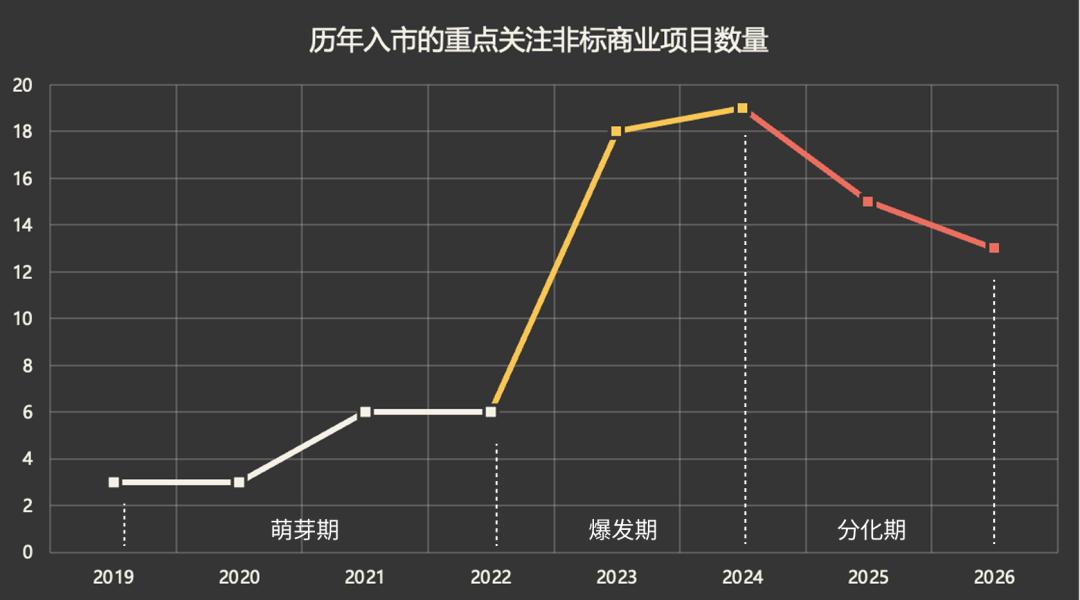
Number of key non-standard commercial projects launched over the years
Projects in the Budding Stage are mainly renovated old shopping malls and urban renewal projects, with spatial forms similar to block commerce and cultural and creative parks; the Outbreak Stage witnessed non-standard commerce evolving from concept to widespread practice, and project positioning generally leans towards youthful trends and social communication.
As early-stage projects successively enter the stable period, the market's focus has also shifted to: Can the projects continuously generate their own uniqueness? Can the opening popularity be converted into stable revisits? Can the methods that work for a single project continue to thrive in new venues?
In the operation-oriented stage, "content efficiency per square meter" may become a new indicator to describe the benefits of non-standard commercial projects.
The "efficiency per square meter" here refers to the comprehensive value created by online and offline content per unit of space in a certain cycle. It includes not only the direct income brought by activities, goods and services, but also the indirectly improved revisit rate, stay duration, brand awareness, etc.
How to create content efficiency per square meter?
From the 187 activity cases of 25 projects recorded so far, markets, performances and festivals constitute the most common content combination; exhibitions, workshops and public art are more focused on shaping the character of the venue, while brand pop-ups undertake short-cycle consumption conversion.
In terms of themes, local customs and public art activities account for the largest proportion of content, followed by outdoor sports and two-dimensional related content.
After in-depth research and tracking of the cases, we found that the content production capacity of non-standard commerce presents two clear trend lines: On the one hand, the cultural production function has become routinized and professionalized, and on the other hand, project operators have begun to explore through self-operation and joint operation to more actively participate in the organization of brands, goods and services.
Cultural Production Becomes a Required Course for Operation
Although our statistics in *Non-standard Commerce in the First Half of 2026 Starts to Take "Small Matters" Seriously* found that the proportion of cultural formats in non-standard commerce is shrinking, this does not mean the failure of the cultural production function.
A more far-reaching change is that cultural production has shifted from relying on a single cultural format or centralized activities to daily operation links composed of institutional cooperation, spatial organization, rhythmic activities and fixed IPs.
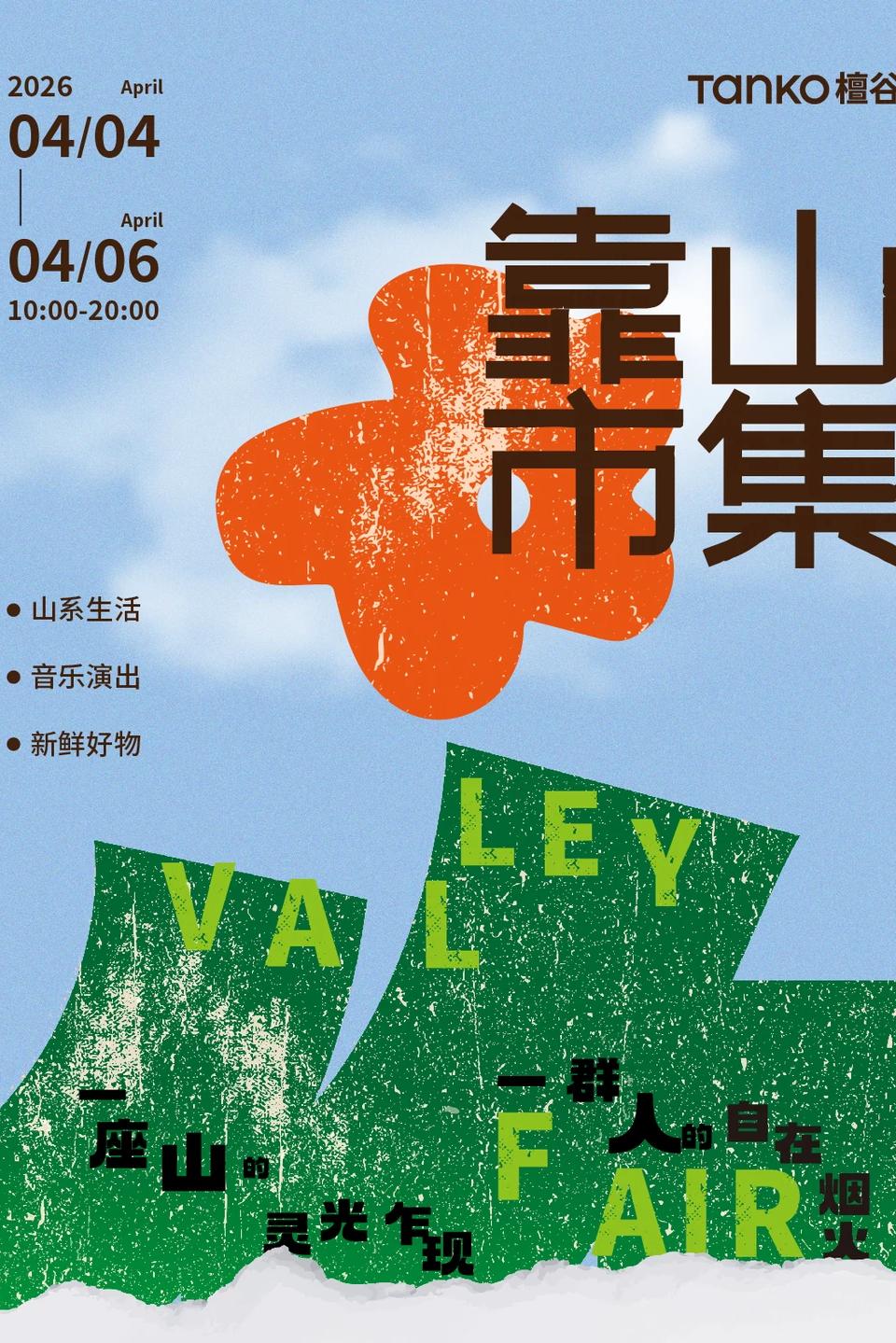
Seasonal events in Tan Valley, Beijing | Source: Xiaohongshu @Tan Valley
The first is the long-term practice of institutionalization, introducing professional cultural institutions to form a stable supply of cultural content.
For example, after the Yuz Museum left West Bund, it moved to Panlong Tiandi in 2023. In addition to the newly built main pavilion, the project also transformed the old houses in the ancient town into project spaces, and scattered public art projects and art derivative stores throughout the project, extending from a single format to a "flowing art museum" embedded in the daily life of the community.
Similarly, A4 Art Museum of Luxe Lake CPI transplanted the venue operation method to Chongqing Green Heart and Wuhan Yanqingli, juxtaposing art spaces with libraries, parks, community services and commercial formats.
For Luxe Lake, cultural production is not an ornament outside of commerce, but an infrastructure that continuously transforms the community life landscape into project attractiveness.
The gregarious public art space in REGULAR Source Field presents another lighter spatial organization method.
gregarious connects the public art space in the center of the project with three sunken gardens, and integrates functions such as books, curation, and pop-ups. Cultural content itself may not form a strong destination attraction, but it is interspersed in the movement lines of walking, resting and other behaviors, subtly shaping the character of the venue.
Secondly, benchmark projects also rely on independent teams or external institutions to form a stable and high-frequency production rhythm of cultural events. Category-oriented events such as bread festivals and coffee festivals, as well as taste-oriented events such as music festivals and drama festivals, have stable business expectations.
Projects such as Tianmuli, Luxe Lake CPI, and Jishe Green Station have been able to maintain daily activity with weekly events. Community-oriented in-depth activities and traffic-oriented commercial activities are intertwined, allowing the project to establish a reusable mechanism for topic selection, planning, recruitment and execution.
Different activity forms such as "market, exhibition, festival" have also changed from temporary marketing events to content products with stable value propositions and implementation frequencies.
From a longer-term perspective, some projects have begun to form their own content IPs that cover the whole year.
For example, Shanghai Longhua Fair relies on the national intangible cultural heritage "Shanghai Longhua Temple Fair" to form a market brand with local cultural characteristics from spring fairs to winter fairs; the Mogan Mountain Yujie Circus Festival has entered its second edition, gradually accumulating a certain exclusivity; annual events such as the Tan Valley Mountain Opening Festival, Panlong Tiandi Jiangnan Customs Season, and Aduo Cangku Pulu Fermentation Festival have also successively entered the continuous holding cycle, with content and space deeply bound.
In addition, the content planning capabilities of a few individual projects have gone beyond commercial scenarios, growing into cultural events with independent audiences and industry influence.
For example, during the May Day holiday in 2026, the Fjaka Music & Life Festival held on Wuhan Luxe Lake Island received good market response with its unique aesthetic style. Even in the music festival industry, Fjaka's content quality is quite competitive.
In addition, in July 2026, Southeast Datong held a week-long Baixi Art Festival in the streets and alleys of the ancient city, which is the first block art event in China with the theme of "Baixi (hundreds of operas)". In addition to driving festival passenger flow, the event content has strengthened the sense of place of the historical block.
Judging from the influence formed by these cases, for non-standard commerce, the value of cultural production is not limited to brand narrative or check-in points. Architecture and brand combinations shape the appearance of a place, and the experience of joint participation connects people with the place.
Therefore, cultural content is not only the source of content production, but also closer to continuous R&D investment: constantly testing what content a place can accommodate, what people it can gather, and what kind of relationships it can form.
Project Operators Begin to Participate in Brand Growth
In addition to content activity planning, non-standard project operators have also begun to actively participate in operations through self-operation and joint operation. Especially when there are no suitable brands in the market, or formats that fit the project positioning cannot afford conventional rent, project operators begin to participate in brand growth more deeply through methods such as investment incubation, low rent, rent exemption or revenue sharing.
Reflected in space, slow-flash markets are a common form for project operators to cut into self-operation and joint operation.
Projects such as LOFT53, Tianmuli, and Luxe Lake CPI have all opened self-operated permanent market spaces, reducing trial and error costs through short-cycle brand rotation, and receiving market feedback more directly. Adjust business strategies in continuous experiments, and dynamically calibrate the perception of the market.
The SMOO Market of LOFT53 covers a total area of about 1,000 square meters, divided into two areas: "market" and "store". The store area is mainly operated by self-owned brands, while the market area is composed of slow-flash shops.
The rotation cycle of slow-flash shops is 3 to 6 months, adopting a sales sharing model to introduce external brands, reducing the entry threshold and operational risk with lower rent, and further binding the interests of operators and merchants.
The KOKO Market of Luxe Lake CPI is reconstructed from two old model houses, with a building area of 810 square meters, and is operated by the commercial management team A Fachi responsible for investment promotion.
In addition to external brands, KOKO Market also includes Combo|Fair Fair, a slow-flash buyer brand operated by A Fachi, with "large self-operation" and "small self-operation" running in parallel. The project operator is not only responsible for selecting brands, but also actively weaves the relationship between merchants through its own brands.
Compared with the continuous renewal of space hardware, the self-operation and joint operation strategy is a low-cost testing mechanism: it provides the necessary buffer space beyond transaction efficiency to respond to project positioning, and finally precipitates into reusable capabilities, more directly expressing the project's own value proposition.
Non-standard Projects Precipitate a Standardized Capability Model
When cultural content, self-operation and joint operation gradually change from one-off attempts to a stable production mechanism, what non-standard commerce accumulates is a set of capability combinations that continuously produce content, organize brands and respond to venues.
Then can these methods that have been repeatedly verified in a single project continue to be valid without the original space and market?
We observe that with the increase in demand for existing space renovation, some non-standard commercial teams that have achieved landing results have begun to disassemble their experience from individual projects and export them to the outside as purchasable products.
Different from the traditional entrusted operation model, the capability model exported by non-standard commercial teams is mostly centered on "positioning planning + investment promotion and operation + content co-creation". In addition, there are some innovative cases that only export standardized, plug-in business modules to quickly test whether the space and brand combinations that have achieved results in existing projects can have chemical reactions with regional markets with different consumption characteristics.
Of course, the premise of capability export is usually based on long-term operation of self-owned projects and repeated verification of the complete method chain. For example, the Luxe Lake series products provide A Fachi with relatively sufficient format exploration space, so that it gradually forms a complete capability chain covering environment creation, content production, community operation, brand introduction, and even product R&D. From Chengdu Luxe Lake CPI to Wuhan Luxe Lake Island, Yanqingli, and Chongqing Green Heart, this set of methods has been repeatedly verified in different development stages.
Based on these experiences, A Fachi has also begun to try to export this capability model externally. In April 2026, A Fachi obtained the 10-year operation right of the southern area of the second phase of Kuanzhai Alley through the full lease model of "guaranteed minimum + floating".
In contrast, the Luxe Lake series products are still rooted in the community context, while Kuanzhai Alley, as the traffic leader of urban cultural tourism, has great differences in customer group structure, consumption motivation and brand rent-bearing capacity. Whether this set of capability combinations can cross scenarios and withstand market tests is worthy of further expectation and observation.
A similar case is Hangzhou Shuiyunjian, which is planned to be launched in 2027, which is a cooperation practice between Saiyuan Commerce, the operator of Chengdu Cidi CyPARK, and local state-owned enterprises.
Saiyuan Commerce's export capabilities cover positioning planning, design optimization, investment promotion organization and subsequent operation, and participate in the rent income sharing during the operation period, which is bound to the project operation results.
Such cases reveal a new possibility: For owners who want to use non-standard solutions to revitalize commercial spaces whose accounts are difficult to close, and lack offline commercial experience, this cooperation model that deeply binds business income with the professional capabilities of the cooperative team will have considerable exploration opportunities in the future.
In addition, some practices of "plug-in" space export have recently appeared in the market. These migratable plugins are space and operation modules that have been operationally verified in non-standard commerce and can be flexibly embedded in different venues.
For example, Empty Field Architecture successively designed pop-up boxes for Yongding River Market in Beijing, and built 11 prefabricated wooden huts in the international block of Tianmuli, Hangzhou. Both practices intervene in the existing venues with lightweight, assembleable spatial units, forming a set of low-intervention, migratable space creation methods.
Similarly, Yu Tianji, a design team incubated by REGULAR Source Field, has successively exported space solutions of different scales to Chengdu Taikoo Li and Aranya, Jiulong Lake.
Compared with replicating complete projects, such practices are more like disassembling the proven spatial modules and operation scenarios, and then recombining them according to the site conditions.
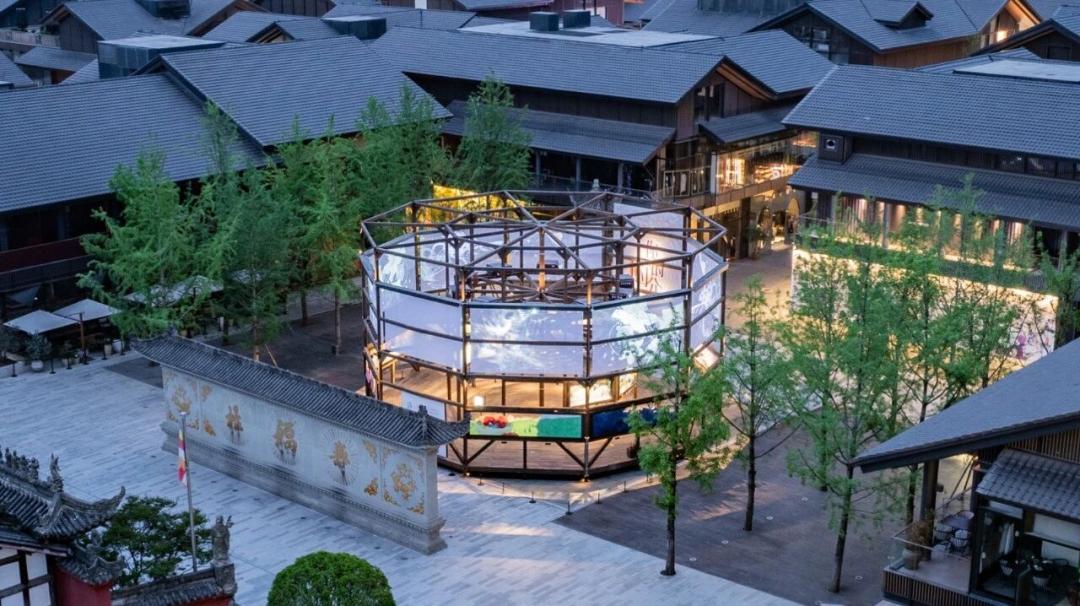
Chengdu Taikoo Li 10th Anniversary - "Your Moment" Installation Design | Source: Official Account @ ArchDaily China
Of course, capability export does not mean simple replication. On the contrary, it requires the team to judge which parts can be standardized and which parts must remain sensitive to the venue.
From this, we can also see the seemingly contradictory evolutionary direction after non-standard commerce develops to a new stage: The non-standard front-end presentation and external expansion need the standardized mid- and back-end methodology as support.
Non-standardization and Standardization Will Happen Simultaneously
Looking back, non-standard commerce once had high expectations for new formats, new scenarios and experiential consumption, but these expectations have not been widely transformed into stable business models.
It is precisely for this reason that instead of relying entirely on the scarcity effect of scenarios and first stores, the ability to continuously create "content" will increasingly become the core competitiveness in the project operation stage. The space can be completed at one time when it opens, but the character of the project must be continuously shaped in the daily operation.
At the same time, with the emergence of a series of new spaces and new content such as park commerce, community construction, and local customs economy, when shopping malls are no longer the only comparison and reference, there will be more diverse answers to the form of non-standard commerce. It may be a local research institution, a cultural place, a neighborhood center, or even just a public space that keeps changing with the development of the community