How does Xiaohongshu, the platform known as being "most wary of AI", carry out its AI development?
Recently, Xiaohongshu has taken frequent actions in the AI field.
On September 3, media reported that Xiaohongshu completed the internal integration of its AI search business, merging the two parallel AI products "Ask One Question" (enhanced search results) and "Click" (conversational life assistant) into a single unified upgraded product named "Click". This is the latest step of Xiaohongshu's AI layout in the past year. Earlier in April, it announced the establishment of Dots, a first-level AI department, and the Enterprise Intelligence Department, granting AI the same organizational status as its three core businesses: Community, E-commerce, and Commercialization. By mid-August, it open-sourced the large model dots3-note preview with a total parameter count of 280B.
But at the same time, Xiaohongshu is carrying out another seemingly opposite initiative.
Also in August, it announced the governance results of the second phase of the "Clear Up · Rectify Chaos in AI Applications" campaign: more than 150,000 non-compliant notes and over 1,400 violating accounts were disposed of, covering seven types of chaos including AI face swapping for celebrity impersonation, AI distorted adaptation of classic literary masterpieces, and batch registration of AI-managed accounts. Among mainstream domestic content platforms, it has implemented the strictest governance measures for AI-generated non-compliant content.
While placing heavy bets on AI and strictly guarding against AI risks at the same time, this stance reflects two necessary attitudes that Xiaohongshu has to hold towards AI. AI search is an inevitable move, as the search scenario is being impacted by AI-native applications, which is also closely tied to the foundation of its commercialization; AI-generated harmful content must be strictly prevented, as it may shake the underlying trust of the community.
As a community that started with a "real human vibe" and is most afraid of AI diluting user trust, why did Xiaohongshu suddenly elevate AI to a first-level strategic priority in 2026? Is the AI it developing the same as that of large tech companies such as ByteDance, Alibaba, Tencent, and Baidu?
01. Three stages in three years, all chips bet on search
Xiaohongshu did not start late in AI development. According to statements from industry insiders and public information, its explorations over the past three years can be roughly divided into three stages.
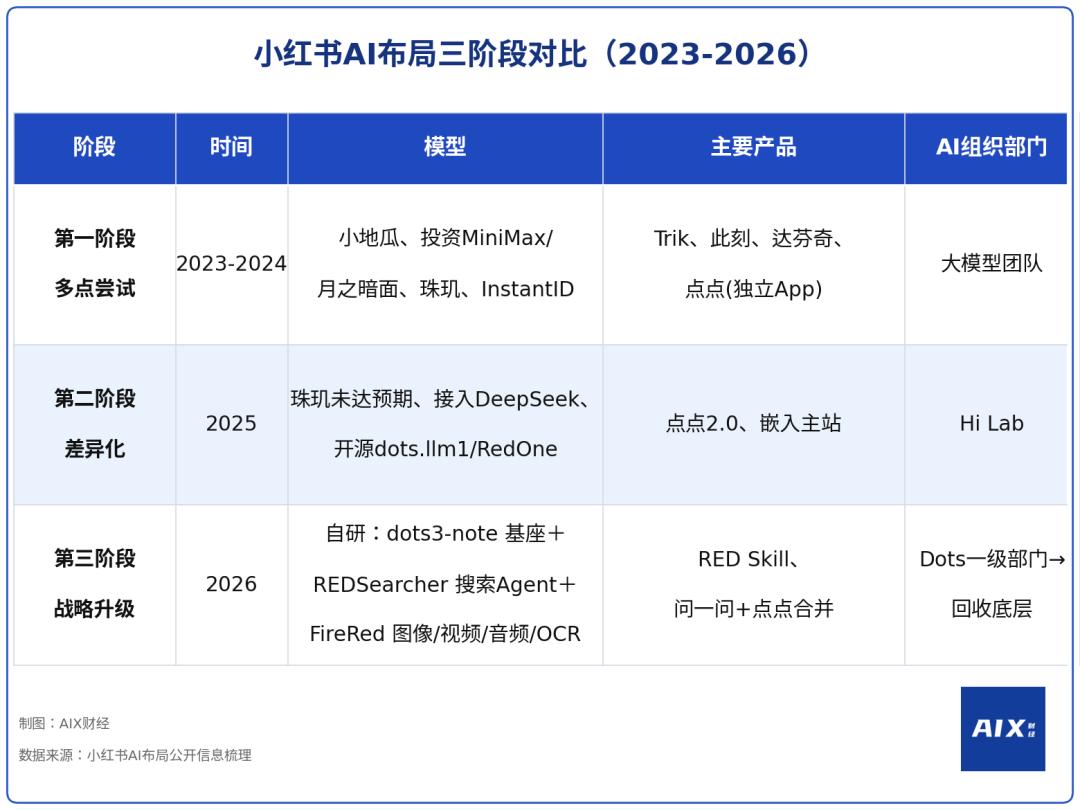
The first stage was multi-point attempts from 2023 to 2024.
After the launch of ChatGPT, Mao Wenchao, founder of Xiaohongshu, once required relevant teams to report on the industry's AI progress every two weeks. In March 2023, Xiaohongshu set up an independent large model team to develop its in-house general large model base "Little Sweet Potato", and also invested in external AI companies such as MiniMax and Moonshot AI. On the product side, it launched at least 4 AI products including Trik (AI painting product) and Moment (text-to-image function), but most of them are auxiliary functions around the graphic content ecosystem, not belonging to strategic-level products.
An internal letter from Mao Wenchao in August 2023 seemed to convey the attitude of "not in a hurry". He judged that overseas users ask life experience questions on ChatGPT because there is a lack of similar experience content precipitation overseas, while Xiaohongshu has a large amount of real and massive life experience content, and AI cannot shake this content moat in a short period of time.
These trial products did not form lasting influence in the end: Trik was taken off the shelf due to copyright disputes, and "Moment" was degraded to an entry of the publishing function. In 2024, Xiaohongshu continued the low-key trial strategy: the C-end focuses on AI life search (Click), the technical side focuses on self-developed large models and multimodal open source, and the commercial side transforms the word selection, matching and review functions of Spotlight (advertising delivery backend) and Dandelion (brand × creator commercial order platform) into AI-powered tools.
The second stage was in 2025, when native AI tools brought anxiety, and the business shifted to AI life assistants.
In early February 2025, the daily active users of DeepSeek exceeded 30 million, and the entry for users to obtain information is migrating to AI-native applications. Reports show that Xiaohongshu's internal actual measurement found that part of the user search volume was diverted, and users directly ask AI when they have questions; in the same month, the independent app Click announced that it would abandon its self-developed model and connect to DeepSeek, and the self-developed base line was once considered to be suspended by the outside world.
With both internal and external pressure coming, Xiaohongshu chose a path that does not catch up with general large models: it does not make general assistants, but turns to develop life assistants with humanistic temperament.
Specifically, it was divided into three steps. The first step was team building. At the beginning of 2025, Xiaohongshu upgraded the original large model team to "Hi Lab" (Humanistic Intelligence Lab), and began to recruit "humanistic trainers" with backgrounds in philosophy, literature and anthropology. The second step was product upgrading. In July 2025, Click launched the 2.0 version, adding voice dialogue and image recognition functions. Users do not need to type, they can directly speak or take photos to ask life-related questions such as "What kind of plant is this?" and "Which dish in this restaurant is worth ordering?". The last step was returning to specific scenarios. In November 2025, Click was embedded into the main site of Xiaohongshu, becoming the AI entry in the search box, so that users can ask questions conveniently when browsing notes.
This route avoids direct competition with ByteDance, Alibaba and Baidu in general capabilities, and creates differentiation relying on a large number of real notes on Xiaohongshu.
The third stage was organizational upgrading in 2026, when AI became a first-level department.
After the direction was determined, the rest was the scale of investment. In April 2026, it open-sourced three models: REDSearcher, FireRed-Image-Edit and FireRed-OpenStoryline, demonstrating its underlying self-development capabilities to the outside world; at the end of the same month, Hi Lab was upgraded to Dots, a first-level AI department, with four subordinate departments for model R&D, infrastructure, engineering and product, and "Click" was incorporated into it. At the same time, Ding Ling (stage name "Conan") was appointed as the president of the company, taking charge of the community, e-commerce, commercialization and technology system, and reporting to CEO Mao Wenchao.
After the establishment of Dots, the product launch pace accelerated significantly. In May, "Click" launched the PC version, and RED Skill was officially launched; during WAIC in July, RED Skill was fully opened, and Vibe Coding entered the internal test; on September 3, "Ask One Question" and "Click" were merged into a unified product named "Click", focusing on the concept of "search is dialogue". Before the merger, although both were AI search assistants, they had different focuses: Click was closer to a "full life assistant", responsible for itinerary inquiry, photo recognition, voice chat and strategy making, while Ask One Question focused more on "enhanced search results", compressing notes into summaries, lists and risk-avoidance points, and citing the original text as much as possible. The merger means that Xiaohongshu has integrated the two capabilities of active dialogue and search summary into one product.
However, the complete closed loop of "from model to application" that was assigned to Dots at its establishment did not last long. According to reports, Dots later carried out a round of adjustment: the product team and part of the engineering team were transferred to the community department, and the business boundary of Dots was recycled to the underlying basic model R&D.
After three years of exploration, the direction of Xiaohongshu's AI exploration has gradually become clear: the first is experience, using self-developed AI to create functions that better fit Xiaohongshu's tone and improve user experience, among which AI search is currently the clearest and most important one. The second is empowerment, using AI to improve the production efficiency of the community, e-commerce and advertising. At the present stage, AI search is the most concerned by the outside world, because it hides the most critical foundation that the company must not lose.
02. Why AI search?
An AI application practitioner believes that ByteDance developing Doubao is to create a new entry, Baidu developing intelligent agents is to transform the old entry, and Xiaohongshu developing AI search is more about defending its main business.
This judgment first comes from external impact.
In the past, when users made travel plans, they might open Xiaohongshu first to search for routes and read reviews, but now they first ask AI, and then come to Xiaohongshu for verification after getting the list. Nomura Securities, citing QuestMobile data, pointed out that Xiaohongshu's total usage duration in May fell by 1% year-on-year, and the average daily usage duration per user (DTSD) decreased by 4%, which is the first negative data growth of Xiaohongshu since Nomura began tracking its data in 2020. In contrast, the daily active users of Doubao surged 3.6 times to 158 million in the same period. Nomura believes that this is similar to the "AI impact" faced by information portals such as search engines, and users are gradually turning to AI chatbots to obtain information and knowledge.
Once the usage duration is diverted by AI products, it will impact the commercial foundation of Xiaohongshu.
Public data shows that Xiaohongshu's advertising revenue in 2025 was about 32 billion yuan, accounting for 76% of the total revenue, which is the most mature revenue plate of Xiaohongshu. Specifically, its advertising products are mainly divided into brand hard advertisements (splash screen, topic page, etc.), performance traffic advertisements (Spotlight platform information flow, search bidding advertisements, etc.), Dandelion platform service fees (matching brands and creators for commercial orders), as well as customized marketing packaged services such as brand accounts and offline activities. This means that the longer users spend browsing the note flow, the more exposure the advertising positions get, and the greater the value.
Therefore, Xiaohongshu must develop AI search to retain user duration. But developing AI search itself also has costs.
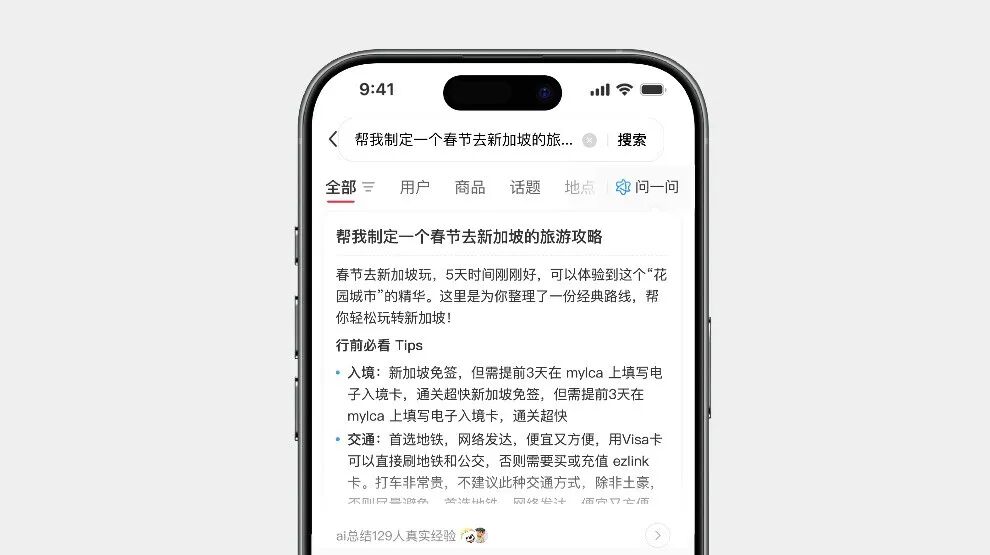
Image source / Official website of Xiaohongshu
The essence of AI search is to "digest" real human experience for users. The more users rely on AI answers, the less they need to scroll down the note flow, but the note flow is the main carrier of advertising positions. The better the AI search performs, the more likely the advertising exposure will decline instead. This paradox is not unique to Xiaohongshu: Perplexity overseas has not run through the advertising model so far, and Google's AI Overviews has led to a drop in advertising click-through rate after its launch. This also explains why Xiaohongshu previously only allowed Ask One Question to cover 3%-4% of search requests.
Therefore, in fact, Xiaohongshu needs to find a balance between two bottom lines when developing AI search. The first is the commercial bottom line: before finding a new monetization model, it cannot make the advertising positions decline too fast. The second is the trust bottom line: whether the AI-generated answers will replace real human notes and dilute the trust of the community.
The mechanism of Ask One Question is regarded as an attempt: all its answers come from real human experience, which are only compressed into faster summaries by AI, and links to the cited notes are usually attached below the answers, so that users can click into the original text at any time. Under this mechanism, AI answers serve as an entry for community notes. According to 36Kr reports, after the launch of Ask One Question, the community retention rate of Xiaohongshu increased by about 2%-3%, with a daily active user scale of tens of millions. The retention improvement is not very large, but at least it proves that AI search does not significantly erode the community.
However, this path does not solve all problems. If the AI answer is good enough, will users still be willing to click into the original text? Even if trust is not diluted, attention may have been intercepted.
In addition, relevant intensive AI actions took place this year, and IPO is an unavoidable background. Multiple media reports said that Xiaohongshu plans to list in Hong Kong with a target valuation of more than 70 billion US dollars, while the official responded that "the currently circulating IPO-related information is not true". But no matter what the timetable is, the pricing logic of the Hong Kong stock market has obviously shifted towards AI.
An investor who focuses on Hong Kong stock consumer Internet said that the premium that the capital market is willing to give now has shifted from consumer Internet to AI, and Zhipu AI and MiniMax are the best examples. Pure advertising platforms cannot get high valuations, and the "AI + search + commercialization closed loop" will get higher premiums.
Another e-commerce practitioner who has long paid attention to Xiaohongshu gave a more direct evaluation: the answer may not be important, but the attitude is important. "No one knows if Xiaohongshu's AI can succeed. Elevating AI to an important strategic position is a long-term move. It is difficult to see returns in the short term, but it has to do it, and it must let the market see that it is doing it."
03. Success does not depend on benchmark scores, but on three closed loops
Whether Xiaohongshu's AI can succeed cannot be judged solely by model benchmark scores, but by whether the three closed loops can be connected smoothly.
The first is the function closed loop, that is, whether the model can be integrated into the product, which is the admission ticket.
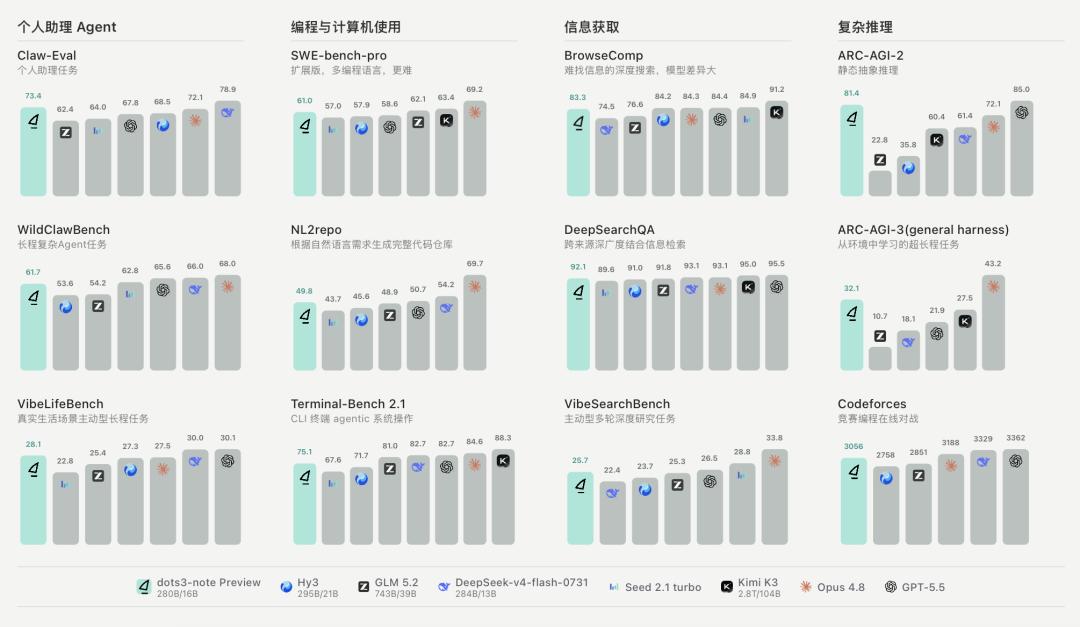
In August 2026, Xiaohongshu fully showed its cards on AI models, releasing and open-sourcing a long-range multimodal Agent base model "dots3-note preview". This model is designed around "search + life decision-making", with MoE architecture and 512K ultra-long context, which can remember hundreds of thousands of words of historical information, and support three modalities: text, vision and voice.
Veteran Agent practitioner Zhao Jiangjie said that judging from the public benchmark results alone, the performance of the model is not bad. But it also depends on how fast the model can be integrated into in-site products. Only when the model is truly connected to products and serves users, each user feedback generated by the product can be converted into training data to feed back the model, and then return to the product to serve users.
The second is the scenario closed loop, that is, whether users are willing to use AI products.
In September, the gray-scale full release of the merger of Ask One Question and Click was completed, with a unified new architecture. But the merger only solves the problems of "what to name the product" and "whether the technical architecture is unified", and has not solved the more difficult problem: whether users are willing to enter the product at first sight. This depends on whether Xiaohongshu's team will increase the weight of AI products in the follow-up. At present, the first thing users see when opening Xiaohongshu is still the information flow, and the AI search product "