Luckin Coffee has secured another $1 billion in investment. Why did this Middle Eastern sovereign wealth fund choose to invest in it?
Luckin Coffee has secured another $1 billion in financing today.
The investors are Dazheng Capital and a new name most Chinese readers are unfamiliar with — Mubadala, a Middle Eastern institution that is stepping into the public spotlight for the first time as an investor in China's new consumption sector.
Dazheng Capital is an old friend of Luckin. This private equity fund founded by Li Hui, former partner of Warburg Pincus, was a key driving force that helped Luckin pull through the 2020 financial fraud scandal. After the fraud incident broke out, Luckin's share price plummeted, facing the dual crisis of delisting and class-action lawsuits. Dazheng Capital led by Li Hui took a large number of shares at a low price, gradually became the largest shareholder of Luckin, and led the management restructuring, debt settlement and store revamp.
It is fair to say that there would be no Luckin as we know today without Dazheng.
Mubadala, by contrast, is a new player in this deal. It is the first time it has appeared in Luckin's capital structure as a strategic investor. Its entry is interpreted by the market as two layers of signals.
First, Luckin has already possessed the international narrative capability that meets the standards of sovereign funds. The fact that it can continuously attract additional investment from sovereign funds after its IPO means that the company's financial model, business model and globalization potential have passed the most rigorous due diligence.
Second, Middle Eastern capital is re-entering China's consumption track. In the past few years, the sovereign funds of Gulf countries have significantly reduced their investment frequency in the Chinese market, and Luckin's financing is a landmark signal of their renewed bet on China's new consumption sector.
With this context in mind, let's move on: Who exactly is Mubadala? What else has it done in China over the past years?
The institution from Abu Dhabi
The full name of Mubadala Investment Company sounds a bit cumbersome, but its actual backer is well known to us — the Emirate of Abu Dhabi, United Arab Emirates.
It started in 1984 under the name of Mubadala Development Company, initially serving as a diversified platform for the Abu Dhabi government to spread its oil revenue across different sectors.
After merging with IPIC, which is under the Abu Dhabi Investment Authority, in 2017, it officially became the comprehensive asset management platform of today, with multiple identities covering private equity, direct investment, limited partner and sovereign fund.
According to public disclosures, its assets under management have long remained above $300 billion, making it one of the two major sovereign wealth funds in the UAE alongside ADIA.
In China's primary market, Mubadala has always been an invisible elephant. It barely gives interviews, rarely issues press releases, and almost never appears on Chinese social media. But if you lay out its investment records, you will find that almost every one of its investments in China landed at a turning point of the times.
10 investments in 10 years, timeline breakdown
According to publicly available records from IT Juzi, Mubadala has made 10 investments in companies based in China or with core business closely tied to China. The number 10 is not staggering on its own — during the same period, it invested 3 rounds in Waymo alone, totaling more than $20 billion — but if you arrange these 10 investments in chronological order, they almost form a condensed history of China's new economy over the past decade.
It is worth emphasizing again that the amount listed in the table below is the total financing amount of that round, i.e. the total sum contributed by all participating investors. Mubadala is just one of the investors, and its specific share in each round has not been publicly disclosed.
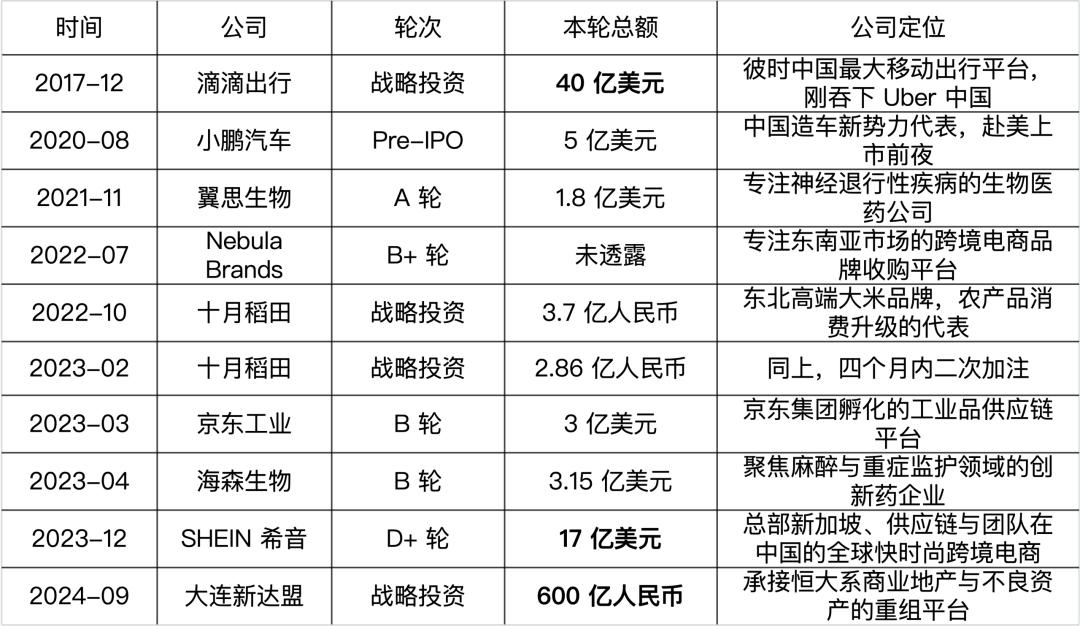
Note: The total amount of this round refers to the total sum contributed by all investors in this financing round. Mubadala is one of the participating investors, and its specific share has not been disclosed.
Mubadala's earliest investment in China dates back to December 2017.
At that time, Didi had just acquired Uber China and was preparing for global expansion. Mubadala, together with SoftBank, Apple and China Merchants Bank, provided $4 billion in strategic investment to Didi, a typical strategic positioning investment with reliable political background, abundant capital and large enough investment scale. Later, the turmoil around Didi's IPO caused this investment to have floating losses on book, but Mubadala has since become one of the most important Middle Eastern buyers in the global mobility sector, and the significance of its presence far outweighs the financial return.
In August 2020, it appeared in the Pre-IPO round of XPeng Motors, side by side with IDG and Alibaba. This time it bet on the global story of China's new energy vehicle startups.
Then in 2021, its attention shifted to the healthcare sector. In November, it led the $180 million Series A round of Yisi Bio, a biopharmaceutical company focusing on neurodegenerative diseases. This was one of the most active periods for Mubadala in China, but it did not make frequent small investments, instead it pushed the single investment amount to the level of a sovereign fund.
From 2022 to 2023, its focus returned to consumption and cross-border e-commerce. It made two follow-on investments totaling RMB 656 million in October Rice Field, invested in Nebula Brands, participated in the Series B round of JD Industrial and the Series B round of Hisen Bio, and finally joined HSG, Tiger Global and General Atlantic to participate in the $1.7 billion D+ round financing of SHEIN.
There is a common underlying logic behind this series of moves: cross-border, brand, agricultural supply chain — they are all connection points between China's manufacturing capacity and global channels.
The last large investment Mubadala participated in took place in September 2024 — a RMB 60 billion strategic investment in Dalian New Alliance. The essence of this deal is the restructuring of non-performing assets of the Evergrande Group, and Mubadala took over a number of core commercial real estate projects. This is the single largest investment Mubadala has ever made in China, and it is also a landmark event marking its transformation from a tech investor to a national-level asset manager.
Four main lines of the 10 investments over 10 years: Mobility (Didi, XPeng), consumption and cross-border (SHEIN, JD Industrial, Nebula Brands, October Rice Field), healthcare (Yisi Bio, Hisen Bio), real estate restructuring (Dalian New Alliance). 7 of these deals have a total single-round amount exceeding $100 million — typical of its "small in number, high in quality, slow in pace, heavy in weight" investment style.
But if you look at the period from 2025 to now, you will find a thought-provoking trend:
Among nearly 23 new investments made between January 2025 and September 2026, none of them are located in China. Middle Eastern capital's interest in China has not disappeared, but quietly changed its form. Luckin may be the very start of this new form.
A global perspective: breakdown of 84 investments
In the IT Juzi database, Mubadala's 84 global investments cover all 16 primary industries, ranging from healthcare, finance, artificial intelligence to agriculture, real estate, blockchain, and even local life services, education, entertainment and media, with no sector left untouched. No matter how diversified its portfolio is, there is a clear main line running through it.
The most heavily invested track is healthcare, with 26 deals accounting for nearly one third of the total.
From Recursion's AI drug development, to the follow-on investment in Exscientia's Series D round, to the $110 billion single large bet on Collective Health, and then to cutting-edge biotech companies such as Kallyope, L-Nutra and Juvena Therapeutics, Mubadala is almost treating life sciences as its most important long-term theme to bet on in the next decade.
The second largest sector is finance, with 14 deals in total.
There is a notable feature here: it is not betting on traditional banks, but on financial infrastructure companies such as Tabby (the leading buy-now-pay-later platform in the Middle East), wefox (the European insurtech company), SpotOn (the US-based payment and restaurant SaaS provider), and C2FO (the supply chain finance platform). In other words, it is betting on the next round of reconstruction of the global payment and credit network.
The third and fourth sectors are artificial intelligence and enterprise services respectively, with 10 deals each. The representative of the former is Waymo (the autonomous driving company under Alphabet, with 3 rounds of investment totaling $20.7 billion), Crusoe (the computing power company that uses flared natural gas to power AI training, with $1.38 billion in Series E round and $3 billion in Series F round). The latter includes mid-to-late stage projects such as PDG, BetterUp, Anaconda and Innovaccer.
If we measure its preference by investment amount, the ranking list is even more striking. It should also be reminded that the amounts listed in the table below are the total financing amount of that round, and Mubadala is only one of the participating investors.
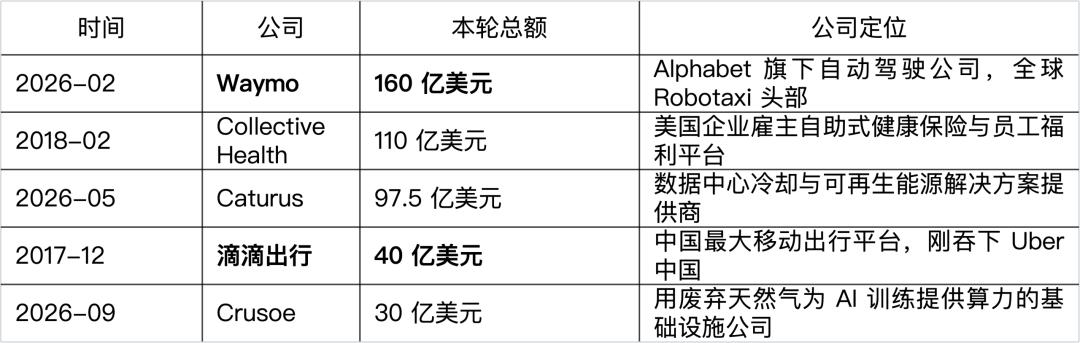
Note: The total amount of this round refers to the total sum contributed by all investors in this financing round. Mubadala is one of the participating investors.
The portfolio's heavy concentration feature is very prominent in this list — the top 5 deals are almost all late-stage, large-scale and strategic investments.
Another interesting phenomenon is its continuous follow-on investment behavior: once it is optimistic about a company, it almost never invests only one round.
It invested in Waymo (the autonomous driving company under Alphabet) 3 times, from the 2020 strategic investment to the 2021 Series B round and then to the 2026 additional strategic investment, totaling more than $20.7 billion.
It invested in Tabby (the leading buy-now-pay-later platform in the Middle East) for 4 rounds, keeping up with the company from Series A to Series D.
Crusoe's $1.38 billion Series E round and $3 billion Series F round took place within just 11 months.
In addition, Mubadala made follow-on investments of no less than two rounds in Moove (the African auto finance platform), Flink Food (the European instant retail platform), Exscientia (the UK-based AI pharma company), SpotOn (the US-based payment and restaurant SaaS provider), and BetterUp (the employee coaching and mental health platform).
This continuous follow-on investment style is completely different from the wide-net investment philosophy of Silicon Valley VCs. It does not try to rely on hit rate to get returns, but uses continuous capital and patience to support a company through the whole process from the growth stage to becoming the infrastructure of its industry.
Why did Mubadala choose Luckin?
Back to the initial question: Why did Mubadala appear in the investor list of Luckin Coffee's this round of financing?
The answer may lie in its investment choices in China over the past decade. It never chases hot trends, what it chases is the possibility of Chinese models being exported. Didi exported China's mobility model to Latin America, XPeng exported China's new energy vehicle industry chain to Europe, SHEIN exported China's flexible supply chain to the whole world, and Dalian New Alliance turned China's real estate distress into a sovereign fund-level asset restructuring opportunity.
Luckin follows the same logic. This company is no longer just a Chinese coffee seller, it is a Chinese-style new retail operating system centered on digitalized stores, user operation and fast SKU iteration. In the Middle East and North Africa, Gulf countries are pushing for similar consumption upgrading and retail digitalization, and Luckin's model has the potential to be directly exported. For Mubadala, this is a typical bet on the Chinese model being replicated in the global market.
From this perspective, the decline of Mubadala's investment frequency in the Chinese market in the past year does not mean its withdrawal, but waiting. Waiting for the next batch of Chinese companies with global narrative capabilities that are worthy of heavy investment by sovereign funds. Luckin may be the next one it has been waiting for.
Middle Eastern capital has not left China, it has just come back in a more down-to-earth way — no longer sweeping across sectors with the posture of petrodollars, but standing behind companies with real long-term value as a patient partner.
The data retrieval and statistics in this article are all from IT Juzi MCP —
This article is from WeChat official account "IT Juzi" (ID: itjuzi521), author: Judy, published with authorization from 36Kr.