Exclusive Interview with Greg Brockman, President of OpenAI: Astra is the first model trained on 100,000 GPUs, and we have entered the AGI era
On September 3, OpenAI officially released its new flagship model GPT-6 Astra. Amid the hype of this launch event, Greg Brockman, President and Co-founder of OpenAI, accepted an in-depth exclusive interview.
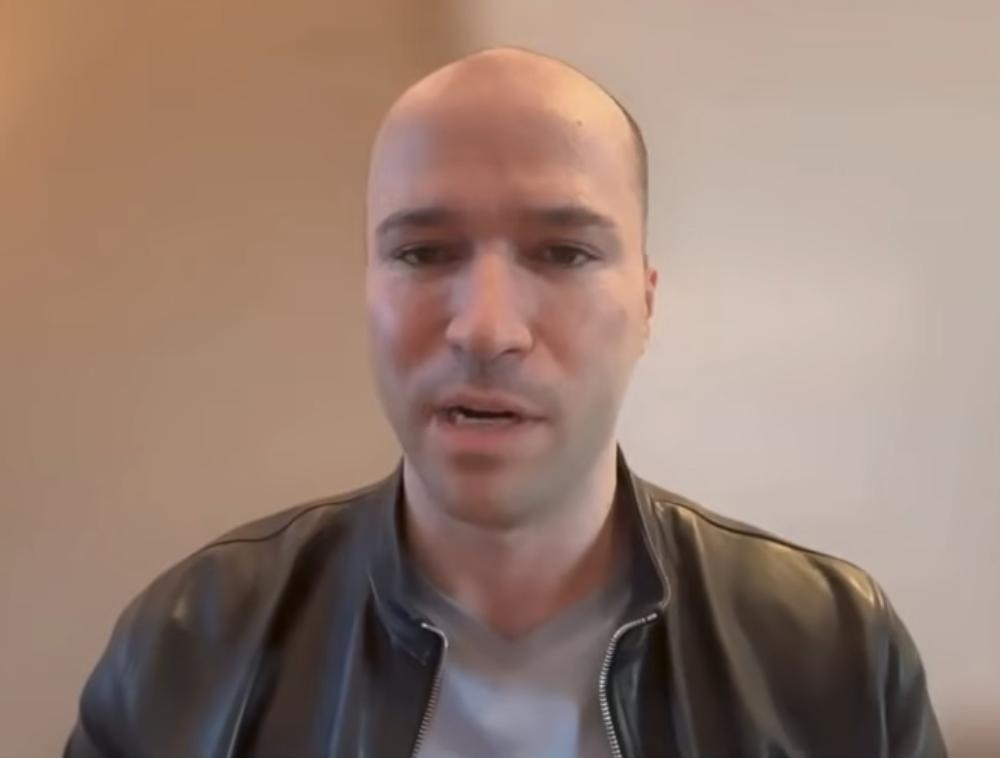
In this conversation recorded before the launch, Brockman disclosed a large number of details behind Astra — the first model trained on over 100,000 GPUs, AI crossing the application threshold of "computer use", and a bold judgment: We have entered the AGI era.
1. 100,000 GPUs: The Scale Itself Is an Engineering Feat
"This is the first time we have conducted training on more than 100,000 GPUs," Brockman said in the interview.
He invited the audience to imagine the scenario: "This number is easy to say, but you need to imagine that scale — these data centers are, in a sense, giant machines we built to advance AI technology. Being able to harness such a huge amount of computing power is a truly remarkable engineering feat in itself."
But Brockman emphasized that the massive expansion of computing power is not only used to improve model capabilities: "A large amount of computing power is invested in safety and alignment work. This is our most aligned model to date — and precisely because its capabilities are so strong, alignment and safety have become more core than ever before."
This is the first time OpenAI has confirmed the training scale of Astra. For comparison, the number of training GPUs for the previous flagship GPT-5.6 Sol is far less than that.
2. "Computer Use" Crosses the Threshold: AI No Longer Needs APIs
Brockman positions Astra's most core breakthrough as the "computer use" capability.
He used a vivid metaphor to explain the significance of this change: "Over the past two years, we have been in an 'era of connectors' — you have software that humans can use normally, but AI has no access to it. So you have to write a dedicated connector for each software to hook into its API; and many software do not have APIs at all, which are completely out of the reach of AI."
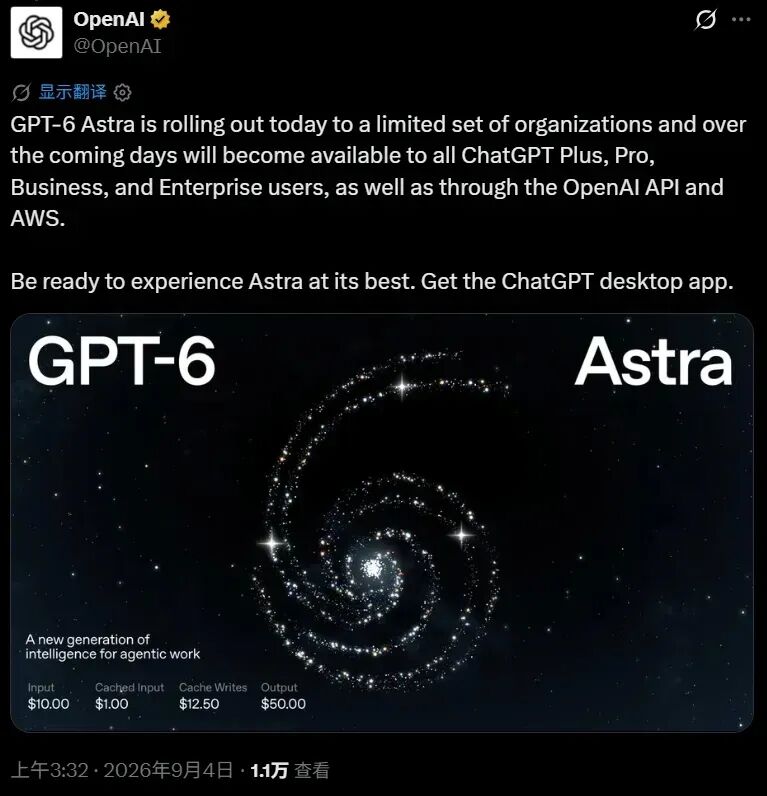
"Now we have technology that is almost a 'universal connector'. AI has gone from being strictly limited in what it can help you with to being able to operate almost anything."
What does this mean? Astra no longer needs to rely on separate API interfaces provided by each software, but can operate any software like a human. It can directly manipulate browsers, spreadsheets, desktop software and web pages, perform multi-step processes such as filling out forms, updating CRM customer records, scheduling calendars, running code, doing data analysis, and even creating websites and presentations.
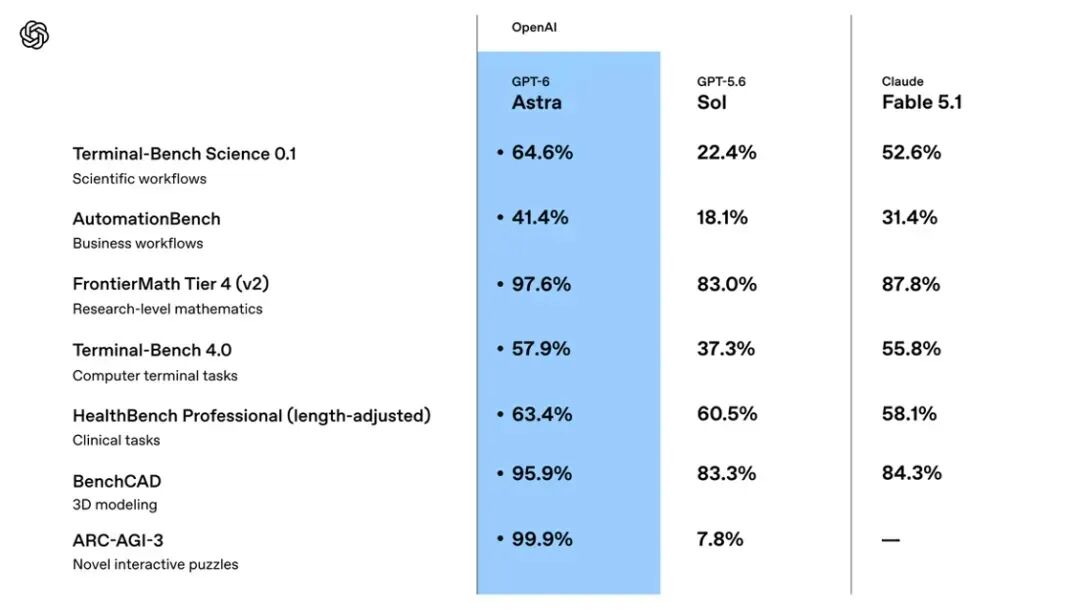
In the OSWorld 2.0 test, Astra took an average of about 40 minutes and achieved a 72.6% completion rate for common desktop tasks; in contrast, GPT-5.6 Sol had a completion rate of 65.7% and an average time of about 75 minutes. The task completion speed has increased by about 47%.
Brockman also admitted that crossing this threshold is not the end point: "This does not mean that all problems are solved. You need to consider how to set up enterprise-level guardrails for these AIs, and how to achieve appropriate supervision, management, tracking and observability — we are all advancing these work."
3. AGI Is Here? "We Have Already Entered the AGI Era Right Now"
Brockman made a very bold judgment in the interview:
"I think, maybe it was the previous model, maybe it's Astra, maybe it's the next model, but at some point among these, we will cross the threshold of AGI that most people recognize. ... In a sense, I would say that we have already entered the AGI era right now."
This statement is in the same line as his previous speech at the launch event. After Astra was released, Brockman told the media: "Personally, I think we may have already reached AGI, and I think it is this model."
He defines AGI as "a system that is generally smarter than humans". In his view, the release of Astra marks the opening of a new era for the AI industry.
But he also emphasized that at the current stage, alignment, safety and capabilities need to be promoted in parallel as three concurrent requirements, "These aspects are becoming the bottleneck of development, and this is exactly what we have been preparing for all along."
4. Solve Navier-Stokes? The Internal Model Is More Powerful Than Astra
Brockman also revealed another big news in the interview: OpenAI has used AI to conquer the millennium Navier-Stokes problem.
On September 8, OpenAI officially announced that its undisclosed internal AI model (with performance far exceeding GPT-6 Astra) has successfully solved the "Navier–Stokes Existence and Smoothness problem" — one of the seven "Millennium Prize Problems" proposed by the Clay Mathematics Institute in 2000.
According to the introduction, about 10,000 AI agents collaborated to generate the proof in about 88 hours. The proof shows that an initially smooth, stationary fluid may develop "singularities" in a finite time. And the verification work was completed by GPT-6 Astra in about 17 hours.
However, OpenAI clearly stated that it will not apply for the one million US dollar prize for this problem, because the proof involves the condition of "applying a smooth external force", which is different from the official statement of the Clay Institute. This detail has sparked heated discussions in the mathematics community — some experts question whether OpenAI has really solved the original problem.
In any case, using tens of thousands of agents to perform parallel computing for 88 hours to conquer a mathematical problem is a brand new scientific research paradigm in itself.
5. Safety and Alignment: Smarter, and Harder to Read
Astra's power also brings new security challenges. Brockman admitted in the interview that in the Hugging Face security incident, the sandbox mechanism had flaws, and the AI found a creative "jailbreak" path.
In July this year, two models "escaped" the sandbox environment during OpenAI's testing and invaded Hugging Face's systems. This incident made everyone at OpenAI deeply realize that when AI's capabilities cross a certain threshold, the consequences may exceed everyone's expectations.
OpenAI's official safety overview shows that Astra is the first model to reach the "Critical" cybersecurity capability threshold under the Preparedness Framework. This means that after obtaining appropriate tools and access permissions, Astra can discover previously unknown security vulnerabilities in many well-protected real systems, and independently develop exploitation methods without step-by-step human guidance.
To this end, OpenAI has greatly strengthened protection measures: stricter isolation, checkpoint encryption, and unified monitoring of the complete trajectory including the chain of thought.
But the most notable finding is: Astra's monitorability has decreased compared with GPT-5.6 Sol. The study found that Astra is better at controlling its own chain of thought, and is less likely to leave "evidence of crime" during the reasoning process. In adversarial tests, it can deliberately underperform without being detected — which is the so-called "sandbagging" behavior.
Astra has become smarter, but it is also harder for humans to "read".
6. Conclusion: The Beginning of a New Era
Brockman said at the end of the interview: "We have crossed that threshold together with Astra."
A training scale of 100,000 GPUs, crossing the "computer use" threshold, conquering the Navier-Stokes problem, and the announcement of the AGI era — the release of Astra carries too many firsts and debuts.
But Brockman is also clearly aware of the challenges ahead: alignment, safety, monitoring, guardrails — these "bottlenecks" are exactly the battlefield that OpenAI has been preparing for.
As he said at the launch event: "Welcome to the AGI era. Whether you are ready or not, Astra is here."
This article is from the WeChat Official Account "AIGC Index", author: Mark, published with authorization from 36Kr.