Ternus's debut after taking over from Cook: Different challenges at the same moment
Open a new chapter, shine with dazzling light.
This is the theme of Apple's 2026 autumn launch event.
The event will unveil Apple's most important annual new products, and at the same time, new CEO John Ternus will make his first public appearance. He succeeded Tim Cook as Apple's new CEO a week ago.
Apple's last leadership change dates back to October 2011, 15 years ago, when Steve Jobs passed away suddenly, and Tim Cook, then COO, was appointed to take charge in the crisis. It was this leadership change that turned a new page for Apple.
Compared with 15 years ago, who faced greater pressure when taking office, Ternus or Cook? What are the differences between their situations? Do the two face the same tests?
01.
"Outstanding Single Product Output" and "Supply Chain System"
4 trillion US dollars.
This is Apple's market value during Cook's tenure. He spent 15 years increasing Apple's market value from 350 billion US dollars to 4 trillion US dollars, with an increase of over 1000%. Meanwhile, the number of global active devices has grown from 1 billion to 2.5 billion, and the service business has grown from tens of billions of US dollars per year to a second growth curve with an annual revenue of hundreds of billions of US dollars.
This is the most intuitive answer Cook delivered during his tenure.
When Cook first took over Apple in 2011, the biggest challenge was neither the supply chain nor Android, but an almost philosophical problem — Steve Jobs cannot be replicated, so what does Apple rely on to keep winning?
Relying on the plan Jobs left for Apple before his death, or Apple's spiritual heritage, everything was unknown. After all, the person at the helm had changed from the world-changing "innovator" to the seemingly mediocre "manager".
At the same time, the external competitive environment has also become harsh.
The Android camp represented by Samsung was launching a full-scale siege with the "massive product lineup" strategy. During the iOS 6 Mapsgate incident, Cook rarely publicly apologized with his personal signature. At that time, the outside world was waiting to laugh at Apple's "innovation hitting the ceiling".
Cook's choice was not to recreate a Jobs, but to pragmatically use the certainty of operation, supply chain and organizational structure to hedge against the uncertainty caused by the absence of a "genius".
As we all know, Apple's advantages in the supply chain have always been unshakable, which is also a moat that other competitors cannot learn. At the same time, Apple has pushed inventory turnover to the extreme of the industry, all of which benefit from Apple's supply chain advantages.
During Steve Jobs' tenure, he never visited China in his life, but Cook visited China more than 20 times during his tenure. The reason seems very straightforward — China is not only one of Apple's largest markets, but also its largest supply chain base. According to statistics, more than 80% of Apple's top 200 core global supply chain enterprises have factories in China.
The reason why Apple can have very strict quality standards and systems also benefits from the dual-supplier competition mechanism implemented by Cook in the supply chain, where two suppliers of the same component compete on price and yield rate.
A number of Chinese enterprises have also risen along with Apple. Luxshare Precision has cooperated with Apple since 2011, expanding its business from connecting wires all the way to iPhone full-device assembly; GoerTek has deeply participated in dozens of products since 2010; Lens Technology, Lingyi iTech, Biel Crystal have grown up with Apple; BYD has even cut into full-device assembly from battery modules and precision structural parts.
Although Apple has tried to disperse production capacity to India and Vietnam in recent years, due to practical problems such as unstable power grids, high logistics costs, and port shutdowns in rainy seasons leading to production suspension and pending delivery, Apple has moved part of its production capacity back to China. This precisely demonstrates the irreplaceability of Chinese manufacturing.
Internal innovation and ecological closed loop are also the core of Apple-style innovation. It does not bet on a single point technology, but carries out vertical integration from chips to systems and then to services. Therefore, in the face of the Android camp, Apple's strategy has never been about who sells more, but about who earns longer.
According to Counterpoint data, in the global high-end mobile phone market above 600 US dollars in the first half of 2026, Apple accounts for 65% of the share alone, with sales volume increasing by 9% year-on-year; it takes about 48% of the revenue of global smartphones, with an average selling price of nearly 6400 RMB. The profit from selling one iPhone is equivalent to the profit from three Android phones sold by Android manufacturers.
According to DoNews statistics, during the 15 years of Cook's tenure from 2011 to 2026, Apple's stock price on the day of the iPhone launch only rose after the release of five series of models: iPhone 4S in 2011, iPhone 7 in 2016, iPhone 11 in 2019, iPhone 14 in 2022, and iPhone 16 in 2024, while other products all saw a large drop after release.
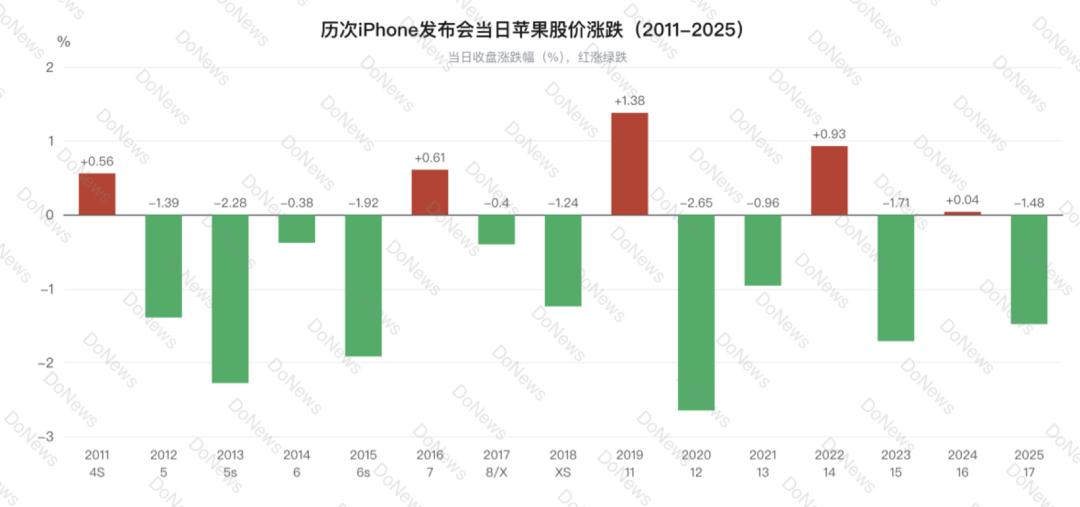
Apple's stock price on the day of previous iPhone launch events, chart by DoNews
In general, the largest increase came after the release of the iPhone 11 series in 2019. The base model of this generation uses the notch screen + Face ID design, which is a great improvement over the Touch ID unlock and traditional LCD screen of the previous iPhone 8 series.
02.
The AI Cards Cook Left to Ternus
During Cook's tenure, he also tried to change Apple's underlying attributes, as if to prove to everyone that Apple without Jobs is still Apple.
In the Jobs era, Apple's strategic approach was to rely on a hit product to define the world, pursuing quality rather than the number of products. But during Cook's tenure, he transformed Apple into a platform company with the trinity of "hardware + system + service" and highly predictable cash flow. At the same time, he also built a service empire consisting of iCloud, Apple Music, Apple TV+, and Apple Pay. The gross profit margin of these products is much higher than that of hardware, which gives Apple the confidence to go through cycles even in the stock mobile phone market.
In addition, Cook also completed the new product categories that Jobs did not have time to roll out — the Apple Watch launched in 2015 gradually became the best-selling wearable device in the world, and AirPods launched in 2016 directly created the true wireless headphone market; Vision Pro in 2024 was a space computing exploration that may not be successful but must be bet on.
If there is any obvious loss in Cook's 15 years, generative AI is undoubtedly the first one.
At WWDC 2024, Apple grandly launched Apple Intelligence, demonstrating a brand new Siri that can operate across apps on the phone, but this function was delayed for two full years. At Apple's internal meeting in 2025, Apple executives admitted that the execution success rate of Siri's new functions was only 60% to 80%; Apple also paid $250 million to settle a class action lawsuit for this, and the market once paid for Apple's AI "make-up exam" with hundreds of billions of dollars in market value fluctuations.
While OpenAI, Google and Anthropic were running all the way, Apple's smart assistant occasionally made mistakes even when setting alarms, which is quite embarrassing for a company that takes experience as its belief.
The real turning point took place at WWDC 2026, where Apple cooperated deeply with Google to jointly build a new generation of Apple Foundation Models based on Gemini, so as to reconstruct Siri AI.
At the same time, Apple opens up options, allowing users to set ChatGPT, Gemini, and Claude as the default AI. The new Siri runs with a three-layer routing of "on-device small model + Apple private cloud + cutting-edge large model", leaving simple instructions locally and uploading complex tasks to the cloud level by level.
The author believes that this may be the ultimate embodiment of Apple-style pragmatism. Apple's real asset is the "last mile entry of AI" with 2.5 billion devices. It does not need to have the strongest model in the world. What it wants is to make AI have the best experience, the most credible privacy and the smoothest call on its own terminals. "Borrowing brains" from Google is essentially paying a sum of rent, but Apple must firmly hold the on-device "sky" in its own hands.
In the author's opinion, the most underrated thing in the Cook era has now become the killer feature that allows Apple to "turn the tables" in the AI field — Apple Silicon. Apple used the M1 chip to migrate the entire Mac from the Intel x86 architecture to the self-developed ARM architecture. The weight of this move did not truly show until the current AI era.
It is this ordinary operation that was understood by the outside world as "changing chips for computers". Looking back now, it was an early sprint for the AI terminal architecture. The high power consumption of x86 has become a burden in the local large model era, while the energy efficiency ratio of ARM, superimposed with the "unified memory architecture" of Apple's self-developed chips — CPU, GPU, and Neural Engine share the same memory pool, no need to move data back and forth between different video memory, which is precisely the key to running large models on the end side, allowing models with billions of parameters to run smoothly on a computer terminal.
In the last week before Cook stepped down, Apple released the new Mac mini equipped with M6 and M5 Ultra chips, which also became the last new product during Cook's tenure. From 5nm of M1 to 2nm of M6, six generations in six years, Apple's chips have completed a complete generational leap.
The author believes that on the road of "cloud large model", Apple is a follower, but on the road of "on-device AI", Apple is the company with the most sufficient architectural preparation in the world. Now Qualcomm, MediaTek and the entire Windows AI PC camp are all taking the path of "ARM + NPU + unified memory", and Apple has already embarked on this path in 2020 when it "changed chips for computers".
The significance of the M6 chip may be to announce a fact — in the computing power competition in the AI era, half is in the data center, and the other half is in everyone's pockets and on the desktops, and the latter half is exactly Apple's home court. This is also the confidence for it to "rent brains" from the Google cloud.
Back then, the key promoter who pushed the Mac to migrate from Intel to the M-series self-developed chips was none other than the new CEO Ternus.
It can be said that Ternus is the only executive in Apple who has fully covered the hardware of all core product lines: Mac, iPad, iPhone, Apple Watch, AirPods, and Vision Pro. He is a real "engineer CEO" who came out of the drawings and production lines. Now, Apple's ship has been handed over from the hands of the "operation master" to a "product engineer".
But the challenges he faces are more complex than Cook's back then. Whether it is the AI comeback battle, the peaking of the iPhone's basic market, or the narration of new product categories, this new CEO needs to face and solve them one by one.
03.
The Same Stage, Different Test Questions
In 2011, Cook was appointed to take charge in the crisis, and his test question was "without Jobs, can Apple continue to be great". 15 years later, he gave the answer with a market value of 4 trillion US dollars, 2.5 billion active devices, annual service revenue of over 100 billion US dollars and a complete set of self-developed chip system, although this system also paid the price of increasingly conservative innovation and being accused of "living on past achievements".
In the author's opinion, Cook has never been an "innovator", but an "innovator's deliverer". Jobs is responsible for drawing the amazing curve that shocks the world, and Cook is responsible for allowing consumers to buy and use the products with stable quality. This is precisely one of the scarcest capabilities in commercial history.
Of course, the price is also real. In the past 15 years, Apple has never given birth to a new category at the level of iPhone, and the accusation of "marginal improvement" has accompanied Cook's entire tenure. This is the mediocrity test that must be faced after "the system defeats the genius".
Now, Ternus is also standing at the same crossroad, and his test question is "when AI redefines all terminals, can Apple continue to be the definer".
Cook launched the M6 chip in the last week before stepping down, as if handing a sword that has been sharpened for six years to his hand — the on-device computing power cards are ready, the ecological barriers are still there, and the supply chain is still the strongest in the world. But the gap in cloud models, the two years of lost trust in Siri, the siege of the Chinese AI market and the high wall of global regulation all require this engineer CEO to respond one by one with products.
When the lights turn on at the Apple Park stage on September 10 (Beijing time), people will instinctively think of Steve Jobs, and also think of Cook who has just stepped down. But Apple's history has never been written by nostalgia.
Ternus does not need to be the next anyone, he only needs to answer the test question belonging to his era — this time, there is no rehearsal.
This article is from the WeChat official account "DoNews" (ID: ilovedonews), author: Yang Bochen, published with authorization from 36Kr.