30 years of tremendous changes, the consumer supply in Shanghai, the Magic City, has been completely restructured!
Anyone who has watched *Blossoms Shanghai* probably remembers that plot: A Bao helped Manager Fan's Sanyang brand T-shirts get stocked in "Hulian Commercial Building", invited Fei Xiang to show up for on-site support, Nanjing Road was packed with people, and this domestic T-shirt instantly became a fashion hit.
In that era, Hualian Commercial Building, the prototype of Shanghai's "Hulian Commercial Building", put forward the slogan of "Dress at Hualian", and its clothing sales ranked first in the whole city; Ma Guining, a model worker at the wool fabric counter of Shanghai No.1 Department Store, had a unique skill — "one glance accuracy". When a customer stood in front of the counter, he would first look at the customer's height, second at the chest circumference, third at the body type, and could tell exactly how much fabric the customer needed without using a tape measure.
That was the golden age of the "counter economy".
At that time, the relationship between shopping malls and consumers was so clear that it barely needed explanation: you pointed across the counter, the sales assistant showed you the product, you paid, and they issued the receipt. Thirty years later, when you walk into a shopping center in the same city, counters have completely disappeared, and there is no sales assistant behind the glass asking "what would you like to buy".
People drink coffee on the steps of the roof, attend open mic events on the second floor of Shikumen lanes, and walk their pets in indoor jungles; they may leave the mall with nothing in their hands, but have spent a whole afternoon there.
In the past 30 years, consumer supply has completed a thorough genetic restructuring — from "selling goods" to "operating venues", from "commodities" to "commodities + services + experiences", from "indoor spaces" to "indoor + outdoor spaces".
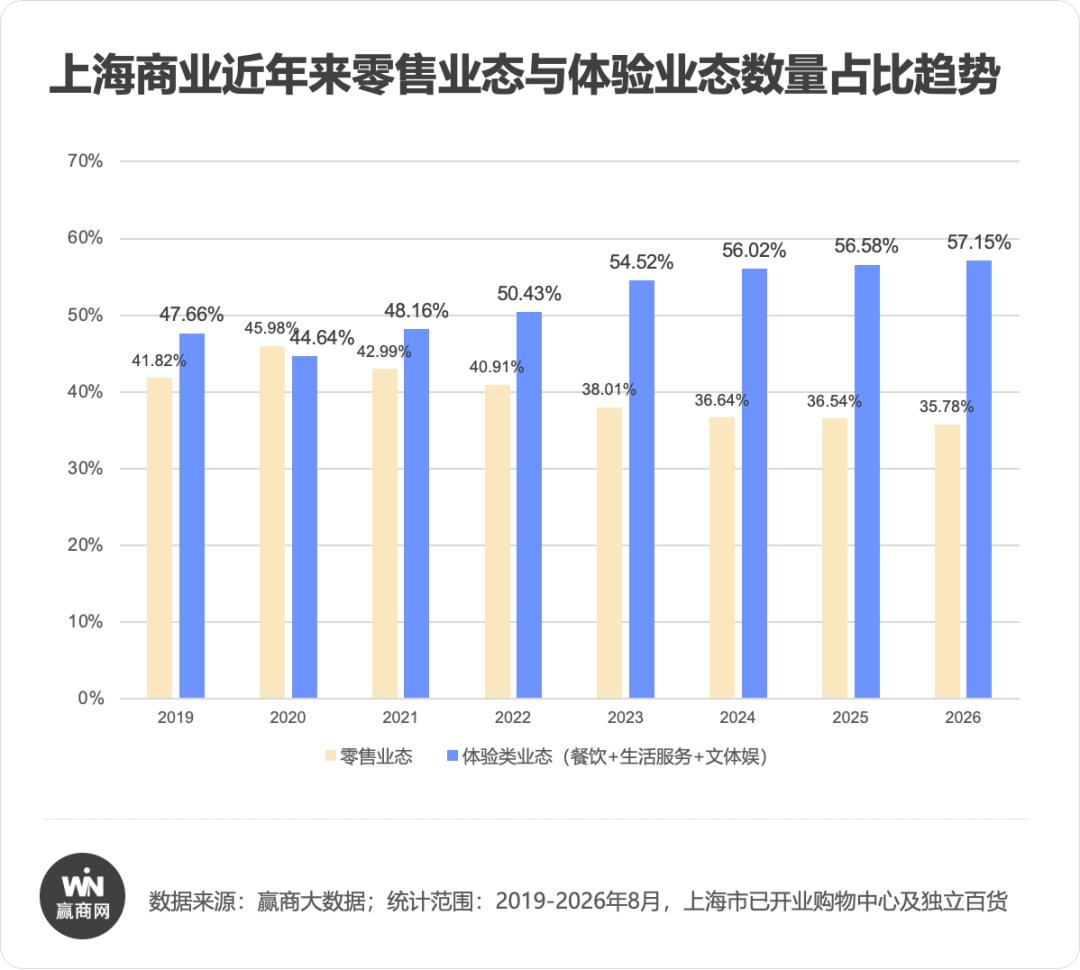
According to Winshang Big Data, from 2019 to 2026, the proportion of retail stores in Shanghai's shopping centers dropped from 41.82% to 35.78%, while the total proportion of three experience-oriented business categories including catering, life services, culture, sports and entertainment rose from 47.66% to 57.15%, marking that the structural inflection point of consumer supply has been firmly established.
01.
From "Shelves" to "Content": The Boundary of Consumer Supply Is Expanding
In the early days, shopping centers were essentially "enlarged department stores". Those who had more products, stronger brands and latest styles would win the market.
Yaohan, which opened in 1995, took "global procurement" as its appeal, and there were always long queues at the counters of imported home appliances and famous brand clothing; Plaza 66, which made its debut in 2001, for the first time brought brands including Louis Vuitton, Cartier and Hermès to Shanghai in the form of a shopping center, becoming the landmark of luxury consumption across the country. Westgate Mall and Grand Gateway Plaza followed one after another. These commercial landmarks from the late 1990s to the early 2000s took commodities as the absolute core. Consumers' action paths were very clear: enter the mall, select products, try on, pay and leave, and purpose-driven consumption dominated everything.
The turning point came around 2010. The rise of e-commerce brought revolutionary changes to the circulation efficiency of standardized commodities — prices became transparent, price comparison became convenient, and delivery became instant. If the same product is cheaper on the mobile phone, why would consumers make a special trip to the mall? The answer emerged from "services".
The first wave of this trend was the massive influx of catering, cinemas, parent-child amusement parks and gyms. In September 2019, Shanghai Commercial Center, which carried the memories of generations of Shanghainese, reopened under the new identity of Bailian Quyang Shopping Center after three years of renovation.
Bailian Quyang increased the proportion of catering to nearly 30%, introduced a five-star reception hall, and built the largest children's themed space in Hongkou District at that time. Targeting community customers and young people from surrounding universities, the mall focuses on the interactive sense of "real neighborhood connection".
In the following ten years, this trend continued to deepen. The common choice of many stock renovation projects is to increase experience-oriented business categories, making commercial spaces not only for "shopping", but also for entertainment, rest and sports. This change points to a clear signal: service-oriented business categories have risen from being "accessories" of shopping malls to being their "driving engine".
The expansion of service boundaries is far from stopping, and it is being implemented in more imaginative forms.
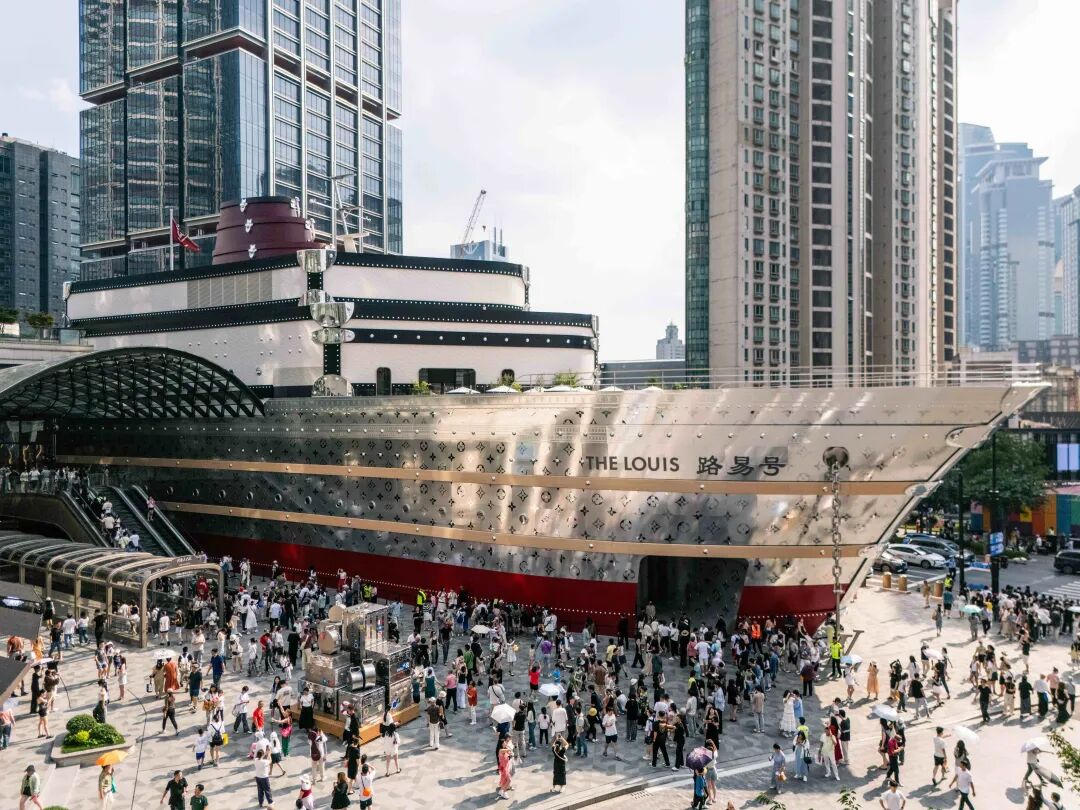
Image source: HKRI Taikoo Hui
In 2025, Louis Vuitton's "Louis" concept landmark settled in HKRI Taikoo Hui, instantly becoming a hot event in the city. This "vessel" combines luxury brand narrative with public space curation. Consumers queued up for a long time not to buy bags, but to complete an immersive "brand pilgrimage". This composite space integrating exhibition, retail and coffee makes commodities recede to the background of the experience, and the brand culture itself becomes the object of consumption.
What deserves more attention is the in-depth operation of vertical customer groups. After the renovation of Phase III of Plaza 66, in addition to introducing more heavyweight international brands, such as the first mainland China flagship stores of Balmain, Berluti, Brunello Cucinelli, etc., it also shifted its focus from simple brand expansion to in-depth service provision, launching exclusive services for high-net-worth customers including private stylists, priority reservation of limited-edition products, and private exclusive dinners. The store visit frequency of high-end members and the cross-brand consumption linkage rate have increased significantly. The experience of Plaza 66 has also driven a number of high-end shopping malls to follow the path of deepening member services.
02.
From "Box" to "Boundless": Commercial Spaces Are Opening Up
As the supply content changes, the space changes accordingly.
From the 1990s to the early 2000s, the fully enclosed "big box" was the standard form of shopping centers. Plaza 66, Westgate Mall, with high density and fully indoor layout, had neat and unified circulation lines, and all designs served the display efficiency of commodities.
Open blocks represented by Xintiandi appeared in Shanghai very early, but the large-scale impact on the "box" form only happened in the last five years. The concentrated debut of a number of projects including Panlong Tiandi, EKA·Tianwu and West Bund Dream Center has rewritten the industry's perception of commercial space forms, and also changed consumers' wandering habits.
In 2023, Panlong Xintiandi opened, creatively integrating the texture of ancient town water towns into commercial operation as a whole. The bridges, lanes, corridors and markets of the Jiangnan region were reactivated in brand investment attraction. Consumers no longer "walk through shops" during their wandering, but "walk through the scenery".
EKA·Tianwu opened one year later than Panlong Tiandi, but followed a more extreme path. The project is located in Jinqiao, Pudong, and was originally a naval ship repair factory built in the 1960s. After renovation, it retains the rough texture of weathered steel plates, old brick walls and industrial trusses, while the newly added mirror stainless steel, red brick arcades and glass curtain walls form a visual contrast. This scene aesthetic of "old and new collision", combined with the store forms of main operator brands such as O' Mills and Yichi Garden launched in independent buildings, quickly became a hit on social media.
West Bund Dream Center offers another path. The project extends along the Huangpu River, seamlessly connecting the waterfront trail, art installations, open lawns and commercial facilities. Consumers can sit by the river for an afternoon, watching ships coming and going, and step into a store casually.
The common logic of these projects is: The space itself becomes the destination, and consumption is just an additional action. What Panlong Tiandi provides is not shops in an ancient town, but "an ancient town that you can wander around"; what EKA·Tianwu sells is not trendy items, but "lifestyle in the industrial atmosphere"; the core competitiveness of West Bund Dream Center is not its brand portfolio, but "seats with river views".
While block-style commercial projects are making a stunning debut, box-style commercial projects are also continuously evolving and "opening up", which is not only the extension of physical boundaries, but also the in-depth exploration of sustainable scenarios.
Opening in 2020, Nanxiang Impression City MEGA brought forests into the shopping center, and created an immersive new green leisure experience with themes such as forests, wetlands and mountains. The tropical rainforest based on the "Secret Realm · Forest" ecological botanical garden, the unique "setback garden" surrounded by terraced green vegetation, and the 400-meter rooftop starry runway along the edge of the building can not only meet the urban people's desire to get close to and touch nature, but also perfectly realize the interaction between architecture and nature, and between people and space.
PRISMA Xinjia Center, which opened in June 2026, features an indoor "floating island atrium" that combines a nearly 1,000-square-meter high-ceiling space with greenery, natural light and waterfalls. The setback-style green plant design makes greenery grow vertically, bringing richer natural layers to the indoor space.
From "bringing forests into shopping malls" to "making businesses grow in canyons", plants and green spaces have become the main narrative of the space, and the spatial imagination of consumer supply has been opened up once again.
03.
Circles as Content: When Commercial Spaces Become Community Containers
The evolution of consumer supply is not only reflected in "what to sell" and "where to sell", but also in "who to sell to" and "who stays together".
Jing'an Joy City is one of the first shopping centers to capture the consumption potential of the ACG circle. By continuously introducing head IP derivative stores such as Animate and Jump Shop, and planning non-stop ACG-themed pop-ups, voice actor meetups, and doujin markets throughout the year, Joy City has turned itself into an "offline stronghold" for the ACG crowd. Every weekend, cosplayers gather and fans exchange "guzi" (peripheral derivatives). The commercial space essentially undertakes the function of community activities. Consumers come here not to "shop", but to "meet": meet people with the same hobbies, meet people in the same circle, meet their peers.
Bailian ZX Fun Field goes even further. The whole mall does not carry out generalized investment attraction, and its commodity supply is precisely anchored in the ACG track, such as figurines, blind boxes, trading cards, etc. Brands with appeal in the ACG circle gather here. Consumers come in with a direct and clear purpose: to "buy guzi" (goods, peripheral derivatives). When the commodity itself has become an identifier of circle identity, the commercial supply is no longer a generalized shelf, but a content collection tailored for specific groups of people.
This logic of "circles as content" is expanding from the ACG circle to more communities. Pet social clubs create offline gathering scenes for pet owners, cycling-themed stores transform parking lots into community departure points, and camping collection stores turn outdoor exhibition halls into venues for weekend sharing sessions.
Shopping centers no longer try to please everyone, but precisely target a certain community and become their offline "spiritual base".
04.
Next Stop: The Urban Imagination of Commercial Spaces
This evolution is still accelerating. The future consumer supply is breaking through the physical boundary of "shopping centers" and evolving towards more complex urban functional complexes.
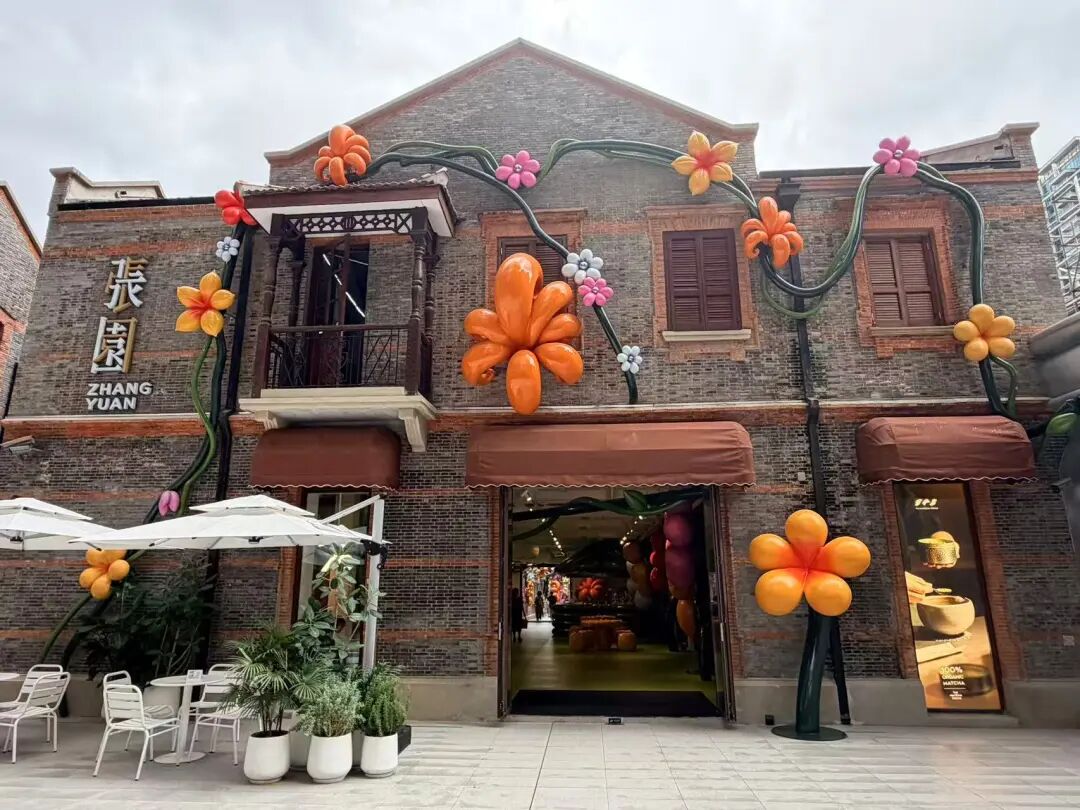
Image source: Winshang.com
Zhang Yuan provides a unique sample. After protective renovation, this largest Shikumen architectural complex in Shanghai was not built into a pure cultural tourism scenic spot, but superimposes historical preservation, public space and high-end commerce. When consumers wander in the lanes, they are not only visiting brand stores, but also reading the city's memory. The commercial space here forms a symbiotic relationship with the urban cultural context.
West Bund Financial City (Gate M) is the most representative sample in this trend. Commerce is deeply integrated with culture and art — consumers move between shopping malls, art galleries, waterfront stages and public squares. There is no physical partition between commercial spaces and cultural sites, and seamless connection is realized through corridors, squares and trails.
What is also worth noting is that commercial spaces are becoming plugins of public life. Suhe Bay MixC World realizes the symbiosis of underground commerce and ground green parks — consumers can take a walk in the park first, and then walk into the underground mall to have a cup of coffee; brand flagship stores are intertwined with lawn markets and public art installations, so there is no need to "make a special trip" between consumption and daily activities.
Baoshan Long Beach adopts an integrated design for the cruise port, riverside park and commercial complex. Commerce is no longer an independent box, but a functional plugin of the entire waterfront destination.
The future consumer supply will no longer answer the question "what do you sell", but answer "what kind of public life can you provide for this city". When commercial spaces are capable of carrying functions such as exhibitions, performances, socializing, sports and even community services, the very concept of "consumer supply" has been rewritten.
Thirty years have passed, from counters to curation, from shelves to content, from boxes to boundlessness. The era when you pointed at a piece of fabric across the counter and the sales assistant measured it with a ruler to close the deal has gone far beyond. Beyond commodities, not confined to indoor spaces, the wonderful chapter of Shanghai's commerce continues to be written.
This article is from the WeChat official account "Winshang.com", author: Echo, published with authorization from 36Kr.