Xiaomi's Unforeseen Misfortune: When Title Sponsorship Marketing Runs Into the Fiery Motor Racing Controversy
At Xiaomi's launch event yesterday, Lei Jun was in high spirits.
The Xiaomi Pengcheng boasts impressive configurations, with its safety performance repeatedly emphasized, and the market response has been overwhelmingly enthusiastic: 10,000 orders were locked in just 4 minutes, a result that almost all competing products can only envy.
But to be honest, while watching the launch event in front of the screen, I could not stop thinking about the accident that happened a couple of days earlier.
Just on the eve of the launch event, on September 5, the China GT Shanghai race that Xiaomi sponsored caught fire.
1
This was not an ordinary track skid or mechanical failure.
During the GT3 category race, Car No. 91 caught fire instantly after a collision, leaving the driver trapped in the cockpit.
The first person to rush over to rescue was not the event staff, but Loek Hartog, the driver of Car No. 79. He abandoned his own race, grabbed a fire extinguisher, and dragged the No. 91 driver out of the fire with his bare hands.
The reason why Loek Hartog had to grab the fire extinguisher himself was that the "staff member" who brought the extinguisher over was an elderly man who dropped it and ran away immediately, no one knew whether he was going to call for help or just got scared and fled.
The entire rescue window lasted only 49 seconds, and these 49 seconds relied not on the professional rescue team, but on other drivers.
As for the official professional ambulance, it did not arrive until about 15 minutes after the accident. What is most unacceptable is that some media reported that the ambulance arrived late because the personnel on board were sleeping.
15 minutes.
At the scene of a burning racing car, what 15 minutes means is self-evident.
In February 2020, during the Daytona 500 race, driver Ryan Newman's car was involved in a serious rollover accident. Just 35 seconds after the car came to a complete stop, a paramedic had already reached the overturned car and started the rescue.
After the incident, the team of the rescued driver announced their withdrawal from the subsequent races, and harshly condemned the event organizer for "serious dereliction of duty in on-site emergency response and safety rescue support".
Although the event organizing committee issued an apology, its response was thought-provoking: "The overall configuration of the event meets the standards for national-level events", and only "the meticulous management needs to be improved".
In other words: The hardware meets the requirements, but the software cannot keep up.
But on a racetrack where human lives are at stake, this kind of explanation is ridiculously feeble.
2
Putting aside the liability determination of the accident itself, what we want to talk about today is the most unfortunate party in this incident — Xiaomi.
This is a typical public relations crisis of "spending money to invite trouble".
Why did the public direct all the criticism to Xiaomi? After all, Xiaomi did not crash the car, nor did it organize the event.
The problem is that Xiaomi has an extremely close relationship with this event.
In March this year, Lei Jun officially announced in a high-profile manner that Xiaomi had reached a title sponsorship cooperation with three major events: CTCC, China GT and CEC, and the SU7 Ultra and YU7 would serve as the official safety car and medical car, with a resounding slogan of "escorting the safety of the event".
This was originally a brilliant move. Putting its own mass-produced cars to work as service vehicles on national-level racetracks is the most powerful endorsement for their "high performance" and "high safety".
But everything can go wrong with that unexpected "but".
After the accident, the rescue was delayed, and the safety car and medical car were practically useless. Many audiences naturally directed their dissatisfaction at the title sponsor that had been emphasizing "safety". Didn't you say you would "escort safety"? Where did that escort go?
What is even more absurd comes next.
What was the first line of the apology statement issued by the China GT Organizing Committee?
It was "Xiaomi · China GT Championship".
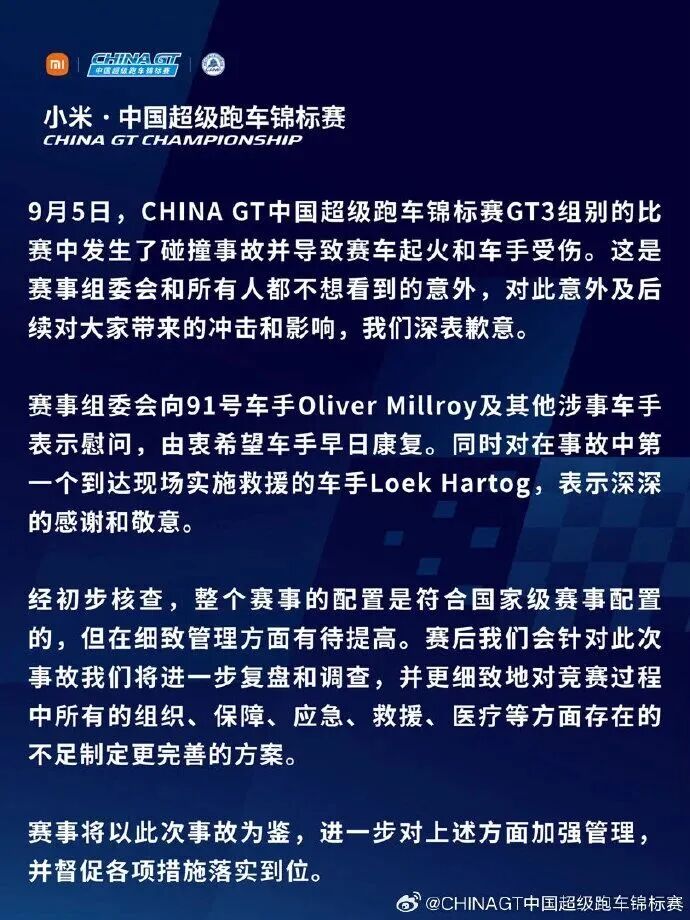
To put the sponsor's name at the top of the apology, to be honest, I can only interpret this operation as using Xiaomi as a scapegoat.
Xiaomi obviously realized this quickly. The subsequent statement was modified, and the "Xiaomi" prefix was quietly removed.
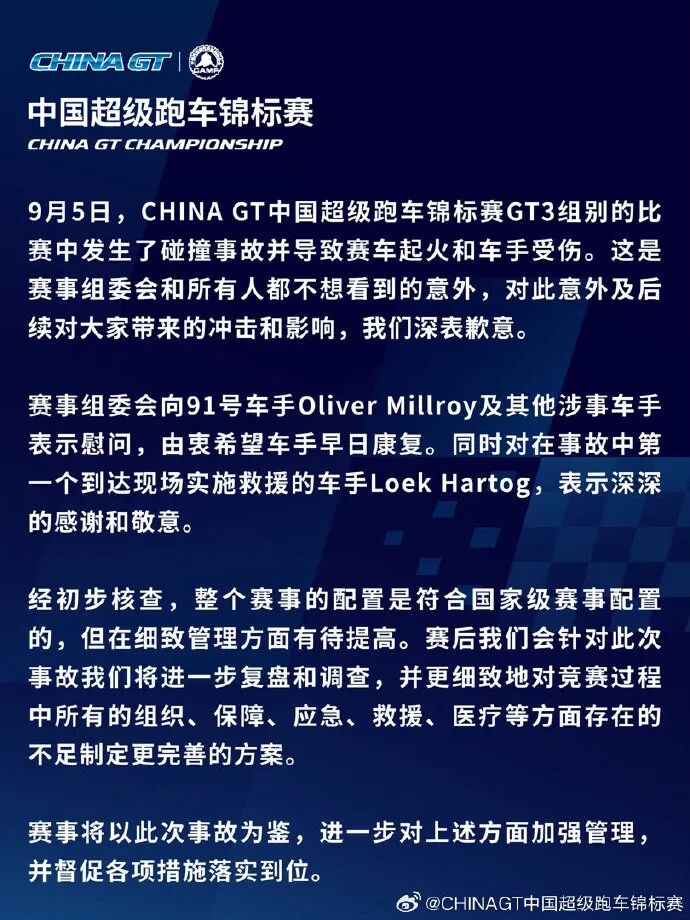
But the first wave of public opinion impact has already taken shape, and Xiaomi was completely pushed to the front line, becoming the scapegoat.
Is Xiaomi wronged? Absolutely.
But this incident also serves as a reminder for all brand owners and marketing executives.
Title sponsorship is not just a matter of spending money and then forgetting about it.
3
In recent years, there have been many cases where Chinese brands' title sponsorship of events went wrong.
Xtep is a previous example. At the 2024 Beijing Half Marathon, the Xtep-contracted athlete won the championship with the "guaranteed promotion" from three other foreign athletes, which raised suspicions of race manipulation. After the incident went viral, Xtep's market value evaporated by more than HK$1 billion in two days, and its status as an event partner was revoked.
Xtep was also wronged, as it spent money and caused its own market value to collapse. But the root cause is the same as the China GT incident: only paying money without control over the details of event execution.
The brand only provides funds, no on-site personnel, no management, and no standards. As a result, when the event organizer encounters an accident, the brand has to take the blame together.
The process for many brands to sponsor events is roughly like this: the marketing team negotiates a cooperation, the legal team reviews the contract, the finance team approves the budget, and the PR team prepares several press releases.
Then they just wait for the exposure data. How the event is operated, how safety is guaranteed, and how the on-site management is carried out — those are the organizer's problems, what do they have to do with me?
This mindset needs to be changed.
Once you pay the money, your brand is tied to this event. If something goes wrong with the event, your brand will be damaged accordingly.
If Xiaomi had dispatched a dedicated project team to be on site at that time, walked through the rescue process in advance, or even just reviewed the emergency plan of the event organizer, it would not have fallen into such a passive situation.
I am not saying that the brand should do the work for the organizer. But as the title sponsor, you have every right, and you should also have the obligation, to request to participate in the operation and supervision of the event.
In particular, Xiaomi itself stated that the SU7 Ultra and YU7 would "serve as the official safety car and medical car to escort the safety of the event".
Since your vehicles are supposed to undertake the "safety" role, you cannot just hand over the cars to the organizer and call it a day.
You need to know what the event's rescue process is, under what circumstances your safety car will be dispatched, what the equipment standards for the medical car are, and whether the on-site fire and medical personnel are sufficient and properly trained.
You pay the title sponsorship fee, and the event organizer is responsible for execution.
But the brand is yours, and the reputation is also yours. You cannot leave the safety of your brand in the hands of an event organizer that can't even carry out rescue work promptly.
4
Xiaomi is at a critical juncture, so it should pay more attention to its brand reputation.
Data from Tianyancha APP shows that in the first quarter of 2026, Xiaomi's mobile phone shipments in the Chinese market decreased by 35% year-on-year. The decline continued in the second quarter, with shipments reaching 31.2 million units, a year-on-year decrease of about 26.5%.
At the same time, the ASP of mobile phones in the first quarter increased by 8.2% year-on-year to 1310 yuan, a record high; the ASP further rose to 1351 yuan in the second quarter.
The cost of core components such as memory chips is rising, and the profit margin of low-end mobile phones is constantly being compressed. For mobile phone manufacturers, there are only two most direct solutions: either raise prices, or achieve high-end transformation to pass on costs through brand premium.
But high-end transformation is not just about hardware. No matter how impressive the parameters are, if the brand image cannot keep up, consumers will not recognize your products.
The high-end market is not only a competition of parameters, but also a competition of brand recognition and premium perception. At this time, no title sponsorship or marketing activity should be allowed to drag down the brand image.
The same goes for Xiaomi Automobile.
The breakthrough from 0 to 1 has been completed, and now it is facing the scaling challenge from 1 to 10.
One of the key points of this challenge is to step out of the "fan circle" and expand from Xiaomi's core fan base to the broader mass market. This not only requires excellent breakthroughs in hardware, but also requires market efforts in brand image building.
At this time, any slight damage to the brand image may be magnified.
Event title sponsorship should be a brand asset, not a negative asset.
Xiaomi is walking on a narrow path from "cost-effectiveness" to "high-end transformation". The most fearful thing on this path is not that the competitors are too strong, but that you accidentally step into the mud yourself.
This article is from the WeChat Official Account "Morgan Channel" (ID: morgantmt), written by the Morgan Business Research Institute team, and authorized for release by 36Kr.