Residential energy storage is still growing, why is Sige in such a rush to foray into the utility-scale energy storage market?
How high are the odds for the leading residential energy storage giant to break into the large-scale energy storage track?
Founded four years ago, Sigen has almost created a "dual myth" at the fastest speed: its revenue surged from 58.3 million yuan in 2023 to 98.74 billion yuan in the first half of 2026, stepping into the 100-billion-yuan level; after its listing, its market value quickly stood at HK$100 billion.
While the growth of residential energy storage remains strong, Sigen has already placed its next big bet on large-scale energy storage.
This is not a story of "the first growth curve has peaked and the company is forced to find a second curve". On the contrary, Sigen voluntarily picked up a more difficult, heavier and more unfamiliar exam paper when it was at its best.
Over the past four years, Sigen has done one thing right: turn the complex energy system into a standardized product, and then quickly replicate it to 85 countries through channels.
But when it comes to large-scale energy storage, standardized products alone are no longer enough to solve problems.
Of course, battery containers, PCS and EMS can continue to be modularized and standardized, but behind every large-scale energy storage order, there is still a specific project: development, financing, grid connection, delivery, acceptance and operation and maintenance, none of which can be bypassed.
When the capabilities that a company used to rely on for success are no longer sufficient in a highly project-based market, can it still replicate the growth of the past four years?
01
Why is it exactly now
To answer this question, we must first understand why Sigen chose to expand at this moment.
It's not because residential energy storage is no longer viable. It's precisely because it's doing so well.
In 2023, Sigen's revenue reached 58.3 million yuan.
In 2024, 13.30 billion yuan.
In 2025, 90.01 billion yuan.
In the first half of 2026, 98.74 billion yuan.
SigenStor has been the growth engine for the past three years. It generated 56.17 million yuan in revenue in 2023, and reached 83.63 billion yuan in 2025, accounting for 92.9% of the full-year revenue.
This is a curve that is still accelerating. But the acceleration itself is changing the way to solve this problem.
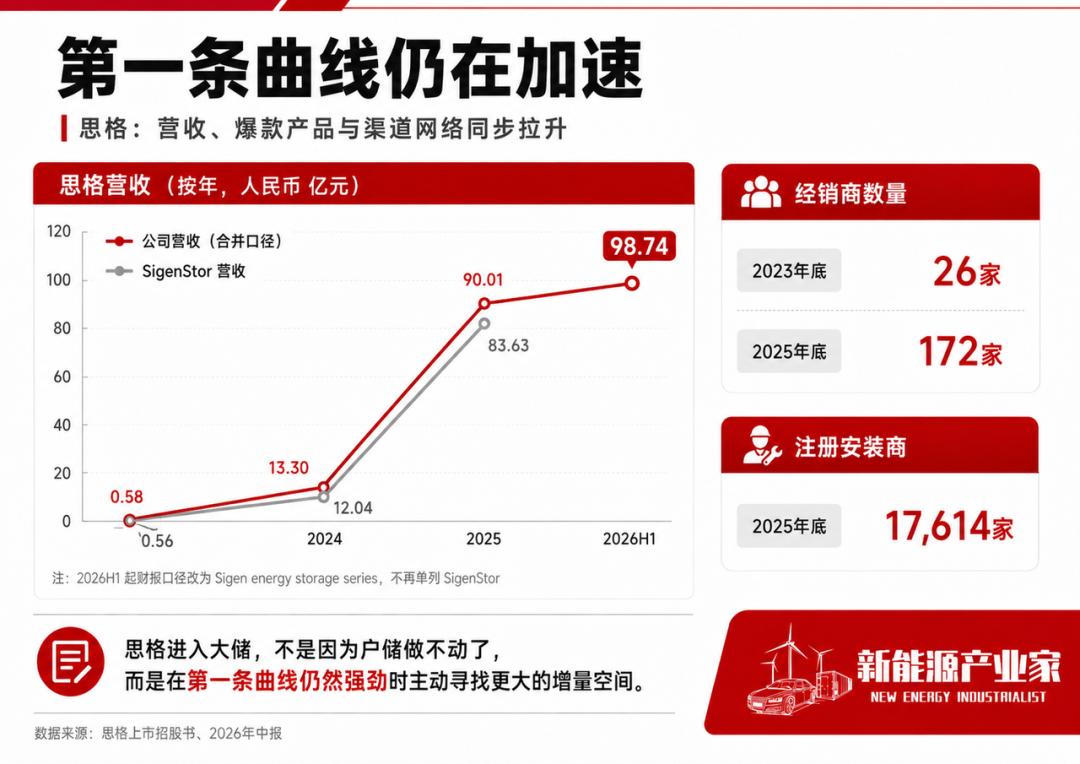
Growing from 100 million to 1 billion only requires an additional 900 million. To double again from 100 billion, the company needs to find a whole new 100 billion in revenue.
When a company reaches the 100-billion-yuan scale, the core growth problem becomes: Where else can such a large amount of new revenue be accommodated? Large-scale energy storage naturally comes into view.
In the first half of 2026, the global shipment of residential energy storage systems was 39.07GWh, and the shipment of large-scale energy storage systems was 260.33GWh. Calculated by shipment capacity, the latter is about 6.7 times the former.
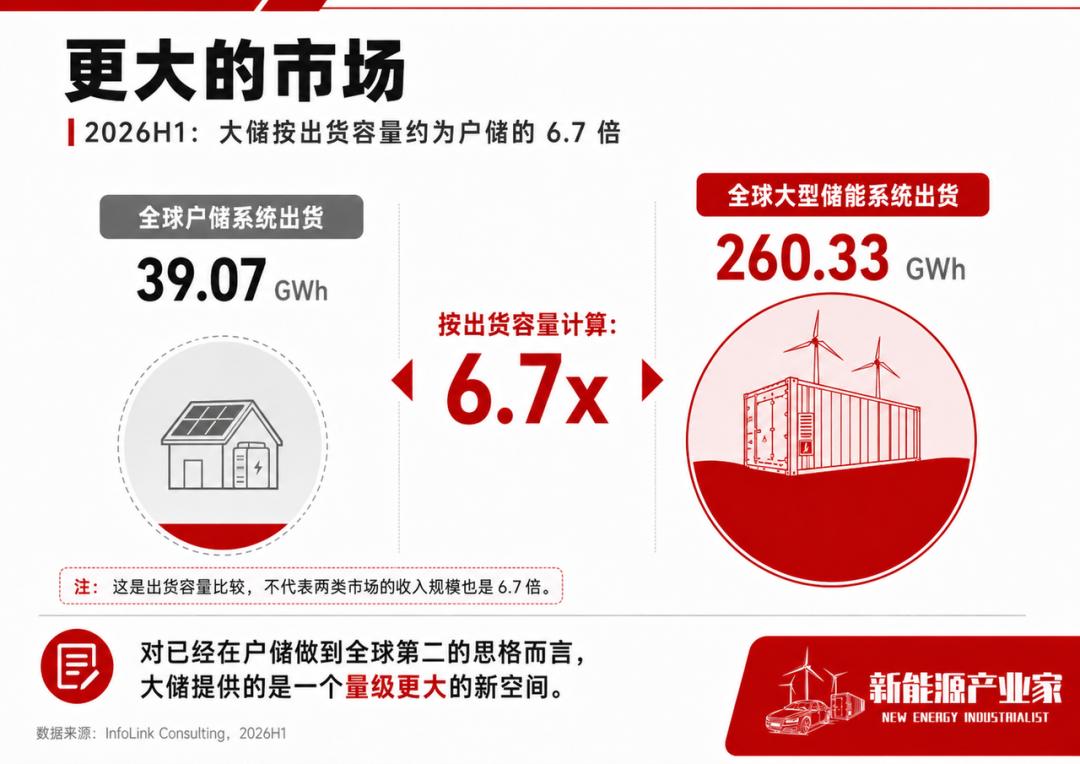
This certainly does not mean that the market revenue of large-scale energy storage is also 6.7 times that of residential energy storage. The selling price per Wh, system boundary and profit level of the two types of products are completely different.
But for a company with revenue of 98.74 billion yuan that still wants to maintain rapid growth, 260GWh is an answer that 39GWh can never provide.
The market capacity is there, and Sigen has already ranked second in the global residential energy storage market. If it continues to stay in the residential energy storage track, it can of course still grab market share and expand to more countries, but the market boundary is becoming more and more visible.
Large-scale energy storage provides a sufficiently large new space, and this change has even been written into the financial report statements.
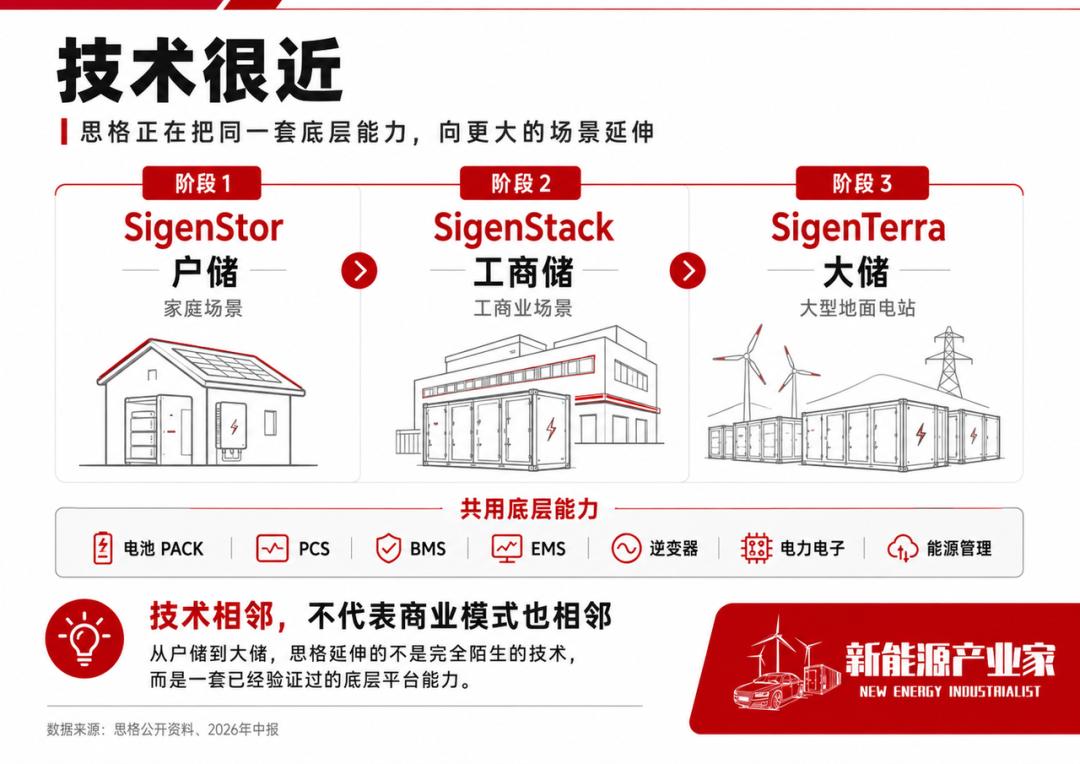
In its listing prospectus, Sigen separately disclosed the revenue of SigenStor. By the first half of 2026, the statistical caliber was changed to "Sigen energy storage series", which includes SigenStor, SigenStack and SigenTerra at the same time. The business description in the semi-annual report extends from residential, industrial and commercial scenarios all the way to large-scale ground power stations.
In the past few years, the market's perception of Sigen was largely equivalent to SigenStor. Now it wants to cover all scenarios under the "Sigen" brand.
Large-scale energy storage is not to take over from residential energy storage, but to re-expand the company's overall boundary.
Related actions have also been implemented intensively.
In March, its subsidiary Shanghai Sigen Energy won the battery container procurement bid package for the 500MW/2GWh project in Duqm, Oman.
In June, Sigen released the "Large Base Strategy" and launched the SigenTerra large-scale energy storage system.
A few days later, SigenTerra obtained the Bankability due diligence report from TÜV SÜD.
Subsequently in Europe, it signed MOU for a 1.4GWh large-scale energy storage project portfolio with Green Glow, PowerUp Energy and Sunny Watts.
During the Intersolar exhibition, it announced that it had reached more than 20GWh of global energy storage cooperation.
The direction is clear. From a technical perspective, this step is not far away.
SigenStor is originally centered on battery PACK, PCS, BMS, EMS, inverters, power electronics and energy management. For SigenTerra, many underlying technologies have not been replaced.
When Xu Yingtong was releasing the "Large Base Strategy", he defined this expansion as "continuously reusing the capabilities of the underlying platform".
The market is large enough, the technology is close enough, and the timing is good enough —— residential energy storage is still at a high level, the company has just gone public, and the cash on its books exceeds 8.2 billion yuan. It seems to be an almost natural path.
But adjacent technology does not mean that the business model is also similar.
02
The closest market is not necessarily the most suitable business
The growth code of Sigen in the past three years can be summed up in one sentence:
Turn the complex energy system into a standardized product, and then replicate it quickly through channels.
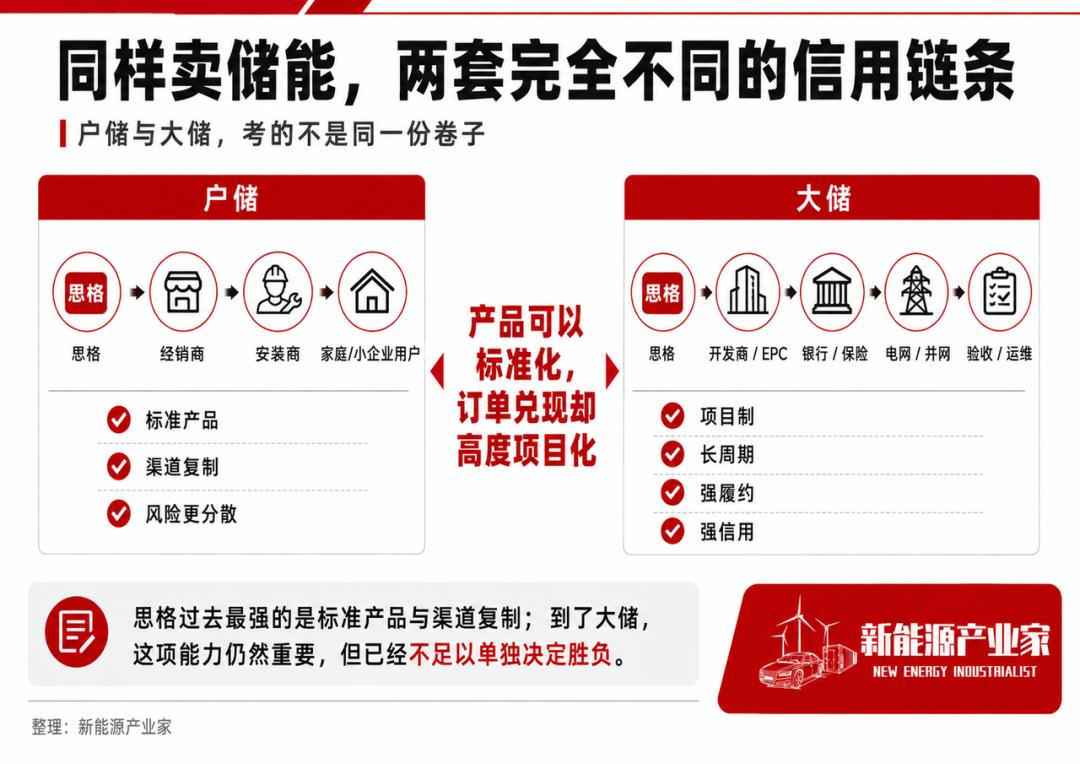
SigenStor integrates scattered devices together. After the product is finalized, the main work shifts from R&D to certification and sales.
Products that can be sold in Germany can be adapted to enter the UK and Australia after adjustment; one well-developed product can be sold repeatedly for millions of sets. 172 distributors and 17,614 installers form the last mile of this replication machine.
Large-scale energy storage further concentrates risks on specific projects.
A GWh-level project involves developers, EPCs, power grids, banks and insurance institutions. Equipment performance is only the first threshold. Financing, grid connection, delivery, and operation and maintenance more than a decade later all affect the final order.
This is why SigenTerra went to get the Bankability assessment right after its launch. TÜV SÜD evaluates not only cycle life and efficiency, but also manufacturing quality, supply chain, customer service and long-term performance capabilities.
In the residential energy storage era, Sigen needs to convince distributors that products are easy to sell, easy to install, and after-sales services are controllable.
When it comes to large-scale energy storage, it also needs to convince developers and financial institutions that after more than a decade, this set of systems is still operational and the company is still in business.
This kind of credibility cannot be established quickly by a single hit product.
Two InfoLink rankings have already illustrated this problem.
In the global total energy storage system ranking, Sigen has ranked ninth. But InfoLink specially pointed out that Sigen and Deye entered the top ten mainly relying on the growth of overseas residential energy storage and industrial & commercial energy storage.
In the large-scale energy storage market, the top players are still those enterprises with many years of project experience, complete supply chain systems and large customer resources.
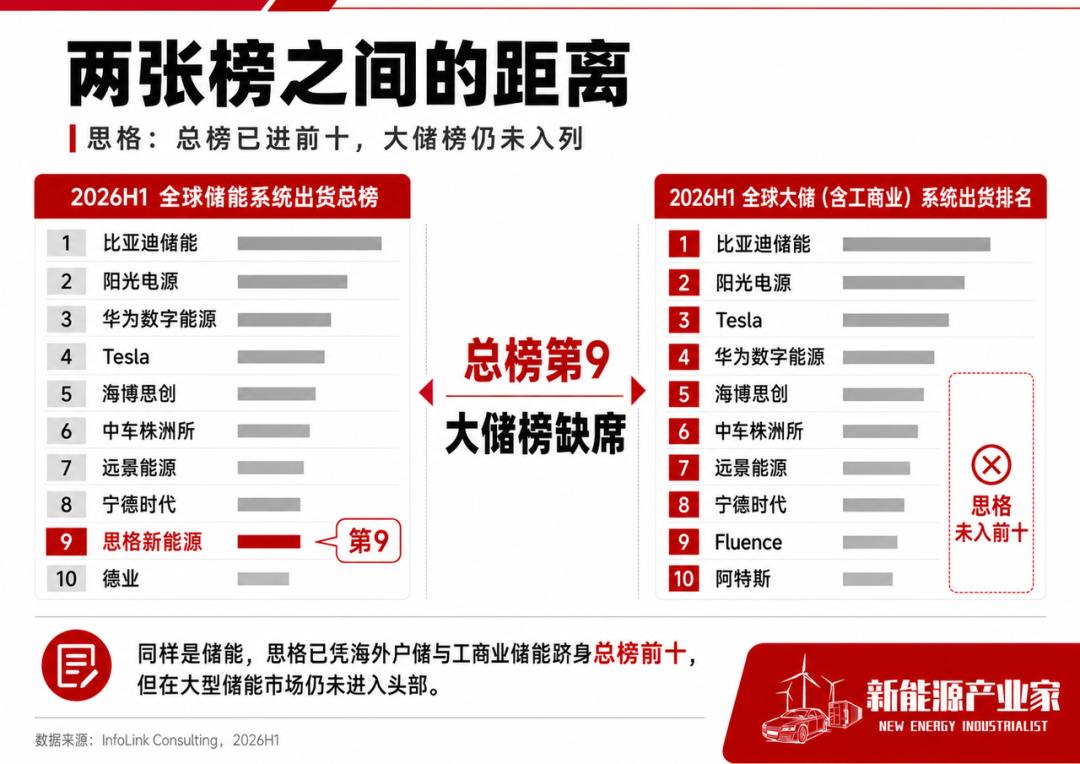
This means that Sigen's most prominent advantages in the past are not exactly the advantages that the large-scale energy storage market values most.
Product definition, power electronics, and global teams can be carried over. But 172 residential energy storage distributors cannot be directly converted into 2GWh orders; selling thousands of MWh of SigenStor cannot automatically become more than ten years of operation experience for large power stations.
Technology can be migrated, but credibility needs to be accumulated from scratch.
Therefore, what deserves the most attention for Sigen at present is not "whether it has large-scale energy storage products". This question has been mostly answered.
The real unanswered question is: Can this set of products be sold continuously and on a large scale?
And even if the answer is "yes", the next question may be more troublesome.
Because the more Sigen wants large-scale energy storage to become a sufficiently large second growth curve, the harder it is to only stay at the product end.
There is a project that is very worth noting.
In April 2026, Sigen cooperated with Arausol and Memodo to build an 11.6MWp PV + 20MWh energy storage project in Germany. Instead of using centralized battery containers, 1660 12kWh SigenStack modules were deployed dispersedly in the ground power station.
20MWh is far from the GWh level, but it at least provides a possibility: Sigen does not necessarily have to become a traditional system integrator. It can move up step by step along residential energy storage, industrial and commercial energy storage, and MW-level projects, and push modular products to larger scenarios.
The problem is that this path has inherent contradictions.
The more "like Sigen" the operation is, the lighter the business will be; but the lighter the business is, the more limited the revenue it can generate.
Conversely, the more you want to quickly build large-scale energy storage into a second 10-billion-yuan business, the more you need to step into the heavier project operation world.
This is the real dilemma.
03
Too shallow to be large enough, too deep to be too heavy
As of the end of June 2026, the cash on Sigen's books reached 82.36 billion yuan. The net inflow of operating cash flow in the first half of the year was 19.74 billion yuan, and the net inflow of financing activities was 56.58 billion yuan.
The listing gave Sigen one of the most precious assets to enter the large-scale energy storage track: the margin for making mistakes. At this stage, capital is not the most obvious constraint.
But if large-scale energy storage is only a small business of more than 1 billion yuan a year, there is no need to discuss the "second growth curve". For a company with a half-year revenue of nearly 100 billion yuan, the business must be large enough to change the growth expectation.
According to a circulated meeting minutes of Huaan New Energy Industry, Sigen's 2027 target for large-scale energy storage has pointed to more than 20GWh, and the target for large-scale ground PV inverters in the same period is 20-30GW; the minutes also mentioned that the large-scale energy storage projects with intended signatures at that time exceeded 5GWh, and the projects under negotiation reached 20-30GWh.
If 20GWh is indeed the goal Sigen hopes to reach in the next stage, this account is worth calculating carefully.
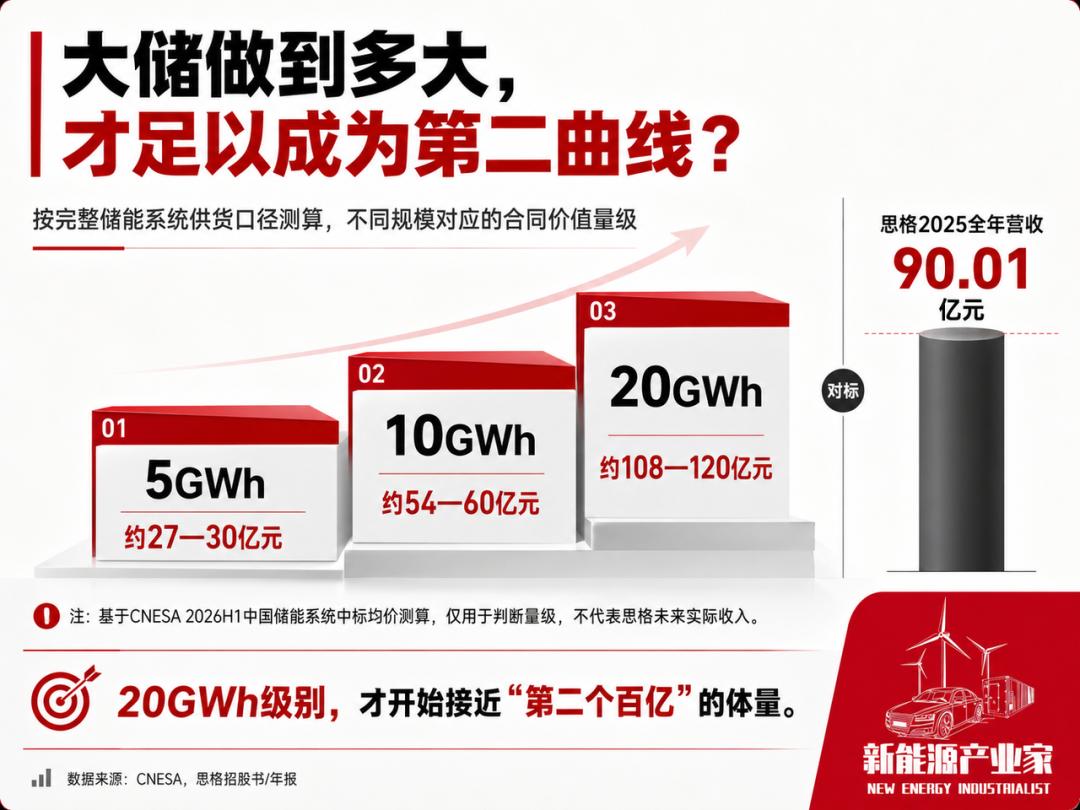
CNESA data shows that in the first half of 2026, the average price of 2-hour energy storage systems in China was about 602.1 yuan/kWh, and the average price of 4-hour systems was about 541.3 yuan/kWh. This is the domestic full system winning bid price, not Sigen's overseas selling price or revenue forecast, but it is enough to judge the order of magnitude.
Sigen's full-year revenue in 2025 was 90.01 billion yuan. If 20GWh of projects are delivered in the same year and Sigen undertakes the full system supply, the corresponding contract value has exceeded Sigen's total annual revenue in 2025.
At this scale, large-scale energy storage is truly qualified to be called the second growth curve.
The problem also starts right here: How deep the 20GWh business goes determines how heavy this 10-billion-yuan scale will be.
Staying at the standardized equipment supply such as battery containers, and leaving EPC, financing and asset operation