How has the market performed since the implementation of the new policies in Beijing and Shanghai?
In August, Beijing and Shanghai successively released new real estate policies. How does the market perform now?
Beijing shows its answer in new home transactions: in the 35th week (August 24-30), the transaction volume of new homes surged to 1,090 units, up nearly 80% month-on-month. This marked the third consecutive week of growth after the 32nd week (August 3-9), with the growth rate expanding increasingly.
Shanghai shows its answer in the transaction proportion of properties outside the Outer Ring Road: the five measures covering eight points of the new policy tilt all core incremental support to areas outside the Outer Ring Road. In the week when the new policy took effect (August 17-23), the transaction proportion of properties outside the Outer Ring Road immediately jumped to 69.3%.
Breaking down the data, the market stories of the two cities present different characteristics at different levels.
01
New home transactions in Beijing rise for three consecutive weeks
The second-hand housing market has a more solid foundation
On August 7, 2026, Beijing Municipal Commission of Housing and Urban-Rural Development, Beijing Municipal Planning and Natural Resources Commission, and Beijing Housing Provident Fund Management Center jointly issued a document, reducing the social security or individual income tax payment period for non-local families purchasing commercial residential properties within the Fifth Ring Road from 2 years to 1 year, and raising the maximum loan limit of housing provident fund to 3.4 million yuan. (For details, please refer to "Beijing Further Loosens Purchase Restrictions, The Weathervane of Real Estate Has Shifted!")
Monitoring data from Puru Data Intelligence shows that in the 35th week (August 24-30), 1,090 new homes with a total floor area of 129,500 square meters and a total transaction value of 6.935 billion yuan were transacted in Beijing. The three indicators increased by 79.9%, 73.4% and 60.4% respectively month-on-month. This is the third consecutive week of growth after the 32nd week (August 3-9), and the growth rate is getting higher and higher: the transaction volume only rose by 4.1% in the 33rd week (August 10-16), increased by 11.6% in the 34th week (August 17-23), and directly jumped to nearly 80% in the 35th week, forming a typical accelerating volume expansion curve.
The figure of 1,090 units ranks among the top seven in the whole year, which is 1.5 times the average weekly transaction of 722 units for the whole year.
However, it should be noted that the volume expansion is highly concentrated: among the 1,090 units, 257 units come from the project Beitou Hejing in Songzhuang, Tongzhou, and this single project accounts for 23.6% of the total transaction units in the city.
Excluding this project, the remaining 833 units still increased by 37.5% month-on-month compared with the 34th week (August 17-23).
It can be seen that the growth is real, and the market activity is indeed recovering after the new policy. But what is more noteworthy is that the average weekly transaction of new homes in Beijing in August was 692 units, lower than the 762 units in July. The single-week high did not push up the monthly average transaction level.
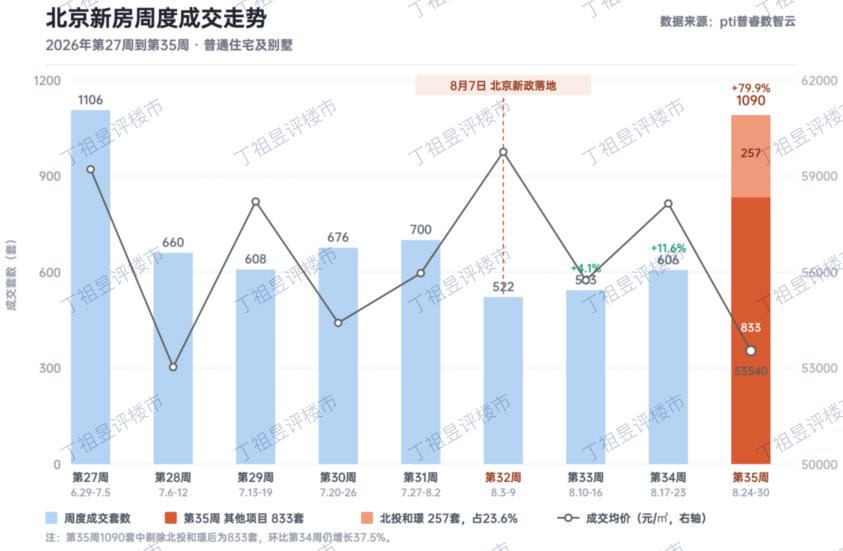
In terms of price, in the 35th week (August 24-30), the average transaction price of new homes in Beijing was 53,540 yuan per square meter, down 7.5% month-on-month, which was the fourth lowest weekly level in the whole year. Rising transaction volume accompanied by falling price seems to indicate that the market is trading at lower prices for higher sales.
However, further analysis shows that this round of price decline is still caused by the concentrated online signing of the low-total-price new project Beitou Hejing, whose average price is only 40,466 yuan per square meter. After excluding this project, the average price of the whole city is 57,146 yuan per square meter, which is basically the same as the 57,874 yuan per square meter in the 34th week (August 17-23). The price foundation has not been shaken, the decline comes from the structural factor rather than the market fundamental.
What really deserves attention is the distribution of total price segments. According to the monitoring data of Puru Data Intelligence Beijing, in the 35th week (August 24-30), a total of 944 units were transacted in the total price segment below 9 million yuan, accounting for 86.6% of the city's total, of which 556 units were transacted in the 3 million to 6 million yuan segment, accounting for more than half of the market. The main effective demand group in Beijing's new home market has clearly converged to the total price range below 9 million yuan.
Apart from new homes, the second-hand housing market in Beijing has a more solid foundation.
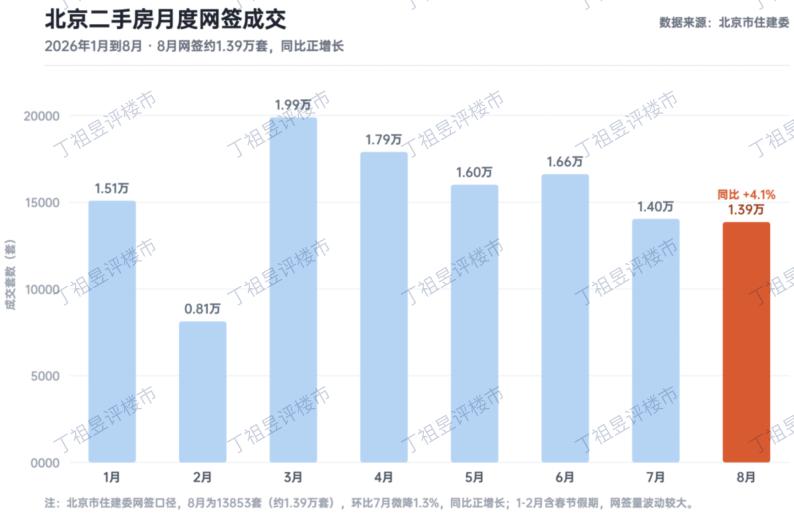
According to data from Beijing Municipal Commission of Housing and Urban-Rural Development, the online transaction volume of second-hand homes in Beijing in August reached 13,700 units, up 4.1% year-on-year, remaining stable above 13,000 units for six consecutive months. This figure is not as eye-catching as that of Shanghai, but its advantage lies in stability, and the bottom outline of transaction volume has been relatively clear.
02
The core target of Shanghai's policy lies in areas outside the Outer Ring Road
The transaction volume in the outer suburban ring area has increased significantly
On August 20, six municipal departments in Shanghai released the "Shanghai Eight New Policies", which simultaneously made efforts in five aspects: housing provident fund withdrawal, credit, purchase subsidy, housing ticket resettlement and stock housing acquisition, with the core of releasing consumption potential in areas outside the Outer Ring Road. (For details, please refer to "From 'Shanghai Seven Policies' to 'Shanghai Eight Policies', There Are Smart Minds Behind Shanghai's New Policies".)
Half a month has passed since the release of "Shanghai Eight New Policies". According to market data, in the 35th week (August 24-30), the supply of new homes in Shanghai reached 930 units, up 226% month-on-month; the transaction volume reached 981 units, up 29% month-on-month, hitting the highest level in the past eight weeks.
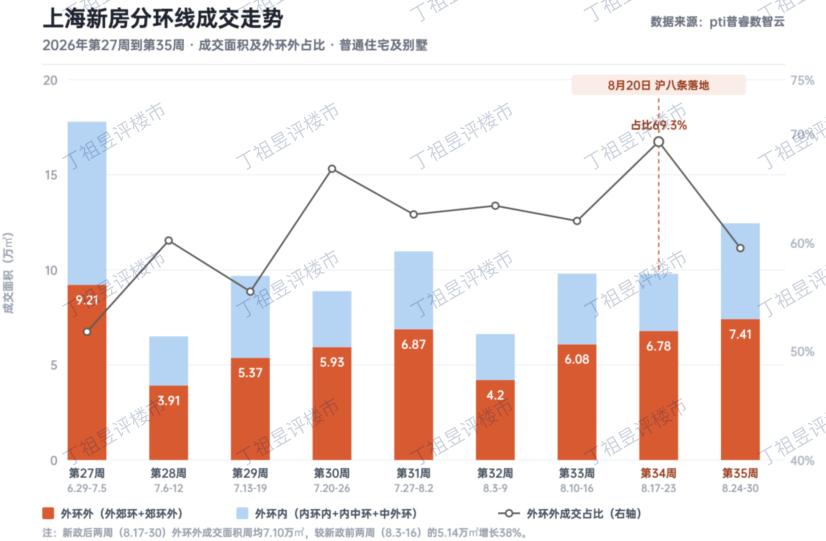
Specifically, "Shanghai Eight New Policies" has a significant effect on stimulating the consumption potential outside the Outer Ring Road. Monitoring data from Puru Data Intelligence shows that the average weekly transaction area outside the Outer Ring Road rose from 51,400 square meters to 71,000 square meters before and after the new policy, up 38% month-on-month, with obvious volume expansion. On the contrary, the average weekly transaction volume within the Inner Ring Road decreased by 49.2%. In particular, in the week when the new policy took effect (August 17-23), the transaction proportion of properties outside the Outer Ring Road jumped to 69.3%, setting a new high in recent weeks.
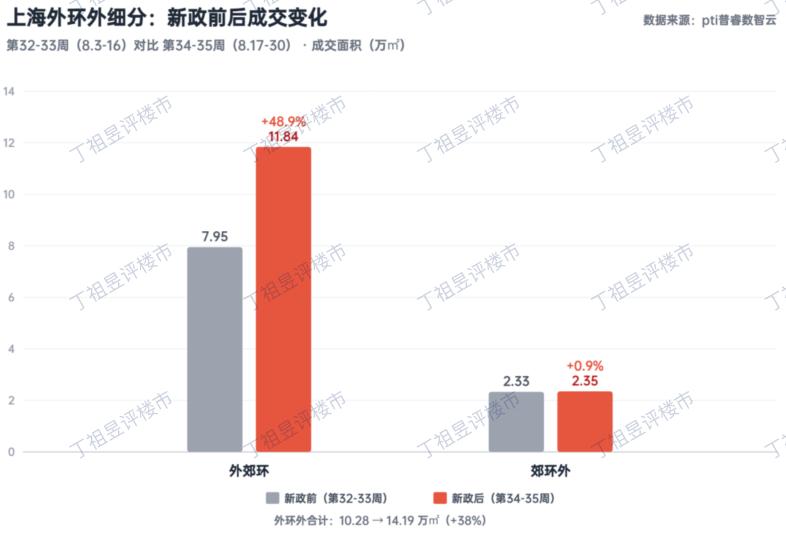
Further breaking down the structure outside the Outer Ring Road, we can see that the outer suburban ring area with larger scale took the lead in recovery after the new policy. Monitoring data from Puru Data Intelligence shows that the transaction volume in the outer suburban ring area jumped from 79,500 square meters to 118,400 square meters before and after the new policy, up 48.9% month-on-month, while the transaction volume in the outermost area outside the Suburban Ring only slightly rose from 23,300 square meters to 23,500 square meters, almost unchanged, with a tiny 0.9% month-on-month increase.
The new policy first activated the more mature outer suburban ring area outside the Outer Ring Road, and the performance of the area outside the Suburban Ring needs to be observed for further growth momentum.
Conclusion
Both Beijing and Shanghai have received responses from the market to this round of new policies, but the responses contain different characteristics. Entering September, with the traditional peak sales season superimposed on the remaining effect of policies, the market performance of the Beijing and Shanghai real estate markets is worthy of continuous observation.
However, it should be noted that the overall supply side of new homes in the market is continuing to shrink. Monitoring data from Puru Data Intelligence shows that in the first 36 weeks of 2026 (by early September), the number of new home supply units in Beijing decreased by 19.3% year-on-year, and the number of new home supply units in Shanghai decreased by 18% year-on-year. The continuous shrinkage of the new home supply side may restrict the upper limit of transaction volume in the future, which is a key issue to be focused on in the next stage.
This article is from the WeChat Official Account "Ding Zuyu Reviews Real Estate", author: Editorial Department, authorized to publish by 36Kr.