The top 10 ranking of domestic Chinese beauty brands has just been released.
With the release of Yatsen Holding's semi-annual report on the evening of September 2 this year, the performance reports of domestic listed beauty companies in the first half of this year have all been unveiled. Based on the disclosed public financial data, Qingyan has sorted out the TOP 10 list of domestic beauty enterprises in the first half of 2026.
It can be seen that under the increasingly fierce competition environment, this ranking has changed significantly compared with the past, and the top ten domestic enterprises have staged a "chasing each other" momentum again with their own strengths. So, which enterprises led the growth of the industry in the first half of this year?
7 Enterprises Recorded Revenue Growth, 3 Saw Decline
According to Qingyan's statistics, the total revenue of the top ten domestic beauty enterprises in the first half of this year reached 28.312 billion yuan, which is basically the same as that of the same period in 2025 (28.304 billion yuan).
In terms of revenue growth rate, 7 enterprises achieved positive growth, while only Shanghai Chicmax, Giant Biotech and Marubi Biotechnology saw single-digit decline. Among them, the growth rates of Lin Qingxuan and Mao Geping both exceeded 20%, with the former recording the highest increase of 42.6% and the latter reaching 26.24%. In addition, Freda also posted a double-digit growth rate of 17.57%. The growth rates of other enterprises that recorded revenue growth were all less than 10%.
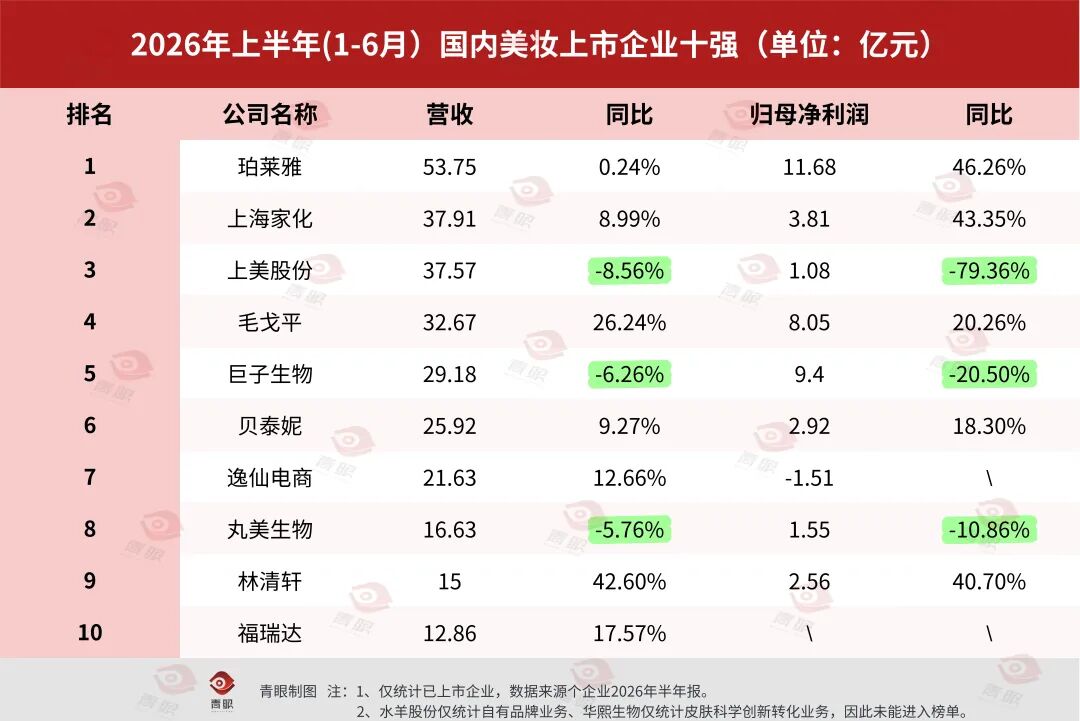
In terms of ranking, Proya is still the "leader" among Chinese beauty enterprises, and it is also the only Chinese cosmetics company whose revenue exceeded 5 billion yuan in the first half of this year.
In the first half of 2026, 3 enterprises achieved revenue between 3 billion yuan and 4 billion yuan, namely Jahwa, Shanghai Chicmax and Mao Geping; there were also 3 enterprises with revenue ranging from 2 billion yuan to 3 billion yuan, namely Giant Biotech, Botanee Group and Yatsen Holding. The revenue of Marubi Biotechnology, Lin Qingxuan and Freda were all below 2 billion yuan.
In terms of attributable net profit, only Proya exceeded 1 billion yuan, reaching 1.168 billion yuan. In addition, Giant Biotech and Mao Geping ranked the second and third with attributable net profit of 940 million yuan and 805 million yuan respectively. The attributable net profit of the remaining 7 enterprises did not exceed 500 million yuan. Besides, Yatsen Holding is still the only enterprise that recorded net profit loss, with a loss of 151 million yuan in the first half of this year.
Overall, in the first half of 2026, 5 of the top ten domestic beauty enterprises recorded growth in attributable net profit. Among them, the attributable net profit growth rates of Proya, Jahwa and Lin Qingxuan all exceeded 40%, reaching 46.26%, 43.35% and 40.7% respectively. In addition, the attributable net profit growth rates of Mao Geping and Botanee Group were 20.26% and 18.3% respectively. While the attributable net profit of Shanghai Chicmax, Giant Biotech and Marubi Biotechnology declined to varying degrees.
It should be noted that since its establishment, Water Sheep Co., Ltd. has adopted the business model of "dual drive of self-owned brands and agency brands". In addition to self-owned brands such as UNIFON, Little Mijoy, Huayaohua, EviDenS de Beauté, RéVive and PIER AUGÉ, it also acts as an agent for multiple brands under Johnson & Johnson. Previously, Water Sheep Co., Ltd. rarely disclosed the performance of its self-owned brands, so it has been on the list of top ten domestic beauty enterprises for many times based on its overall performance.
In the first half of this year, Water Sheep Co., Ltd. disclosed that the revenue of its self-owned brands was 1.148 billion yuan. Therefore, calculated only by the performance of self-owned brands, the company failed to enter the top ten domestic beauty list this time.
CHANDO is currently in the stage of applying for IPO on the Hong Kong Stock Exchange. The group once appeared on the 2025 top ten domestic beauty list with an annual revenue of 5.318 billion yuan (for details, please refer to Qingyan's article "Latest! The ranking of China's top ten beauty companies has changed drastically"). However, up to now, CHANDO has not updated its prospectus, and its performance in the first half of this year has not been disclosed, so the company is not included in this list.
Another domestic beauty enterprise, Fullerene, recorded a revenue of 1.156 billion yuan in the first half of this year, with a year-on-year increase of 33.95%, which is less than Freda that ranks the 10th, so it also failed to enter the top ten. Bloomage Biotechnology, which was previously on the list (only counting the skin science innovation and transformation business), recorded a revenue of 448 million yuan in the first half of 2026 and fell out of the top ten.
Fierce Competition, Obvious Changes in Top Ten Rankings
China's beauty market is facing the cyclical challenge of growth shift. How to go through the cycle and maintain the upward momentum is undoubtedly a deep test for the comprehensive operation capability of enterprises.
By sorting out the rankings of the top ten domestic beauty enterprises in the first half of the past 3 years, Qingyan found that the changes are very obvious. While new enterprises enter the list, some enterprises also drop out of the top ten list, which reflects the fierce competition situation of domestic beauty brands.
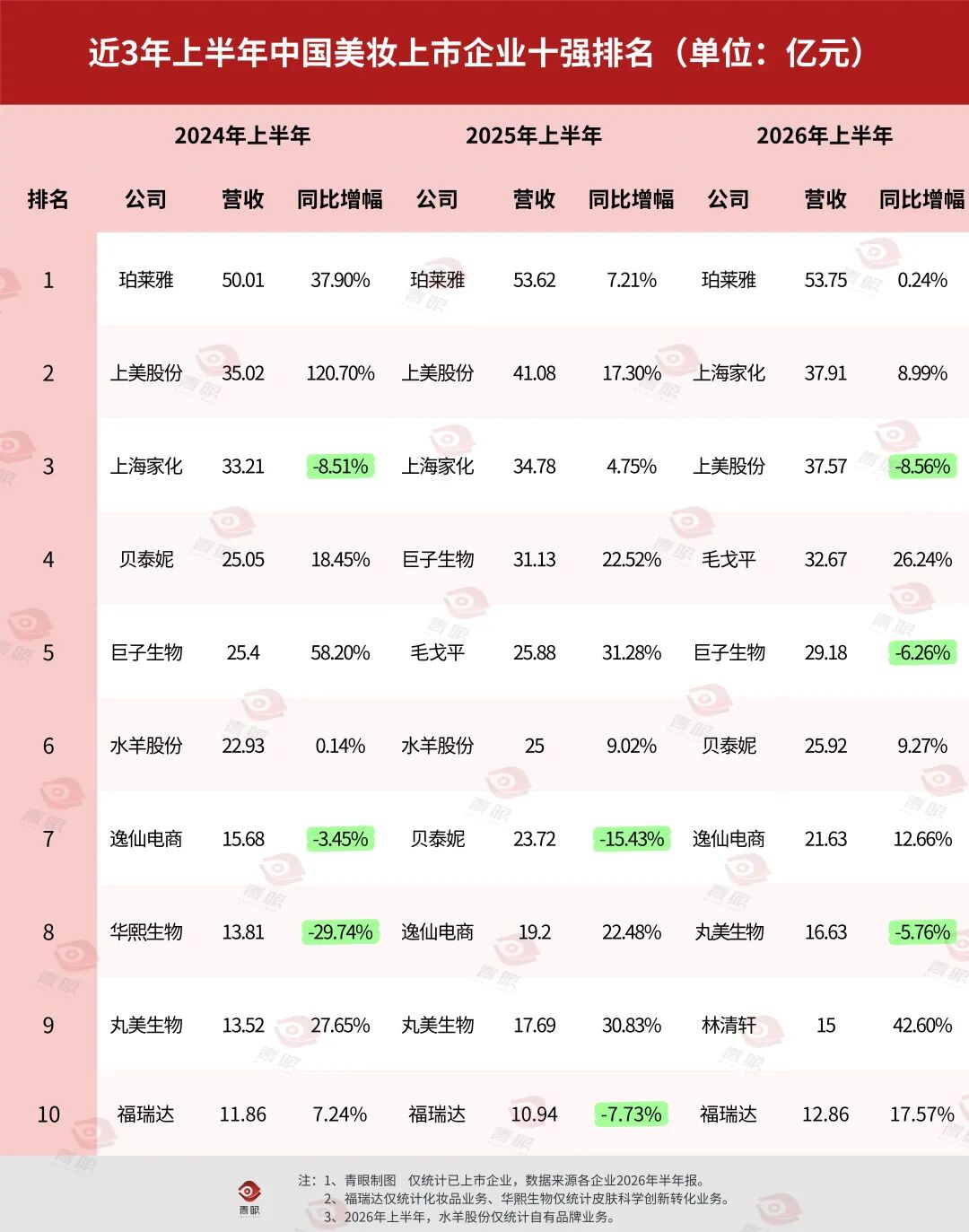
Specifically, the top 3 positions in the list have always been firmly occupied by Proya, Shanghai Chicmax and Jahwa. Among them, Proya steadily ranks first; in the first half of 2024 and 2025, Shanghai Chicmax slightly surpassed Jahwa and ranked second, but in the first half of this year, Jahwa overtook Shanghai Chicmax with a slight advantage and rose to the second place.
Botanee Group, which ranked 4th in the first half of 2024, also saw fluctuations in its ranking. It dropped to 7th in the first half of 2025 and rose to 6th in the first half of this year. Giant Biotech has been hovering between the 4th and 5th place. The enterprise maintained a rapid growth state in the first half of 2024 and 2025, but recorded a slight decline of 6.26% in the first half of this year. Mao Geping's ranking in the first half of this year rose by one level compared with the same period last year, ranking 4th.
It is worth mentioning that Lin Qingxuan is on the list for the first time in the past 3 years, ranking 9th. The company was successfully listed on December 30 last year, and became a "new player" in the top ten domestic beauty enterprises with its good growth momentum. In the past three years, Freda's ranking has not changed much, and it has always been in the 10th position.
As mentioned above, due to the change of statistical caliber, Water Sheep Co., Ltd. steadily ranked 6th in the first half of 2024 and 2025, but failed to be on the list this year because only the performance of self-owned brands is counted.
Due to the continuous decline in performance, Bloomage Biotechnology has never returned to the list after only ranking 8th in the first half of 2024.
Overall, the competitive pattern of the top ten domestic beauty enterprises has changed greatly in recent years. Some enterprises that once grew rapidly have gradually declined for various reasons; while some other enterprises seized opportunities and achieved counter-trend growth.
1 Billion Yuan, the New Threshold for the Top Ten Domestic Beauty Brands
For the brand side, Qingyan further sorted out and ranked the brands under Chinese listed beauty enterprises. The top ten domestic beauty brands are: Proya, KANS, Comfy, Winona, Lin Qingxuan, Marubi, Fullerene (only counting cosmetics business), Yilian, Page Zero and Tang Dynasty.
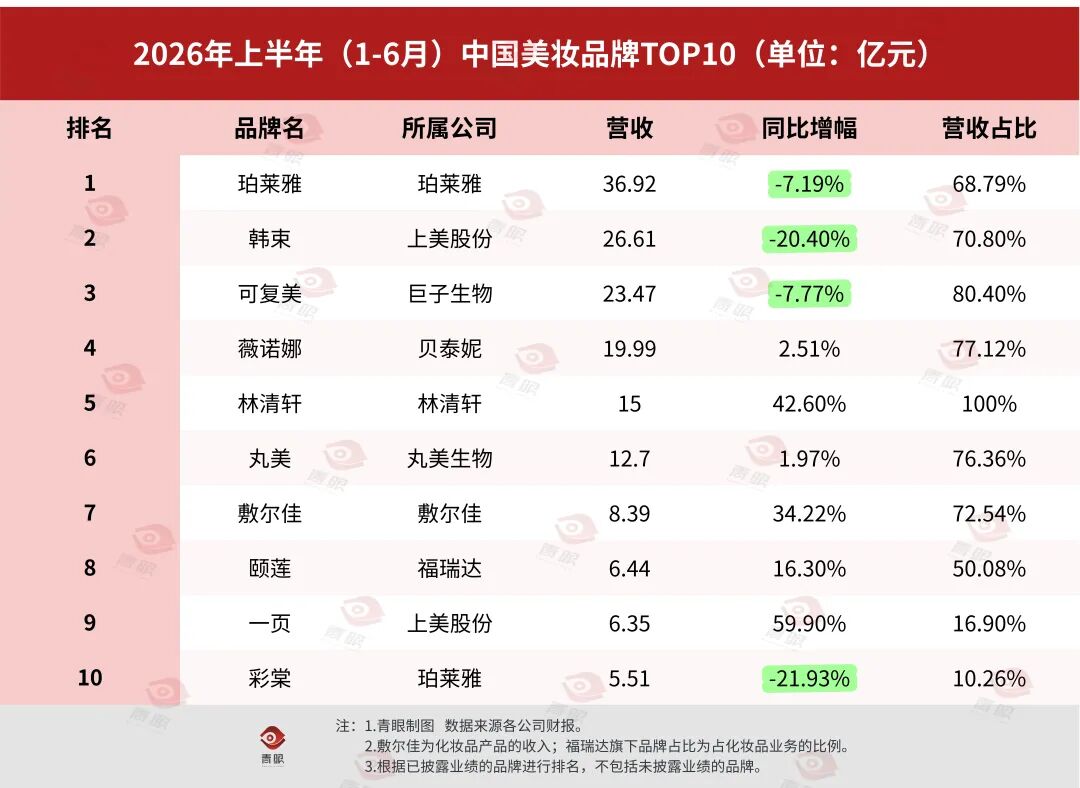
In terms of the parent companies of the brands, 90% of the brands come from the top ten domestic beauty enterprises, and only Fullerene belongs to Fullerene Group, which has not been on the top ten domestic beauty list for the time being. It is worth mentioning that Proya has two brands on the list, namely Proya and Tang Dynasty; Shanghai Chicmax also has two brands on the list, namely KANS and Page Zero.
It is not difficult to find that most of these top ten brands are the core brands of their respective parent companies. Among them, 6 brands including Lin Qingxuan, Comfy, KANS, Winona, Marubi and Fullerene account for more than 70% of their parent companies' revenue.
It is worth noting that among the top ten brands on the list, only Page Zero and Tang Dynasty account for less than 20% of the parent company's revenue, but their presence on the list also indirectly shows that the second growth curve brands of Shanghai Chicmax and Proya have achieved considerable development.
Overall, all the beauty brands that enter the top ten domestic brands recorded revenue of more than 500 million yuan in the first half of this year. For example, Tang Dynasty, which ranks 10th, recorded a revenue of 551 million yuan in the first half of 2026. Among these 10 brands, only 3 brands have revenue exceeding 2 billion yuan, namely Proya, KANS and Comfy. Moreover, only Proya's revenue exceeded 3 billion yuan, reaching 3.692 billion yuan, which is far ahead of other brands.
It is noteworthy that if we calculate based on the revenue of 551 million yuan of Tang Dynasty, which ranks 10th in the first half of this year, the annual revenue threshold for the top ten domestic beauty brands may exceed 1 billion yuan.
In addition, among the above 10 brands, 6 brands achieved performance growth in the first half of 2026, and 4 brands recorded decline. Among them, Page Zero has the highest growth rate of 59.9%. In addition, the growth rates of Lin Qingxuan and Fullerene both exceeded 30%, reaching 42.6% and 34.22% respectively.
It should be noted that since Jahwa, Mao Geping, Yatsen Holding and other enterprises did not disclose the revenue of their respective brands in the 2026 semi-annual report, the ranking cannot be carried out.
It is also worth mentioning that Mao Geping previously disclosed in the 2024 semi-annual report that the revenue proportion of MAOGEPING brand was 99.3%, and in the 2026 semi-annual report, the company also clearly stated that the MAOGEPING brand contributed the main sales revenue to Mao Geping. Therefore, combined with the revenue of Mao Geping in the first half of 2026, it is estimated that the revenue of MAOGEPING brand in the first half of this year may be around 3.2 billion yuan.
As we all know, with the change of economic cycle and the fading of traffic dividend, the domestic beauty market has entered a new growth dilemma in recent years. Therefore, many enterprises have begun to actively seek the second growth curve in addition to the main brand, and building a multi-brand matrix has become the consensus of leading beauty groups. At present, leading enterprises represented by Proya and Shanghai Chicmax have formed their second growth curve after years of cultivation.
Therefore, under the guidance of this correct path, more and more enterprises have started to make layouts. A typical example is that while consolidating the foundation of its main brand, Lin Qingxuan has started to build multiple brands including Huarongzhuang for community beauty services, Xiaoxinxuan for adolescent skin care, Moqi for men's skin care, and Shaohua for CS channel sub-brand.
In addition, Shanghai Chicmax also publicly stated that in the second half of 2026, it will successively launch multiple brands such as Hello Kitty, Light Guard and Cui Yutao to further enrich its brand matrix. Proya has acquired most of the equity of Huazhizhao and included it in its brand portfolio.
It can be predicted that with the implementation and maturity of the multi-brand matrix strategy of the top ten domestic beauty enterprises, on the one hand, the competition among domestic beauty brands will become increasingly fierce; on the other hand, China's beauty market is expected to present a new pattern of diverse development.
Notes:
1. The top ten domestic beauty list only counts listed enterprises;
2. IPO enterprises such as CHANDO are not included as they did not disclose the latest financial information.
This article is from the WeChat official account "Qingyan", the author is Baicong, and 36Kr is authorized to publish it.