Surprised? The first IP movie of Chiikawa, whose related merchandise you frantically lined up to snap up, has achieved a massive box office hit.
Chiikawa is a web manga serialized by Japanese manga artist Nagano on Twitter (X) since 2020, and it has become one of Japan's national-level IPs in just a few years. It won the annual championship of the 2025 Japan Character Awards for two consecutive years, and the organizer commented that it has triggered an inestimable "Chiikawa economic effect" in Japan, with an estimated scale of over 350 billion yen.
As the first theatrical animated film of this IP, *The Secret of Mermaid Island* was released in Japan on July 24. For more than a month, its box office has approached 12.2 billion yen, attracting more than 7.66 million viewers.
The industry estimates that its box office is expected to exceed 15 billion yen. Just as *The Witch Brigade*, a phenomenal animated film, made its soundtrack a nationwide hit, the two original soundtracks (OST) of *The Secret of Mermaid Island* also took the top two spots on Japan's Billboard JAPAN and ORICON charts in August 2026, and Usagi's catchy viral rap has also become widely popular across social platforms.
The Chinese domestic market is no stranger to this IP. In 2024, Alibaba Fish became the exclusive general agent of Chiikawa IP in China. Thanks to a series of successful operations, these cute characters became popular in the form of emojis very early, attracting a large number of pan-cultural audiences, and making many people's impression of Chiikawa deeply associated with the cute images of pop-up stores and various brand co-branding campaigns.
An IP that the general public in China roughly equates to "emojis" — why did its native region produce its first feature film, and how did it achieve phenomenal box office performance with almost no large-scale promotion, but only by generously giving away peripheral merchandise?
In contrast, why can we say that its localized implementation in China is actually a success?
A more practical discussion may lie in: when domestic Chinese IPs are expected to enter regular content development in the future, how can IPs create high-quality content?
We talked with professional IP, animation and film practitioners in China and Japan, as well as IP fans, and some ideas may serve as references.
The core of Chiikawa's first IP feature film
It balances the cuteness that meets public demand and the native "dark" realistic elements
It must be admitted that no matter in the IP's native origin or the Chinese market, the first reason why fans love the Chiikawa IP is indeed "cuteness", and it is a distinct, non-repetitive style of cuteness.
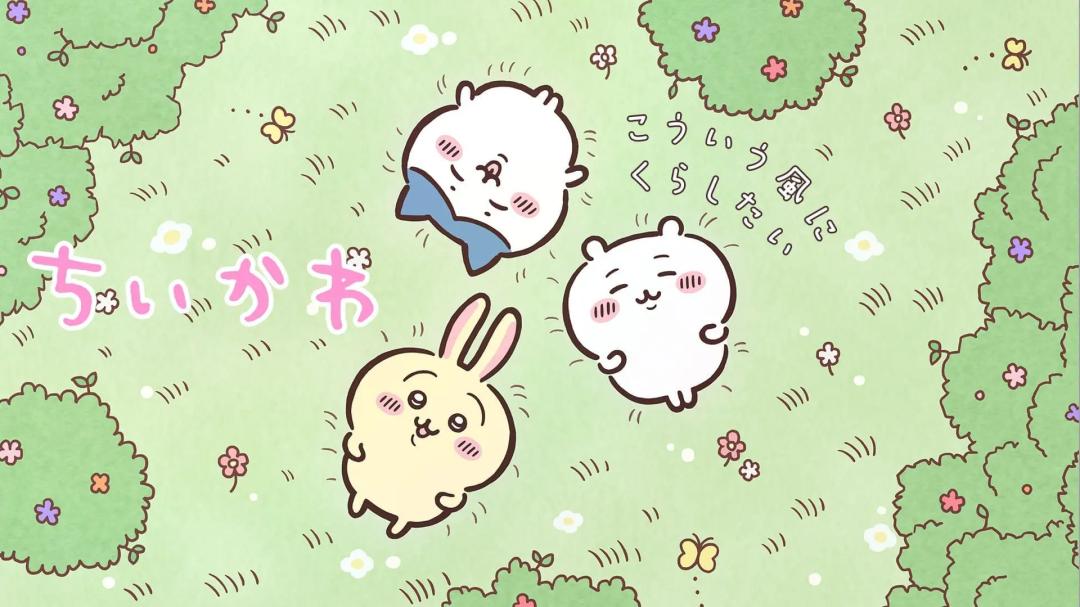
For example, the three-member main group: Chiikawa is soft, socially anxious, but has the diligence of a classic shonen protagonist. It seems to be the most timid, but will summon up courage to save friends at critical moments. Hachiware is a typical "extrovert" with super high insensitivity, and is the only one in the main group who can speak fluently, often acting as a "translator" and full of enthusiasm for life and friends. Usagi has a magical train of thought and mental state, acting as the brain of the team. It seems unreliable but has the strongest combat power, forming a contrastingly cute character that turns the tide at critical moments.
However, the original worldview of Chiikawa is not as cute as the appearance of the characters, and it can even be described as profound.
In the original setting, the operating rules of the Chiikawa world have many similarities with the adult society.
For example, there is a wealth gap in this world: Chiikawa can move into a house in a wealthy area by winning the lottery, while Hachiware lives in a cave. The protagonists usually earn money through labor such as generating electricity, weeding, and monster hunting. To get higher pay, they also need to pass exams to obtain different levels of certificates. More "dark" is that if the mental pressure from work, interpersonal relationships and other aspects is too high, they may turn into a chimera and eat their companions.
This time, *The Secret of Mermaid Island* even amplifies this somewhat "dark adult" underlying tone.

The film is adapted from the long chapter "Siren Arc" which sparked a lot of discussions during the manga serialization. At the beginning of the story, Usagi receives a special island invitation: as long as you go to the island to complete a "simple monster hunt", you can get 100 times the huge remuneration, and you can also eat limited ramen and desserts for free. So the main group sails to the island, starting a seemingly happy island adventure, but actually explores propositions such as the view of immortality and revenge.
However, just like the manga, the film also has a warm side under the "dark rules" of the adult society. The main group helps each other to solve problems together, showing the warm healing power of mutual assistance among working people.
Feedback from several audiences in Japan interviewed by East-West Entertainment shows that despite the controversy over the exquisiteness of the picture and the completeness of the narrative, there are no real villains in the film, the ending is thought-provoking, and different people can have different interpretations of it.
Ma Yanwu, a film investor who has experience in introducing and distributing copyrights of top Japanese animation IP films, believes that the first half of the Chiikawa feature film continues the consistent cute and relaxed tone of the characters, while the second half turns to a deep expression even with dark aesthetic elements. This contrast creates strong topicality, making the film not just a simple IP fan movie, but a work that can trigger discussions on issues such as the view of life and death and human nature.
In short, it balances the "moe" attribute of this IP at the level of mass consumption and its native setting. While ensuring that the current value and "selling points" of the IP are not affected, it also follows the social resonance that the film itself needs as a medium.
An industry veteran who has long been engaged in Japanese two-dimensional IP copyright agency told East-West Entertainment that for IP owners, making films is an opportunity to reinterpret the IP in front of more users. In recent years, Japanese IP owners attach great importance to whether their films can trigger discussions, so it is not surprising that their first film chooses to fit social issues. Even "some seemingly weird operations in content production may be deliberately designed for higher discussion volume."
The first IP feature film became a huge hit immediately
Is the distribution mainly relying on natural traffic and giving away IP peripheral merchandise?
In Japan, a film that breaks 10 billion yen at the box office can be called a huge hit.
According to exchanges between East-West Entertainment and Japanese film practitioners, an important indicator of Japanese films is the "audience mobilization number", that is, the number of people who go to the cinema to watch the film, which is related to Japan's population distribution structure and other factors. Cinemas in the three major metropolitan areas can be reached on foot, while other cinemas can only be reached by car. As a result, cinemas basically cannot arrange screenings after 9 p.m., because the audience cannot get home after the show. Especially due to curfew regulations, children's films cannot be scheduled with a closing time later than 11 p.m.
All kinds of factors make the main audience of Japanese cinemas now housewives and the elderly.
Most adult men are attracted to cinemas by "moe-style" animations, while adult women mainly go to cinemas to watch concerts or films starring and voiced by idol stars. Earlier, the first film of Light Chaser Animation, *White Snake: The Origin*, was released in Japan in July 2021 and achieved a box office of about 200 million yen. "A big reason is that we found Sakuma Daisuke, a member of the popular Japanese idol group Snow Man, to voice the male lead," said a Japanese-based animation producer.
In this context, a film that can break 10 billion yen at the box office can be called a huge hit. The Chiikawa film has attracted a large number of young, middle-aged and elderly female audiences to the cinema.
In addition to the factors of IP and film audience base, the strategy of the producer of *The Secret of Mermaid Island* is also very focused: after completing all standard operations, it did not invest extra money in overwhelming social media promotion and offline ground promotion, but directly gave away peripheral merchandise to boost box office, and continuously launched new peripheral merchandise for sale during the film's hot screening period.
In fact, it is very common for Japanese films to promote movie-watching through multiple rounds of special gift giveaways, and the types of gifts are very diverse. But most of the time, the giveaways are conditional, such as lottery selection, limited quantity, divided rounds and so on.
However, this time Chiikawa's film has a very large intensity of giving away peripheral merchandise: a special gift peripheral is given away with every ticket purchased, and three rounds of different products have been given away since the film was released. The first round is 8 randomly distributed mini pendants, the second round is BonbonDrop three-dimensional stickers with transparent candy texture, and the third round is 3 movable siren car toys of different characters. There is always one product that can make fans tempted, not to mention that many fans will buy tickets repeatedly just to collect all the peripheral gifts.
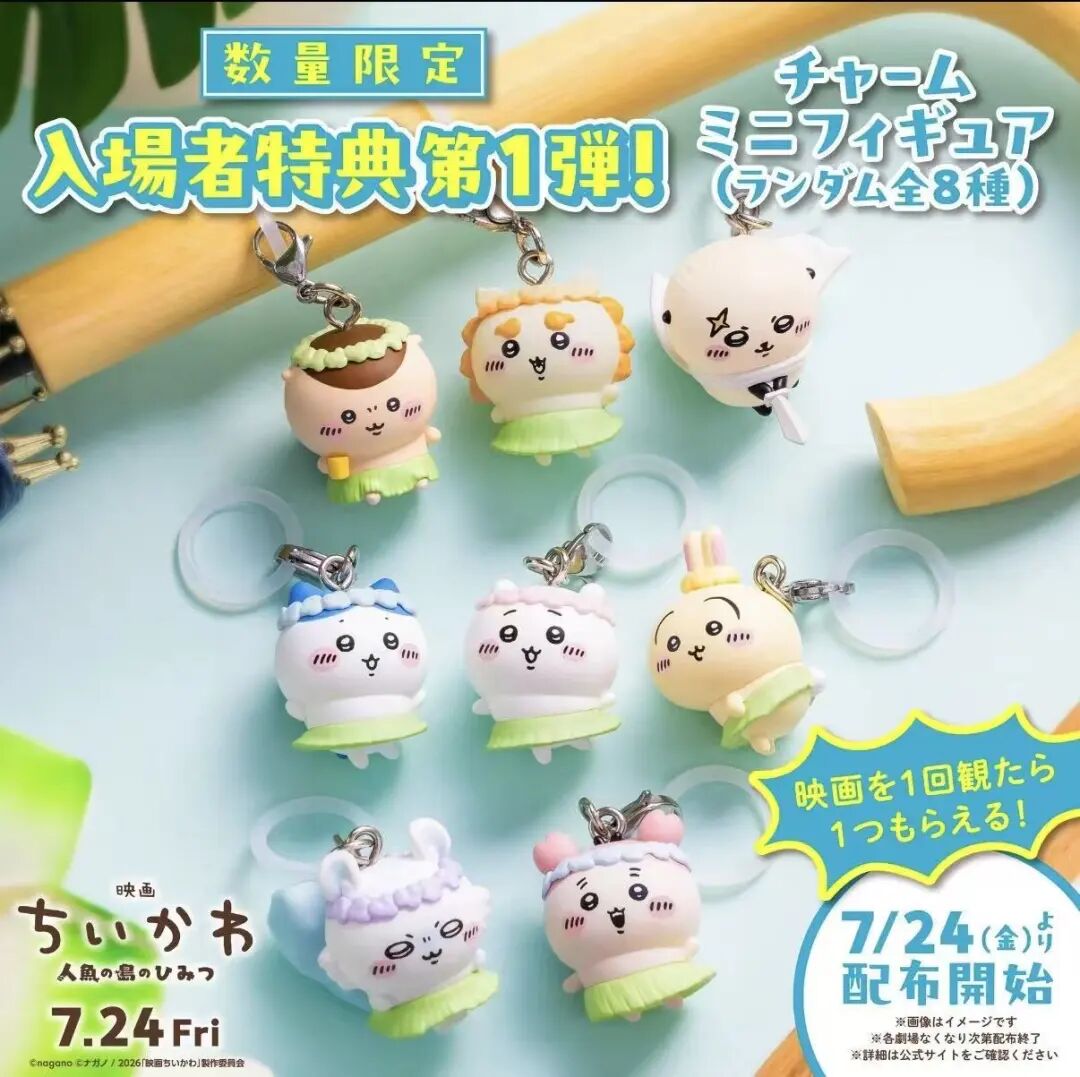
Now the box office of the film is still growing, and the producer has also announced that it will launch the fourth round of special gifts with tickets starting from September 5, which is one of the reasons why the industry is optimistic that its box office will exceed 15 billion yen.
In fact, the development period of *The Secret of Mermaid Island* is not very long.
In the first half of last year, some domestic practitioners engaged in the import business of Japanese batch films learned that Chiikawa had a plan to adapt its work into a film. In November last year, Toho Co., Ltd. officially announced that it would adapt this IP into an animated film for the first time, directed by Oikawa Kei, the director of popular animations such as *Cells at Work! CODE BLACK* and *Minami-ke*, scheduled for the summer of 2026, and it was released as scheduled on July 24 this year.
Ma Yanwu estimates that judging from the presentation effect of the film, the pure production cost is estimated to be as low as tens of millions of RMB or even lower, and 30 million RMB can be regarded as a high investment. And since it is adapted from the serialized plot, the profit margin will be even higher.
According to the Japanese film revenue sharing system, for producers, the box office break-even line is generally 2.5 times the cost. That means the film can break even once its box office exceeds 50 million RMB (about 1.2 billion yen).
The production cost is not high, so what about the distribution? From a series of operations, this distribution is not very "film-like" at all, but very direct: it is essentially "selling" the IP.
The above-mentioned Japanese-based animation producer told East-West Entertainment that Chiikawa is already a national-level IP in Japan on par with *Chibi Maruko-chan* and *Crayon Shin-chan*. "The entire Chiikawa IP does not have large-scale promotion operations in Japan. For example, the animation itself basically relies entirely on natural traffic."
Different from general animations, Chiikawa animation has been broadcast every Tuesday and Friday since April 2022, as a fixed small segment in Fuji TV's signature morning news and information program *Mezamashi TV*. Each episode of the animation lasts for about more than 1 minute, usually broadcast around 7:40 in the morning, and interactive content such as "Chiikawa divination" will also appear in the program. After the TV premiere, the episodes will be available for limited-time playback for one week on online channels such as YouTube.
"This time period almost covers all adult audiences of Fuji TV. And Fuji TV is not very keen on investing in marketing now."
So overall, the producer did not spend a lot of money on promotion, as long as the basic operations are in place. The biggest significance of this film for the IP owner is to further boost the IP value and sell IP merchandise in a benign way.
The permanent lesson for IP operators
Open the closed loop between IP merchandise and IP content, and learn how to balance and respect both sides
Last year, the film *Yokoyama Little Monster* achieved a box office of 1.719 billion RMB, which to some extent verified that telling "working people's narratives" in a fictional animation form can resonate with many young people.
These two IPs actually have something in common: they both have a sense of reality under a fantasy background, which can trigger discussions on realistic issues. Under a slightly cruel worldview, they can also show a warm and healing side. And the characters are not perfect, with obvious shortcomings, which makes them closer to the hearts of ordinary people.
However, such IP expressions relatively need the support of localized social emotions. When moving to non-local markets, good cultural translation work must be done.
Relevant practitioners told East-West Entertainment that if the native Chiikawa worldview is directly introduced into China, it will definitely be acclimatized.
In the Chinese market, Alibaba Fish officially announced in October 2024 with SpiralCute, the Japanese character copyright management company that owns the Chiikawa IP, that the two sides will carry out strategic cooperation around the three major IPs of Chiikawa, Nagano's Kani-san and Kamosan. Alibaba Fish thus became the exclusive general agent of Chiikawa IP in China.
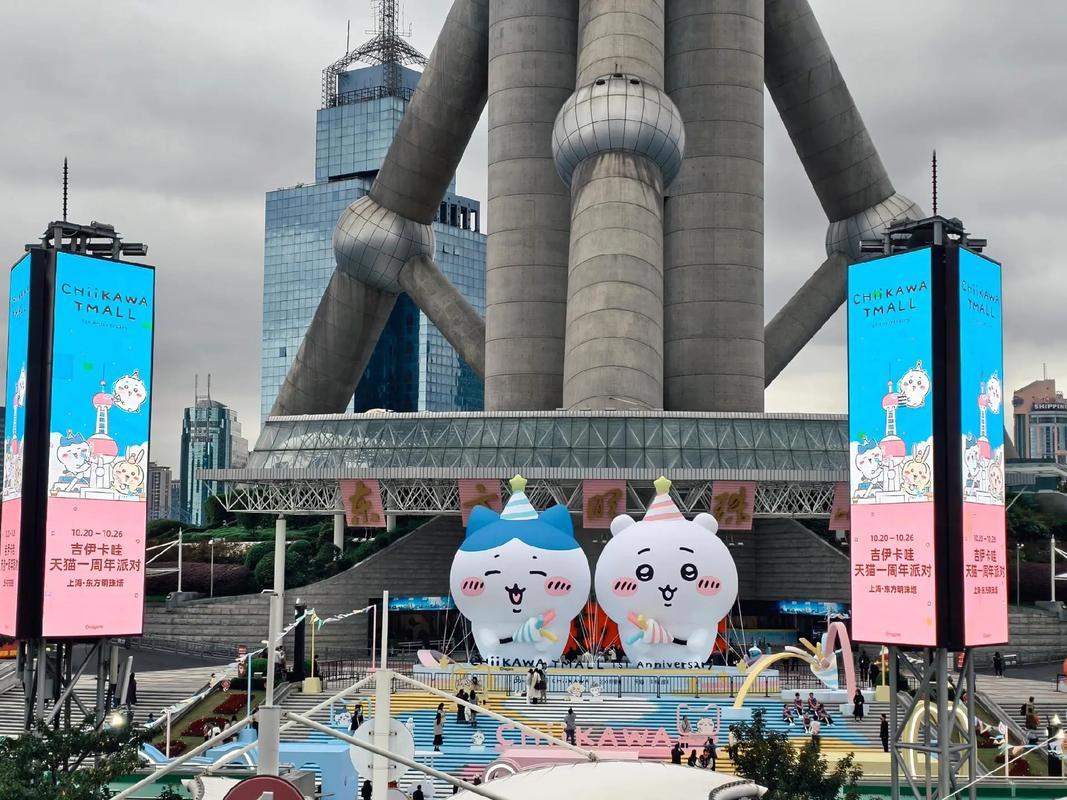
Alibaba Fish's localized operation strategy for Chiikawa strengthens its characteristic as a "cute image", and successfully avoids risks such as cultural acclimatization of the content.
For example, this is how it is described in its business manual for IP licensees such as brand owners:
Together with their best friends Hachiware and Usagi, Chiikawa touches the hearts of millions of people with warm stories in their daily lives. In a cozy fantasy world, they work hard and live their lives. Sometimes they encounter difficulties, but they help each other get through the tough times and have fun along the way.
This is indeed a more universal operation method for many overseas IPs entering China. For example, IPs such as Loopy and Peppa Pig all originate from animations, but in China, they are more recognized by the public as image IPs, and their cute characteristics have been amplified.
Back to the point that more people in China think Chiikawa is an emoji IP, the underlying logic is the same: it's not that content is unimportant, but in a market that lacks the support of local social emotions, cuteness itself is the most efficient passport.
Focusing on the cute image and amplifying the derivative value of the IP, Chiikawa also caught up with the rising period of China's badge and trendy toy economy.
In 2024, the Shanghai-themed pop-up store co-branded by Miniso and Chiikawa achieved a turnover of more than 8 million RMB in the first three days of opening. The number of fans of Chiikawa's official Tmall flagship store has reached 819,000, and this IP also ranked 16th in the popular IP list for the full cycle of Tmall 618 in 2026.
Under this relatively realistic model, content does have an important value: it serves the vitality of the IP.
When the Chiikawa IP's native market was operating the film, it was obviously well aware of this