2026 Mid-year Review of the Residential Energy Storage Sector: "Three New Kings" Lead the 3-Billion-Yuan Profit Club, with Mid-tier Players Engaged in Fierce Cutthroat Competition
In the first half of 2026, a rather abnormal scenario emerged in the residential energy storage industry: The hotter the market is, the more disparate the operating status of companies in this same industry becomes.
The global shipment volume reached 39GWh in H1, representing a year-on-year increase of 137%. Subsidies in Australia pushed the market to a high level, while emerging markets in Asia, the Middle East, Africa and other regions also saw rapid volume growth. The InfoLink ranking is even more striking: the top 5 players worldwide are all Chinese enterprises.
Judging solely from demand, this is undoubtedly the best period in the past three years. Logically speaking, a rising tide lifts all boats, and it should have been a collective harvest for all players.
However, if you look through the semi-annual reports of several companies, you will find a very surreal phenomenon: The market has doubled in size, but the business performance of all players has not improved in tandem.
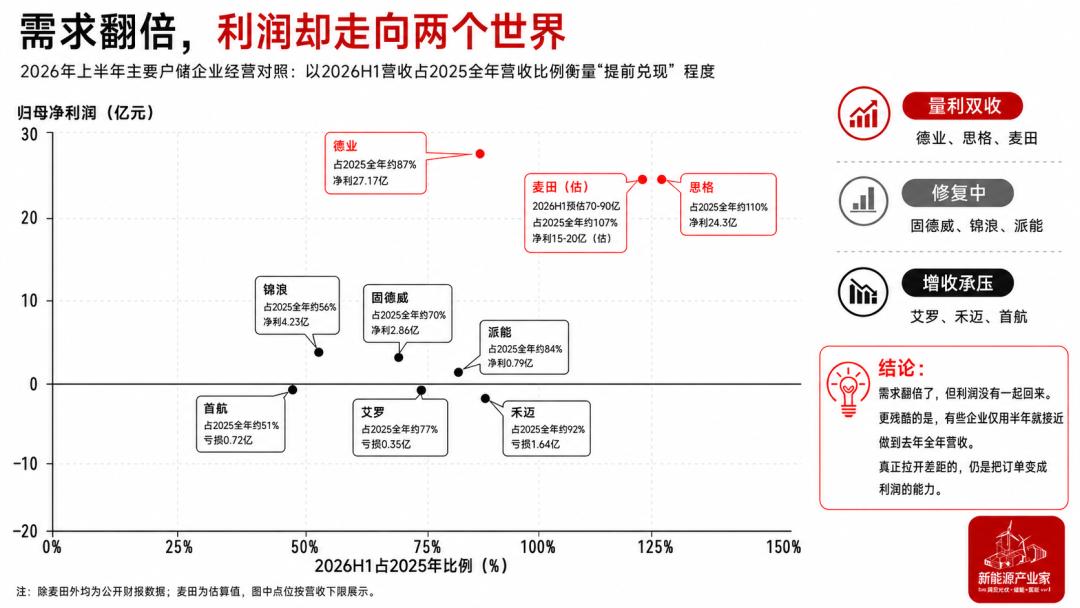
All players are selling residential energy storage products and catching up with the booming market, but the "Three Kings of Residential Energy Storage" we proposed earlier have further widened their leading gap against other peers.
Deye made a net profit of 2.7 billion yuan in the first half of the year, while Sungrow Power Supply earned 2.4 billion yuan, with both companies posting profits exceeding 2 billion yuan. Exclusive information from New Energy Industrialist shows that Maitian recorded revenue of approximately 70-9 billion yuan in 2026 H1, with net profit reaching roughly 1.5-2 billion yuan.
But on the other side, the revenue of Aolu and Hemai both increased by more than 70% year on year, yet both companies swung into net losses. Shouhang faced an even worse situation: its revenue only rose by over 10% year on year, and it directly fell from a 90 million yuan profit to a 70 million yuan loss.
Pylon Technology in the middle tier is in a clear recovery phase: its product sales volume in H1 increased by 158% year on year, and its attributable net profit rebounded to 79.29 million yuan. GoodWe has just turned profitable, while Growatt's energy storage business doubled in scale, but its overall profit still declined.
Do you still remember our previous article "The Three Kings of Residential Energy Storage"? The three players we named at that time, Maitian, Sungrow and Deye, have turned the prediction into solid financial results: the annual profits of the three companies are all approaching the 3 billion yuan threshold. They have not only firmly secured their positions in the first tier, but also completely widened the gap with other market participants.
While other players are still struggling to turn losses around and restore profitability, these three companies have already entered a new development dimension. The poor performance in the past two years could be attributed to high inventory in Europe, channel destocking and the extremely fierce price war.
But in 2026, these excuses no longer work.
When everyone's orders are growing, demand can no longer be used as a shield. The real question becomes: In the same booming market, why can some players make 2.7 billion yuan in half a year, while others lose more money the more products they sell?
01 A booming market fails to deliver identical performance results
If we compare the H1 2026 revenue with the full-year revenue of 2025, the leading advantage of the top three players will be more intuitive.
Sungrow recorded 98.74 billion yuan in revenue in H1, which is already equivalent to approximately 110% of its full-year revenue in 2025;
Calculated based on the latest estimated range of 70-9 billion yuan, Maitian's H1 revenue accounts for roughly 107%-138% of its full-year revenue last year;
Deye has also completed about 87% of its full-year revenue of last year.
Further down the ranking, Hemai, Pylon, Aolu and GoodWe have respectively completed 70% to 90% of their full-year revenue of last year, while Growatt and Shouhang have only completed over half of their full-year revenue target of last year.
In other words, 2026 has only passed half of the year, Sungrow and Maitian among the "Three Kings of Residential Energy Storage" have already finished or even exceeded their full-year revenue of last year in advance, and Deye has also approached 90% of its full-year revenue of last year. The gap between top players and mid-tier and lower-tier players is continuing to widen.
More importantly, for those enterprises that suffered the most losses in the inventory cycle over the past two years, their energy storage business has started to operate smoothly again.
GoodWe got rid of the loss predicament relying on the volume growth of energy storage batteries and inverters, and its operating cash flow also turned positive again.
Pylon's recovery is more straightforward. Its Q2 sales volume nearly doubled quarter on quarter, and the demand for residential, industrial and commercial energy storage in Europe, the Middle East and Southeast Asia rebounded simultaneously, finally pulling the company back to the growth track from the shadow of destocking.
Even for Growatt, whose revenue barely increased, there are bright spots behind the data: its revenue from energy storage inverters surged by 107%, but the decline of its traditional business is still dragging down its performance, so its net profit failed to keep up with the growth pace.
Up to now, the first-tier performance gap has emerged.
Judging from the semi-annual reports, the recovery of this round of residential energy storage prosperity is quite universal: the new top players are expanding rapidly, the veteran players are recovering their performance, and the transforming enterprises are also quickly tilting their revenue structure to the energy storage sector.
The real cruel divergence appears in the next dimension: profit.
In the same market boom, there are three completely different fate scripts for different players.
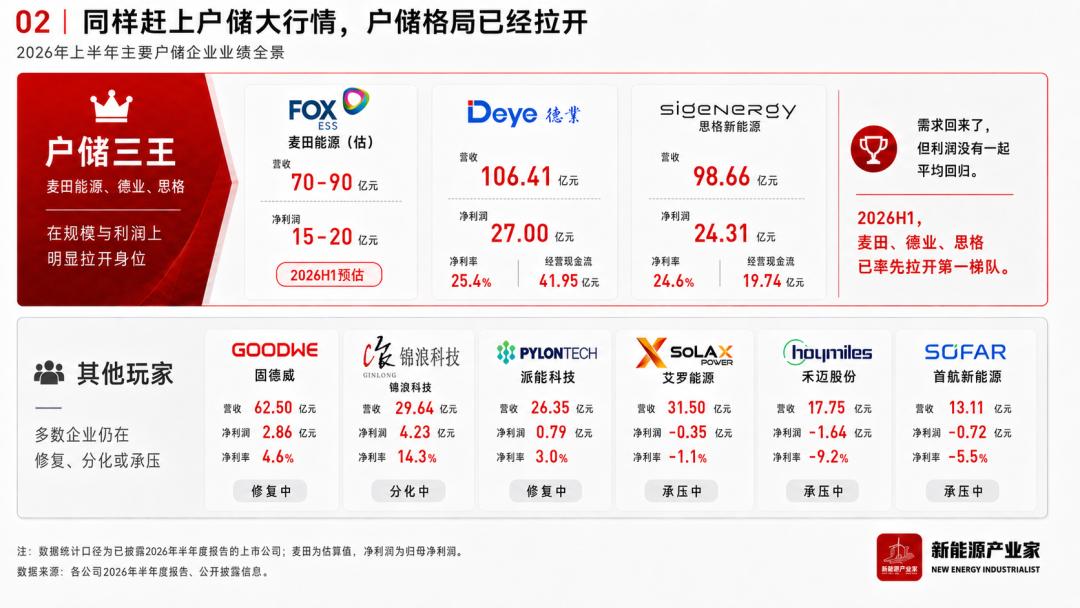
The first category is the winners who achieve both volume and profit growth: Maitian, Deye and Sungrow.
The three companies all reached the scale of billions of yuan in semi-annual net profit, with extremely high profit quality. They not only successfully sold out their products, but also collected solid cash returns. While expanding their scale, their profits are realized synchronously, which is the healthiest growth paradigm.
The second category is the backbones in the "recovering with wounds" stage: GoodWe, Growatt and Pylon.
They do benefit from the dividend of energy storage growth, but are still in different stages of performance recovery.
GoodWe has just climbed out of the loss pit;
Pylon's sales volume and revenue have recovered first, and it has returned to profitability, though its profit margin is still in the recovery process;
Growatt is struggling in the pain period of transition between new and old businesses, and the high growth of its energy storage business is still filling the gap left by its declining traditional business.
The third category is Aolu, Hemai and Shouhang, which are facing profit pressure despite revenue growth.
Their energy storage businesses have not stalled, and their growth rates are even quite impressive, but the newly added revenue has not been successfully converted into net profit in the end.
In H1, Shouhang's energy storage-related products (inverters + batteries + systems) contributed most of its revenue increment, but its net profit dropped from a profit of 91.23 million yuan to a loss of 72.11 million yuan.
The contrast of Hemai is even more drastic: nearly 80% of its revenue comes from energy storage systems, pushing its total revenue up by 77% year on year, but its attributable net profit fell from a profit of 16.27 million yuan into a huge loss of 164 million yuan.
Aolu is another extreme sample. New markets including Australia, Vietnam and the Philippines are growing rapidly, its revenue increased by 74.6% year on year, but its net profit dropped from 142 million yuan to -35.13 million yuan. Its energy storage business has not stalled, and its growth rate is even quite fast, but the newly added revenue has not been converted into net profit in the end.
This is the biggest difference between the 2026 semi-annual reports and those of the past two years.
When looking at residential energy storage financial reports in 2023 and 2024, the core question was "Has the inventory been digested completely?". But in 2026, this question has retreated to a secondary position.
The real question we should ask now is: For a residential energy storage company, for every 100 yuan of newly added revenue, how much money can it finally retain?
The three companies Deye, Maitian and Sungrow have firmly secured their positions as the Three Kings of Residential Energy Storage. While another group of companies are also sparing no effort to expand their revenue scale, they may only retain a few yuan from every 100 yuan of revenue, or even end up with a negative profit.
In the same market boom, the fate divergence among players has been so large that it cannot be explained only by the word "industry prosperity".
To figure out why some players achieve both scale and profit growth, some are recovering with wounds, while others lose more money the more products they sell, we have to re-examine the semi-annual reports of these companies — instead of only looking at revenue growth rate, we need to track every 100 yuan of revenue from the moment it is recorded: how much is taken away by product cost, how much is consumed by sales expenses, R&D investment and overseas expansion, and after the multi-layer filtering of exchange rate fluctuations, inventory impairment and accounts receivable, how much money finally flows back into the company's account.
That is exactly the battlefield where residential energy storage enterprises have widened their gaps this round.
02 Where does the profit divergence start?
If you break down the income statements of these companies, you will find that the gap that was really widened in H1 2026 comes from a very plain accounting logic:
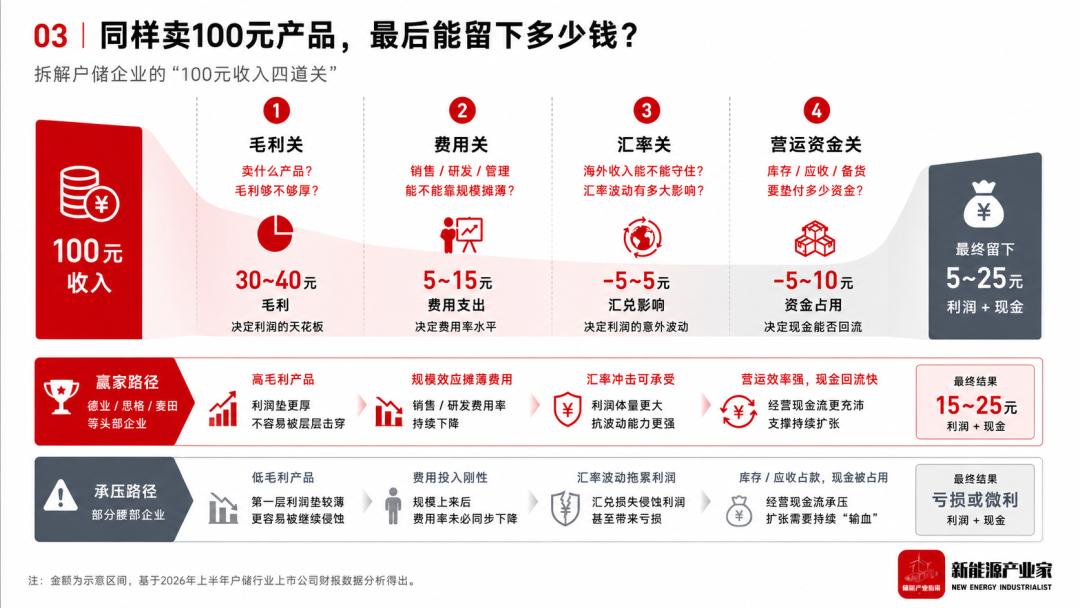
For every 100 yuan of revenue, the company needs to pass four barriers —
The first barrier is gross profit: the product cost cuts a part first, and the remaining part is the gross profit;
The second barrier is expenses: sales, R&D and management expenses each take a share, and the remaining part is operating profit;
The third barrier is exchange rate: unexpected items such as exchange fluctuations, inventory price decline and bad debt provision will make another round of screening;
The fourth barrier is cash flow: for the remaining paper profit, how much of it has actually turned into the balance in the company's bank account?
After going through the four steps, the fate of players that all earn 100 yuan of revenue has been completely different.
First: Growth is essentially a product structure problem
The first factor that divides enterprises into different tiers is not sales expenses, but gross profit. Deye recorded a comprehensive gross profit margin of 37.65% in H1, which is almost the same as that of last year.
This means that while its revenue increased from 5.535 billion yuan to 10.641 billion yuan, nearly doubling, it did not sacrifice much profit margin. Roughly calculated, for every 100 yuan of revenue, it can retain 38 yuan of gross profit first.
Sungrow performs even better, with a gross profit margin of 40.5%. Although it dropped by 11 percentage points compared with last year, its huge revenue base offsets this decline: nearly 10 billion yuan of revenue first generates 4 billion yuan of gross profit. The company also stated that the decline in gross profit is caused by rising raw material prices and increased channel incentives.
To put it simply, Sungrow made a very clear deal: it gave up a small proportion of profit margin in exchange for a larger market share. Its revenue more than tripled, and even though the gross profit margin declined, the total gross profit nearly tripled. This is a very cost-effective deal.
But for mid-tier companies, the situation is completely different.
Hemai is the most typical example. It was famous for micro-inverters in the past, but its energy storage business surged this year, accounting for 80% of its total revenue, and its business focus has been completely shifted.
The problem is that the profit generation capacity of these two businesses is not at the same level at all. The gross profit margin of micro-inverters is 33%, while that of energy storage systems is only 14%. As a result, an seemingly abnormal but actually inevitable result appears: The fastest growing business is exactly the least profitable one.
Its total cost rose by 98%, and its comprehensive gross profit margin dropped from 27% to 18%. It is not that it failed to seize the energy storage opportunity, but after the energy storage business expanded, the entire company's revenue structure has been completely rewritten.
Shouhang faces another type of pressure. In H1, its energy storage revenue accounted for more than half of its total revenue for the first time and doubled year on year, but the gross profit margins of both batteries and systems declined, and its traditional grid-tied inverter business is also lagging behind.
So the problem of Shouhang is not that the energy storage business is inherently unprofitable, but that the profitability of its newly added energy storage revenue is declining, while its traditional business has not been fully stabilized.
Aolu's situation is more straightforward. Its revenue rose by 75%, but its cost increased by 89%, and the gross profit margin dropped from 34% to 28%. The reasons are clearly stated: rising raw material prices, lower export tax rebates, and low prices for new market expansion.
So the first watershed of the 2026 residential energy storage industry is hidden in the revenue structure.
A 100% increase in revenue does not mean that the profit margin will also increase by 100%. Selling high-margin inverters is one type of growth, while selling low-margin battery systems is another type of growth; maintaining stable prices in mature markets is one type of growth, while seizing new markets with low prices is another type of growth.
The first answer from the semi-annual reports is very clear: What determines whether a company can make profits is not only how many products it sells, but also what products and what markets the newly added revenue comes from, and how much money can be retained from every 100 yuan of revenue at the very beginning.
Second: Scale advantage starts to convert into cost advantage
But only looking at gross profit is far from enough. Sungrow is a counterexample: its gross profit margin dropped by 11 percentage points, but why did its net profit still increase by 201%?
Because its revenue grew much faster than its expenses. The absolute amount of sales and R&D expenses are both increasing, but