Put a stop to the spillover of involution and impose shackles on automobile exports.
On the afternoon of September 1, the Ministry of Commerce, the Ministry of Industry and Information Technology, and the State Administration for Market Regulation released the *Guidelines on Overseas Competition Practices and Compliance Building for the Automotive Industry*, which provides guiding specifications for automakers' global expansion from two aspects: regulating overseas market competition practices and improving the capability of localized compliant operation abroad.
The release of this document is highly timely.
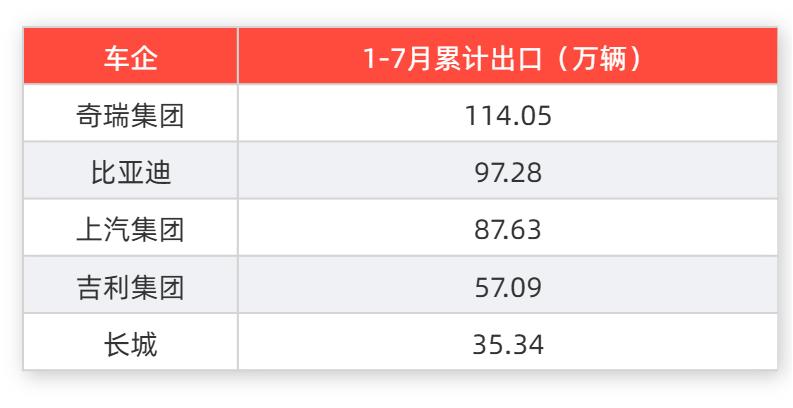
Since the beginning of this year, China's domestic auto market has continued to face mounting pressure, and overseas exports have become a key driver to stabilize sales. Data from the China Passenger Car Association shows that from January to July, China's auto exports reached 6.41 million units, a year-on-year increase of 54%. Leading enterprises including Chery, BYD, SAIC, Geely, Great Wall have all delivered remarkable performance. In July alone, auto exports hit 1.09 million units. The China Passenger Car Association estimates that China's auto export volume will reach 12 million units in 2026.
Alongside the rapid growth, the risks of unregulated expansion are also accumulating.
Over the past decade, China's automotive industry has achieved remarkable leapfrog development, yet various chronic problems left by extensive development have also erupted intensively in recent years, bringing extremely profound lessons to the domestic market.
Now the industry's overseas expansion has also ushered in a similar explosive growth cycle. To avoid repeating past mistakes, prompt reminders and warnings from authoritative departments are urgently needed.
The release of the Guidelines is a forward-looking arrangement made by the regulatory authorities based on the long-term development of the industry, to set norms, clarify bottom lines and avoid risks for automakers' overseas operations.
Signs of Involution Spilling Overseas Have Emerged
The booming export market, to some extent, reflects the anxiety of domestic sales. From January to July this year, the cumulative number of domestic passenger vehicle insurance registrations reached 10.2 million units, a year-on-year decrease of nearly 20%.
On the competition side, low-price involution has been curbed to some extent but can hardly be eradicated. Just to avoid being eliminated, the entire upstream and downstream industrial chain is already showing obvious signs of fatigue.
Even so, market sales are still hard to stabilize, and the overall profit margin of the industry has repeatedly hit new record lows. During the long period of downturn, signs of market rebound have not appeared for a long time, and a normal and stable market pricing system is still difficult to rebuild, putting automakers under sharply increasing pressure.
On the production side, the issues of labor employment, hastily assembled "quick-release vehicles" and payment terms that have sparked heated discussions in the past two years expose the management lag behind the industry's rapid expansion.
The recent layoff scandal of Xingyu has been widely discussed and continued to ferment for half a month. The enterprise has expanded its scale and achieved better benefits, but its management remains as extensive as that of a small workshop. In addition, complaints from employees in the upstream and downstream of the industry about long working hours and low wages also emerge from time to time.
The phenomenon of quick-release vehicles is also worthy of vigilance: the automobile R&D cycle has been drastically shortened, and products are rushed to the market without sufficient verification, leaving hidden dangers in quality control lingering.
The implementation of payment terms also faces obstacles. According to the first-quarter financial reports of more than a dozen listed automakers sorted out by media, the average payment turnaround days of the industry has increased instead of decreasing, rising by 27 days from the end of last year to 216 days, making the capital chain of upstream and downstream sectors increasingly tight.
From this perspective, the overseas expansion of Chinese auto brands has factors of natural progression, but more driving force comes from the pressure and anxiety in the domestic market. At present, the contradictions accumulated in the domestic market have not been completely resolved. When multiple brands pour into overseas markets in large quantities at the same time, their behavior patterns and competition inertia will inevitably be difficult to get rid of the abnormal haze from the domestic market.
In fact, this kind of involution spilling overseas has already shown initial signs.
Taking the Southeast Asian market as an example, some Chinese automakers have flocked to the A-class new energy passenger vehicle track, with prices highly overlapping in the range of 100,000 to 150,000 yuan, quickly replicating the domestic strategy of trading price for volume. Although this move reduces vehicle prices, it has greatly impacted the local existing model of supporting car purchases with loans, as well as the stable pricing system for new and used cars. Moreover, this strategy will also compress the profit margin of automakers themselves, which is not conducive to enterprises to take root overseas and achieve sustainable development in the long run.
This scene reminds people of the lessons from China's motorcycle exports to Southeast Asia in the past.
In the 1990s, Chinese motorcycles entered Southeast Asian markets such as Vietnam on a large scale relying on price advantages, once occupying more than 80% of the market at its peak. However, vicious price wars between enterprises emerged one after another, product quality was uneven, and after-sales service systems were almost non-existent, which eventually led to the collapse of the reputation of "Made in China" that has not recovered to this day.
Now the automotive industry is facing the same Southeast Asian market, the same logic of price wars, and the same kind of short-sighted risks when expanding overseas. History is the best textbook, but few people seem to take it to heart.
It is against this background that the Guidelines have been released in a timely manner.
In the interpretation released simultaneously by the Ministry of Commerce, it is clarified that the purpose of the Guidelines is to "promote the long-term, healthy and international development of the automotive industry, enhance the compliant operation capability and international influence of automotive enterprises, and promote the international cooperation of the global automotive industry chain and supply chain".
In short, it is to ensure that Chinese brands operate in compliance when going global, and avoid "spilling" domestic problems into overseas markets.
Beyond the Guidelines, Tough Enforcement Is Also Required
While releasing the Guidelines, the Ministry of Commerce also interpreted the logic behind its release, which mainly has three major characteristics.
The first is to highlight the public service attribute. As a specific achievement of the construction of the overseas comprehensive service system, the Guidelines are a public service product serving automotive enterprises' global expansion, which helps enterprises to standardize overseas competition practices in a timely manner, strengthen compliance building, and improve the level and influence of international operation.
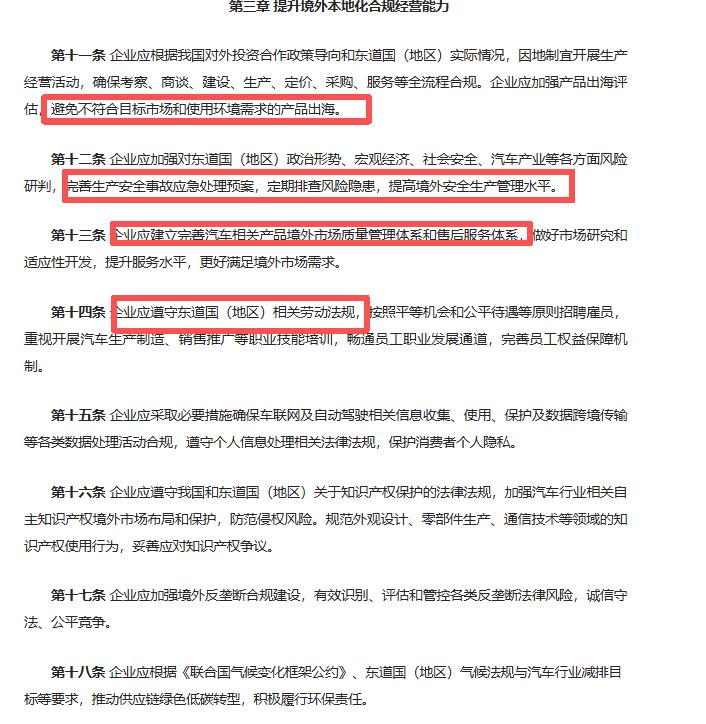
The key to this feature lies in "service". The Guidelines not only advise automakers to sell cars in compliance, but also advocate that automakers supervise dealers and agents to set reasonable prices, and establish a sound overseas market quality management system and after-sales service system for auto-related products. It covers the whole chain from sales, supervision to after-sales service, with every detail taken care of.
In the past, some enterprises simplified the construction of overseas channels into the extensive mode of "finding agents and conducting wholesale", with long-term absence of after-sales services. This kind of "one-off deal" practice is actually overdrafting the brand reputation and even the overall image of Chinese automobiles.
Especially in the field of new energy vehicles, after-sales demands such as battery health monitoring, software OTA upgrade and remote fault diagnosis are far higher than those of traditional fuel vehicles. If the service system fails to keep up, the consequences will be more serious. The Guidelines incorporate distribution and after-sales compliance into the norms, which is a timely complement to this short board.
The second is to highlight the practical application orientation. In the formulation process of the Guidelines, the current situation of Chinese enterprises' overseas production and operation has been fully considered, and the compliance practice experience of leading enterprises in the industry has been referred to, so as to provide operable guidelines for automotive enterprises' global expansion. Enterprises are encouraged to adjust and improve their work in the implementation according to local conditions, in line with relevant laws and regulations, anti-monopoly policies, market principles and commercial conventions.
This is reflected in advocating enterprises to carry out production and operation activities according to local conditions, ensuring that the whole process including investigation, negotiation, construction, production, pricing, procurement and service is compliant. At the same time, they should abide by local labor laws and regulations, improve the mechanism for protecting employees' rights, and strictly protect consumers' personal privacy in the process of data collection and use.
Taking labor compliance as an example, trade unions in South Korea and Europe have strong power, and labor laws have strict provisions on working hours, overtime work and dismissal protection. Recently, Hyundai Motor suffered losses of over 10 billion yuan due to workers' strikes during labor-management negotiations. If some enterprises with non-standard labor practices copy the domestic labor rhythm, they are very likely to trigger strikes, lawsuits and even administrative and economic penalties.
The third is to highlight the concept of win-win cooperation. The Guidelines emphasize the basic principles of legal compliance, fair competition and mutual benefit, which helps guide automotive enterprises to actively fulfill social responsibilities overseas and better integrate into the economic and social development of the host country; it also helps expand high-level opening-up and cooperation in the automotive industry, and promote the in-depth integration and common development of the global automotive industry chain and supply chain.
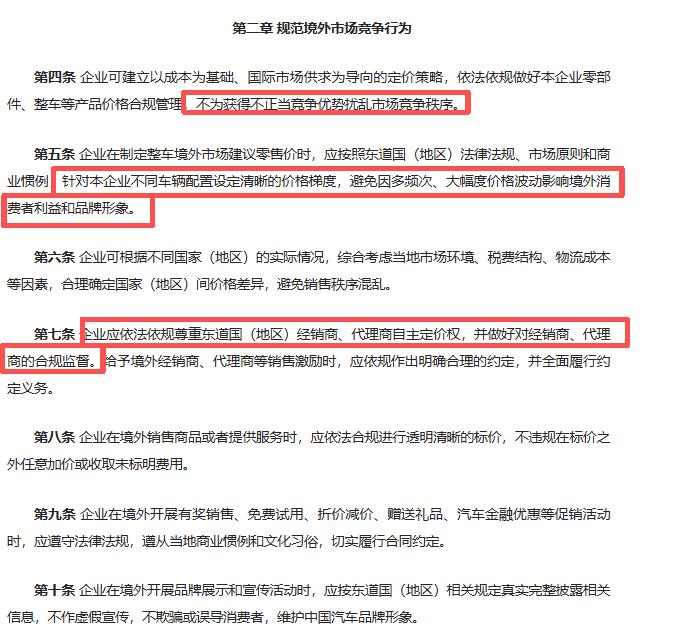
In the specific provisions, the Guidelines clearly advocate that automakers avoid price wars, refrain from frequent and substantial price adjustments, clearly mark prices, and do not make false or misleading publicity, which is also the core part of the entire document.
Price is the ultimate outlet for the core contradictions in the current market. In the domestic market, price wars have long reached a brutal stage. The low prices formed by involution, although making enterprises lose money reluctantly, have become the normal prices that are taken for granted in the minds of consumers.
However, in overseas markets, automobile prices can still remain at a relatively high level, which not only leaves valuable profit space but also is conducive to brand premium.
Taking traditional luxury brands as an example, the new all-electric Mercedes-Benz GLC, BMW iX3 and other models have significant price differences between domestic and overseas markets. The high pricing in overseas markets does not affect their sales, but instead consolidates the high-end perception of the brand.
Chinese brands also have the ability to achieve high premium overseas. The domestic price range of Denza Z9GT is between 250,000 and 350,000 yuan, but its price in the European market is close to one million yuan, in the same price range as Porsche. Even so, the orders have been scheduled for half a year, and there is no worry about sales.
This shows that the brand value of Chinese automobiles is recognized overseas. This overseas premium capability can not only provide a valuable profit buffer for domestic operational pressure, but also help improve the overall image positioning of Chinese auto brands. For this reason, this price buffer zone is extremely precious.
If the price war spreads to overseas, not to mention what impact the stable overseas market will suffer, the most valuable profit buffer zone for Chinese automobiles will also completely fail. In the end, the industry will still not get rid of the nightmare of involution.
The win-win concept advocated by the Guidelines already has positive cases for reference. For example, the cooperation between Leapmotor and Stellantis, where Leapmotor's products combined with Stellantis's local channels, brand endorsement and rich regional operation experience, form deep complementarity. Chery's OEM cooperation with local enterprises in Russia, Spain and Brazil has achieved good sales for the produced models.
However, we should also clearly realize that the essence of the Guidelines is still an advocacy and guiding policy document, rather than a legally binding law and regulation. The key to implementing it in practice lies in whether enterprises can establish a real industry consensus.
The same is true for the domestic auto market. Various norms and industry appeals are put forward every year, but it is the rigid constraints and the cost of violation that make the norms "truly enforceable". As Li Shufu said, "the survival of the fittest mechanism is the law", and the competition in the automotive industry must be based on more mandatory norms.
In overseas markets, in addition to domestic supervision, enterprises also have to face the multiple scrutiny of the host country's anti-monopoly, consumer protection and industry supervision. A single illegal price adjustment, a single data leak, a single labor dispute all contain huge risks, and overseas law enforcement will never be lenient.
The export target of 12 million units is close at hand. What is equally important is the long-term and sustained rooted growth. The Guidelines have pointed out the direction, and next it depends on whether enterprises have such awareness from the bottom of their hearts.
This article is from the WeChat official account "Auto Community" (ID: iAUTO2010), written by Sai Jiatong, authorized for release by 36Kr.