One Year After TikTok Shop Japan's Launch: A Smooth Start While Challenges Still Remain
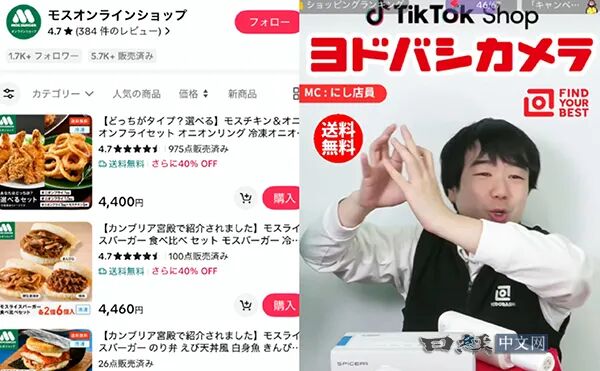
MOS FOOD SERVICES (left) and Yodobashi Camera have settled in TikTok Shop
TikTok Shop launched in Japan one year ago, with a gross merchandise value reaching approximately 50 billion yen. Despite a smooth start in Japan, the country's market size still lags behind overseas markets. A considerable number of people in Japan still have resistance to video e-commerce...
TikTok has been running its e-commerce business in Japan for a full year. While the pool of users and settled merchants is expanding, Japan's scale still pales in comparison to the leading United States. Whether TikTok can break the barrier that prevents video e-commerce from gaining widespread popularity in the Japanese market remains to be seen, with relevant explorations still ongoing.
A 24-year-old woman living in Setagaya Ward, Tokyo, said: "When I usually watch cosmetics reviews, I often search on TikTok. After scrolling through a recommended video and getting interested in the product before, I bought an umbrella that opens with one click."
ByteDance, which operates TikTok, launched the e-commerce feature "TikTok Shop" in Japan in June 2025. Users can directly purchase products introduced in short videos or live streams within the app, and complete the entire settlement process in the app as well.
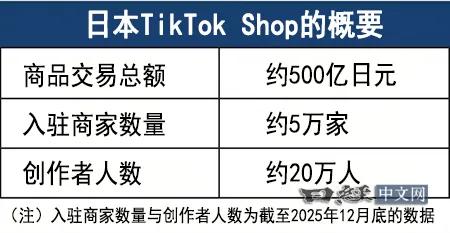
According to data from the Digital Commerce Research Institute, in the one-year period from June 2025 to June 2026, the gross merchandise value (GMV) of TikTok Shop in Japan reached approximately 50 billion yen, and the number of settled merchants reached around 50,000 as of the end of December 2025.
Compared with other e-commerce platforms, TikTok's biggest advantage lies in video. Around 70% of its total gross merchandise value comes from live streams and short videos.
Employees of Yodobashi Camera Go Live 5 to 6 Days a Week
Yodobashi Camera, which settled in TikTok Shop in November 2025, arranges 3 employees to live stream for 4 to 6 hours every day, 5 to 6 days a week. Kyosuke Nikaido, head of TikTok Shop operations, said: "The number of users is gradually increasing, and sales have shown an upward trend since January 2026."
The best-selling product in June was BOSE wireless headphones (priced at 39,600 yen, approximately 1,695.87 RMB). It is claimed that products that allow easy and detailed introduction of features such as noise cancellation are very suitable for display in live streams.
Looking at the top-ranked merchants by gross merchandise value, the sales generated by "Affiliate Videos", in which creators with more than 1,000 followers introduce products, account for a higher proportion than videos produced by the merchants themselves. Merchants adopt a mechanism that pays creators based on sales performance. In some cases, nearly 90% of the gross merchandise value comes from affiliate videos.
Products recommended by trusted creators are more attractive to consumers. The number of creators on TikTok Shop in Japan has reached approximately 200,000 as of the end of December 2025.
Japan's MOS FOOD SERVICES settled in TikTok Shop in April, and sales generated by creators account for about 80% of the company's total TikTok Shop sales. At present, around 300 creators have registered and published 766 videos.
Misaki Fukamochi from the MD Division of the Product Headquarters at MOS FOOD SERVICES said: "Products that are easy for creators to promote sell better, and the hot-selling categories are significantly different from those on existing e-commerce platforms." Products that can intuitively show the cooking process and are highly appetizing, such as frozen MOS fried chicken and onion rings, are very popular. About 3 months after launching TikTok Shop, its sales accounted for 20% of the company's overall e-commerce business, and the annual sales scale is expected to reach hundreds of millions of yen.
ByteDance, the operator of TikTok, stated that compared with overseas markets, food sales growth in the Japanese market is particularly prominent. Qiu Kaizhou, executive director of ByteDance's Japanese subsidiary, believes that live e-commerce is highly compatible with food categories as it easily conveys the texture and experience of food.
Compared with markets such as China, video e-commerce has failed to gain a firm foothold in Japan. TikTok has about 49.5 million users in Japan, and whether its entry into e-commerce can become an opportunity for video e-commerce to take root in the Japanese market has drawn widespread attention.
Japan's Gross Merchandise Value Lags Far Behind That of the US Market
Although TikTok Shop has got off to a smooth start in Japan, its market size still lags behind overseas markets. According to data from Singapore-based research firm Momentum Works, TikTok Shop's global gross merchandise value (GMV) reached approximately 64.3 billion U.S. dollars in 2025, doubling its scale from the previous year. The U.S. market reached about 15.1 billion U.S. dollars in GMV, a year-on-year increase of 70%.
Industry insiders believe: "At this stage, the number of TikTok Shop users in Japan may only account for a few percent of the total number of TikTok users." Some settled merchants revealed: "Most of the top sellers in the sales ranking are Chinese enterprises, and there are still very few well-known local Japanese brands and products familiar to Japanese consumers."
The operation of video e-commerce imposes a heavy burden, and many enterprises remain on the fence about whether to join the platform. Live streaming takes a long time, and it is difficult for a single person to take care of both replying to comments and introducing products. Many merchants need to entrust third-party service providers to make up for their lack of experience, which pushes up operating costs.
TikTok has begun to take measures to expand the scale of settled merchants in Japan. In March, it launched the "TikTok Shop Local" program to support the sales of local specialties. The program connects popular creators with local merchants to promote products through live streams, and was first launched in locations including Kagawa and Okinawa.
The platform will also roll out more support programs. In August, it launched the "Japan SOAR Together" support plan for small and medium-sized merchants, recruiting about 30 enterprises across Japan to support merchants operating handicrafts and agricultural products.
It is reported that 60% of TikTok Shop users in Japan are aged 35 or above, and video e-commerce has the potential to cover a wide range of age groups. But at the same time, many people in Japan still have resistance to video e-commerce. A female office worker in her 20s said: "The product introductions on TikTok Shop feel very much like blatant advertisements." Eliminating the resistance of Japanese consumers is also a key challenge the platform needs to overcome to expand its popularity.
This article is from the WeChat Official Account "Nikkei Chinese Network" (ID: rijingzhongwenwang), written by Ikuko Inafuku, and authorized for release by 36Kr.