The product has not been launched yet, but its valuation has reached 2.5 billion US dollars: In 2026, hot money in Silicon Valley is flocking to AI personal assistants.
Nowadays, what features are mainstream AI Agent products competing to develop? Programming, writing, design and drawing, video production, and video editing. It is clear that they are heavily focused on work scenarios. Whether it is Tencent, ByteDance or Alibaba, both large tech companies and unicorns are sparing no effort to make breakthroughs in this track.
But for ordinary people, work is the A side of life, and daily life is the B side. Have you ever been looking forward to a personal AI assistant that truly understands you, which can help you complete daily tasks such as booking flights, managing schedules, communicating, and shopping? Capital giants in Silicon Valley have already placed their bets on this future in advance.
IT Juzi has noticed that in the past six months, a number of AI startups have targeted the direction of AI Agent personal assistants, and all of them have achieved smooth financing.
For example, just the day before yesterday, on August 26, Instinct closed a $250 million Series B round of financing, with a valuation of $2.5 billion, co-led by Index Ventures and Benchmark.
Also in August, River AI, founded by Igor Babuschkin, co-founder of xAI, announced that it had secured $1.1 billion in seed and Series A financing only two months after its establishment, with investments from NVIDIA and AMD.
Turning our attention from the east coast of the Pacific to the west coast, Today AI, a Chinese company operated by Cijian Wuxian, announced a $10 million angel round of financing right after its establishment in March, with investment from IDG Capital.
I. Instinct: AI Life Butler Developed by a 23-Year-Old That Makes Users "Addicted"
Instinct was founded by 23-year-old Noah Shinn in 2025.
They are committed to developing AI personal assistant products. Users can grant it access to their emails, text messages, screen content, and location, then assign tasks to it via text message or phone call: replying to emails, managing calendars, booking flights, buying groceries, finding houses, comparing insurance prices, and even canceling the subscriptions that users have long wanted to unsubscribe from.
In February this year, Instinct launched an invitation-only beta test. In early August, users spontaneously shared their experience on social platforms, and its reputation quickly spread.
The financing pace also accelerated at this stage: it raised tens of millions of dollars in the seed round in April this year, followed by a $75 million Series A round, and then announced a $250 million Series B round on August 26, with total financing reaching $350 million and a valuation of $2.5 billion.
Shinn has an impressive resume. He used to be an early researcher at Sierra, a Silicon Valley AI customer service agent unicorn whose founders are former employees of OpenAI and Google.
Shinn's main research directions include Reflexion (which enables large language models to improve execution through written self-reflection) and tau-bench (a benchmark for evaluating the ability of agents to follow rules).
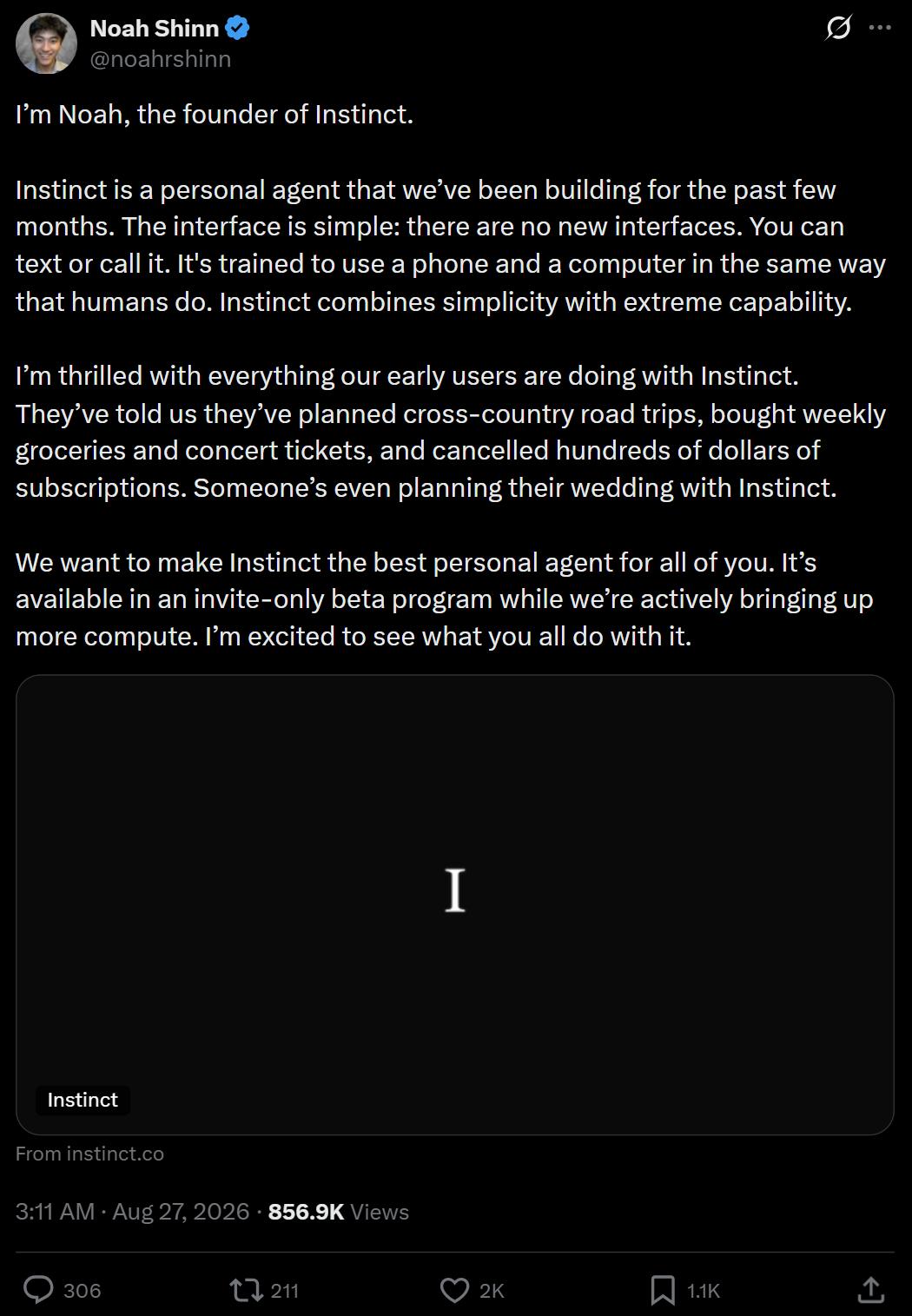
Just yesterday, Shinn shared real user scenarios on X: some users used it to plan a cross-state road trip, some let it take charge of weekly grocery shopping, some used it to cancel hundreds of dollars' worth of subscriptions, and others are using it to prepare for their weddings.
This post on X has received more than 800,000 views.
However, this huge innovation is also accompanied by a lot of controversy.
Users have to hand over a large amount of personal data to it, and its terms allow user data to be used to train the model, which makes many people worry about privacy and security. Shinn has also responded that the team has revoked some of the autonomous operations in the previous version.
II. Cijian Wuxian: An AI Operating System That Wants to "Understand You"
If Instinct represents "AI taking over your digital life", Today AI developed by Cijian Wuxian aims to build AI into an operating system that runs around the individual. Its official positioning is "an operating system (covering mobile phones and computers) with autonomous thinking ability, with you as the absolute core".
The company was registered on March 4, 2026, founded by Qi Junyuan, former head of Doubao's PC-side product, and its direction inherits his previous experience in efficiency tools and AI products. (For a detailed introduction to Qi Junyuan, founder of Cijian Wuxian, you can check the article we published half a year ago if you are interested. ✋️ The company was just founded for 2 days, IDG Capital transferred the investment funds in a hurry, who is he?)
Only two days after its establishment, Cijian Wuxian announced a $10 million angel round of financing, with investors including IDG Capital and Stepfun, among which Stepfun is responsible for providing underlying model support.
Unexpectedly, only 4 months later, Today AI has made significant progress and entered the internal beta period, and the product form has become clear accordingly.

According to public demonstrations, after obtaining authorization, Today AI can access the SMS, contacts, calendars and files on the local device, and can also connect to 32 external services such as Google, Notion, GitHub, X, and Discord, continuously reading this information to build a long-term understanding of users.
The application has five main entrances: Chat is responsible for communication, Today actively sorts out the information worthy of attention every day and generates personal briefings, Tasks undertakes tasks, Memories stores long-term memories, and the personal homepage manages devices and external connections.
It can also call the Computer Use capability to look up information for you in the browser, perform operations across applications, and even turn WeChat, DingTalk, and Telegram into entrances for issuing instructions.
The core of this design is to let AI get to know the user first, and then work continuously around the user's information, habits and schedules.
Every day when you wake up, the Today page has sorted out bills, meetings and activities, just like a continuously updated personal briefing.
III. River AI: Make "Personal AI" Ownable and Controllable
River AI was established in June this year. Its founder Babuschkin previously worked at DeepMind and OpenAI, and later co-founded xAI.
On August 11, it announced the completion of $1.1 billion in seed and Series A financing, led by General Catalyst and AMP PBC, with NVIDIA, AMD Ventures, Y Combinator and Temasek participating in the investment.
For a company that has only been established for two months, this figure itself shows the eagerness of capital.
What it wants to do is more fundamental than being an "AI assistant".
River's point is that current AI is too dependent on prompt engineering, and users are renting large models that they cannot control; it wants to provide a full set of tools to enable individuals and enterprises to use open-source models to train their own AI — an agent shaped by your preferences, tasks and goals, rather than a general-purpose chatbot.
Its first product is an open-source model API that supports reinforcement learning and LoRA fine-tuning. In its words, instead of relying on prompts to tune a model that does not belong to you, it is better to train a system that you can continuously improve and truly own.
This also explains why this round of financing can reach such a large scale: in the eyes of investors, the first step to realize personal AI is not to develop products, but to rebuild the entire chain from training to deployment.
River believes that there will be tens of thousands of agents "trained for specific individuals" in the future, and it will become the foundation supporting all of this.
IV. The Bigger Picture: Capital Is Flowing to Every Layer of "Personal AI"
Instinct handles daily affairs such as itineraries, shopping and subscriptions for you via SMS and phone calls; Today AI accesses your local and cloud data, continuously organizes information around your life, generates daily briefings and executes tasks; River AI provides open-source model training and fine-tuning tools, allowing you to train an AI that belongs to you.
In addition to these three companies, the financing scale of the personal AI Agent track this year is also very considerable.
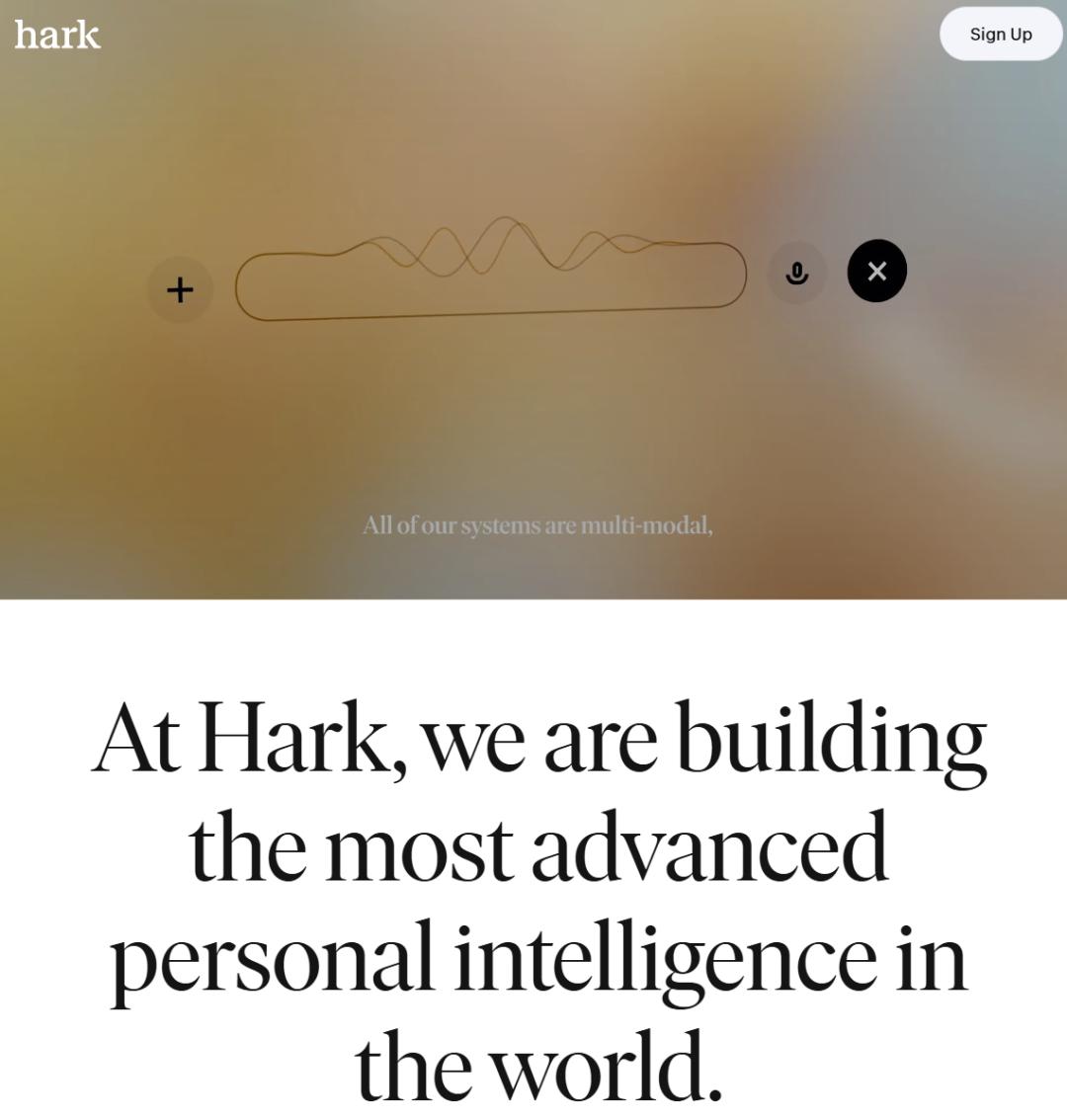
The most typical AI hardware player is Hark, whose founder Brett Adcock previously founded the humanoid robot company Figure AI and the electric aircraft company Archer Aviation.
It aims to make AI a portable hardware: a self-developed multi-modal model plus supporting equipment to form a general interface between humans and machines, an assistant that is always online, remembers your preferences, and actively manages your digital life. It plans to launch the first batch of models this summer, and the supporting hardware is still under development, with a team of about 70 people.
In May this year, Hark completed a $700 million Series A round at a valuation of $6 billion. The list of investors is very strong: the four chip giants NVIDIA, AMD, Intel and Qualcomm all appeared, as well as Salesforce Ventures and others.
There are also a number of more segmented startups in this track.
Pally is an AI personal assistant with its entrance in SMS. It can directly assign tasks via SMS, arrange schedules, look up information, and handle daily affairs, with an experience close to sending messages to a real human assistant. It was founded in 2025 and completed a $5.2 million seed round in August this year, led by Cyber Fund and Y Combinator.
Littlebird is a computer AI assistant that can "understand the screen". It can read the content displayed on the user's screen and directly give answers combined with the context, eliminating the need to paste the background materials to AI again. According to foreign media reports, the company completed a $11 million seed round in March this year.
Imagination and Risks Coexist
In the past two years, the AI people are familiar with is an assistant in the dialog box: you ask a question, and it gives an answer.
Personal AI assistants aim to turn the model from a "tool for answering questions" into an "agent that handles things for you", and the market space expands from individual conversations to your entire digital life — booking tickets, shopping, paying fees, managing subscriptions, and arranging schedules.
A consumer survey from PYMNTS shows that current users are more accustomed to using AI for information retrieval, writing, research and work. The next growth demand for AI is concentrated in repetitive personal daily affairs such as eating, shopping, reminders, and budgeting. This is a far larger market imagination than the "question and answer" scenario.
It can be said that capital pays a premium for the concept of "personal AI assistant", betting on the position of the next interaction paradigm.
Capital is willing to pay in advance for huge demand signals, but risks are also obvious.
For example, privacy and data security is the top priority — giving payment, email, SMS and location access to an AI is equivalent to handing over the keys to your entire digital life.
The second is reliability: an assistant that "acts on its own" and makes mistakes in key matters may lead to consequences far more serious than the time it saves. If the AI makes a mistake, who will be held responsible?
The last is the rationality of valuation, which still needs to be tested by the market.
When users are willing to hand over their monthly itineraries, consumption and subscriptions to AI, and it really does not make any mistakes, the era of personal AI can be regarded as truly beginning, and the valuations today will have the opportunity to be consolidated.
This article is from the WeChat official account "IT Juzi", authorized for release by 36Kr.