The Ambition of the Robot Body Manufacturer: Dissect the External Investments of Leju Robotics, and Get a Clear View of the "Ecological Occupancy" Battle in the Humanoid Robot Track
In the embodied intelligence track in 2026, the strategy of "financing while investing" has evolved from a special practice of a few leading enterprises to a normal behavior for all participants in the track. IT Juzi has previously published special reports and analysis on this phenomenon. Statistics show that at least 29 domestic embodied intelligence enterprises are currently making external investments.
Today we will focus on Leju Robotics, which has relatively high activity among them.
I. About Leju: A Humanoid Robot Ontology Manufacturer Marching for IPO
In 2016, Leng Xiaokun founded Leju in Shenzhen together with his partners from the Harbin Institute of Technology Robot Club. After ten years of development, the company launched the humanoid robot Kuavo, the first full-size high-dynamic humanoid robot in China that can jump, walk on multiple terrains, and is the first to be equipped with open-source HarmonyOS and connected to Huawei Pangu large model.
According to data from institutions including Omdia and IDC, Leju's shipment volume in 2025 ranked top 4 globally, and its full-size bipedal robot ranked second in the world. In the same year, 577 units of Kuavo were sold, generating a revenue of about 178 million yuan (a year-on-year increase of about 12 times), accounting for nearly 70% of the company's total revenue. Its overall revenue rose from 54 million yuan in 2023 to 258 million yuan in 2025.
Behind the impressive growth, there are still profitability pressures: the cumulative net loss over three years exceeded 170 million yuan, and the gross profit margin dropped from 50.45% to 40.78%, showing the feature of "trading price for volume".
In May 2026, Leju's IPO application on the ChiNext board was accepted (the first applicant under the "fourth set of standards" of the Shenzhen Stock Exchange), with a planned fundraising of 2.6 billion yuan and a post-investment valuation of 4.327 billion yuan.
The company's industrial logic is hidden in its prospectus: on one hand, it promotes the localization of core components and reduces costs through supply chain collaboration, and on the other hand, it lists the embodied intelligence R&D center and high-quality data sets as the key directions for raised investment. This strategy of "cost reduction, full-stack layout, and production expansion" almost accurately maps to the targets of its external investments in the past two years.
II. Panorama of 13 External Investments: Three-level Layout Along the Value Chain
According to data from IT Juzi, as of August 2026, Leju has made 13 investments as an investor, which can be divided into three categories by value chain: core component supply (4), software and intelligence layer (6), scenario joint venture and industrial collaboration (3).
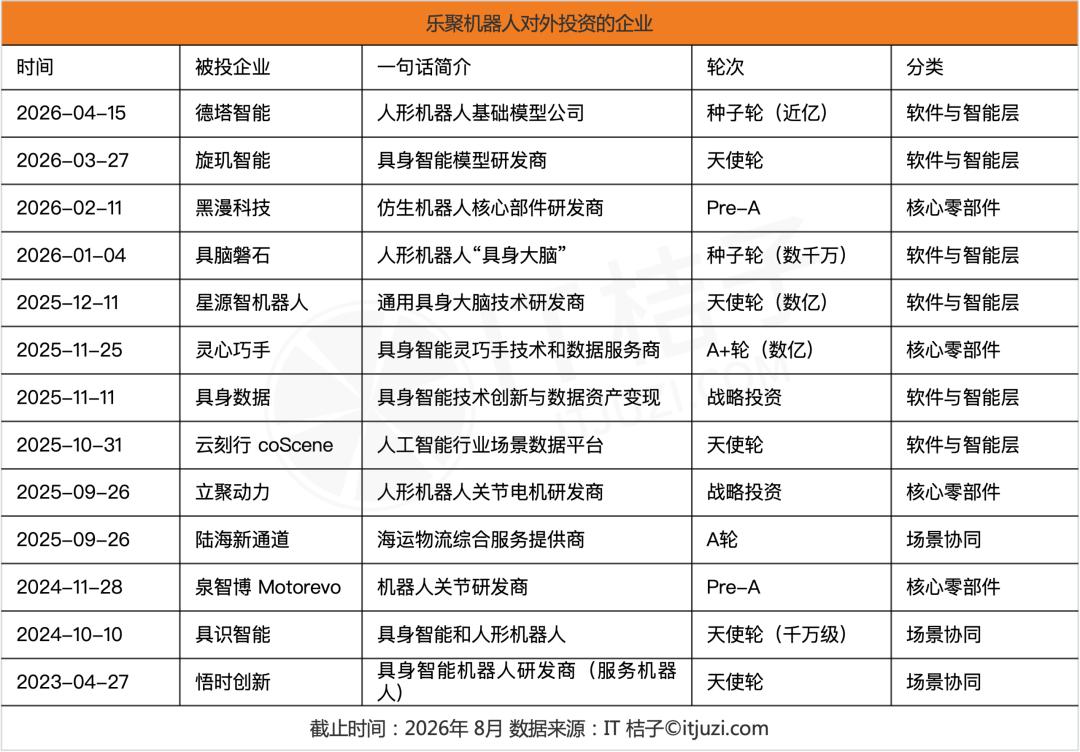
III. Logic Analysis: How Are the 13 Investments Laid Out?
1. Core Components: Take Cost Control Into Its Own Hands
The most expensive parts of humanoid robots are exactly the motion joints and end effectors, and the prospectus clearly lists "supply chain collaborative cost reduction" as the fundamental source of Kuavo's price advantage.
The four investments Leju made in the component sector have put the lifeline of cost reduction into its own shareholder roster.
The most noteworthy one is Lingxin Qiaoshou. This company located in Haidian, Beijing, is already a unicorn in the dexterous hand track, and raised hundreds of millions of yuan in Series A+ financing.
Dexterous hand is recognized as the end effector of "the last piece of the puzzle" for humanoid robots, which directly determines whether the robot can complete fine operations such as grasping, pinching and twisting. By betting on the leading company, Leju not only locks the supply and bargaining power of high-end dexterous hands, but also makes Kuavo no longer rely on external procurement to complete practical work, which is highly consistent with the industrial and commercial service landing scenarios emphasized in its prospectus.
Further upstream, Quanzhi Bo and Liju Power respectively occupy the joint module and joint motor tracks.
Quanzhi Bo is located in Wuxi, focusing on robot joints and servo motors, and has been recognized as a high-tech enterprise. Liju Power is based in Ningbo, specializing in joint motors.
The two companies form a "module + drive" combination, which takes the heaviest part of Leju's cost structure under control, and avoids the passive situation in the early years that "core components rely on imports, and millions of yuan are spent to develop a generation of prototype machines".
Heiman Technology supplements the future option of bionic core components, leaving differentiated space for the next generation of robot ontology.
2. Software and Intelligence Layer: Keep a Backup for the "Brain"
Leju's strength lies in its "cerebellum" — high-dynamic bipedal motion control, while its "brain" has long relied on external partners such as Huawei Pangu. The six investments in the software sector are its alternative forces laid out on the "brain" side.
The youngest and most bold investment among them is Data Intelligence.
This company, founded in 2026 with a team background from Google and Facebook, received nearly 100 million yuan in its seed round, betting on the commanding height of "humanoid foundation model", with the imagination of world model and spatial intelligence behind it.
In response to that, Junao Panshi develops the "embodied brain" for humanoid robots, and its team has Huawei background. While deeply binding with HarmonyOS and Pangu, Leju obviously wants to keep an independent and controllable backup, so that it can take advantage of the ecosystem without putting all eggs in one basket.
Embodied Data and Yunkehang extend their reach to training data.
The former focuses on the monetization of data assets for embodied intelligence, while the latter is an industry scenario data platform with a team background from Apple.
The two projects are directly targeted at the "high-quality large-scale data set" (about 616 million yuan) in this IPO fundraising, which is equivalent to extending the R&D system to the outside of the company to provide data for the continuous iteration of Kuavo.
In addition, Xingyuanzhi Robot, Xuanji Intelligence and other companies have made their respective layouts in the general embodied brain and multi-modal vision, making the "external brain" network more dense.
3. Scenario and Industrial Collaboration: From Selling Equipment to Selling Solutions
The remaining three investments are not in the pure supply sector, but point to real landing scenarios. What Leju wants is not only financial returns, but also a channel to turn Kuavo from "a single robot" into "a complete set of solutions".
New International Land-Sea Corridor is a cross-border logistics service provider that has been operating for nearly ten years. Leju's investment in it opens up a real channel for humanoid robots to enter the logistics handling scenario and even go global along with Chinese manufacturing, which also echoes the "logistics" industrial scenario specified in the prospectus.
Jushi Intelligence and Wushi Innovation supplement the complete machine ecosystem: the former is a Shanghai-based company that also develops humanoid robots, which can complement Leju in complete machine solutions and joint delivery as an ecological collaboration and co-opetition partner; the latter is rooted in Shenzhen and develops service robots, which can perfectly undertake commercial service scenarios such as Leju's exhibition hall tour guide and store shopping guide.
By bringing scenario partners in the upstream and downstream industrial chains into its own circle through investment, Leju's industrialization story is complete.
IV. Ecosystem Empire and Hidden Worries
As humanoid robots are approaching the eve of industrialization, simply "self-developing ontology" is no longer enough to form a competitive barrier.
Leju's choice is to weave the value chain into a network with capital: self-developed ontology, externally connected brain, and shareholding in the supply chain, which not only tells a complete industrial chain story for its IPO, but also lays a foundation for mass production cost reduction and scenario landing.
However, the hidden worries are also obvious: Leju itself is still in a loss-making state, its operating cash flow continues to be negative, and its gross profit margin is declining. Most of the 13 investments are in the early stage, with undisclosed or small amounts, long return cycles, and most of them have not formed quantifiable collaborative revenue with the parent company.
If there is a short-term overcapacity in the industry and the price war intensifies, the "collaborative dividend" of this ecological network may not be realized as expected.
Leng Xiaokun, the founder, once said frankly: "Only by doing the tough and trivial work can we build a competitive barrier, and technology may not necessarily become the barrier of the industry." Leju is using 13 external investments to turn those "tough and trivial work" — joints, motors, dexterous hands, embodied data — into its own moat little by little.
Time will tell whether this network can finally support the future of a pre-listed company.
This article is from the WeChat official account "IT Juzi" (ID: itjuzi521), written by Judy, authorized for release by 36Kr.