Who is siphoning away the foot traffic in the bulk section?
Recently, according to reports from Tide New Consumption, a sampling survey was conducted in a core market in South China, the sales of bulk leisure food in supermarkets dropped by 30% year-on-year, and the decline of standard products ranged from 10% to 20%. A large hypermarket with a daily turnover of over 700,000 RMB saw the daily sales of its bulk snack area drop from over 10,000 RMB to 8,000 RMB, with a floor efficiency of less than 0.5 RMB per square meter per day.
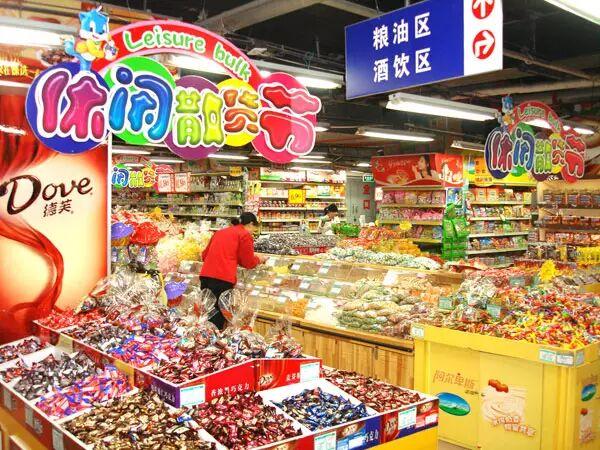
A square meter of shelf generates less than 0.5 RMB a day, not counting the labor costs for restocking, weighing and cashiering. In the past, bulk food was a powerful tool for supermarkets to attract customers, but now it has become an "operational burden" that brings no reward despite great efforts.
Where have all the customers gone?
01
Two-way Customer Diversion
Price Undercut, Quality Outperformance
First of all, for the discount snack sector, according to the announcement of Mingming Mangmang Group, as of July 2026, the number of its signed stores has exceeded 30,000, and the total GMV in 2025 reached 935.69 billion RMB. The brands under Wanchen Group have opened about 23,000 stores. The two groups have nearly 50,000 stores in total, forming a clear duopoly pattern.
Discount snack players are waging price wars, but they are not losing money for publicity — their supply chain models are completely different. For bulk food in traditional supermarkets, it has to go through multiple levels of distributors from factory to shelf, with distributors marking up prices by 30% to 50%. Discount snack brands skip middlemen and connect directly with factories, so the terminal selling price is 20% to 30% lower than that of large supermarkets. According to the price comparison by Blue Whale News, 500g of Want Want Senbei costs 19.8 RMB at discount snack stores versus 35.2 RMB at RT-Mart, 38g of Lay's potato chips sells for 2.8 RMB at discount stores versus 4.5 RMB for 70g at Sukelong, almost every product is about 30% cheaper. Consumers are not foolish. When they see the exact same product 30% cheaper at a discount store, their mindset will completely change when they go back to the bulk food section of traditional supermarkets.
Secondly, it is the freshly-made snack sector. According to the 2025 China Snack Consumption Trend Report, 78% of people list "freshness" as the top priority when buying snacks, far exceeding brand awareness and price. 53% of consumers prioritize high-quality real ingredients, and 50% require no additives or preservatives. These are precisely the weakest points of the bulk food sections in supermarkets: open shelves, invisible production processes, simple ingredient labeling, and lack of raw material traceability.
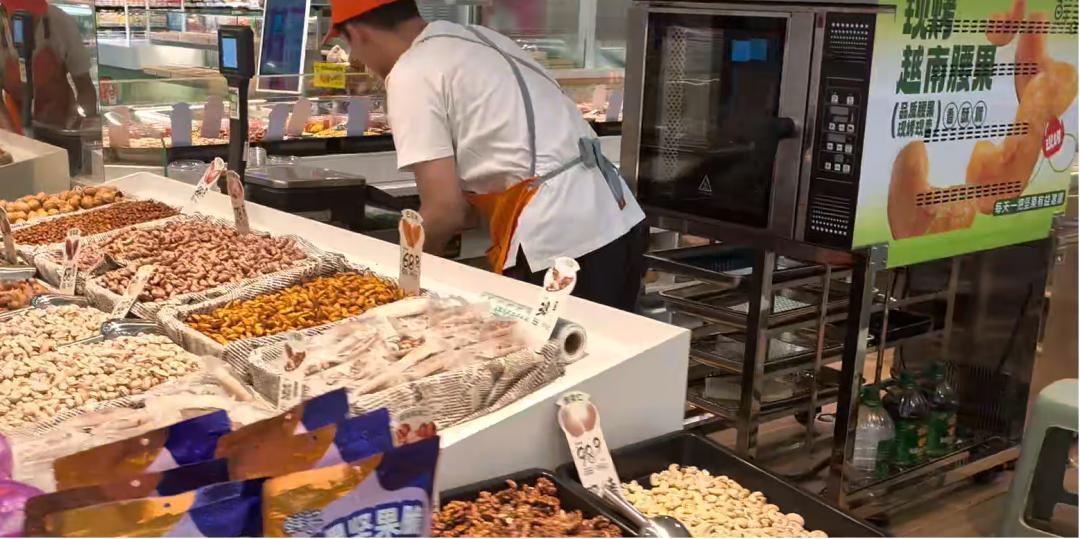
Xueji Roasted Nuts focuses on "freshly roasted, never leftover overnight". As of September 2025, it has more than 1,100 stores nationwide, with significantly higher customer unit price and repurchase rate than traditional bulk nuts in supermarkets. The trend is even more obvious in the baking sector: freshly-made baking accounted for over 60% of the entire market in 2025. Taoli Bread reported full-year revenue of 5.448 billion RMB, down 10.5%, and net profit of 284 million RMB, down 45.63%, marking the fifth consecutive year of decline. The same goes for the braised food sector: freshly-made hot braised food features "braised and sold on the spot", and the convenience advantage of pre-made vacuum-packed bulk braised food has been greatly weakened.
The three core categories of roasted nuts and seeds, baked goods, and braised meat products have been successively siphoned off by freshly-made snacks. It is not that no one buys products in the bulk section anymore, but that there are far too many better alternatives.
In addition, regulation is also tightening. In March 2025, the State Administration for Market Regulation issued the Food Label Supervision and Administration Measures, which will come into effect in March 2027. Traceability of ingredients is evolving from a "bonus item" to a "mandatory threshold".
02
The Blame for Bulk Section Losses Is Finally Passed to Distributors
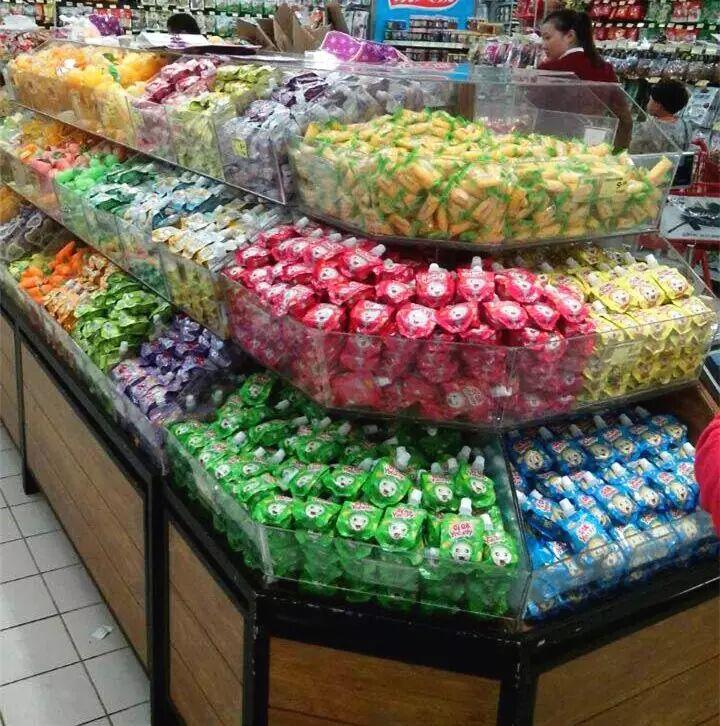
The bulk section is not profitable, but supermarkets will not bear the losses on their own. The "bulk section contracting model" that has emerged in recent years is increasingly unfavorable to distributors. More and more supermarkets package their bulk sections and outsource them to distributors. On the surface, distributors are granted independent operation rights including full control over product selection, display and pricing, but in essence, supermarkets transfer all the risks of overstocked inventory and cash flow losses to distributors.
According to feedback from distributors in the South China market, the return rate of large and medium-sized supermarkets has increased by an average of 1.5 percentage points, and that of small supermarkets has increased by 2 percentage points. Distributors have repeatedly negotiated price cuts with upstream manufacturers, giving up their gross margins to barely reach an agreement. Even after repeated price cuts, customer flow still does not recover. Distributors who previously only needed to handle delivery and customer relationship maintenance are now pushed to the front line, in charge of goods, staff and sales performance, facing pressure from both sides.
Leading supermarkets are taking self-rescue measures.
As of June 2026, Yonghui has completed the renovation of 331 stores, reducing the area for bulk snacks and expanding the space for baked goods and cooked food. In the first half of 2026, it achieved attributable net profit of 253 million RMB, turning around from loss year-on-year, and the customer flow of renovated stores increased by 80% on average. Wumart has removed a large number of bulk and packaged snack shelves, putting cooked food and baked goods in the core position, and the combined sales of freshly-made cooked food and baked goods increased by more than 70% year-on-year. RT-Mart has cooperated with Three Squirrels to launch a "fresh snack in-store shop", completing category upgrading at low cost with the advantage of procurement scale.
Leading supermarkets have different priorities in their paths, but their core logic is the same: cut loss-making businesses, and concentrate resources on profitable businesses. However, this strategy cannot be replicated by the vast majority of small and medium-sized supermarkets, who lack funds for renovation, sufficient supply chain resources and organizational capabilities.
03
After the Tide Recedes, What Should Food Manufacturers and Distributors Do?
For food enterprises, the shrinking of bulk channels is not a cyclical fluctuation, but a structural change. They need to figure out three key points.
First, re-prioritize your channel strategy. Discount snack stores are not enemies, but a new channel that cannot be avoided. With nearly 50,000 stores and 230 billion RMB in GMV, this scale means the question is no longer "whether to enter this channel", but "how to enter it". But once you enter the discount snack channel, you have to accept its rules: transparent pricing, fast turnover, and delisting for slow-moving products. The era of making profits from information asymmetry and multi-level markup is gone. You need to clarify which products are for the discount snack channel to drive sales volume, and which products are kept in supermarkets and convenience stores to secure profits. Don't put all your eggs in one basket, and don't expect one single channel to cover all your business.
Second, your product strength should focus on "tangible, perceivable quality". The rise of freshly-made snacks is not due to low prices, but because it allows consumers to "see, smell and trust" the products. If your products still only compete on packaging design and price range, without making improvements in freshness, ingredient transparency and quality perception, you cannot gain a foothold in any channel. Especially for bulk food, what consumers check first when they pick up the product are the ingredient list and production date. If these two points are not up to standard, even the strongest brand power cannot support repurchase.
Third, the new labeling regulation that will take effect in March 2027 is a countdown, not a gentle reminder. Ingredient traceability and standardized labeling are the bottom line for compliance if you make layout in advance. If you lag behind, you will lose your competitive edge and even get fined. There is more than half a year before it goes into effect, which is enough for you to make adjustments, but do not procrastinate.
For distributors, the bulk section contracting model seems to grant operating rights, but actually transfers all the risks. Distributors also need to figure out three key points.
First, check your product category structure. If the bulk section you contracted is still selling old-fashioned biscuits, traditional pastries and large-packaged puffed food, which are completely out of date compared with the products in the adjacent discount snack stores and freshly-made snack stores, you should negotiate with the supermarket for category adjustment as soon as possible. Consumers vote with their feet much faster than you expect. By the time you find the products are not selling well and want to adjust, the inventory will have been stuck in your hands.
Second, check your price system. The discount snack channel has made prices fully transparent, and the pricing space for the bulk section in traditional supermarkets is locked. If your procurement price is almost the same as the retail price in discount snack stores, this business cannot sustain. You need to renegotiate with manufacturers, either get exclusive specifications and flavors that are not available in discount snack stores to achieve differentiation, or accept the logic of small profits but quick turnover to boost inventory turnover.
Third, clarify your own role positioning. Distributors can no longer only be responsible for delivery and collecting payments, which is a job anyone can do. You need to transform into a category operator: capable of coordinating product selection, managing shelf display, driving sales performance, and helping supermarkets calculate the floor efficiency. Distributors who can achieve this are irreplaceable for supermarkets, while those who cannot will be replaced at any time.
Channels are changing, and consumers are changing too. The hollowing out of the bulk section did not happen overnight, and it will not recover overnight. But opportunities always lie in changes: the fact that discount channels are attracting more customers means that the demand for snacks has not disappeared, it is just that consumers are buying them elsewhere. The fact that freshly-made snacks are siphoning off customers means that consumers are willing to pay for high-quality products, but their requirements are higher.
The first player that turns the products on the shelf into what consumers really want to buy will get the next admission ticket.
This article is from the WeChat official account "Nashi", author: Industry Observer, published with authorization from 36Kr.