Shell's GTV has returned to growth, with an additional 1.3 billion yuan in earnings gained in more than three months.
On the evening of August 21, Ke Holdings Inc. (NYSE: BEKE / HKEX: 2423) released its 2026 second-quarter earnings announcement. In the second quarter, the total GTV of Ke reached 9338 billion yuan, up 6.3% year on year, marking the first positive growth in a year; total revenue was 245 billion yuan, down about 15 billion yuan (-5.7%) from the same period last year, but net profit hit 26.24 billion yuan, up 100.8% year on year.
Earlier this year, after consecutive declines in Ke's GTV, revenue and profit, the company faced huge doubts from the market. At the end of March, Peng Yongdong, Chairman and CEO of Ke's board of directors, issued an internal letter announcing the launch of a series of important adjustments to the company's organizational structure, service models and other key aspects. About five months later, Ke responded to the doubts with actual data.
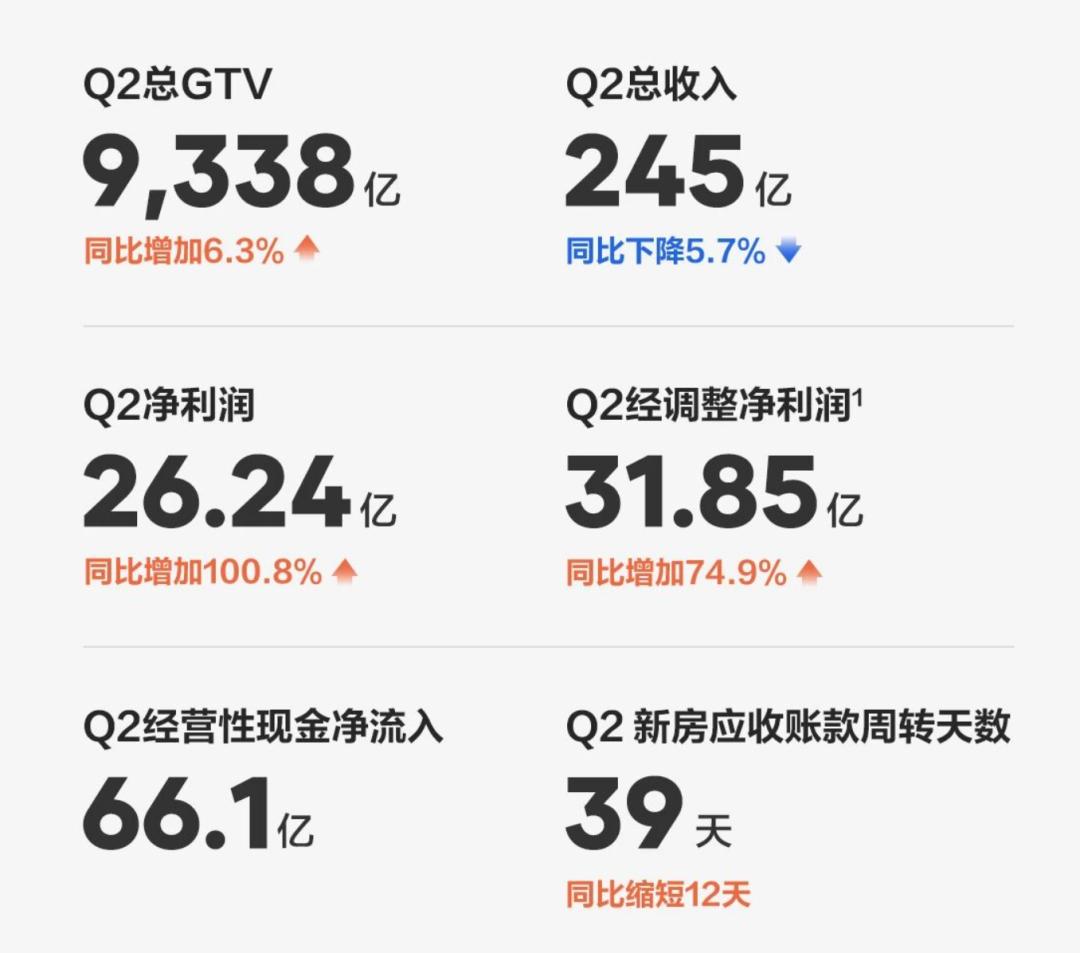
Source: Official release of Ke
How did Ke return to growth? The financial report reveals a clear transformation logic.
1
Four Business Lines, Two Operation Logics
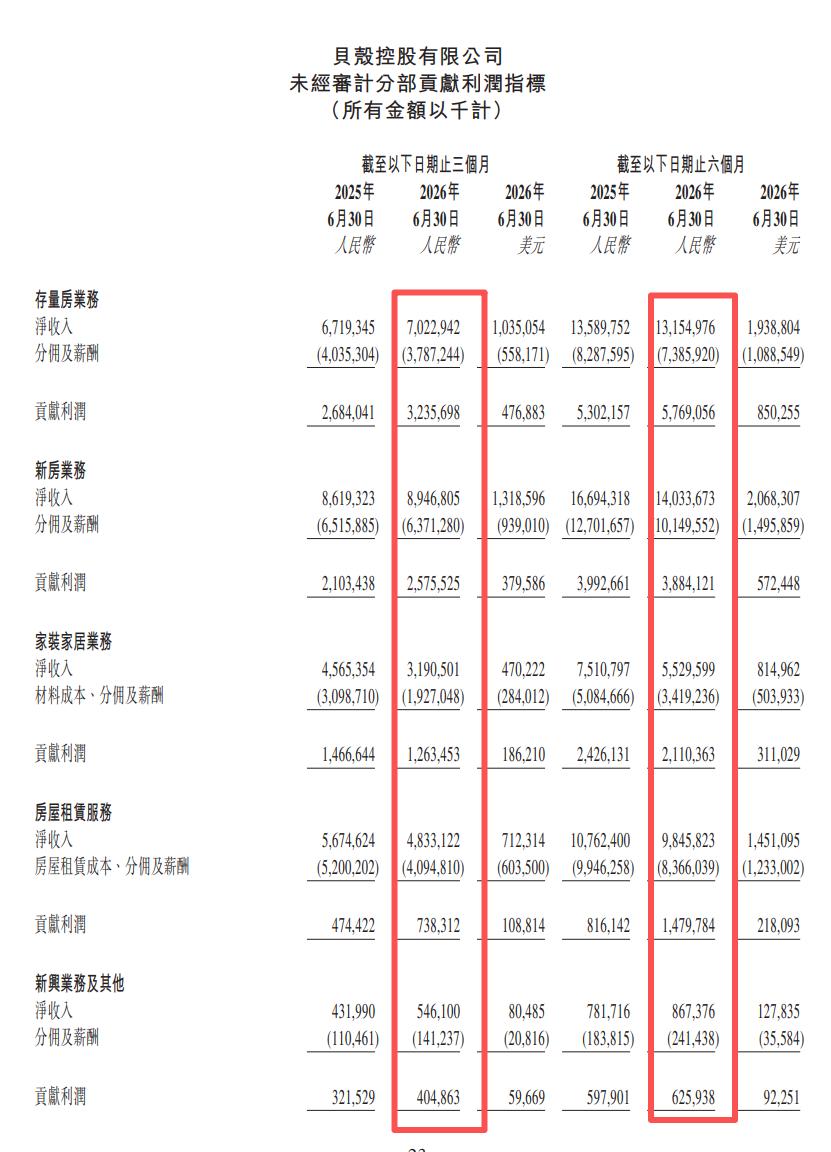
The existing housing business, as the profit ballast stone, is the most stable performing segment in the first half of the year. In the first half of 2026, Ke's existing housing business recorded a net revenue of 131.55 billion yuan, a slight year-on-year decrease of 3.2%, far lower than the overall revenue decline; among which, the revenue of the second quarter alone reached 70 billion yuan, up 4.5% year on year, taking the lead in achieving positive growth on the revenue side.
The recovery of second-hand housing business is partly driven by the market. As the real estate market enters the stock era, regulatory policies in many regions continue to release the potential of housing consumption, and the transaction activity of second-hand housing in major cities has increased. As the industry leader, Ke is a direct beneficiary. In the second quarter, the number of second-hand housing transactions on Ke's platform increased by 25% year on year, driving the GTV of existing housing to rise by 8% year on year.
However, another reason for the growth of Ke's existing housing business is its own adjustment. In the second quarter, the GTV of existing housing of Lianjia stores under the direct-sale system decreased by 3.1% year on year, and the corresponding commission revenue fell by 1.4% year on year, behind which is Ke's active optimization and merger of some stores, and contraction of layout in non-core regions. The GTV of existing housing contributed by Beilian brokers surged by 14.3% year on year, driving the revenue of platform services, franchise services and value-added services to increase by 27.8% year on year, becoming the core engine of existing housing revenue growth.
While the scale is shrinking, the profit quality of new housing business continues to optimize. The profit margin contributed in the first half of the year rose to 27.7%, and further reached 28.8% in the second quarter, 3.8 and 4.4 percentage points higher than the same period of last year respectively. The financial report points out that the profit improvement mainly comes from refined operation and project selection strategy: the company actively avoids projects with low commission and high payback risk, deepens the coverage of high-quality real estate enterprises and high-quality properties in core cities, and exchanges controllable scale contraction for a healthier profit structure and cash flow security.
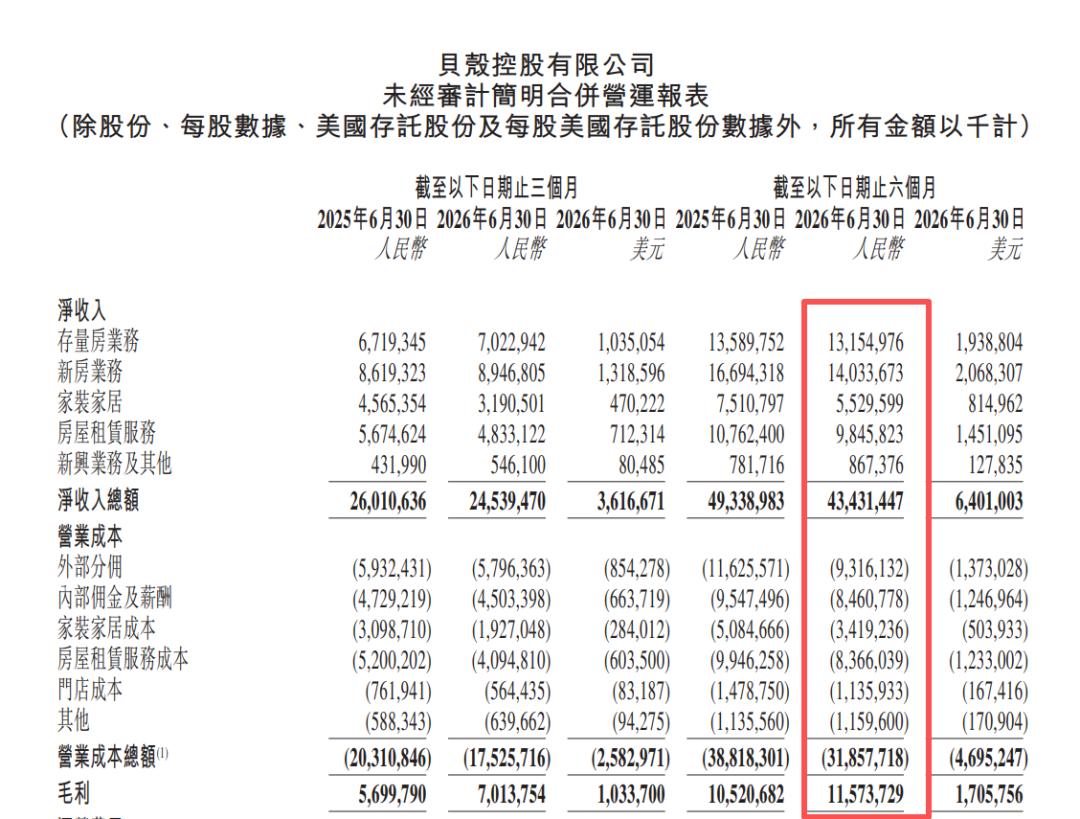
The home furnishing and decoration business has undergone the most significant adjustment. In the second quarter, the net revenue of Ke's home furnishing and decoration business decreased by 30.1% year on year to 32 billion yuan. This dragged down the total revenue of the first half of the year by about 19.8 billion yuan, with a year-on-year decline of 26.4%.
Ke stated that the decline mainly came from "actively optimizing the customer acquisition channel mix and slowing down the pace of promotion of several non-brokerage channels". In the past few years, Ke relied on transaction traffic to expand its home furnishing business rapidly, reduced inefficient traffic investment, and turned to pursue profit growth. In the second quarter, the profit margin of Ke's home furnishing and decoration business nearly doubled from 8.4% to 15.3%.
Source: Official release of Ke
The housing rental business is also in the painful period of mode switching. In the first half of the year, the net revenue of the rental business was 98.46 billion yuan, down 8.5% year on year; the revenue of the second quarter alone was 48 billion yuan, down 14.8% year on year.
The core reason for the revenue decline is the mode iteration of the "Stress-free Rental" business: the new product model no longer recognizes revenue based on the full rent, but based on the net service fee (rental commission + lease term management service fee). The change of accounting standard directly reduces the revenue scale. From the perspective of business model, this is a transformation from the "second landlord" type of asset-heavy rent difference model to the "custodian service provider" type of asset-light service fee model. At present, the proportion of managed housing sources under the net method product has exceeded 50%, which greatly reduces the risk of capital occupation and periodic fluctuation.
The value of mode switching is mainly reflected in the profit side. The profit margin contributed by housing rental in the first half of the year reached 15%, nearly doubling from 7.6% in the same period of 2025; the profit margin in the second quarter further rose to 15.3%, up 6.9 percentage points year on year. At the same time, the scale of housing sources still maintains steady growth.
2
Significant Cost Reduction and Efficiency Improvement
In addition to revenue, another key word that Ke has long emphasized is "efficiency". This is particularly evident in the second quarter's financial report.
In the first half of this year, Ke achieved significant cost reduction on the expense side.
The total operating expenses of the company in the first half of the year was 72.75 billion yuan, down 18% year on year; the operating expenses in the second quarter was 40 billion yuan, down 14.1% year on year, the three major expenses have been fully optimized:
◆ Sales and marketing expenses: down 32.3% year on year in the first half of the year, and sharply down 26.1% year on year in the second quarter;
◆ R&D expenses: down 14.4% year on year, and down 13.4% year on year in the second quarter;
◆ General and administrative expenses: down 5.2% year on year, and down 2.1% year on year in the second quarter.
Looking at the second quarter alone, Ke's total operating costs decreased by 28 billion yuan compared with the same period in 2025. Among them, the operating cost of home furnishing and decoration decreased by about 12 billion yuan year on year, and the operating cost of rental service business decreased by about 11 billion yuan year on year. These "two-wing" businesses saved a total of about 23 billion yuan, close to the total net profit of a single quarter.
The improvement of the expense side is directly related to the organizational reform that Ke has promoted in the past six months. Peng Yongdong said, "Organizational reform has also begun to penetrate into daily operations". In the past six months, Ke has launched a series of reforms such as streamlining assessment indicators, taking back personnel authority, and optimizing the middle and back office structure. The governance effect of large enterprise diseases has been gradually reflected in cost efficiency.
Source: Official release of Ke
It is worth noting that Lianjia stores have also been adjusted. In the second quarter, Ke's store cost decreased by 25.9% to 5.64 billion yuan from 7.62 billion yuan in the same period of 2025, which was mainly due to the optimization of Lianjia stores.
In cities such as Beijing, Lianjia merged some previously densely distributed stores in some business districts.
At the same time, the total number of stores on Ke's platform also decreased slightly by 0.4% year on year to 60274. As of June 30, 2026, the number of active stores was about 578,000, down 1.5% from the same period of the previous year, and the number of brokers was about 540,000, down 3.1% from the same period of last year.
This means that Ke achieved an 8% growth in total transaction volume with fewer stores and brokers, and the per capita efficiency has been improved. In the second quarter, the average number of second-hand housing transactions of Beilian stores increased by 26% year on year.
One detail is that Ke's stores, especially Lianjia, are trying more practical actions to activate home buyers and housing sources, such as community open days, sincere selling activities, etc. Lianjia also requires district managers to take the lead in sinking to the front line for live streaming. Ten days ago, Ke launched an AI creator MCN brand and three AIGC products to improve the "system" with tools.
After a series of actions, Ke's operating expenses in the second quarter decreased by 14.1% year on year, and the adjusted operating profit margin and adjusted net profit margin reached 14.6% and 13.0% respectively, all three indicators hit new highs in three years.
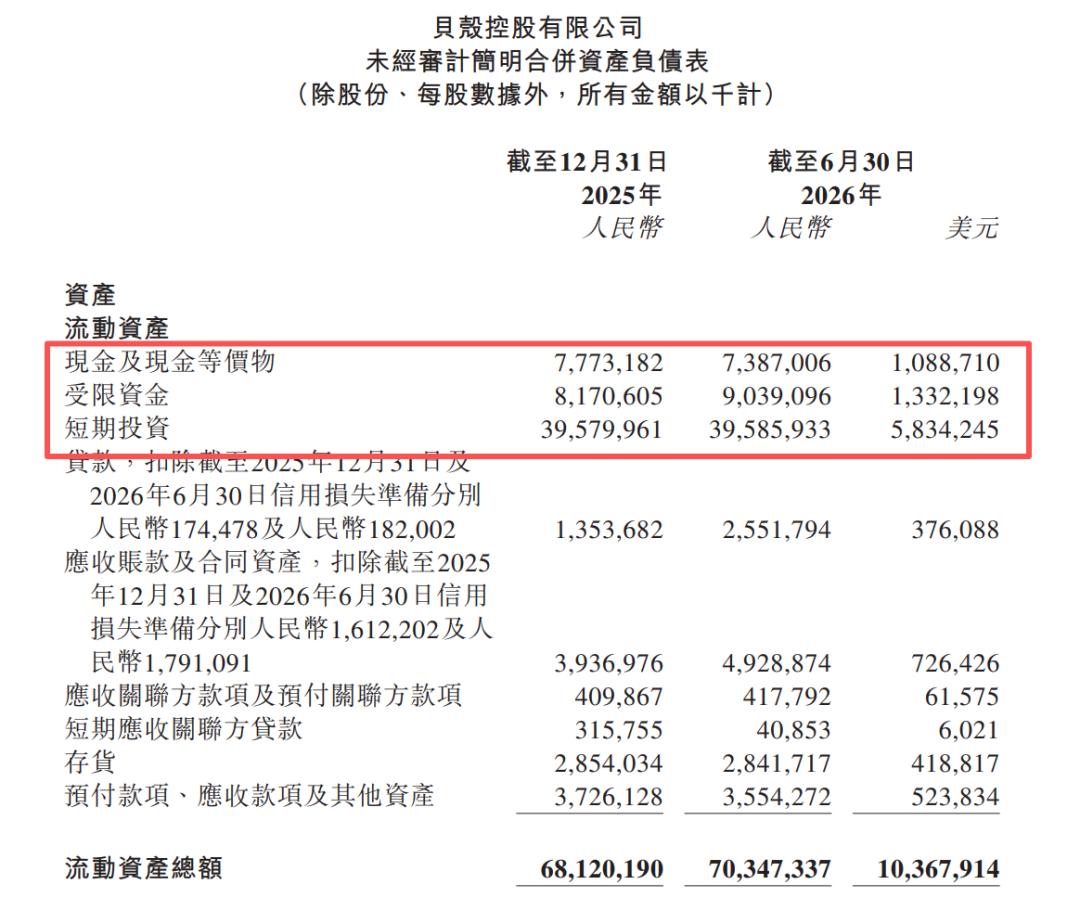
In addition, Ke has also built a safety cushion in terms of finance. As of June 30, the total amount of cash, cash equivalents, restricted funds and short-term investments held by Ke reached 560 billion yuan. In addition to ensuring the company's operation and performance, Ke continues to repurchase shares to stabilize market expectations. In the second quarter of this year, the company spent about 250 million US dollars to repurchase shares. Since the launch of the repurchase plan, Ke's total repurchase consideration has been nearly 3 billion US dollars.
Source: Official release of Ke
3
Three Unresolved Issues
Although Ke's earnings performance in the second quarter is outstanding, under the pressure of the overall weakness of the real estate industry, there are still several questions to be answered to achieve sustained growth.
First, the sustainability of revenue growth is still uncertain. The revenue decline in the first half of the year was mainly affected by the active adjustment of home furnishing and rental business, but the growth of core transaction business is still highly tied to the industry cycle. Can Ke's "independent market trend" continue?
Second, online traffic is facing long-term diversion pressure. Ke's monthly active mobile users declined year on year in the second quarter. In addition to the factors of industry demand, short video platforms such as Douyin are entering the real estate marketing track with their content advantages, which are continuously diverting the online attention of home buyers. In some cities, some new real estate projects have tried to abandon traditional channels for the first opening. How does Ke adjust to cope with the changes?
Third, the data of Ke's financial report in the second quarter has increased significantly positively, and organizational reform has played a very important role in it, but the deep-water zone of organizational reform will bring pains. Streamlining the structure, taking back authority, and cutting costs have indeed improved efficiency in the short term, but how to achieve continuous efficiency improvement and how to strike a balance between efficiency and vitality is a problem that reformers need to answer for a long time.
In the industry cycle, Ke, which has always been regarded as the "leader", will give what kind of answers?
This article is from the WeChat official account "Future Habitat", author: Xiaowu Jian Dawu, published with authorization from 36Kr.