12.7 million college graduates are entering the employment season, and key cities have launched a number of rent preferential policies.
In 2026, the number of graduates from regular higher education institutions nationwide is expected to reach 12.7 million, an increase of 480,000 compared with 2025, hitting a new record high. Since the 2026 graduation season, college graduates have left campuses, sought jobs and taken up positions in a concentrated manner, driving the release of phased rental housing demand. For graduates who are new to the workplace, rent is a major part of their living expenses. Reducing the housing cost in the early stage of job hunting and employment has become the core focus of rental support policies for graduates across regions.
Since the beginning of this year, key cities including Beijing, Shanghai and Shenzhen have successively launched support measures targeting the rental housing demand of college graduates, and some cities have also centrally raised and launched rental housing units for graduates during the graduation season. In terms of main support methods, existing policies include short-term free accommodation for the job-hunting stage, as well as special rental allocation and rent discounts for the housing demand after employment. This report sorts out the rental support policies for college graduates in key cities, selects typical special rental allocation projects, and analyzes their characteristics from the aspects of housing sources, rent, location and supporting facilities.
The rental support methods for college graduates in key cities are increasingly diversified. According to the main support methods, they can be divided into three categories: short-term free accommodation, special rental allocation, and rent discount. It should be noted that special rental allocation mainly reflects the housing supply method, and rent discount mainly reflects the price support method, and the two may overlap in actual implementation.
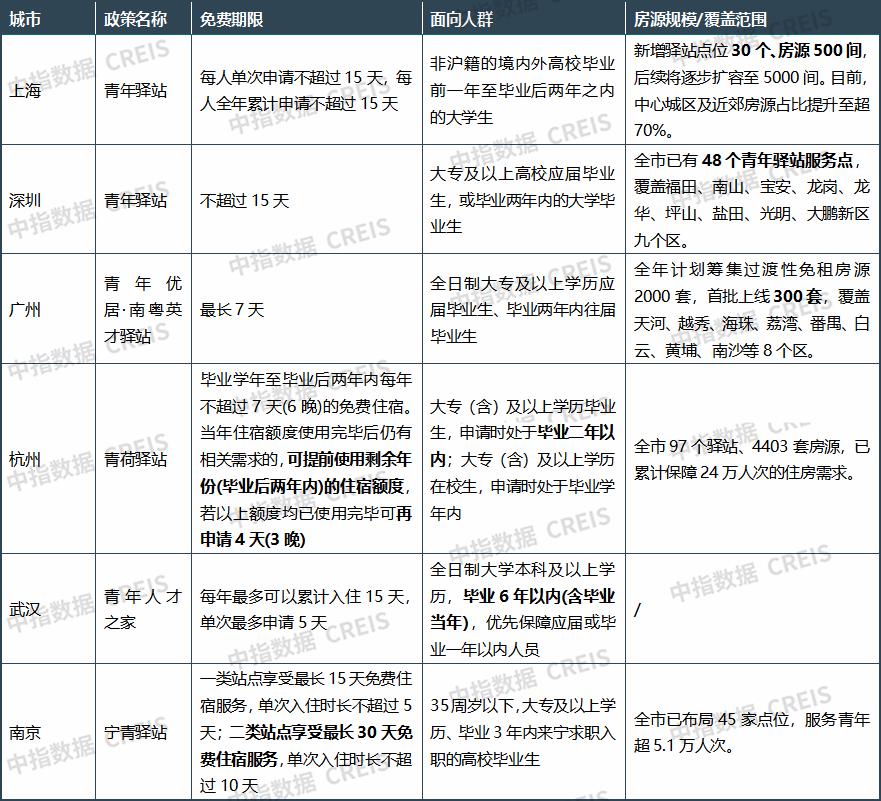
First, provide short-term free accommodation to meet the phased housing needs of graduates for cross-city job hunting, internships and early workplace entry. Regions differ in the free duration and the scope of applicants. Nanjing has set up two types of post stations for college graduates with junior college or above degrees who have graduated for less than 3 years. The second-type post stations can provide up to 30 days of free accommodation, and the first-type post stations up to 15 days, with a longer guarantee period among key cities. Cities including Shanghai, Shenzhen and Wuhan can provide 15 days of free accommodation. Among them, Wuhan extends the applicant group to young people with bachelor's degree or above who have graduated for less than 6 years, covering a wider range. Hangzhou allows each person to apply for 7 days of free accommodation per year, permits the advance use of the remaining annual quota after the free quota of the current year is exhausted, and allows applying for an additional 4 days of accommodation after all the quota is used up, with a more flexible mechanism design. Guangzhou allows applying for up to 7 days of free accommodation.
Table: Part of the 2026 Short-term Free Transitional Accommodation Policies in Key Cities
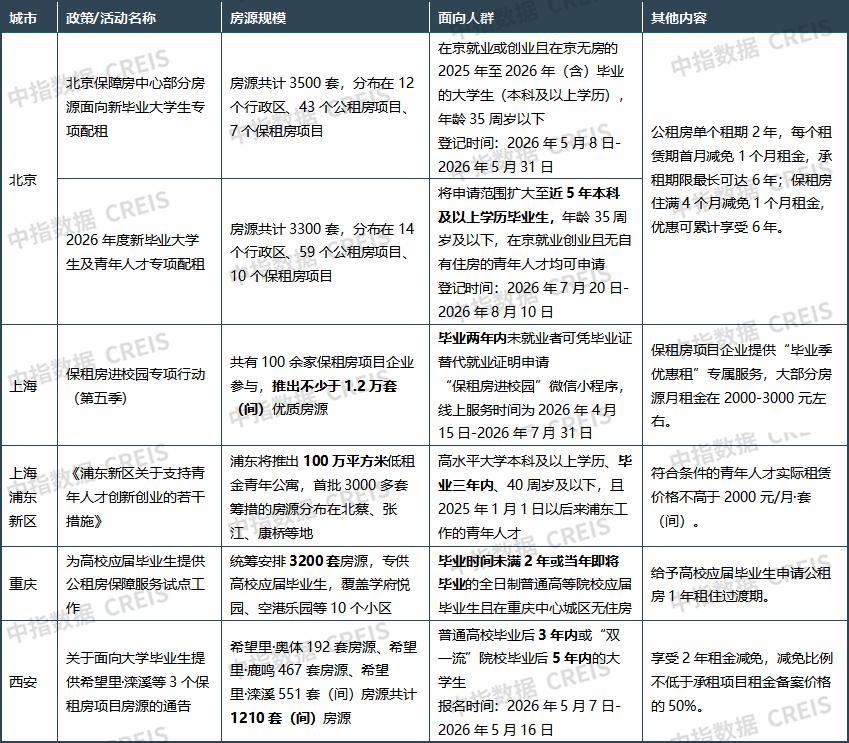
Second, supply part of the housing units of specific projects to graduates and young talents in a targeted manner through special rental allocation. Relying on housing sources such as indemnificatory rental housing and talent apartments, some cities centrally launch special rental allocation during the graduation season or specific periods, and reduce the actual rental cost through rent discounts and exemptions. In 2026, the Beijing Housing Security Center has successively launched two rounds of special rental allocation for newly graduated college students and young talents. The first round in May put 3,500 housing units on the market for graduates of the past two years, and 3,300 additional units were launched in July for graduates with bachelor's degree or above who have graduated for less than 5 years. In the 5th season of the "Indemnificatory Rental Housing Graduation Season into Campus" event, Shanghai has targeted collected no less than 12,000 units (rooms) of indemnificatory rental housing for eligible college graduates and young talents.
Table: Part of the 2026 Special Rental Allocation Policies in Key Cities
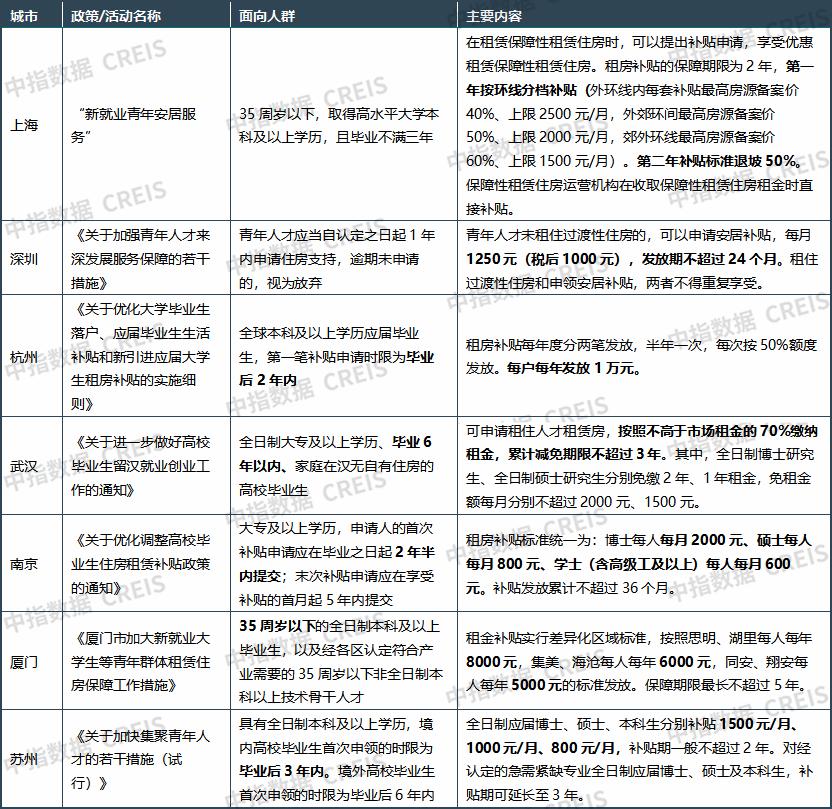
Third, provide rent discounts for graduates to reduce their actual rental cost through rent discounts or cash subsidies. In such policies, the rent discount intensity or cash subsidy standard is usually linked to conditions such as educational background, talent category, employment area and housing status. Wuhan clarifies that graduates with junior college or above degrees who have graduated for less than 6 years and rent talent rental housing can pay rent at no more than 70% of the market rent, and provide 2-year and 1-year rent-free support for doctors and masters respectively. Shanghai implements tiered rental subsidies, with 40%-60% tiered subsidies divided by ring roads in the first year, and the subsidy drops by 50% in the second year, but it is only open to young people with bachelor's degree or above from high-level universities and who have graduated for less than 3 years, with a relatively high threshold. Suzhou provides monthly subsidies of 1500 yuan, 1000 yuan and 800 yuan for doctors, masters and undergraduates who have graduated for less than 3 years respectively, with a subsidy period of no more than 2 years, and the period can be extended to 3 years for graduates with bachelor's degree or above in recognized urgently needed majors.
Table: Part of the 2026 Rent Discount Policies in Key Cities
From the perspective of projects, most of the special rental allocation housing units for college graduates are provided by local state-owned enterprises or professional housing rental enterprises, and the housing units are mainly small and medium-sized apartments such as studios and one-bedroom units. The projects are generally close to concentrated employment areas or rail transit stations, and some projects far from the subway improve commuting conditions through shuttle buses. The community supporting facilities are mainly shared kitchens, fitness and public activity spaces, which mainly meet the basic living and housing needs of graduates in the early stage of employment.
In terms of rent, the support methods of various projects are different. Beijing Capital Land Star reduces rent mainly through discounts on lease term, graduation year and payment method. Shanghai Puxin Young Talent Community sets a ceiling on the actual rental price for eligible housing units. The second phase of Wuhan Rongyu Jianghan Road Store talent rental housing calculates rent based on a certain proportion of the market assessed rent, and provides phased rent-free support for eligible masters and doctors. The price advantage of special rental allocation projects depends on the standard rent, discount ratio, housing area and applicant conditions of the project, and simple comparison cannot be made only based on the rent of individual housing units and the surrounding market.
On the whole, special rental allocation mainly eases the phased rental pressure of some college graduates in the early stage of employment. Due to the limited number of housing units and the requirement that applicants need to meet conditions such as educational background, age, employment and no local housing, its coverage is relatively narrow, and its impact on the overall supply and demand and rent level of the urban rental market is relatively small. In the follow-up, the location and supply rhythm of housing units can be optimized according to the employment distribution of graduates, and the efficiency of application, review and contract signing can be improved at the same time, so that the limited housing units can better match the actual rental demand.
This article is from the WeChat Official Account "China Index Academy", written by China Index Research, and published by 36Kr with authorization.