Has Codex started to strike back against Claude Code?
The number of active users of Codex has reached 20 million.
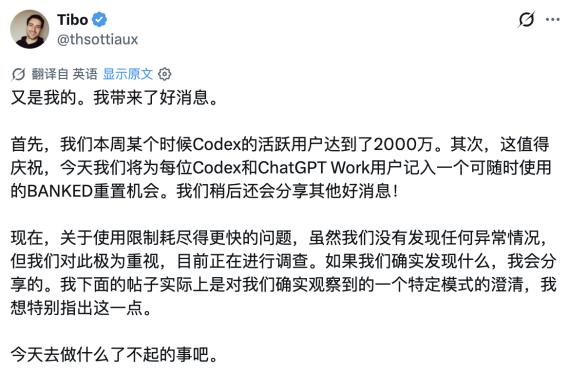
Tibo, head of OpenAI Codex, confirmed on X yesterday that Codex has exceeded 20 million active users this week. Internal OpenAI data previously obtained by CNBC also shows that the company's AI programming and work-oriented Agent products have reached about 20 million weekly active users.
This figure continues the rapid growth of the past month or more. In July, OpenAI successively announced user milestones of 6 million, 7 million, 8 million, 9 million and even 10 million for Codex and ChatGPT Work.
In addition to user growth, OpenAI's enterprise business is also accelerating significantly. According to CNBC disclosure, since the beginning of this quarter, calculated on an annualized basis at the current revenue level, the revenue scale of OpenAI's enterprise business has increased by about 50%, significantly faster than the 35% growth rate of the company as a whole.
On the other side, Claude Code, which almost defined the AI Coding boom this spring, has started to slow down.
The latest tracking from data tracking platform TickerTrends shows that as of August 10, the growth rate of Claude Code in the past four weeks has dropped to 5.2%; while OpenAI Codex has grown by 20.8% in the same period, nearly 4 times that of the former.
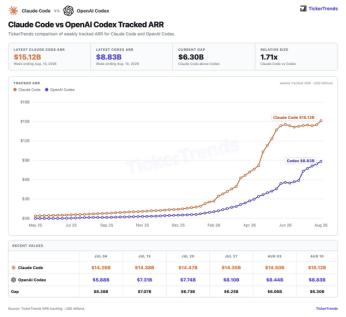
A few months ago, the two curves were nothing like what they are now. From February to June this year, Claude Code surged all the way, leaving its competitors far behind. But entering July, its growth curve flattened significantly for the first time; while Codex, which was originally lagging behind, stepped on the gas.
The dominance of Claude Code in AI Coding is being impacted.
Claude Code hits the brakes
Claude Code's growth myth has finally run into a very ordinary business rule: users are limited.
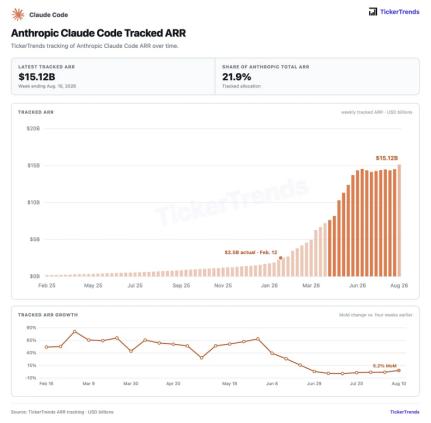
In February this year, Claude Code's annualized revenue was only around 2.5 billion US dollars. In the following months, this figure almost jumped all the way: it exceeded 6 billion US dollars at the end of March, broke through 10 billion US dollars at the end of April, and had exceeded 14 billion US dollars by June.
In just four months, it has multiplied more than five times.
During that period, Anthropic itself kept adding to this surge. In May, the company disclosed that Claude could already complete more than 80% of the code within Anthropic; in June, it began to discuss recursive self-improvement, "AI building AI", and how Agent can go from performing a bug fix task to deciding for itself what problems to solve.
Claude Code has almost become the best example for Anthropic to show "how AI changes software development".
Then, July came.
TickerTrends' tracking data shows that on July 6, Claude Code's annualized revenue was about 14.26 billion US dollars; one week later it was 14.38 billion US dollars; on July 20 it was 14.47 billion US dollars; by July 27, it even briefly fell back to 14.35 billion US dollars. It returned to 14.5 billion US dollars on August 3, and did not jump back to 15.12 billion US dollars until August 10.
Money is still being made, and revenue has not really dropped.
But that Claude Code, which used to refresh records every few weeks and grow by dozens of percentage points at every turn, has suddenly fallen into the tight single-digit growth range in the real world.
As of August 10, Claude Code grew by only 5.2% in the past four weeks compared with the previous four weeks.
This is not difficult to understand in itself: the first group of people Claude Code got was the group that was easiest to be converted by AI Agent.
Programmers are already sitting in front of computers, with clear tasks, code bases, test results, and even it is easier to verify "whether the AI has finished the work" than other knowledge workers. After the product is good enough, developers will flock in quickly and form strong usage habits.
The Information interviewed multiple enterprises at the end of July this year and found that even if Claude Code is getting more and more expensive, many engineers are still unwilling to switch. Among more than 200 enterprises tracked by Weave, the cost per user of Claude Code more than tripled in the first half of this year, while active users tripled. In the AI programming usage of Workato, Claude Code accounts for 80%, and Codex only accounts for 20%.
Claude Code not only grabbed the first batch of users, but also became the default option for developers.
But there are only so many programmers after all. The further back you go, the harder it is to convert the remaining people. Early adopter developers have already installed Claude Code; heavy users can use it for more than ten hours a day. Anthropic's research in June this year even shows that Claude Code users have already used it for about 20 hours per week on average.
After a product penetrates to such a level, it is unrealistic to expect it to expand forever at the early speed.
In the past year, coding has become one of the most important business pillars for Anthropic: Claude Code directly contributes revenue, and customers such as Cursor, Cognition, and GitHub Copilot call Claude through APIs, which essentially amplifies Anthropic's advantages in the programming scenario.
Claude Code's current slowdown in growth does not mean that something has suddenly gone wrong with it. The more likely situation is: the most accessible market has been almost eaten up by it.
Anthropic itself certainly knows this.
In the past few months, it has been trying to extend the working methods verified by Claude Code beyond the programmer group.
Cowork allows users to hand over files, browsers and various tools to Claude to complete multi-step work; Claude Tag, launched in June, was even directly called by Anthropic "an evolution of Claude Code", hoping to bring this Agent-style working method to product, customer service, data analysis and other teams. Anthropic's own Economic Index has also begun to study Claude Code and Cowork together, observing how Agent spreads from software development to a wider range of knowledge work.
But as of now, there is no second growth curve as exaggerated as the early Claude Code in public data.
Anthropic's best first story has reached the second half.
It just so happens that at this time, Codex, which has been chasing behind, starts to run fast.
Codex is catching up
While Claude Code is slowing down, another curve seen by TickerTrends is moving upward.
As of August 10, the Codex annualized revenue indicator estimated by its model increased by 20.8% in the past four weeks, nearly 4 times the 5.2% of Claude Code in the same period. At the beginning of July, the estimated size of Claude Code was 2.4 times that of Codex; five weeks later, this gap has narrowed to about 1.7 times.
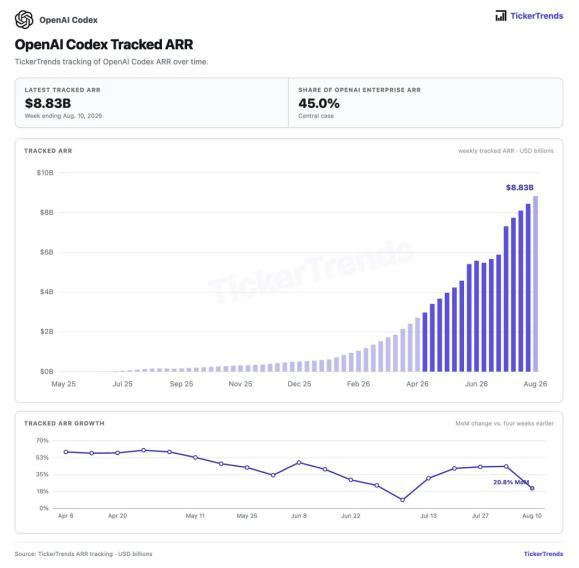
But here is a very important note first: TickerTrends has not directly tracked how much money Codex has earned.
At least the Claude Code curve has an official anchor point: Anthropic disclosed in February this year that its annualized revenue has exceeded 2.5 billion US dollars, and TickerTrends extrapolates backward based on its own data.
Codex does not have such official revenue figures. TickerTrends' approach is to first estimate OpenAI's enterprise annualized revenue, and then assume that 45% of it belongs to Codex, thus getting the figure of 8.83 billion US dollars and a growth rate of 20.8%.
Even so, the trend is real. OpenAI's own management has also listed Codex as one of the important drivers of recent revenue acceleration.
More direct evidence comes from OpenAI's own user data.
On June 2, OpenAI officially disclosed that Codex's weekly active users had exceeded 5 million, an increase of more than 6 times compared with the launch of the desktop application in February.
And its user group is not just programmers. At that time, knowledge workers already accounted for about 20% of Codex users, including analysts, marketers, operations staff, designers, researchers, investors and banking practitioners; the growth rate of this group of users was even more than 3 times that of developers.
After the release of GPT-5.6, OpenAI announced the user milestones of Codex and ChatGPT Work for several consecutive days: 6 million, 7 million, 8 million, 9 million... In those days, this figure is rising at a rate of almost 1 million per day.
On July 21, OpenAI announced that the total number of weekly active users of Codex and ChatGPT Work has reached about 10 million.
In less than a month, this figure has doubled again.
The latest internal OpenAI data obtained by CNBC shows that the company's "AI programming and work-oriented Agent products" have reached about 20 million weekly active users.
However, after OpenAI integrated Codex into the ChatGPT entrance, the product definition became very vague, and it is no longer possible to use a separate "Codex user count" to measure the competition between it and Claude Code.
OpenAI and Anthropic are already taking two different paths.
Anthropic expands outward from Claude Code, first capturing programmers, and then moving the Agent working methods verified by Claude Code to Cowork, Claude Tag and a wider range of knowledge work. Anthropic's own definition of Cowork is to bring the execution capabilities that Claude Code has proven to more people.
OpenAI is just the opposite. Codex also started with programmers at first, but since June this year, it has been continuously absorbing non-developer users such as analysts, marketing, operations, and researchers; after the release of GPT-5.6, OpenAI brought Codex and ChatGPT Work together into the larger entrance of ChatGPT. Today, the ChatGPT desktop terminal is clearly divided into several work entrances: Chat, Work and Codex. Among them, Work is responsible for long-time, multi-step knowledge work, and Codex continues to be responsible for software development, but the two share the same set of Agent usage quotas.
Anthropic is expanding Claude Code outward, while OpenAI is integrating Codex into ChatGPT.
If we strictly compare Coding Agents, we should look at Codex vs Claude Code; but if we discuss the 20 million AI programming and work-oriented Agent users announced by OpenAI now, the closer reference on the Anthropic side should actually be Claude Code + Claude Cowork, and even add Agent products evolved from Code such as Claude Tag.
But OpenAI has not caught up with Anthropic yet
If we pull the lens from Codex and Claude Code back to the two companies, the situation suddenly reverses.
At the end of 2025, OpenAI's annualized revenue run rate had exceeded 20 billion US dollars, more than twice that of Anthropic's about 9 billion US dollars.
More than half a year later, the leader has changed.
By the end of July, Anthropic's annualized revenue run rate had exceeded 65 billion US dollars, and OpenAI's latest disclosed annualized revenue level had exceeded 40 billion US dollars.
Calculated based on the lower limits of 65 billion US dollars and 40 billion US dollars, Anthropic's current annualized revenue level is at least about 60% ahead.
Even looking at Anthropic itself, from the end of May to the end of July alone, Anthropic added more than 18 billion US dollars in annualized revenue, and the new volume in two months is close to the total annualized revenue scale of OpenAI at the end of last year.
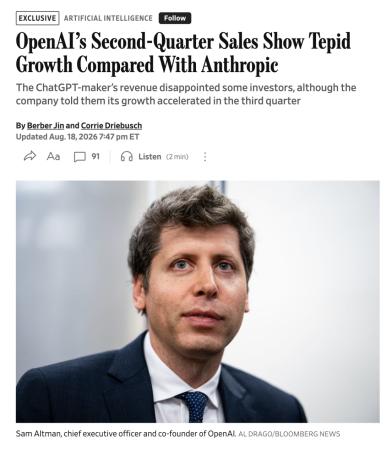
In addition, non-public financial data of the two companies obtained by The Wall Street Journal shows that in the second quarter of this year, OpenAI's revenue was 6.7 billion US dollars, a quarter-on-quarter increase of 18%; Anthropic's revenue in the same period more than doubled, reaching 11.6 billion US dollars, surpassing OpenAI in single-quarter revenue for the first time.
Although the revenue recognition calibers of the two companies are not completely consistent, for example, Anthropic will include part of the revenue generated by selling Claude through cloud partners into its own revenue, while OpenAI has a different processing method, these figures are not a strict one-to-one comparison.
But from the company's perspective, the change in Claude Code's growth rate is far from enough to shake the revenue advantage that Anthropic has already established.
One very important reason is that Claude Code is not all of Anthropic's revenue, not even the majority.
Anthropic's real main revenue force is still selling Claude model capabilities to enterprises and third-party products. Products such as Cursor, Cognition, and GitHub Copilot call Claude through APIs, and enterprise customers directly purchase model services. The sum of these revenues constitutes Anthropic's most important business base. The company previously even predicted that by 2028, API and related enterprise application revenue will still contribute more than 80% of total revenue.
The significance of Claude Code is more like turning Anthropic's model advantage in the coding scenario into a direct user-facing product, while in turn strengthening the demand of enterprises and third parties for the Claude model.
In other words, even if the steepest growth phase of Claude Code has passed, the revenue advantage that Anthropic built through coding has not disappeared.