Against the backdrop of the prevailing luxury residential market, properties targeting first-time homebuyers and immediate home upgraders also have runaway hits.
In 2026, the trend of upgrading in the new residential property market continues. Data from China Index Academy shows that from January to July 2026, the transaction volume of new residential properties priced above 10 million yuan in Beijing accounted for more than 15% of the total, while the figure in Shanghai exceeded 25%. From project layout to product iteration, real estate enterprises are further tilting resources to the mid-to-high-end market.
While transactions of high-end upgraded housing demand are active, first-home purchase and first-upgrade demand still constitute an important part of the new residential property market in many cities. From January to July 2026, 12,600 new residential properties priced below 6 million yuan were transacted in Beijing, accounting for nearly 60% of the city's total; 21,700 new residential properties priced below 2 million yuan were transacted in Chengdu, also accounting for about 60%.
This group of home buyers is relatively sensitive to the total price, and their requirements for living quality are also improving. With the advancement of the construction of "high-quality housing", unit function, actual usable area, community environment and public supporting facilities have gradually become the common concerns of all types of home buyers. For projects targeting first-home buyers and first-upgrade home buyers, the focus of competition is no longer only on controlling the purchase threshold, but also on maximizing the living quality within a limited area and budget.
This article sorts out the best-selling projects in key cities including Beijing, Shanghai, Guangzhou, Hangzhou and Chengdu from January to July 2026. Although most of the top 10 projects by transaction value in key cities are high-end upgraded housing projects, some properties targeting first-home and first-upgrade families still achieve rapid de-inventory. These projects do not rely on low prices to drive transactions, but seek a balance between total price, area, function and quality. Through optimization of plot ratio rules, refined unit design and upgrading of public spaces, they provide a living experience close to that of upgraded housing at a relatively controllable total price.
It should be noted that the "projects for first-home buyers and first-upgrade home buyers" mentioned in this article do not refer to projects where all units are small and medium-sized, but refer to projects whose core transaction products or main supply are concentrated in the area and total price range affordable for local first-home and first-upgrade families. Due to the differences in housing price levels and residents' payment capacity in different cities, this article mainly examines the relative threshold, target customer group and transaction structure of projects in the local market.
Best-selling Samples in Key Cities: Products Matching Mainstream Payment Capacity Still Have Market Space
The projects selected this time are distributed in key cities including Beijing, Shanghai, Guangzhou, Hangzhou and Chengdu, and their core products cover the mainstream area and total price range of local first-home and first-upgrade families.
In terms of sales performance, some projects have achieved rapid de-inventory. The de-inventory rate of the 103-square-meter unit of Wanbo Hezhen in Guangzhou is close to 90%, significantly higher than that of large-sized units in the same period; all 808 units of the first phase of Jinmao Xiaotang in East Chengdu were sold out, and the de-inventory rate of the second phase is about 94%. These projects are distributed in different cities and sectors, but all reflect the feature that the main total price, product function and target customer group are mutually matched.
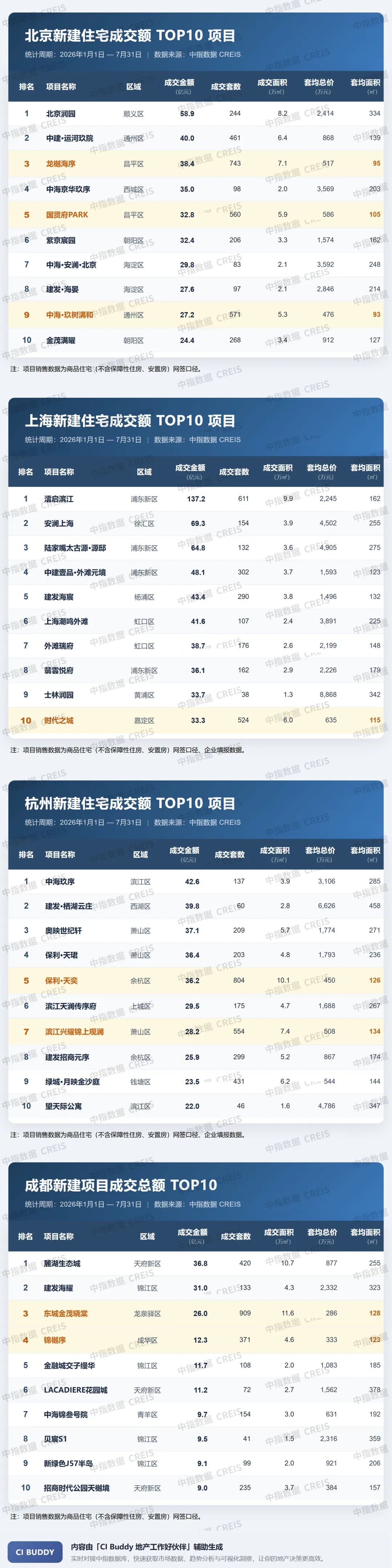
Common Features of Best-selling Projects: Controllable Total Price, Delivering Upgraded Value Within Limited Budget
Sorting out the best-selling projects for first-home and first-upgrade home buyers in key cities shows that these projects do not win by relying on a single low price, but form a good balance between location, total price, unit type and community supporting facilities around the payment capacity and family needs of the target customer group.
First, the land conditions match the regional purchasing power, leaving space for total price control. The feasibility of projects targeting first-home and first-upgrade home buyers first depends on whether the plot conditions match the regional purchasing power. Most typical projects are located in sectors with concentrated industrial population, convenient rail transit, or that can undertake the spillover demand from core urban areas, while the land cost, plot ratio and planning conditions can support the development of small and medium-sized units. For example, Longyue Haixu in Beijing mainly serves the technology innovation customer group in Haidian, and Poly Tianyi in Hangzhou targets the industrial population in Future Science and Technology City. Stable employment and population base form effective demand, and the adapted land conditions provide the product basis for controlling the main total price.
Second, control the total price of main products to match the payment capacity of target customer groups. The starting total price of typical projects for first-home and first-upgrade home buyers in Beijing is about 4-5 million yuan, and Jinmao Xiaotang in East Chengdu mainly launches products priced at 2-3 million yuan. The sales change of Wanbo Hezhen in Guangzhou is more representative: in 2024, units of 120 square meters and above accounted for more than 65% of the first phase, the overall de-inventory rate was only 54% that year, among which the de-inventory rate of 103-square-meter units was close to 90%; after that, the supply of small and medium-sized units was increased in the second phase, and the sales performance improved accordingly.
Third, improve space utilization efficiency to enable limited area to carry more family functions. Typical projects generally use optimized plot ratio design for balconies, bay windows and equipment spaces, expand the actual usable space by optimizing unit design, and enable small and medium-sized units to carry more family functions by reducing ineffective traffic space, increasing lighting surfaces and setting flexible spaces. For example, Longyue Haixu in Beijing realizes three bedrooms on 76 square meters, and Wanbo Hezhen in Guangzhou realizes four bedrooms in the 97-106 square meter area range. For first-home and first-upgrade customer groups, the number of rooms, storage system and space flexibility have more practical value than the single index of floor area ratio. However, in terms of sales performance, the area is not the smaller the better. How to find a balance between the total price threshold and living comfort also tests product design capabilities.
Fourth, materialize public spaces to improve the quality of high-frequency living scenarios. Typical projects generally add spaces such as overhead floors, children's activity areas, fitness areas, social areas and community commercial spaces, but do not simply copy luxury clubhouses. Instead, they convert the high-frequency living demands in upgraded housing products into perceptible and usable community supporting facilities for first-home and first-upgrade projects. Jinmao Xiaotang in East Chengdu presents living scenarios in advance through the pre-operation of community commerce and supporting facilities, enhancing home buyers' certainty about the future community life.
Overall, the common path of these projects can be summarized as: controlling the main total price based on real customer groups, undertaking family functions through space optimization, and supplementing living quality with high-frequency public supporting facilities. For projects with corresponding customer group base, land conditions and product space, this product mix can form certain differentiated competitive advantages.
In addition to the above three projects, some other projects also perform well in product strength and other aspects, with impressive sales volume. Shanghai Times City was first opened in June 2024. As of August 17, 2026, a total of 2086 high-rise and low-rise units have been launched on the market, 1963 units have been transacted, with a de-inventory rate of 94%. Jinmao Xiaotang in East Chengdu is the first work of Jinmao's "Tang Series" in Chengdu. The first phase of the project was opened in May 2025, with 808 units all sold out; the second phase was opened in October 2025, with 1102 units and a de-inventory rate of 94%; the third phase was opened in December 2025, with 884 units and a de-inventory rate of 92%, showing steady de-inventory performance.
Conclusion
Upgrading remains an important trend in the new residential property market, but market demand is not single. For projects with industrial population and first-home & first-upgrade customer group base, and matching land conditions, total price level and product planning, products for first-home and first-upgrade home buyers can still find market space and form competitive advantages through differentiated products.
From the perspective of best-selling projects, this differentiation does not simply mean lowering the total price or reducing the area, but on the basis of clarifying the customer group, controlling the total price within an affordable range, and improving the living experience through unit optimization, space efficiency and high-frequency living scenarios. The core is how to match product value with customer demand more accurately within a limited budget.
For real estate enterprises, products for first-home and first-upgrade home buyers are not a replicable product template, but a product strategy that needs to be judged in combination with the conditions of the city, land, customer group and cost. When projects have corresponding conditions, instead of engaging in homogeneous competition in the high-end upgraded housing market, it is better to make more accurate product choices around the clarified customer group to form differentiated competition.
This article is from the WeChat Official Account "China Index Academy", author: China Index Research, authorized for release by 36Kr.