The business districts have fallen into stagnation, and knowledge parks are becoming the new magnetic pole for talents.
JPMorgan Chase's new billion-dollar headquarters in New York, located at 270 Park Avenue, stands nearly 1,400 feet (426.72 meters) tall and occupies an entire city block. The building is constructed around a large public square with restaurants, shops, and green spaces.
Pfizer and BlackRock's new headquarters at Hudson Yards are also two sculptural skyscrapers that rise in an area interwoven with transit, retail outlets and public spaces. Another billion-dollar supertall, One Vanderbilt, is connected to Grand Central Terminal, creating a vertical community that brings together restaurants, leisure and entertainment, terraces and meeting rooms. Across the Atlantic in London, Google, Meta and Universal Music Group have also transformed old railway freight yards near King's Cross Station into a bustling enclave packed with technology, media and creative companies.
At a time when the corporate headquarters was widely expected to disappear, they have been recreated on an unprecedented scale and investment as a new type of urban campus, integrated into the urban fabric and drawing on the vitality of urban life. We call this new corporate location model a knowledge campus. Compared with traditional headquarters buildings, they are more like university campuses in form. This knowledge campus can support the full rhythm of people's daily lives — work, meetings, learning, socializing and travel — all brought together in a highly connected place. Moreover, these campuses are usually connected to major transportation hubs, which can reduce commuting time, thereby improving employees' work efficiency and overall life satisfaction. As is well known, commuting time can seriously affect people's quality of life and work performance. In addition, the rise of knowledge campuses is not limited to the world's megacities. Similar models are emerging in cities, suburbs and even rural areas of all sizes, which are gradually moving away from single-use purely office or purely residential development models to dynamic environments that better integrate work, daily life and interpersonal interaction.
Based on detailed questionnaires of professional knowledge workers and analysis of major business districts in 13 cities around the world, this article explains how and why "location" has become a key factor in attracting talent and improving work efficiency. After that, taking two major business districts in Tokyo as examples, we outline the four elements of this new model. Finally, we will provide some core principles to help corporate leaders think more prudently about "location" — no longer treating it as a symbol of real estate cost or status, but as a core element of corporate strategy and one of the drivers of competitive advantage.
The Link Between Efficiency and Location
The office was thought not to make a comeback. Digital technology had almost rendered office buildings obsolete. During the pandemic, remote work and hybrid work models once represented the future. But the "end of the office" never came. Instead, the office is being reborn from the ashes. Because for jobs that rely on collaboration, judgment and learning from each other, "being together" remains critical. Working side by side makes collaboration easier and helps employees build the trust relationships that organizations depend on to survive. As a result, headquarters buildings have not disappeared, but have been transformed to become a boost for corporate collaboration, innovation and talent attraction.
Currently, the arguments in favor of returning to the office are based on a narrow view of efficiency: measuring only the work employees complete on the job (output per hour worked), but ignoring another key part of the efficiency equation. Efficiency encompasses two interrelated dimensions: work efficiency, which is the work completed in the office, and life efficiency, which is what people accomplish in their lives outside of work. Work efficiency actually depends on life efficiency. Life efficiency includes activities such as commuting, handling personal affairs, and getting enough rest to recharge, which make sustained and efficient work possible.
In 2025, we conducted a questionnaire survey of 1,200 professional knowledge workers from 7 countries (France, Germany, India, Japan, the United Arab Emirates, the United Kingdom and the United States) to assess the two dimensions of efficiency. The results found that overall, work efficiency in the office environment was significantly higher than working from home, mainly due to closer collaboration, more interactions and the ability to solve problems together.
However, when we looked at life efficiency, the picture changed dramatically. Commuting was the biggest drain: survey respondents spent an average of 75 minutes a day traveling to and from the office, time that could not be used for work or for family. Looking more broadly, the survey found that the energy and attention employees spend on trivial matters, fragmented daily schedules, and the stress of coordinating childcare or personal affairs also drain energy and attention during working hours.
In fact, work efficiency and life efficiency do not have to be a zero-sum game. With the right location and design, offices can retain the advantages of face-to-face interaction while reducing the inconvenience of life caused by commuting.
The Rise of the Knowledge Campus
To foster a better relationship between work efficiency and life efficiency, business leaders should not only see offices as individual buildings, but embed them in a broader place, an environment that integrates workspaces with transportation, services and various amenities, so that employees can seamlessly switch between professional and personal life.
Such knowledge campuses integrate multiple spaces such as offices, retail and entertainment, and have convenient transportation networks that reduce the costs of excessively long commutes and fragmented daily life. Perhaps the most typical example of a knowledge campus is the cluster of high-rise buildings near a major railway station in Tokyo. These towers function like vertical cities, with hotels and apartments on the upper floors, restaurants and clubs on the middle floors, and innovation incubation centers and co-working spaces on the ground floors. Corporate executives sometimes live in office buildings. Visiting team members can stay in hotels connected to the office campus. Employees with families can take high-speed rail and reach the office area in 10 to 20 minutes. When offices, accommodation, catering, leisure places and transportation are all concentrated in one place, employees do not have to waste time coordinating various arrangements. The location itself sets the rhythm of people's day.
To better understand knowledge campuses, we examined 39 central business districts in 13 megacities around the world, focusing on 15 areas that have undergone the most significant transformation since the 1990s. Based on this analysis, we constructed a Knowledge Campus Index, which is built around four core dimensions that distinguish these places based on the degree to which work efficiency and life efficiency reinforce each other.
First, knowledge campuses reintegrate important components of daily life with the rhythm of work. They integrate workplaces with housing, services, culture and amenities, with dining, fitness and even childcare services located within or adjacent to the campus. In addition, many of the new headquarters and campuses we studied explicitly leverage the vitality of the surrounding city. Cafes, pedestrian streets, parks and public spaces are integrated into the workday. These spaces can be used for walking meetings as well as quick breaks, enhancing social vitality and improving the efficiency of face-to-face work.
Second, they enhance interaction and connection. By narrowing the distance between work and personal life, knowledge campuses create many opportunities for informal exchanges, which sustain culture, consolidate trust, and inspire collaboration and new ideas.
Third, they form around unique industry clusters, such as finance, technology or creative fields. Geographic proximity enhances knowledge sharing.
Fourth, they are connected to major transportation hubs, thus reducing commuting drain, which not only drives work efficiency but is also a key driver of employee life satisfaction.
In our questionnaire survey, employees in knowledge campuses performed better than employees in traditional central business districts in terms of concentration, collaboration ability and daily affairs management. On a standardized scoring system of 0-100, the average work efficiency score of employees in knowledge campuses was 63.4 points, while the average score of employees in traditional central business districts was 56.8 points, a difference of 6.6 points, or about 12%. The gap in life efficiency was even larger: the average score of employees in knowledge campuses was 57.9 points, while the average score of employees in traditional central business districts was 50.4 points, a difference of 7.5 points, or about 15%. Interviews with corporate management also confirmed these findings; executives at companies in knowledge campuses said employees are more focused, energetic, and able to maintain high performance.
From this perspective, knowledge campuses reveal why old-style corporate headquarters and traditional business districts are in decline. Traditional business districts were originally built as single-use office areas, designed around activities inside office buildings, leaving employees' daily needs for them to solve on their own. Moreover, because these areas often cannot have both public transportation and housing options, commuting becomes a daily burden.
As these old central business districts decline, out-of-town areas often thrive. Former industrial districts, waterfront areas, and communities centered on universities or hospitals, even if only a few kilometers apart, show stronger demand, higher rents, and lower vacancy rates. (See "Why Central Business Districts Are Declining While Suburbs Thrive?")
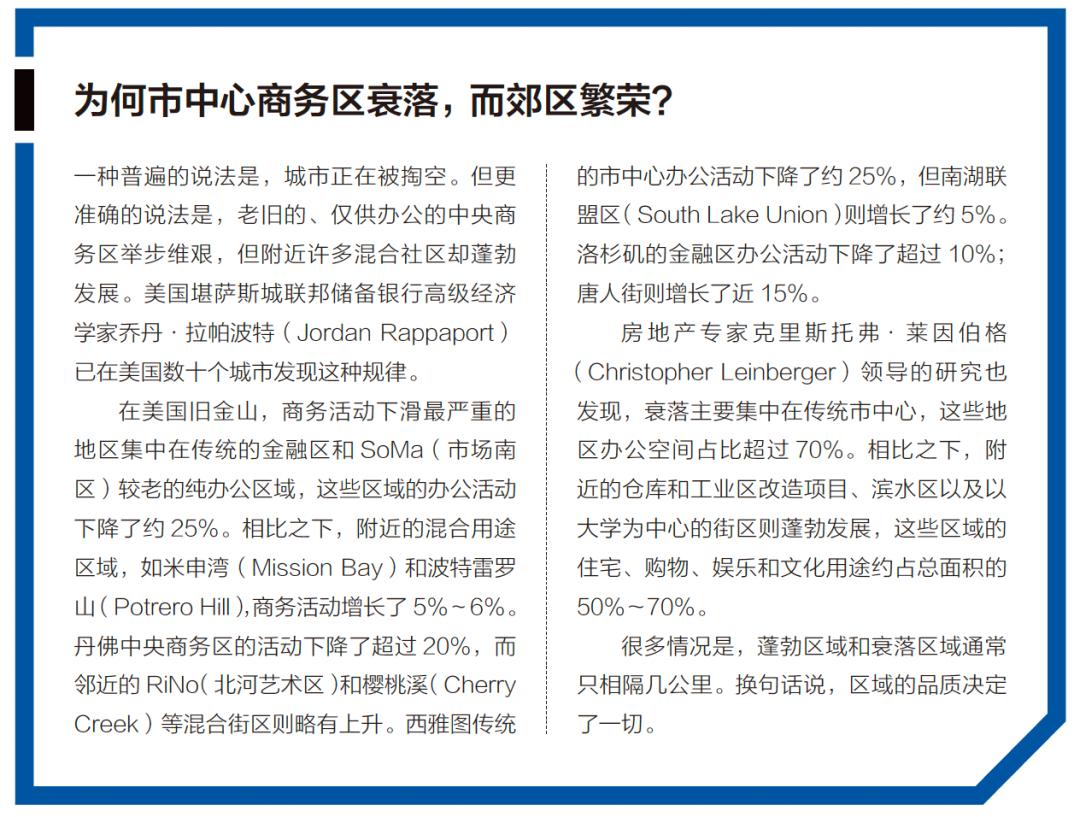
The same logic explains the limitations of another once-dominant model — suburban tech parks. Most of these campuses offer on-site amenities, including cafes, gyms and green spaces, but they are often located in remote areas, rely on car travel, and are disconnected from daily life. Employees often face long, tiring commutes that drain significant time and energy before the workday even begins. As a result, many startups and tech companies have abandoned suburban campuses in favor of city centers in cities like San Francisco, New York, Tokyo and London.
A New Model Rises in Tokyo
We plotted the scores of urban areas around the world on the Knowledge Campus Index against business performance (measured by sustained rent growth and low vacancy rates) (see "Global Ranking of Central Business Districts in Major Cities"). Tokyo's Roppongi and Shibuya districts ranked at the top on both metrics. In contrast, many well-known traditional business districts — including Midtown and Downtown Manhattan in New York, Canary Wharf in London, and La Défense in Paris — scored lower on the index and had weaker business performance.
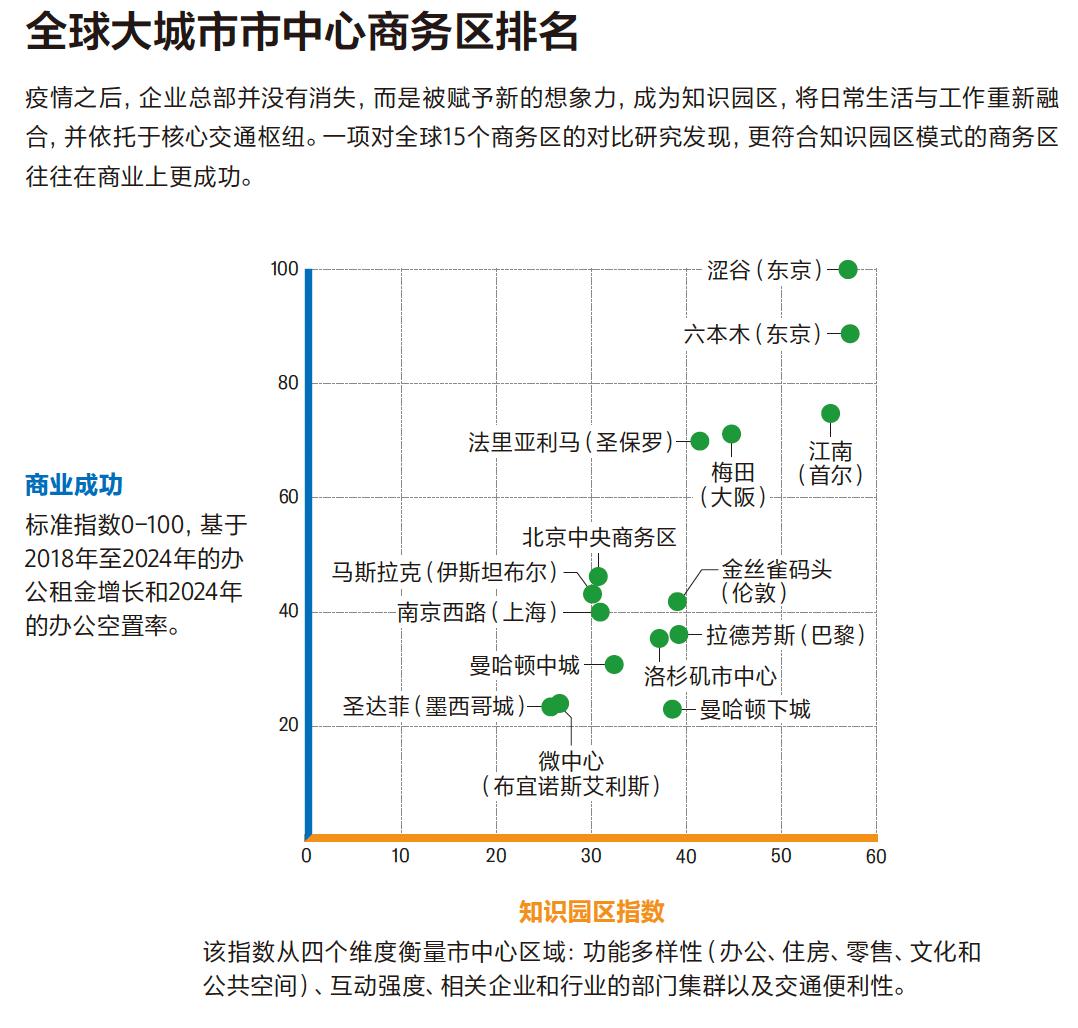
How to explain this difference? Decades before New York and London, Tokyo began building knowledge campuses. In the 1990s and early 2000s, developers in Tokyo had already begun building mixed-use districts centered on transportation hubs, on a scale comparable to entire city blocks. These developers took a long-term view, spending 15 to 30 years acquiring land parcel by parcel, and coordinating with hundreds of small businesses and residential property owners. While many Western cities were still building single-use office buildings, Tokyo was creating complete urban communities.
Tokyo's rise is easy to overlook because it occurred during the country's long period of deflation and slow economic growth. But its model has shown remarkable resilience. To understand how this model works in practice, we conducted field research, interviewed developers, corporate executives and local officials, and delved deep into the evolution of two major areas in Tokyo.
Roppongi: From Nightclub District to Knowledge Campus. In the 1990s, the Roppongi area of Japan was known for its nightlife and expat bars, not a business or financial center. In the early 2000s, Mori Building Company, the developer that reshaped Roppongi's future landscape, launched Roppongi Hills and a series of other large projects, reimagining the area as a seamlessly connected whole rather than a collection of individual buildings. The developer's goal was to create a so-called "urban efficiency platform", aiming to build innovation centers and co-working spaces that connect large corporations, startups and investors.
Persol Career, a Japanese HR services firm, saw immediate results after relocating from Marunouchi, Tokyo's traditional central business district, to Roppongi. Internal company data shows that within a year, the proportion of employees voluntarily coming to the office increased by 75%, and the proportion of employees who found collaboration more convenient rose from 61% to 84%. This shows that location affects performance. Office location is not just the background of work, but can be a lever for corporate culture and work efficiency. The advantage of Roppongi lies not only in its rich and convenient amenities, but also in the fact that it saves a lot of time for employees by compressing daily work processes. A large global technology company moved its Japan headquarters from Shinjuku to Roppongi with the slogan "No wasted time". This move shortened commuting time, reduced daily inefficiencies, and made it easier for employees to balance work and life. The improvement in work efficiency and employee retention did not come from mandatory attendance, but because the new office location saved time costs and employee energy. Multinational companies such as Goldman Sachs, Apple and McKinsey have also located their Japan headquarters in Roppongi.
Shibuya: Where Cultures Meet and Intersect. While Roppongi is the product of a developer's master plan, Shibuya's advantages stem from its unique identity. It did not come from commercial development, but was nurtured by culture. In the 1970s and 1980s, Shibuya was the center of Tokyo's youth culture, where fashion, music, art and design thrived. Art schools and grassroots experiments injected vitality into the neighborhood, spawning new tastes and talents. This creative gene has not faded with economic changes, but has become the cornerstone of its development, enabling it to attract global companies in technology, entertainment and design while maintaining its own vitality.
Over the past 20 years, Shibuya has transformed its unique cultural charm into a tightly connected industrial ecosystem centered on consumer technology. About 80% of major tenants come from the consumer electronics sector, including companies such as Google, ByteDance/Douyin, as well as creative agencies such as Wieden+Kennedy and R/GA. Subsequently, human resources companies and startups have moved in one after another, further strengthening the industrial cluster effect and promoting knowledge spillovers and talent flow.
The key to the continuous expansion of the Shibuya ecosystem is its connectivity, especially the integration of the area's transportation conditions and development. Shibuya is centered on Shibuya Station, where nine railway lines converge, making it one of the most conveniently accessible transportation hubs in Tokyo. Tokyu Corporation, the region's major railway operator and leading developer, has built commercial, retail, residential and public spaces above and around the station, adding shared innovation centers and so-called "third spaces" where people can meet, collaborate and relax.
The result is an area that has a huge talent market while remaining livable, keeping people very active outside of work. Many employees live nearby, and some companies also provide housing subsidies so that employees can live within two subway stops, which further enhances this vitality. A survey by Tokyu Corporation shows that employees' efficiency and satisfaction have increased by about 40%, while voluntary attendance is also higher — a manifestation of the work-life balance predicted by the knowledge campus model.
The more traditional central areas of Tokyo are now embarking on the same transformation path. Marunouchi, once a 9-to-5 financial center, has now added plazas, pedestrian streets, restaurants, residences and cultural venues, making it vibrant even after night falls. Shinjuku, centered on the Tokyo Metropolitan Government Building and one of the world's busiest railway stations, has developed into a multi-functional hub integrating offices, hotels, entertainment venues and shopping centers.
Roppongi and Shibuya have two mutually reinforcing structural advantages: a convenient transportation network and land use rules that allow large-scale residential construction near workplaces. In Tokyo, dense, diverse communities can truly become knowledge campuses, where people can get to work easily and quickly, and a significant number can live close enough to work to avoid the ordeal of commuting.
New Ideas for Site Selection
For decades, corporate headquarters location decisions were primarily based on traditional real estate metrics: cost per square foot, lease terms, and preferential policies offered by developers and cities to attract corporate tenants. This framework made sense when the primary function of corporate headquarters was to get employees to work. But these traditional incentives hardly reflect the actual operating conditions of a district.
Measure Return on Place. The most important metric today should be Return on Place (ROP), which is the effectiveness of a location in facilitating collaboration, reducing friction, and strengthening corporate culture. The knowledge campus assessment framework provides three key variables that leaders can measure and manage during the site selection process, while continuing to use traditional metrics such as cost and utilization.
Interaction and Collaboration. Managers should assess whether the office location naturally facilitates frequent informal interactions, both within the office area and in the surrounding area or campus. This includes the quantity and density of cafes, restaurants, shared meeting places, public spaces, and street activities where people often run into each other throughout the day. Areas with active sidewalks and many nearby meeting places can facilitate collaboration without prior arrangement. That's why companies are willing to pay higher rents in vibrant neighborhoods, such as along Fifth Avenue in New York or near major transportation hubs, compared to areas that lack opportunities for interaction.
Life Efficiency and Commuting. A company's site selection assessment must go beyond the building itself to focus on the time and energy people lose or save by working there. This includes the direct cost of commuting, of course, but also the time, uncertainty