A commercial landscaping robot enterprise backed by Li Zexiang has completed financing worth tens of millions of yuan, targeting the intelligent operation and maintenance of overseas green spaces | Exclusive First Release from Hard Krypton
Author | Huang Nan
Editor | Yuan Silai
36Kr has learned that PANDAG, a commercial landscaping robot company, has recently completed tens of millions of RMB in Series A financing. This round is exclusively invested by Yunshi Capital, with Star Capital serving as the financial advisor. The raised funds will be mainly used to build the delivery system for the European, American and Australian markets and deploy global sales channels. Previously, the company has obtained investments from institutions including Professor Li Zexiang, MiraclePlus, and Shunfeng Changqing.
Founded in 2021, PANDAG started its business with the PANDAG G1 commercial lawn mowing robot, and is evolving towards a multi-task commercial landscaping robot platform centered on modular hardware, equipment operation and closed-loop operation data.
In 2025, PANDAG completed the construction of its first self-owned production line and realized mass production and delivery, with its products entering actual operation in multiple overseas markets. In terms of channels, the company has signed head agents in multiple overseas regions, including a cooperation with one of the largest local golf operators in South Korea. Its PANDAG G1 has been deployed at KLPGA (Korea Ladies Professional Golf Association) tournament courses to carry out daily maintenance operations. In addition, benchmark clients in scenarios such as photovoltaic power stations and municipal green spaces have been successively onboarded.
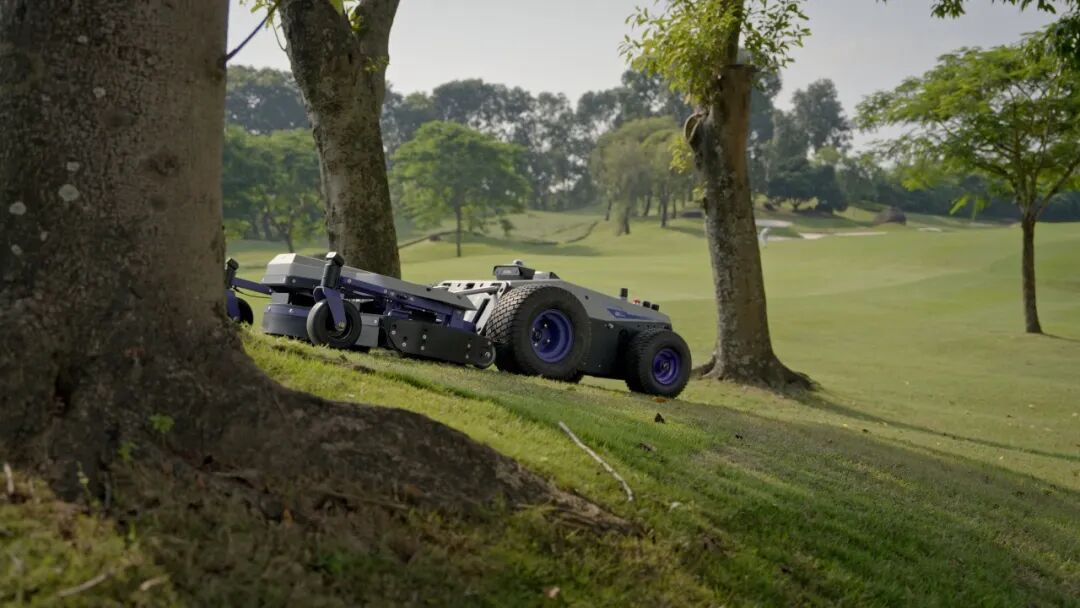
PANDAG G1 commercial robot from PANDAG (Source / Enterprise)
Over the past few years, the intelligent landscaping track has developed two distinct paths. Consumer-grade lawn mowing robots for yards have rapidly entered households to meet the needs of lightweight, single-person operation. However, for large-scale commercial scenarios such as golf courses, photovoltaic parks and municipal green spaces, there has long been a lack of automated solutions covering the full operation process. Traditional riding and hand-push machinery only complete basic mowing, and there have long been pain points such as labor intensity and low efficiency in complex terrain and overgrown weed scenarios.
Data from the National Association of Landscape Professionals (NALP) shows that 60% of landscaping maintenance enterprises have long-term job vacancies, and labor costs are expected to rise by a further 20% by 2029.
Labor shortage is only a superficial problem. The deeper challenge for the commercial landscaping industry lies in the fact that both work execution and professional experience are difficult to scale up, and there is a lack of a complete system covering site planning, autonomous operation and data-based maintenance.
On the one hand, most of the existing landscaping equipment is still efficiency tools requiring manual operation. Taking a standard golf course as an example, daily maintenance requires the cooperation of dozens of types of equipment, and a large amount of manpower is consumed in repeated driving and operations. On the other hand, professional maintenance experience is difficult to be standardized and transferred. Lawn management requires differentiated strategies based on grass species, seasons, climate and terrain. Decisions on when to operate and what speed and power to use often rely on the on-site judgment accumulated by the team over a long period of time.
Zhou Yongfeng, founder and CEO of PANDAG, told 36Kr: "Top landscaping maintenance teams are often invited to sites without mature systems to provide guidance. But to truly improve the local lawn construction level, simply upgrading equipment is far from enough. It also requires continuous training and coaching for the local team for half a year or even several years, which features a long cycle and high cost."
The core demand of commercial green spaces is not only "mowing more cleanly", but a new replicable productivity model that can reduce costs and increase efficiency. This is the key entry point for PANDAG to enter the commercial landscaping track.
"For commercial robots, being able to run is just the starting point. Being able to complete work well for a long time is where the value lies," said Zhou Yongfeng. "Commercial landscaping robots should not only complete tasks in scenarios such as professional courses and municipal green spaces, but also truly integrate into the daily operation of professional teams, and continuously and stably deliver operation results in different seasons, grass conditions and terrain."
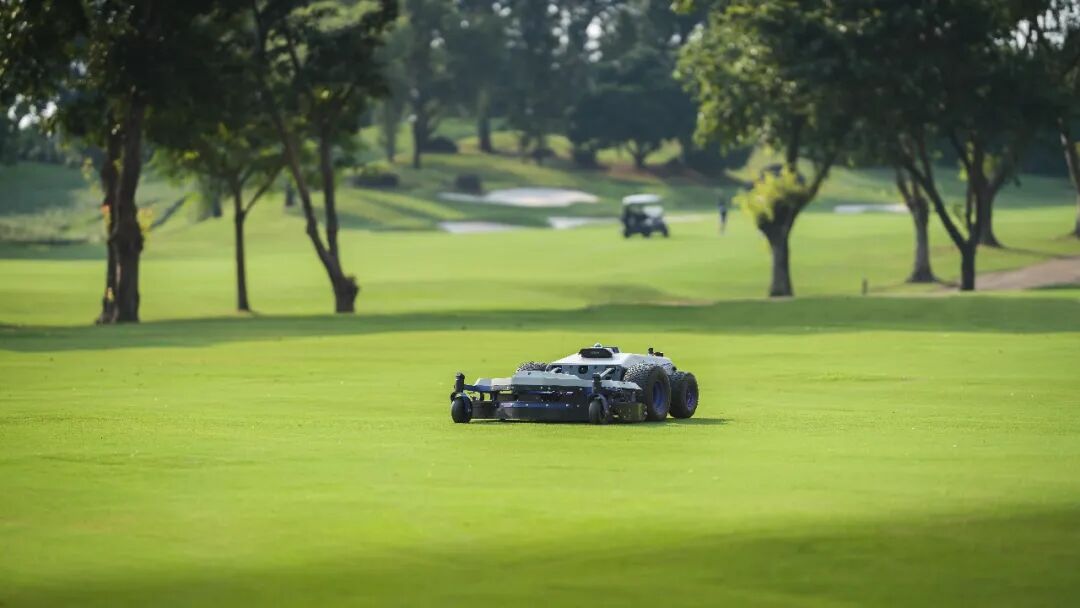
Application of PANDAG G1 in golf scenarios (Source / Enterprise)
At present, PANDAG has launched the PANDAG G1, which adopts a heavy-duty chassis and fully modular design. Its walking, cutting and energy systems support quick disassembly and replacement, and are equipped with modular cutting units to meet different operation needs. The three-blade cutting system is designed for heavy-duty operation scenarios such as tall grass and dense vegetation, which can complete grass crushing and discharging synchronously during the cutting process, reducing the risk of tall grass tangling and clogging.
In terms of power and operating mechanisms, high-power motors ensure the continuous operation of the cutting system. The cutting deck adopts an adaptive floating design, which can adjust with the ups and downs of the ground to better adapt to uneven operation environments with undulations and gravel. The energy solution provides two configurations for fixed deployment and mobile operation: the former can be equipped with an automatic recharging module to support unattended cyclic operation; the latter can be paired with a lightweight endurance module to meet the needs of cross-site mobility.
In terms of energy configuration solutions, the fixed deployment model can be optionally equipped with an automatic recharging module to support unattended cyclic operation; mobile service provider customers can also independently choose a lightweight endurance module to meet the needs of cross-site mobility. Different from the integrated fixed body, the PANDAG G1 is also reserved with standard expansion interfaces, which can provide the reuse basis for different landscaping tasks.
While the heavy-duty hardware capability is the foundation, the core differentiation of PANDAG's full solution also comes from the closed loop between real execution and operation data.
The PANDAG G1 is equipped with a navigation system integrating LiDAR and binocular vision. Compared with traditional solutions that only rely on RTK positioning, it can still stably map and continuously operate in areas with blocked satellite signals such as under tree shades and around buildings. As the machines are deployed in more regions, seasons and grass species environments, these real operation data are further used for the iteration of products, algorithms and operation strategies.
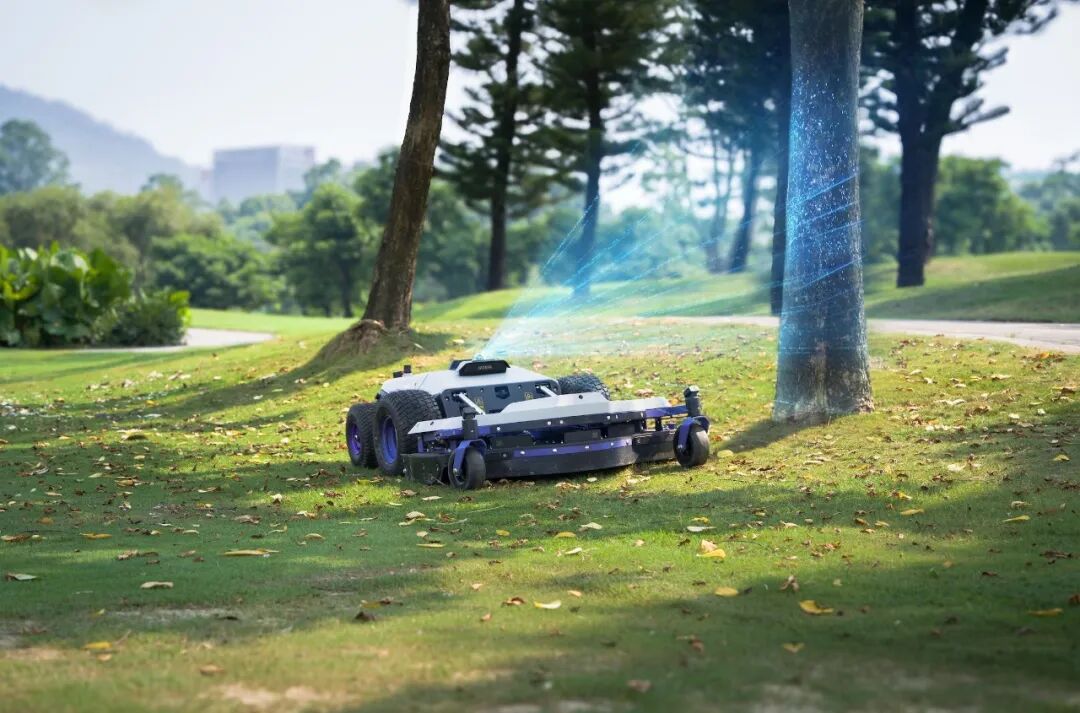
PANDAG G1 operating under trees (Source / Enterprise)
Different from basic solutions that only realize path planning, the PANDAG Agent platform can understand the growth law of vegetation, and adjust operation frequency and travel routes according to grass species, seasonal changes and site usage. For example, weeds in photovoltaic plants grow fast, and the model will automatically increase the inspection frequency; for high grass areas of golf courses, it will generate refined operation paths.
Based on the existing autonomous navigation and operation capabilities, PANDAG is further exploring intelligent decision-making capabilities for commercial landscaping.
Zhou Yongfeng pointed out to 36Kr that mowing is the most rigid demand entry point for customers, but it is far from the full demand of commercial landscaping. PANDAG chooses a modular design, hoping that the same hardware base can provide a reuse basis for different landscaping tasks, thus reducing the cost for customers to repurchase the whole machine and improving the utilization rate of equipment assets.
"Our goal is to let the system gradually participate in the optimization of operation decisions with the continuous accumulation of real operation data and professional experience. In the near future, all kinds of commercial green spaces will reduce their dependence on scarce senior operation and maintenance personnel, and realize reusable and iterable machine capabilities only with modular robots and intelligent platforms," said Zhou Yongfeng.
36Kr learned that relying on the service model of "hardware delivery + supporting intelligent green space platform", the product reliability of PANDAG has been verified in overseas markets. The team is cooperating with distributors in Japan, North America, Australia and other regions, the products are continuously launched in offline roadshows across Europe and America, and the production line is simultaneously in the stage of capacity expansion.
The following is an excerpt of the interview between 36Kr and Zhou Yongfeng, founder and CEO of PANDAG (slightly edited):
36Kr: PANDAG chose to enter the commercial landscaping track with a modular hardware platform. What is the industrial logic behind this judgment?
Zhou Yongfeng: The most acute contradiction in the commercial landscaping industry is not only the high labor cost, but also the fundamental difficulty in recruiting workers. Under the superposition of multiple factors such as intensifying aging, young people being unwilling to engage in the industry, and seasonal labor shortage, the industry is facing a structural labor gap.
However, the more tricky problem is that what is lacking is not labor, but people who can make decisions. For lawn maintenance, what is really scarce is not physical strength, but judgment. For example, golf courses have millimeter-level requirements for the height of putting green grass, but senior technicians who can get this right are scarce across the whole industry.
What we want to do is to replace repetitive labor with equipment and replace empirical decision-making with models.
Therefore, mowing is the most rigid demand entry point for customers, but it is far from all. We hope that what customers buy is a sustainable and expandable hardware base, rather than a lawn mower. The same chassis supports the full-cycle green space maintenance, and only the module needs to be replaced without repurchasing the whole machine. This is the starting point for us to define the "intelligent operation platform for commercial landscaping".
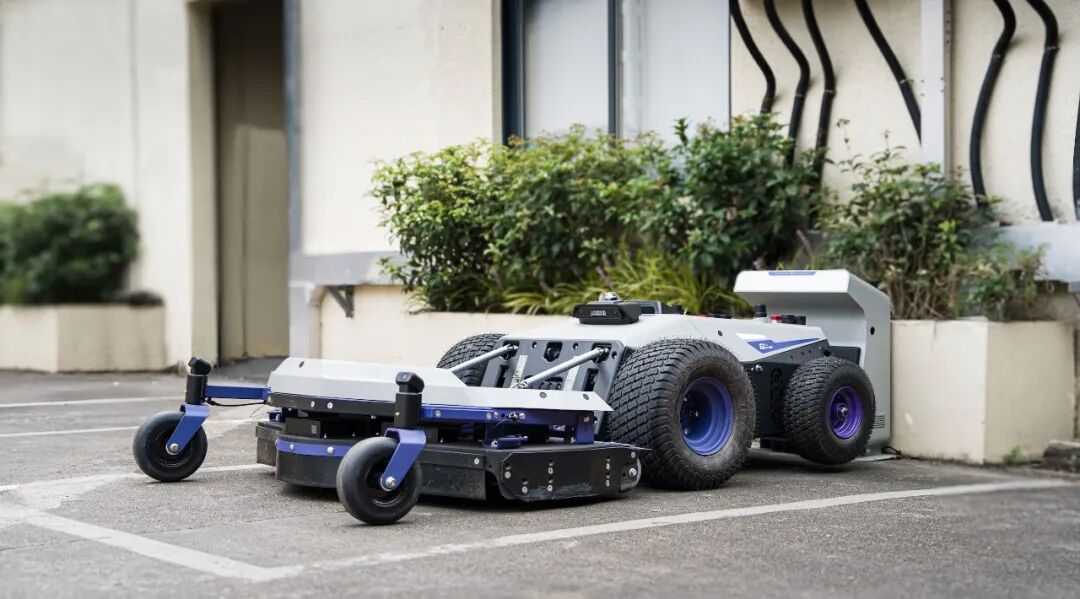
PANDAG automatic recharging function (Source / Enterprise)
36Kr: Modular hardware solves the problem of reuse. How do you build your long-term moat?
Zhou Yongfeng: The moat comes from the cross-scenario migration capability of intelligence and data accumulation.
The refined path planning and low mowing algorithms we accumulated in the golf scenario are essentially a set of "cognitive models for lawn management". As the equipment is deployed in more regions, different grass species and different terrain, the real operation data continuously feeds back to the underlying model. The training data of each new scenario deepens the platform's understanding of "lawn management": how to mow what kind of grass, how to pass through what kind of terrain, and what kind of process to carry out in what season, accumulating experience just like a senior technician.
The longer this part runs, the higher the threshold. The model trained based on real site data of more than 100,000 mu around the world, as well as the cognition of different vegetation, terrain and operation constraints, cannot be replicated in the short term simply by financing or poaching talents.
Investor's View:
Yunshi Capital stated that we believe that with the continuous evolution of intelligent technology, end-user demand and industrial foundation, robots are moving from standard environments to a wider real world, spawning a new round of opportunities for global technology products. The commercial landscaping market is mature, with high-frequency rigid demand, and highly dependent on professional equipment and manual experience, which is an important scenario for robots to realize large-scale value. The PANDAG team is highly entrepreneurial. Starting from commercial mowing, it has long been rooted in real customer scenarios, improved its intelligent capabilities, and continuously iterated and expanded its product matrix. We look forward to the company growing into a globally competitive commercial robot brand and building a top robot company in the outdoor vertical field.