The new "Shanghai Eight Policies" has been rolled out: the minimum down payment for second homes located outside the Outer Ring Expressway has been cut to 15%, and the housing provident fund can be withdrawn to pay the down payment for new completed residential properties.
On August 20, six municipal departments in Shanghai jointly issued the Notice on Optimizing the City's Real Estate Policy Measures, launching 8 policies covering 5 aspects: optimizing housing provident fund withdrawal, optimizing individual housing credit, implementing "trade-in" home purchase subsidies, promoting housing voucher resettlement, and advancing the acquisition of second-hand housing for affordable rental housing. Following the "Shanghai Nine Rules" in May 2024, the "Shanghai Six Rules" in August 2025, and the "Shanghai Seven Rules" in February 2026, Shanghai has further optimized its property market policies within the year. This new policy further focuses on the linkage between the outer ring suburbs and new and second-hand housing, representing a comprehensive and systematic optimization of real estate policies. It is expected to inject new momentum into the market recovery during the "Golden September and Silver October" period, and further consolidate the stable market trend.
[Core Conclusions]
Optimize the scope and frequency of provident fund withdrawal, and there is still room for further optimization of provident fund policies in the future. The scope of provident fund withdrawal is extended to completed new commercial residential properties. For eligible groups, the withdrawal frequency is relaxed from "once every 5 years" to "once per natural year", and the withdrawal amount is relaxed to no more than "the home purchase payment made with self-owned funds". New withdrawal scenarios for deed tax, purchase of parking spaces (garages) and storage rooms are also added. The new version of the *Regulations on the Administration of Housing Provident Fund* has been released recently, and Shanghai has responded actively. There is still room for optimization of provident fund policies in the future, which is expected to continue to upgrade to a "housing consumption support tool".
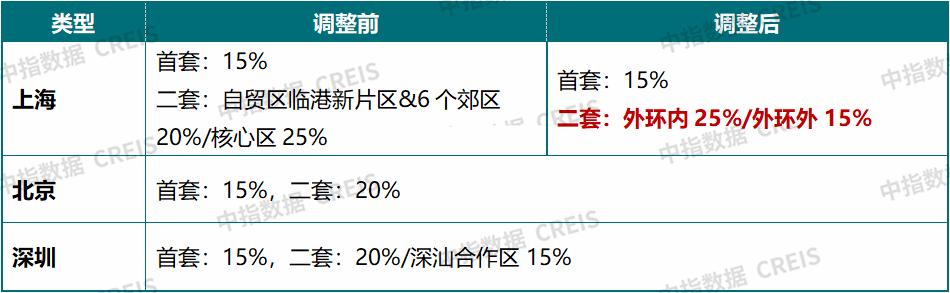
Lower down payment ratios to further ease credit restrictions. The minimum down payment ratio for second-home loans outside the outer ring is reduced from "no less than 20%" to "no less than 15%", the same as that for first homes, lowering the home purchase threshold for second homes outside the outer ring, which is expected to directly benefit families seeking to improve their housing conditions outside the outer ring.
Increase home purchase subsidies to help smooth the housing replacement chain. New "trade-in" home purchase loan subsidies are introduced (1% of the total loan amount, maximum 50,000 yuan per unit, total fund of 200 million yuan). The original "trade-in" subsidy targets are expanded from selling "the only housing completed before 2000 within the outer ring with a floor area of 70 square meters or less" to "second-hand housing within the outer ring" with no restrictions on housing age and floor area. Eligible applicants can stack the two subsidies for a maximum of 80,000 yuan, helping to remove the obstacles in the "sell old, buy new" process.
Promote both housing voucher resettlement and second-hand housing acquisition simultaneously. The implementation of housing voucher resettlement (focusing on urban village renovation and old town reconstruction) and the advancement of acquiring second-hand housing in central urban areas (including the area within the outer ring of Pudong) for use as affordable rental housing will help expand housing demand, improve the relationship between market supply and demand, and the policies take into account both "stabilizing the market" and "ensuring people's livelihood".
In the future, measures such as supporting housing "trade-in" and increasing home purchase subsidies may become policy tools for more core cities to stabilize the market. Recently, Beijing and Shanghai have successively released new policies, and it is expected that more cities will follow up to optimize property market policies, further raising the expectation of policy implementation in Shenzhen and Guangzhou.
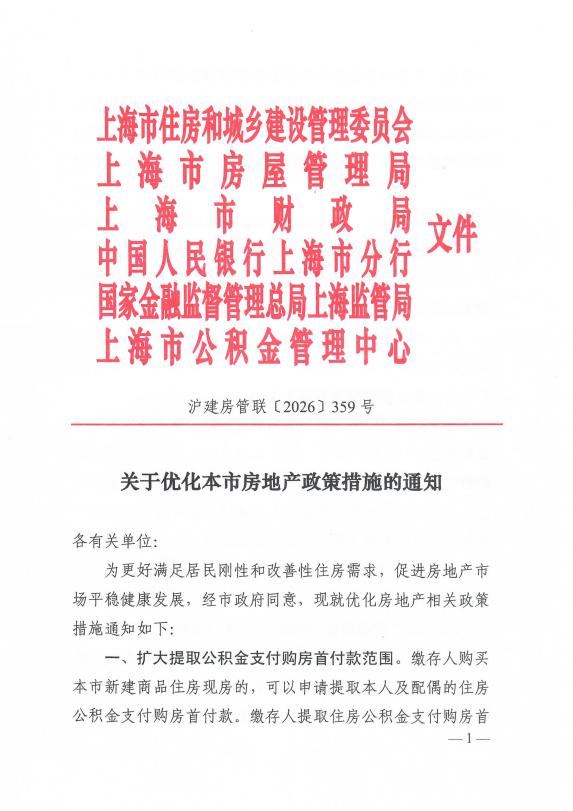
Optimize the scope and frequency of provident fund withdrawal, and there is still room for further optimization of provident fund policies in the future
The 2025 "Shanghai Six Rules" first allowed the withdrawal of provident fund to pay the down payment for pre-sale new commercial residential properties. This time, the policy is extended to completed properties. The continuation of the "withdrawal plus loan" policy also ensures that the down payment withdrawal does not occupy the loan quota, which helps reduce the pressure on homebuyers to raise down payment funds and shorten the home purchase cycle. Meanwhile, for existing homebuyers who are provident fund contributors without provident fund loans or have not applied for the loan repayment offset service, the home purchase withdrawal rule is adjusted from once every 5 years to once per natural year, and the upper limit of the withdrawal amount is relaxed to "the home purchase payment made with self-owned funds", which benefits more groups who buy houses with full payment or pure commercial loans.
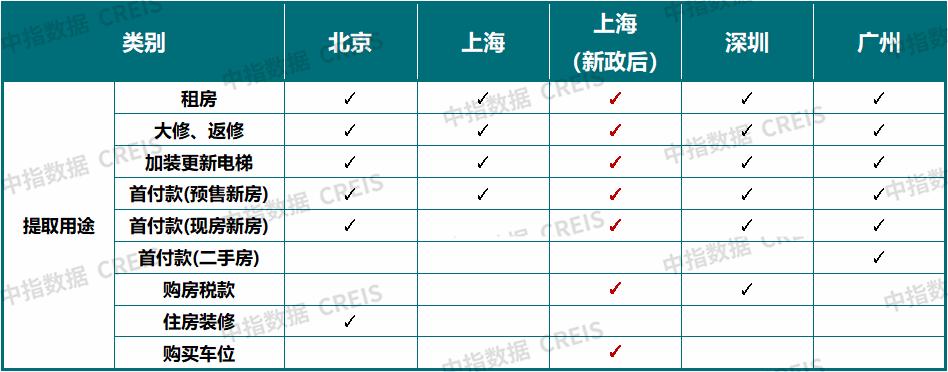
In addition, the new version of the *Regulations on the Administration of Housing Provident Fund* has been released recently. Shanghai has responded actively this time, adding new provident fund withdrawal scenarios for home purchase deed tax, supporting parking spaces (garages) and storage rooms, which also helps reduce the comprehensive home purchase cost for residents. There is still room for optimization of Shanghai's provident fund policies in the future, which is expected to continue to upgrade to a "housing consumption support tool".
Table: Changes in provident fund policies before and after the adjustment of Shanghai's new policies
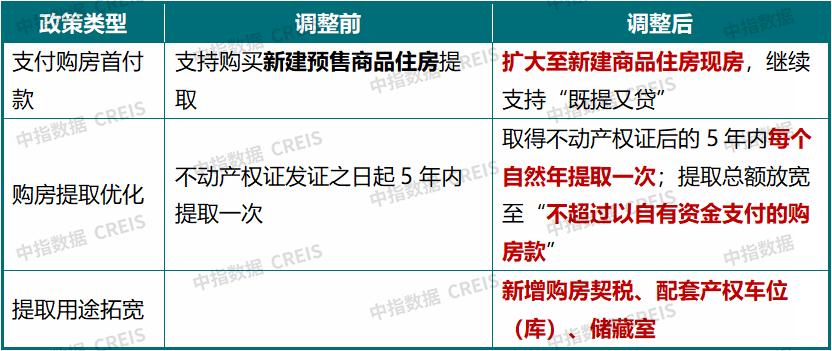
Table: Comparison of provident fund withdrawal purpose policies among first-tier cities
Lower the down payment ratio for second homes outside the outer ring, continue the regional differentiated policy
This time, Shanghai adjusts the minimum down payment ratio for commercial individual housing loans for second homes from "no less than 20%" to "no less than 15%". After the adjustment, the down payment ratio for first homes is unified at 15%, that for second homes within the outer ring is 25%, and that for second homes outside the outer ring is 15%, maintaining regional differentiation in second-home housing credit policies. Taking a second home with a total price of 4 million yuan as an example, the down payment threshold will be reduced from 800,000 yuan to 600,000 yuan, which is expected to play a positive role in accelerating the destocking of new homes outside the outer ring and activating the housing replacement chain.
Table: Changes in Shanghai's credit restriction policies before and after the new policy adjustment
Increase home purchase subsidies to help smooth the housing replacement chain
The new home purchase subsidy policies in Shanghai mainly involve two aspects. First, issue home purchase loan subsidies, with the subsidy amount being 1% of the total loan amount of the new home, and the maximum subsidy per unit being 50,000 yuan, which means that applicants can apply for the maximum subsidy if their loan amount reaches 5 million yuan or more. The total subsidy fund is 200 million yuan. If the subsidy per unit is 50,000 yuan, it can cover 4,000 housing units; if the average subsidy per unit is 30,000 yuan, it can cover more than 6,000 housing units. The policy window period lasts from August 21, 2026 to March 31, 2027, and the 200 million yuan subsidy fund will be terminated once exhausted, which has a strong time guidance effect and is expected to promote the concentrated release of replacement demand within the window period. The applicable conditions of the policy are "buy new homes outside the outer ring + sell second-hand housing in this municipality (no regional restrictions) within 1 year before or after the online signing and filing".
Second, optimize the original "trade-in" subsidy policy. The trade-in subsidy in the "Shanghai Nine Rules" in May 2024 was limited to selling "the only housing completed before 2000 within the outer ring with a floor area of 70 square meters or less", with tiered subsidies of 20,000 / 25,000 / 30,000 yuan. This time, the scope of old houses is extended to "second-hand housing within the outer ring", with no restrictions on housing age, floor area and the "only housing" condition, and the coverage is expanded. The subsidy standard is unified at 30,000 yuan per unit, which directly incentivizes replacement families that sell old houses within the outer ring and buy new houses outside the outer ring.
Families that meet the above two conditions can stack the two subsidies, that is, families that "sell old houses within the outer ring and buy new houses outside the outer ring" can receive a maximum subsidy of 80,000 yuan. It is worth noting that both subsidies require "purchasing new commercial residential properties outside the outer ring", focusing on guiding residents to sell second-hand housing in central urban areas and buy new homes outside the outer ring, which helps speed up the destocking of new homes outside the outer ring and smooth the replacement chain between new and second-hand housing.
Increase the intensity of housing voucher resettlement, which will inject home purchase demand into the real estate market
Shanghai has clearly included housing voucher resettlement in the expropriation compensation and resettlement system this time, focusing on serving urban village renovation and old town reconstruction projects. On the one hand, it helps improve resettlement efficiency; on the other hand, housing voucher resettlement can direct compensation funds to the local market, which helps increase home purchase demand and directly promote the destocking of new homes. This year, Shanghai plans to relocate 12,000 households of villagers in urban villages across the city. As reported, as of August, more than 1,700 housing vouchers have been issued accumulatively across the city. At present, multiple districts including Xuhui, Changning, Putuo, Hongkou and Jiading have gradually implemented the housing voucher resettlement policy in urban village renovation projects. For example, in the Malu Pengzhao urban village renovation demonstration project in Jiading District, 60% of residents chose housing voucher resettlement. In the future, Shanghai may introduce city-wide supporting rules to further clarify the face value, usage rules and circulation arrangements of housing vouchers, and housing voucher resettlement is expected to provide important support for stabilizing the property market.
Central urban areas are expected to fully promote the acquisition of second-hand housing, with policy intensity possibly upgraded
In February this year, three districts in Shanghai including Pudong, Jing'an and Xuhui launched a pilot program of acquiring second-hand housing for affordable rental housing, focusing on acquiring properties within the inner ring, with a floor area of 70 ㎡ or less, a total price of 4 million yuan or less and clear property rights. Since May, the pilot program has been expanded to all central urban areas. As of July 25, 2026, Xuhui, Pudong and Jing'an districts have accumulatively acquired 551 second-hand housing units, among which 16 households have successfully disposed of their old houses and purchased new ones. This policy clearly adopts a demand-oriented approach, requiring all central urban areas (including the area within the outer ring of Pudong) to promote the acquisition of second-hand housing, which means that the policy implementation scope, coverage and intensity may be upgraded in the future.
Table: Year-to-date comparison of transaction volume of new and second-hand housing in Shanghai, Beijing and Shenzhen (year-on-year)
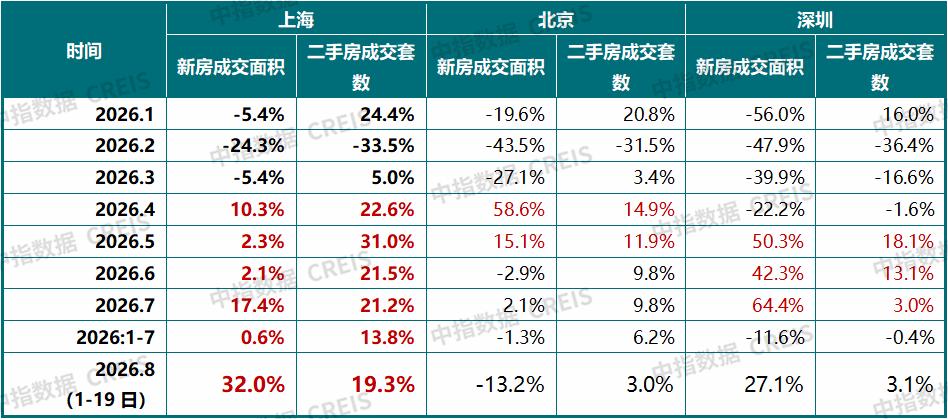
From the trend of the real estate market, after Shanghai optimized its property market policies at the end of February, the market showed a recovery trend, and the market has maintained high activity since August. According to data from the China Index Academy, in July, the transaction volume of new commercial residential properties and second-hand commercial residential properties in Shanghai reached 916,000 ㎡ and 23,000 units respectively, down month-on-month, but up 17.4% and 21.2% year-on-year respectively against a low base. From August 1 to 19, the transaction volume of new commercial residential properties and second-hand commercial residential properties reached 541,000 ㎡ and 13,605 units respectively, up 32.0% and 19.3% year-on-year respectively. According to the 100-city price index of the China Real Estate Index System, the price of second-hand housing in Shanghai stopped falling month-on-month in March, and the month-on-month price increase lasted for 5 consecutive months up to July, showing a certain stabilization trend of housing prices.
Overall, the "Shanghai Eight Rules" this time continues the idea of city-specific policies and refined adjustment, comprehensively using multiple policy tools such as provident fund, credit, home purchase subsidies, housing voucher resettlement and housing stockpiling, with the focus further concentrated on the market outside the outer ring and the linkage chain between new and second-hand housing. The new policy is launched just in time for the "Golden September and Silver October" home purchase window period. It is expected that the transaction volume of new and second-hand housing in Shanghai will continue to pick up in the short term. The new policy will bring more direct benefits to new housing products outside the outer ring, accelerating the destocking speed of new homes outside the outer ring, and the overall stable trend of the real estate market is expected to be further consolidated.
In the future, measures such as supporting housing "trade-in" and increasing home purchase subsidies may become policy tools for more core cities to stabilize the market. Recently, Beijing and Shanghai have successively released new policies, and it is expected that more cities will follow up to optimize property market policies, further raising the expectation of policy implementation in Shenzhen and Guangzhou.
This article is from the WeChat Official Account "China Index Academy", author: China Index Academy, published by 36Kr with authorization.