Why has hamburger become the favorite "sub-brand business" of catering giants?
Haidilao has quietly launched another sub-brand, and this time the category it targets is burgers.
iBrandi learned that the first national store of Haidilao's new brand "Happy Fresh Burger" officially opened in Wuhan recently. The new brand focuses on "freshly made burgers", using Angus beef delivered on the same day, which is freshly cut, pan-fried and roasted in an open show kitchen to make 130g thick-cut beef patties.
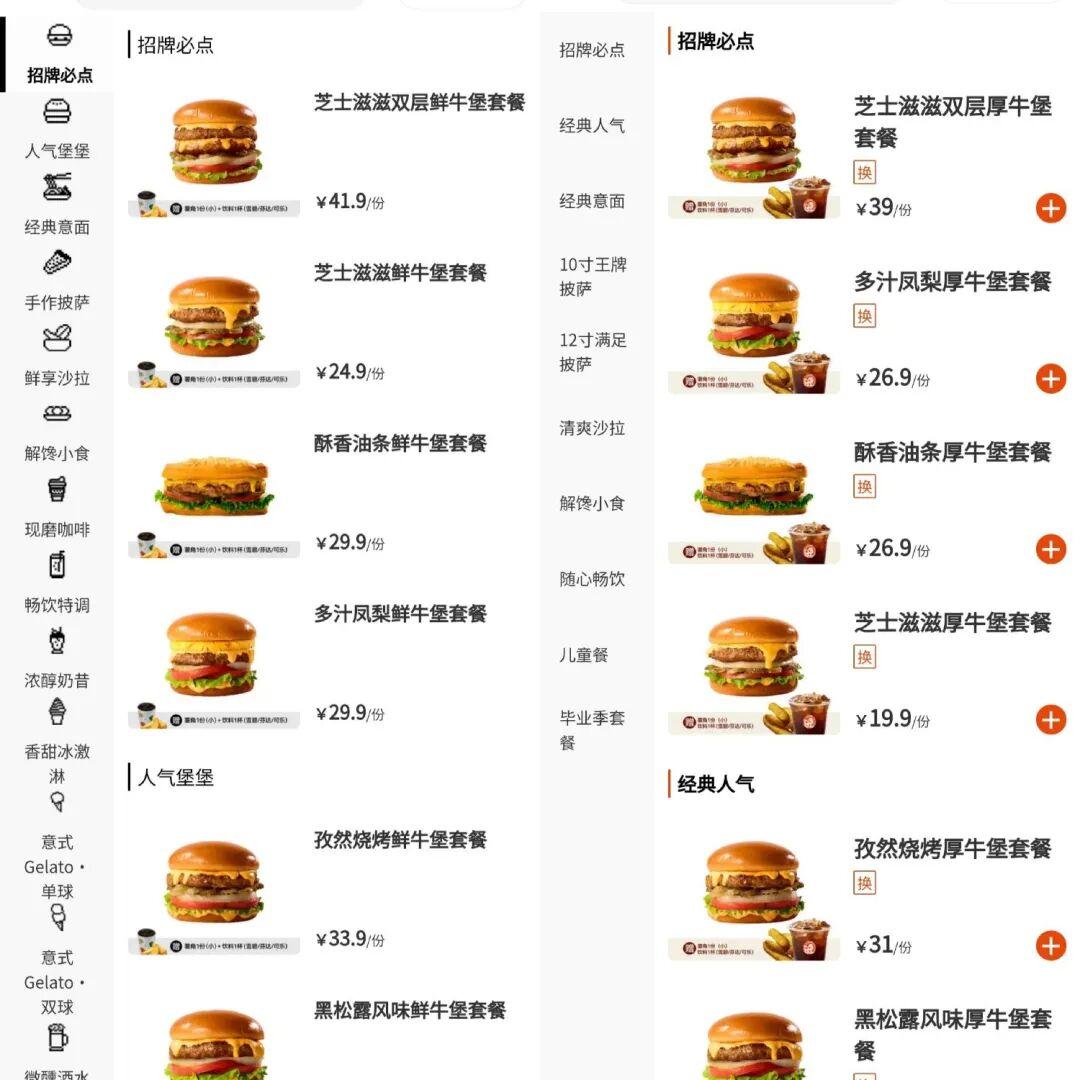
In terms of pricing, the unit price of Happy Fresh Burger's burgers ranges from 18.9 yuan to 41.9 yuan. In addition to burgers, the stores also provide products such as pizza, pasta, coffee, ice cream and craft beer. Obviously, Haidilao also hopes to use this brand to cover more consumption periods such as full meals, afternoon tea and even late-night snacks.
In fact, this is not the first time Haidilao has entered the burger track. In 2024, Haidilao launched the affordable fried chicken brand "Xiaohai Aizha". After successively adding products such as burgers, pizza and coffee, at the end of 2025, Xiaohai Aizha was officially upgraded to "Xiaohai Aizha · Hiburger", making burgers one of the core products of the brand.
In other words, Haidilao has bet on two brands in the same category.
On the other side, some catering giants have long set their sights on burgers.
Huangji Huang, a catering brand that started with three-sauce braised pot, recently set up a small burger stall in its Changying Longhu Tianjie store in Beijing, and opened a takeaway section of "Huangji Huang Wok Qi Burger" online, launching products such as spicy marinated fried chicken thigh patty burger, garlic flavored fried chicken thigh patty burger, pineapple sweet and sour fried chicken nugget burger and other products.
Pizza Hut, which took action earlier, has moved faster. In December 2025, Pizza Hut opened two first stores of its new brand "Pizza Hut Burger" in Shenzhen; in May this year, the brand announced that the number of its nationwide stores had exceeded 100. In less than half a year, Pizza Hut Burger has almost maintained the speed of opening one store every two days on average.
Hot pot, braised pot and pizza brands are suddenly all selling burgers collectively. It seems that the burger track is getting "hot" again. But behind these brand moves, there is another change worthy of more attention: when catering groups are all looking for new growth points, burgers are becoming the easiest new business to start.
Catering Giants Collectively "Sandwich" Into the Burger Track
It is not surprising that Haidilao chose the burger track.
Since Haidilao launched the "Red Pomegranate Project" at the end of 2024, trying to incubate more catering brands outside its core hot pot business. By the end of 2025, Haidilao had operated 20 sub-brands, covering segmented fields such as seafood food stalls, sushi, Western-style light food, small hot pot, and Chinese fast food, with a total of 207 stores; the operating revenue from other restaurants reached 1.521 billion yuan.
In terms of scale, this part of revenue cannot be compared with Haidilao's main brand, but it proves one thing: for leading catering groups with supply chains, capital, talents and organizational systems, multi-brand incubation is no longer just a trial, but a formal growth path.
However, even with strong hard power, it is not easy to run a new catering brand well. After all, re-entering an unfamiliar category means that enterprises need to re-understand products, consumers, supply chains and store models. Haidilao can incubate sushi, barbecue, fast food and baking brands, but different categories have completely different complexity, store opening cost and replication speed.
And burgers are a relatively "light" choice among them. It does not need to re-educate the market: consumers know what a burger is and clearly know in which scenarios to buy it; it is suitable for dine-in, takeaway, and can cover lunch, dinner, afternoon tea and late-night snacks; its price can be as low as more than ten yuan, and can also be sold at 30 to 40 yuan through fresh beef, handmade buns and freshly made processes.
More importantly, the burger market is a large enough mature market.
Data from Hongcan Catering Industry Research Institute shows that the size of China's Western-style fast food market reached 297.5 billion yuan in 2024, with a year-on-year increase of 11%; by March 2025, the number of Western-style fast food stores nationwide reached 325,000, with a year-on-year increase of 6.6%. Among them, burger is the largest segmented category. In 2024, the size of China's burger market reached 210 billion yuan, accounting for 70.6% of the market share in Western-style fast food.
With considerable scale, high consumer awareness, mature consumption scenarios and strong standardization capabilities, burgers are almost a natural "test field" for catering groups looking for new growth. In addition, making some "Chinese-style burgers" can better cater to the tastes of Chinese people. No matter whether it is innovation or gimmick, burger is a pretty good choice.
This is also why Haidilao is not the only cross-border player. Pizza Hut that sells pizza, Huangji Huang that sells braised pot, and previous brands that sell cold noodles, coffee, ice cream and baked goods, are all entering the burger market in different ways. They do not necessarily want to become the next McDonald's, but they all want to take a share of the business that did not belong to them before through burgers.
Burger, the "Minimum Growth Unit" for Catering Groups?
However, although they are all selling burgers, looking deeper, Haidilao, Huangji Huang and Pizza Hut have actually chosen three different entry methods.
Haidilao adopts the "independent brand" model.
From Xiaohai Aizha · Hiburger to Happy Fresh Burger, Haidilao is trying to verify different burger models in different price bands. Xiaohai Aizha is more inclined to affordable fast food, while Happy Fresh Burger uses selling points such as Angus beef, 130g thick-cut patties and open-kitchen on-site production to target the quality market. This is a relatively heavier approach. It requires independent brand name, store image, product system and operation team, but once the model is proved feasible, it also has more opportunities to develop into a truly independent new business.
Huangji Huang has chosen a lighter way.
It did not rush to set up a new business separately, but added a small burger stall in its existing stores, using the original space, staff and takeaway accounts to test products. Compared with re-renting stores, decorating and building teams, this model has lower trial and error costs. For Huangji Huang, burgers do not necessarily need to become an independent brand immediately. First of all, it can be a new set of added SKUs, and also a tool to expand takeaway orders, low-unit-price consumption and single-person dining scenarios.
Pizza Hut Burger represents the third path: rapid replication relying on the existing store network.
At present, most Pizza Hut Burger stores are opened side by side with Pizza Hut, directly setting aside areas in existing restaurants to make and sell burgers. This saves the brand a lot of site selection and decoration costs, and can directly reuse Pizza Hut's existing store traffic, staff, membership system and supply chain. Pizza Hut itself has experience in bread baking, beef frying, Western-style casual dining and takeaway operation. For it, entering the burger track is not starting from scratch, but rearranging and combining its original capabilities.
This is the real advantage of catering giants selling burgers across categories. They do not necessarily understand burgers better than small brands, but they already have ready-made stores, equipment, raw materials, traffic and organizational resources in hand. A new brand or new stall can be inserted into the original catering system like a building block.
When the industry enters stock competition, the way enterprises seek growth is changing from "opening another identical store" to "letting one store carry more businesses".
Burgers just fit this role perfectly. They take up relatively limited space, have high consumption frequency, the products are easy to understand, and are also suitable to form set meals with drinks, side dishes and desserts. For catering groups, burgers are not only a category, but also a "minimum growth unit" that can be used to test price bands, consumer groups, takeaway demands and store efficiency.
The Two Sides of "Standardization", and Can Catering Groups "Do Burgers Well"?
The burger market is huge, but it does not mean that it is an easy market to win.
On the one hand, before catering giants entered the track collectively, this track was already crowded enough. On one end are international chain brands such as McDonald's and KFC, which have huge store scales, mature supply chains and high-frequency preferential systems; on the other end are local chain brands such as Wallace and Tastien, which have formed advantages in price and sinking markets; in the middle are Burger King, Dicos, as well as a large number of regional fresh beef burger and premium burger brands.
On the other hand, the market is still growing, and leading brands have not stopped expanding. From March 2024 to February 2025, the number of net new stores of KFC and McDonald's in China both exceeded 800; Tastien added more than 2000 new stores, and the total number of stores exceeded 9000.
In addition, there are overseas giants eyeing this market. Recently, the American handmade burger brand FIVE GUYS announced through its official WeChat account that it will open two new stores simultaneously in two top business districts, Xidan Joy City and Chaoyang Joy City, on August 3, 2026. It is said that its beef patties strictly follow the classic 2:8 golden ratio, and are freshly pan-fried on iron plates after orders are placed; the bread is the brand's exclusive patent with a globally unified secret recipe; there are also 16 kinds of free ingredients that can combine 250,000 different DIY flavors.
In fact, for new players, the biggest attraction of burgers is standardization, but the biggest danger also comes from standardization.
No matter Western-style burgers or Chinese-style burgers, their product structure consisting of bread, patties, vegetables and sauces is simple enough, so it is very easy to fall into homogenization. When "thick-cut", "handmade", "freshly baked" and "freshly fried" become the common selling points used by more and more brands, freshness itself is changing from a differentiated advantage to a basic threshold.
For example, Haidilao's Happy Fresh Burger emphasizes Angus beef delivered on the same day, open show kitchen and whole-process on-site production; but Pizza Hut Burger also emphasizes daily freshly baked bread, iron plate freshly fried beef and transparent show kitchen.
This means that what Happy Fresh Burger really needs to face is not just traditional frozen patty burgers, but another batch of new-style burger brands that also focus on "fresh meat, freshly made and visible production".
In addition, for Haidilao, there is a more direct question: since it already has Xiaohai Aizha · Hiburger, why do it still need Happy Fresh Burger?
Although the two brands have differences in price and positioning, their core products and consumption scenarios still overlap. How to make consumers clearly understand the difference between the two, avoid the dispersion of internal resources and mutual competition between brands, will become the first problem that Haidilao needs to solve.
Huangji Huang also needs to answer whether burgers are just supplementary products in its braised pot stores, or a business that can operate independently. Store stalls can reduce the cost of trial and error, but they may also make burgers stay in the position of "buy one by the way" for a long time, making it difficult to form stable brand awareness.
Pizza Hut Burger opened 100 stores fast enough, but rapid store opening is only the first step. Attaching to Pizza Hut stores can bring efficiency, but it also means that it needs to prove that consumers buy Pizza Hut Burger not just because there is a Pizza Hut downstairs.
Catering groups can quickly launch a burger with the help of their original resources, but they cannot directly copy a successful burger brand. The supply chain solves the problem of "can we make it stably", the store network solves the problem of "can we sell it quickly", but the brand ultimately solves the problem of "why do consumers want to come back again".
Conclusion
In the past few years, when catering enterprises look for the second growth curve, it often means entering a new track and incubating a new brand.
But judging from the moves of Haidilao, Huangji Huang and Pizza Hut, a more pragmatic path is emerging in this multi-brand competition: it does not necessarily start from the most attractive and novel category, but first choose a business that is mature enough, standardized enough, and easy enough to reuse original capabilities.
Burgers have therefore become the favorite "test field" for catering giants. They can be easily placed in an existing store, and can also be easily packaged as an independent brand; they can compete in the fast food market with a price of more than ten yuan, and can also be sold at 40 yuan with fresh beef and freshly made processes.
But the fact that burgers are easy to start does not mean that they are easy to succeed. When all brands start to emphasize fresh cutting, fresh frying and fresh baking, what is really scarce is no longer a fresh beef patty, but a reason for consumers to make a special trip and are willing to buy repeatedly.
Catering giants may be able to quickly make burgers with resources, but whether they can turn burgers into a successful brand still needs to be re-examined by the market.
This article is from the WeChat official account "New Consumption Daily" (ID: ibrandi), author: Empower Global Brands, published with authorization from 36Kr.