Uber: Troubled by its Robotaxi business, is it pivoting to go all in on food delivery?
"Uber (UBER.US), known as the international version of Didi, released its Q2 2026 earnings report during U.S. pre-market trading on the evening of August 6. Overall, the absolute growth rate of business volume and profit is decent, but both are roughly in line with market expectations, seeming rather unremarkable. The guidance for the next quarter is similar, with little difference from expectations either.
With the threat of autonomous driving technology to the company's core main business still hanging overhead, the market undoubtedly needs stronger-than-expected performance to boost confidence. In other words, no good news at the moment is equivalent to bad news. The details are as follows:
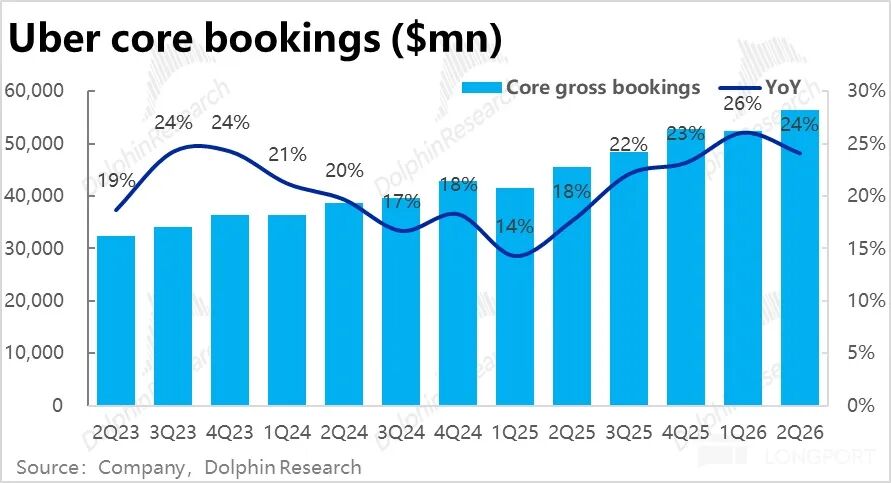
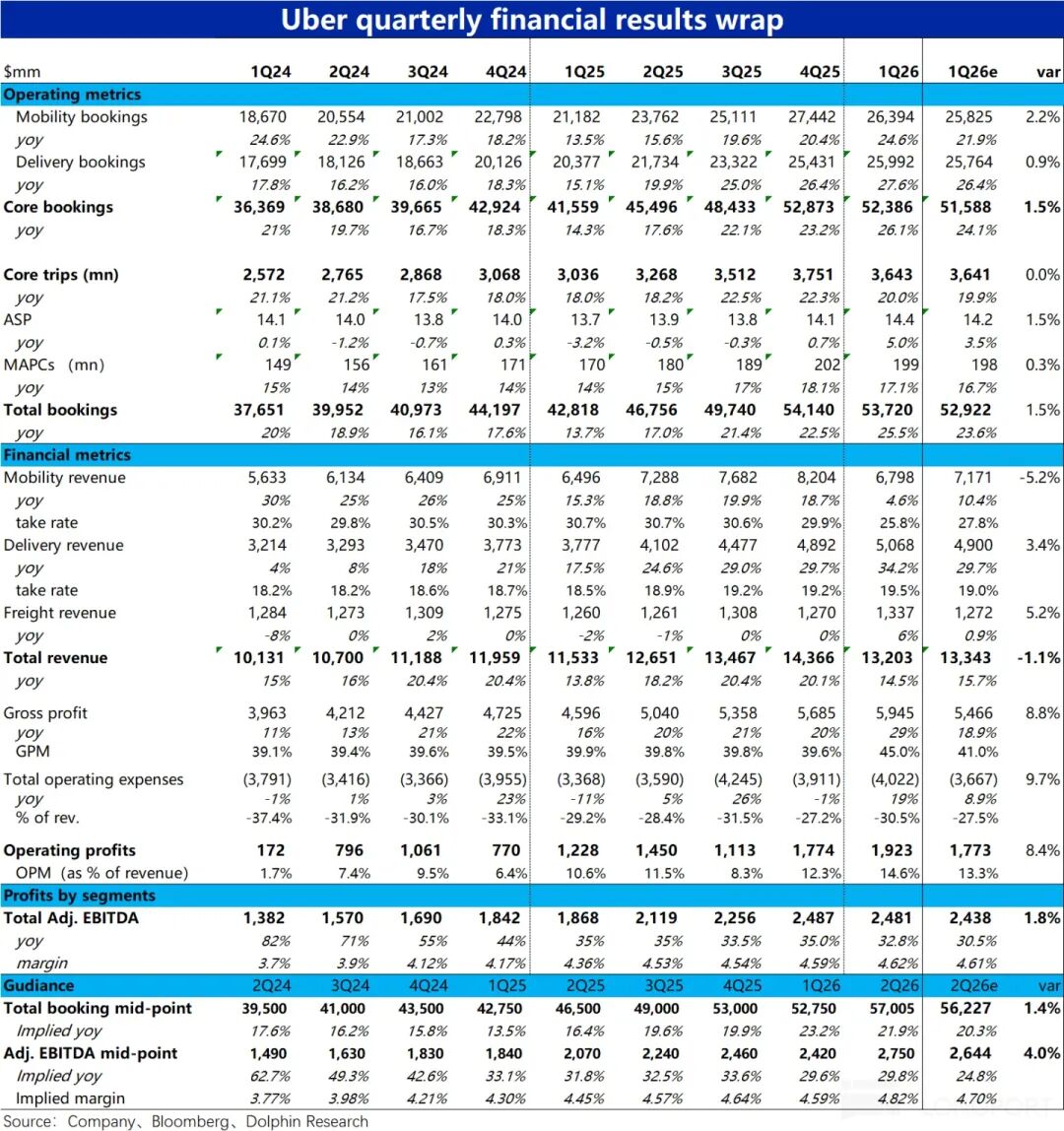
1. Core business sees rising unit price and slowing volume growth: The gross bookings of Uber's core business (Mobility + Delivery) in this quarter increased by 24% year-on-year, slightly 1 percentage point higher than market expectations. At first glance, the growth rate has slowed down slightly compared with the previous quarter, but this is mainly affected by exchange rate fluctuations, and the real growth rate of gross bookings should have accelerated slightly.
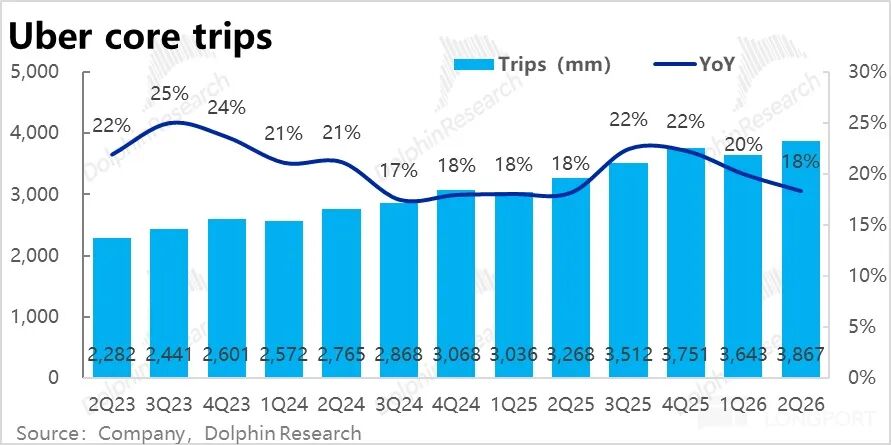
It is worth noting that the growth rate of core order volume has slowed down substantially, reaching 18% in this quarter, with a cumulative slowdown of 4 percentage points in the past two quarters. This is indeed worthy of attention -- is the demand (especially for ride-hailing) really weakening?
In other words, the maintenance of non-declining GBV growth is mainly driven by the increase in average order value. However, according to the disclosure in the earnings call, the increase in average order value is not due to product price hikes, but mainly driven by the rising proportion of high-value food delivery business.
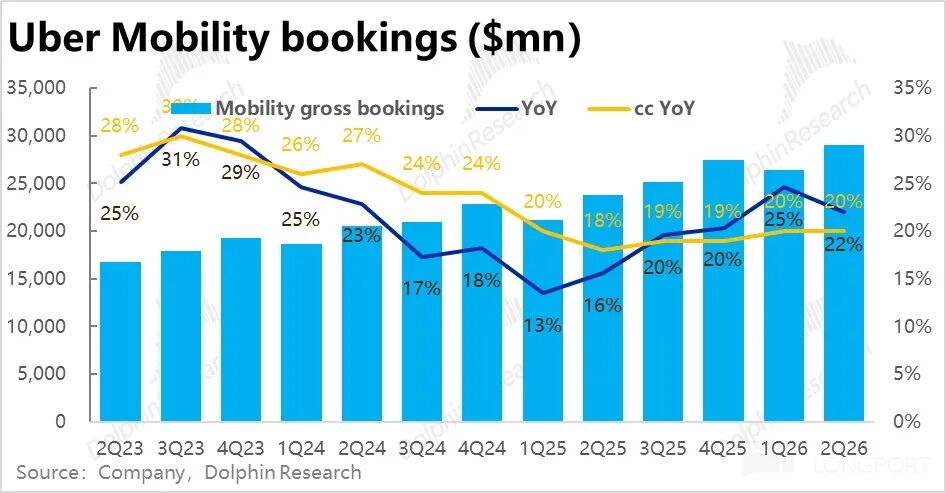
2. Ride-hailing revenue growth appears to stagnate at first glance, but actual performance remains stable: By segment, the growth rate of gross bookings of the Mobility business excluding exchange rate benefits is 20%, basically flat with the previous quarter and broadly in line with expectations. However, based on the previous speculation, it is very likely that the situation is also characterized by slowing volume growth and supported by unit price.
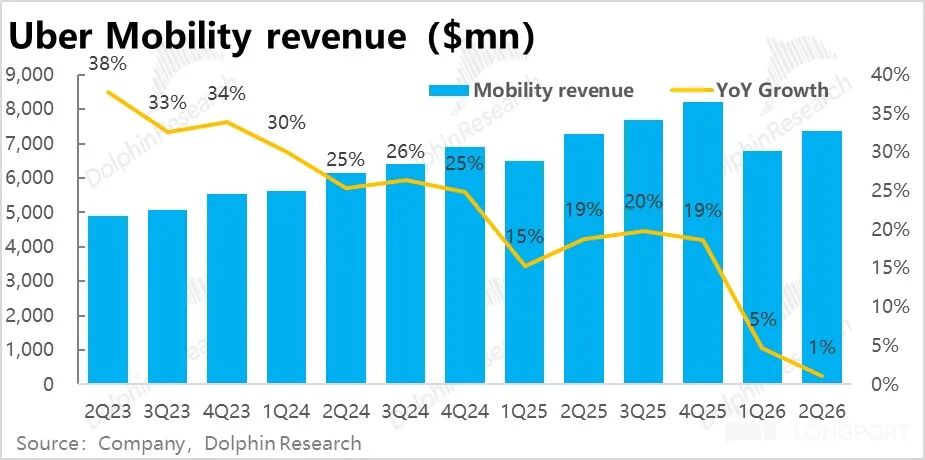
Another point worth noting is that the revenue growth rate of Mobility slowed sharply to 1% this quarter, which at first glance is significantly lower than expectations, and the monetization rate (revenue / gross bookings) decreased by more than 500 bps year-on-year. According to the company's explanation, about 400 bps of this impact is due to the change in accounting caliber of the UK business (from gross revenue to net revenue). In addition, the negative impact on monetization rate from re-investing the funds saved on insurance premiums into user subsidies, which started from the last quarter, still persists.
However, the adjusted operating profit of the Mobility business still increased by 28% year-on-year, higher than the growth rate of gross bookings, which shows that excluding the pure caliber adjustment, the real monetization of Uber's Mobility business has not deteriorated.
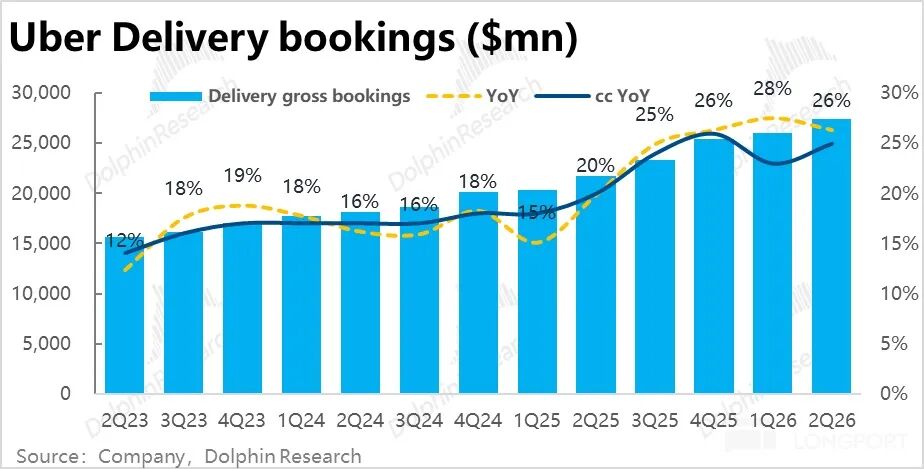
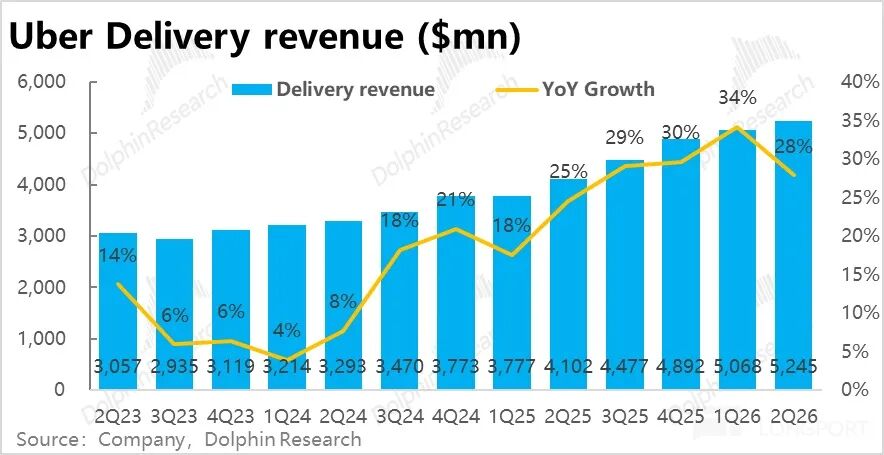
3. Food delivery delivers stronger performance with accelerating growth: In contrast, the food delivery business performed more strongly, with gross bookings up 25% year-on-year at fixed exchange rates, 2 percentage points faster than the previous quarter. Revenue growth also reached a faster 28%, slightly higher than market expectations. Excluding the impact of exchange rates, it also grew by 26%, higher than the growth rate of gross bookings, implying that the monetization rate of the food delivery business continues to rise slightly.
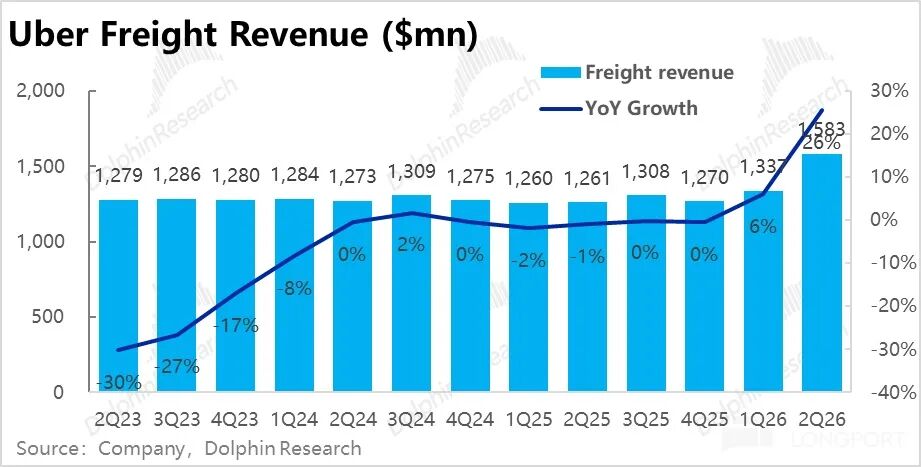
4. Is the freight business starting to recover? Another unexpected point is that the freight business, which has been marginalized since 2022, unexpectedly saw its revenue surge by 26% year-on-year this quarter, significantly higher than market expectations of only single-digit percentage growth.
Previously, Dolphin Research did not notice any signs or reports that the company's freight business was improving. The official disclosure explains that the cross-selling between pure freight forwarding agency business and actual carrier business in the Freight business performed well this quarter, which may be the reason for the sharp rise in revenue.
After all, pure agency business generally only records revenue based on commission, while actual carrier business records revenue based on total freight. The growth of the actual carrier business can quickly amplify nominal revenue, but has much smaller impact on profits.
Combined with the fact that the adjusted operating profit of the Freight business is still losing about 24 million US dollars this quarter, with limited change from the previous quarter, Dolphin Research believes that this sudden acceleration of Freight business revenue is mainly driven by the change of revenue caliber, with no particularly significant substantive change.
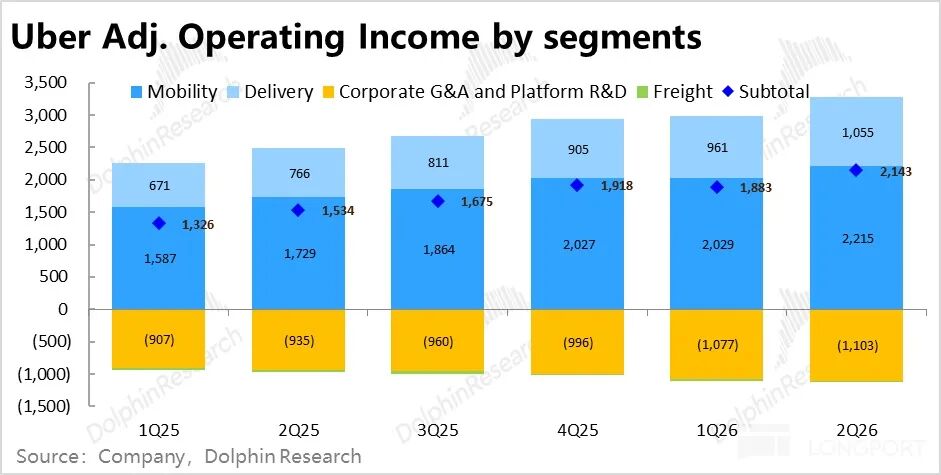
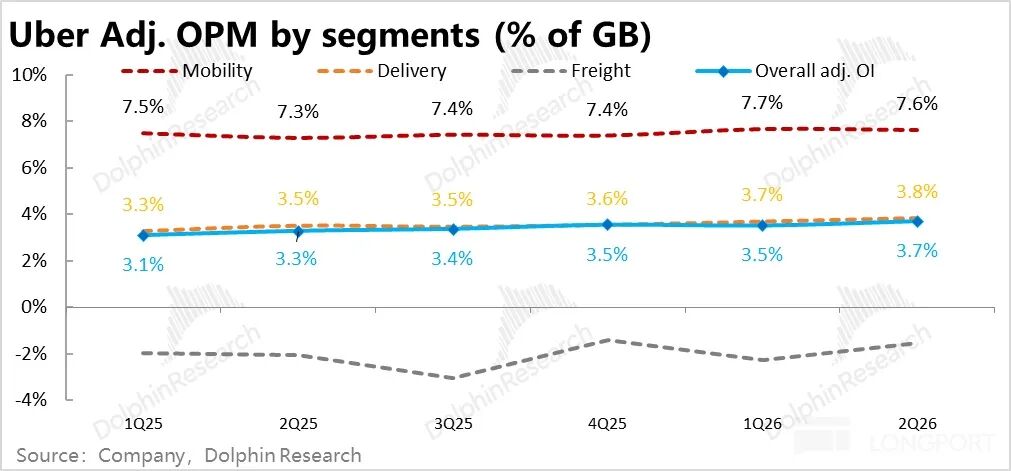
5. Profit margin continues to rise steadily: In terms of profit performance, based on the new caliber of adjusted operating profit, the profit margin of the Mobility business is 7.6%, up 0.3 percentage points year-on-year, but down about 0.1 percentage points quarter-on-quarter. On the one hand, it can be seen that the profit growth of the Mobility business is still good (+28% YoY), but on the other hand, re-investing the saved insurance premiums into users is not entirely without impact on profit margins.
Meanwhile, the profit performance of the food delivery business is even better, with profit margins improving both year-on-year and quarter-on-quarter, and the year-on-year growth rate of profit reaching 38%, which is significantly stronger.
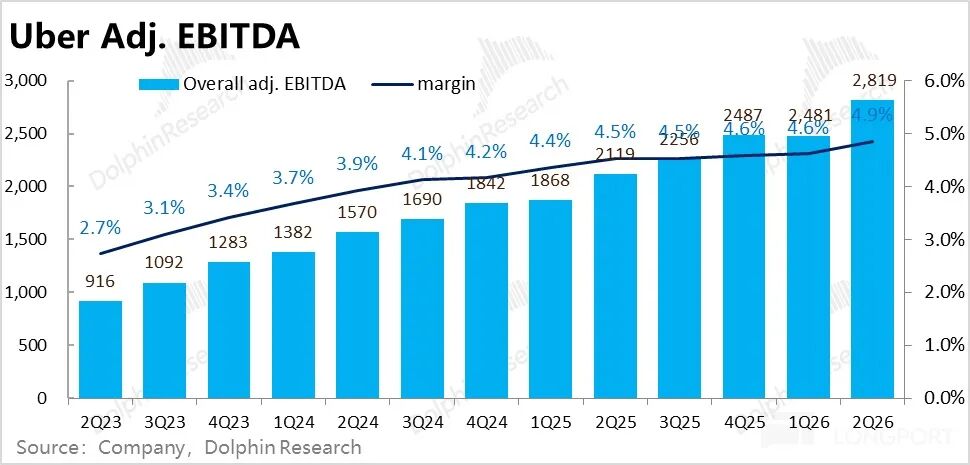
Overall, for comparability, using the previous caliber, the company's overall adjusted EBITDA reached 2.82 billion US dollars, up 33% year-on-year, better than the market expected growth rate of about 31%. It is also higher than the total gross bookings growth of about 24%, and the overall profit margin is still in an upward trend.
Dolphin Research Views:
1. Decent performance this quarter, solid guidance as well
Overall, there are no major flaws in Uber's performance this quarter, with all core indicators generally meeting or slightly exceeding expectations, and the trend is roughly stable compared with the previous quarter. The 24% total gross bookings growth and 28% total profit growth are also decent from an absolute perspective.
The only noteworthy flaw is that the growth rate of core business order volume continues to slow down, which is most likely dragged down by the ride-hailing business. It is worth observing whether this is caused by overall weakening demand, or the impact from autonomous ride-hailing vehicles.
Looking ahead, the company's guidance for the next quarter is also broadly stable. The company expects total gross bookings for the next quarter to be around 58.25 billion to 60.25 billion US dollars, implying a growth rate of 18%~22% at constant exchange rates, which is slightly weaker than the actual growth rate of this quarter and market expectations, but consistent with the guidance given for Q2 earlier. In other words, the growth in the next quarter will most likely not differ much from that of this quarter.
And the profit guidance for the next quarter (based on adj. EBITDA caliber) is 2.86 billion to 2.96 billion US dollars, implying a year-on-year growth rate of 29%, higher than market expectations of less than 28%. This will also continue to significantly outpace the growth rate of gross bookings, meaning that the profit margin in the next quarter will still rise steadily. In this regard, the business and profit growth in the next quarter will remain robust.
2. Investment logic & recent developments
As can be seen from the above, Uber has no major problems in its fundamental performance, so why did its stock price drop significantly by more than 5% after the earnings release? In summary, there are two major issues affecting the company's narrative recently: one is the lingering threat of autonomous ride-hailing, and the other is the company's repeated moves in M&A of the food delivery business recently.
a. The threat of autonomous ride-hailing is hard to eliminate: There are two important developments on this topic recently. First, Waymo, the current leader in autonomous ride-hailing, announced at the end of July that it is considering terminating its cooperation with Uber in Austin and Atlanta (i.e. shifting to independent operation).
The other is that Uber and Nvidia announced that they will jointly build an autonomous driving ecosystem, with Uber responsible for fleet management and platform monetization, and Nvidia responsible for R&D and building a full autonomous driving technology ecosystem including computing chips, autonomous driving models and sensors. Combining the two developments, we believe that the competition in autonomous driving is not only becoming more diversified, but also more intense and exclusive.
Judging from Waymo's move, leading autonomous driving technology developers will most likely shift to independent operation as their main business model in the end, to obtain larger profit margins and higher autonomy, which is not good news for players like Uber. The entry of Nvidia means that there will be a long-standing autonomous driving technology provider with strong technical strength that is likely to maintain an open development ecosystem, preventing the technology from being completely monopolized by closed developers.
From this perspective, the competition and final outcome of autonomous ride-hailing will depend on which side can ultimately take the lead in technology and efficiency, the integrated players like Waymo and Tesla, or the pure technology providers like Nvidia.
In this regard, Dolphin Research holds a relatively cautious and worried attitude. If Uber cannot master all core technologies in its own hands, it may end up still "depending on others' faces".
b. Food delivery business M&A: Perhaps also seeing that the competitive threat in the ride-hailing segment is hard to eliminate, Uber has recently shown a clear tendency to increase the proportion of its food delivery business and reduce its dependence on the ride-hailing business.
Previously, Uber has completed the acquisitions of Turkey's Trendyol Gp and Getir, and a larger recent move is its acquisition offer for Delivery Hero.
In summary, the total acquisition price offered by Uber this time is 14.8 billion US dollars (100% equity value). Excluding the shares Uber already held in Delivery Hero before, the total actual consideration to be paid is about 13.7 billion US dollars.
c. Views on the acquisition of Delivery Hero:
First of all, what can the acquisition bring to Uber? According to disclosures, after the completion of the acquisition, it can help Uber quickly enter 20 new markets, increasing the total number from 79 to 99. It can also help the company's overall monthly active users and total gross bookings increase by 1/5 to 1/4, and make the food delivery business account for 56% of the company's total gross bookings (2025 data).
From this perspective, acquiring Hero can indeed quickly help the company expand the scale of its food delivery business and reduce its dependence on the ride-hailing business, which supports the company's strategic orientation.
However, investors are not positive about the acquisition at present, and we believe the reasons include the following points:
First of all, the asset quality of Delivery Hero is not high. In the past 2 years, Hero's gross bookings growth rate is only high single-digit percentage (Uber Eats is around 20%), and Hero's EBITDA margin