The first batch of stocks hyped on the embodied intelligence concept have suffered a disastrous slump.
Embodied AI is one of the hottest concepts at the moment. On July 2, the STAR Market IPO registration approval for Unitree Robotics further pushed up this wave of popularity. However, not all related companies have benefited accordingly.
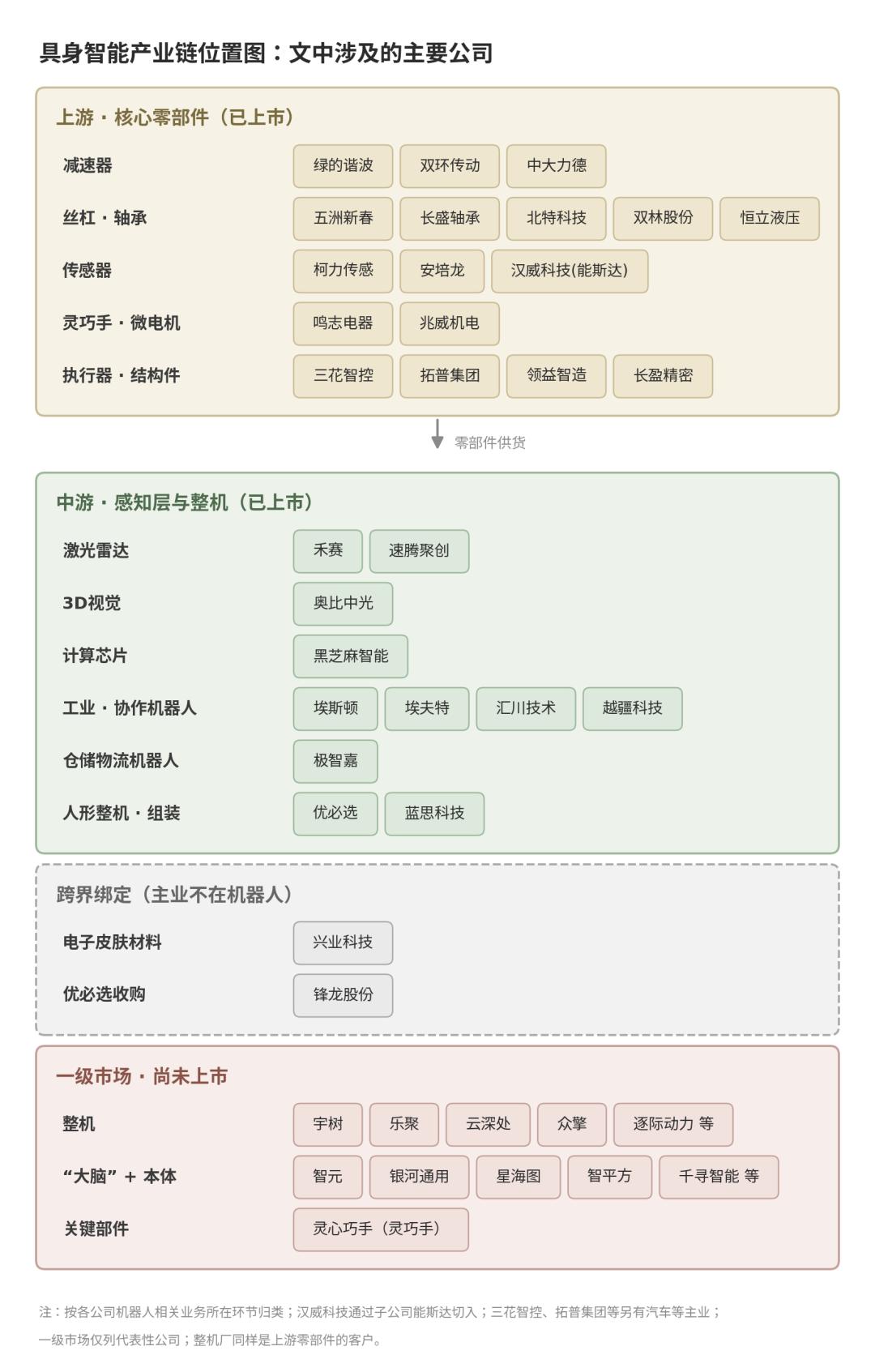
"AIX Finance" has sorted out 30 listed companies related to embodied AI, which are roughly divided into two categories: one is native robotics companies, such as UBTECH and Geek+; the other is existing robot manufacturers and manufacturing companies that extend their original businesses to embodied AI, such as Estun, Inovance, Leader Harmonious Drive Systems, and Sanhua Intelligent Controls. To clarify the relationship between stock prices and performance, the following content is further divided into two groups according to financial statement standards: 15 companies with existing robot revenue and 15 companies purely tied to the concept (Sanhua Intelligent Controls' A-shares and H-shares are calculated separately, totaling 16 targets).
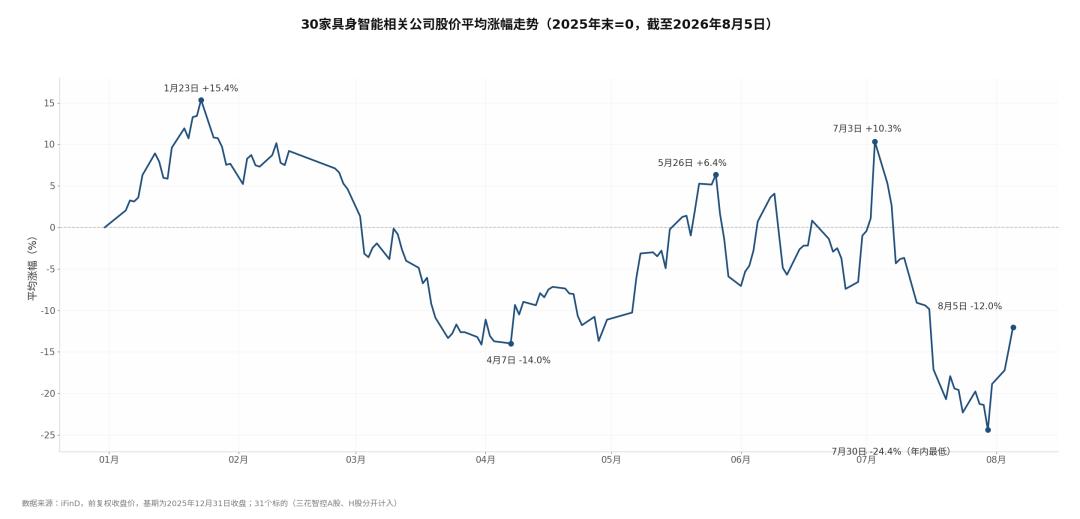
Since the start of the year, these 30 companies have experienced three rounds of market trends: starting from January, the market began to warm up for the robot program at the Spring Gala in February; in May, the production expectation of Optimus emerged; in July, Unitree obtained the approval. Capital entered the market in each round, but the scope of stock price increase narrowed round by round: 22 companies hit new highs in the first round, 9 in the second round, and only 4 in the third round. The recent pullback has almost covered the whole sector, and most concept stocks have retreated by more than 30% from their highs. As of August 5, only 6 of the 30 companies are still up since the beginning of the year. The average decline of the sector once reached the year's lowest point of 24.4% on July 30, and rebounded significantly in recent days.
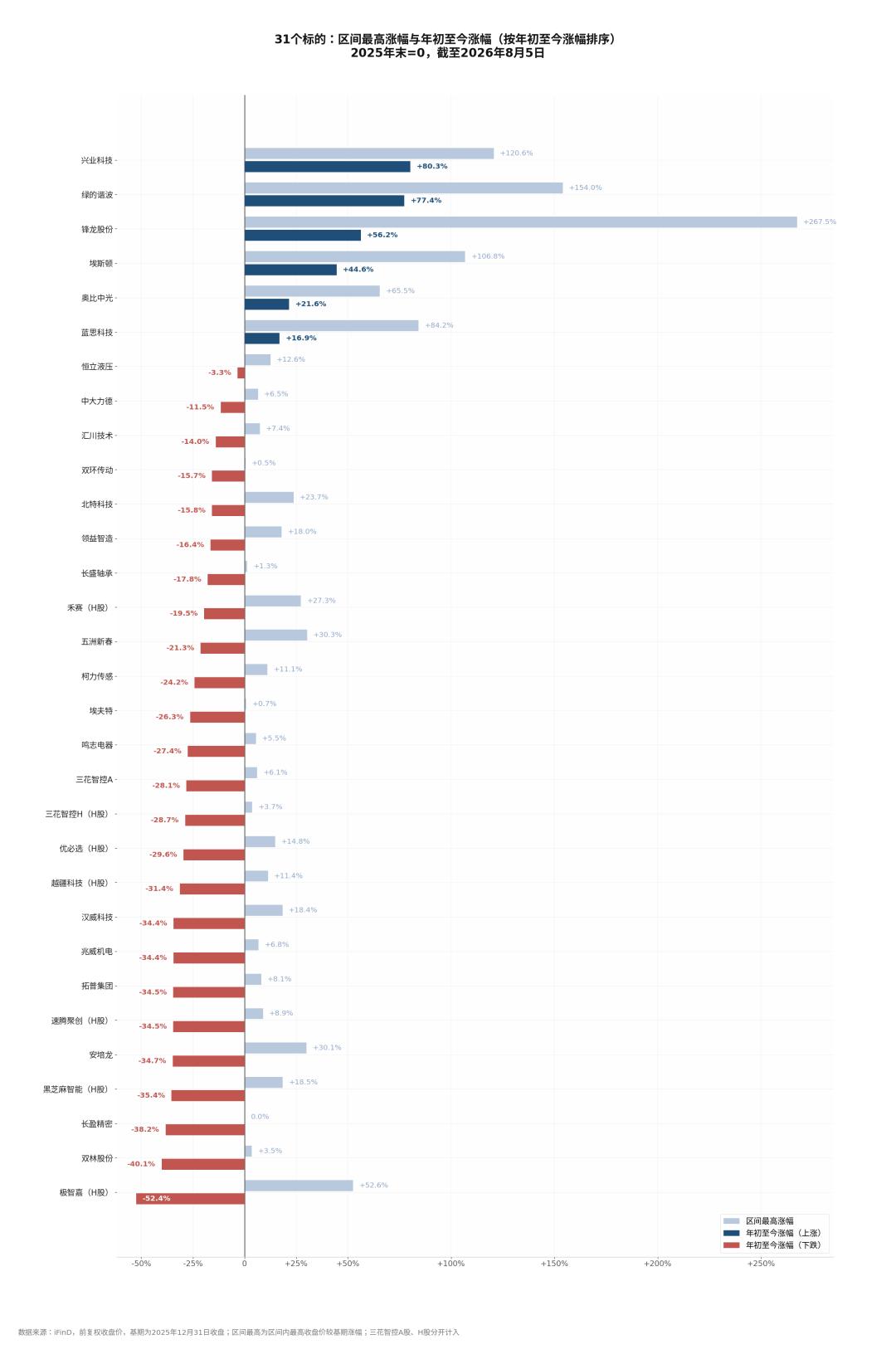
The comparison between the maximum increase in the interval and the year-to-date increase of the 31 targets is as follows:
Another group of unlisted companies are the ones that are actually still rising. Unitree, Agibot, Galaxy Universal and other companies still get high valuations in the primary market: Galaxy Universal is valued at about 23 billion yuan, and according to its fundraising plan, Unitree's issuance valuation is about 42 billion yuan.
While the secondary market concept stocks are generally pulling back, the primary market continues to raise valuations. This round of embodied AI market trend is worthy of detailed analysis.
01. Companies with strong performance are more resilient to stock price declines
First look at the first group, the 15 companies that have disclosed robot business revenue are the most resilient in this round of pullback.
They can be divided into three tiers according to stock prices and financial reports:
Leader Harmonious Drive Systems has strong performance and stock price;
Estun, Lens Technology, and Orbbec have rising stock prices while their performance remains to be observed;
The remaining 11 companies (UBTECH, Inovance, Dobot, Hesai, Hesai, Robosense, Changying Precision, Black Sesame Technologies, Luxshare Precision, Shuanghuan Transmission, Effort, Geek+) have existing business revenue but their stock prices have fallen, among which UBTECH and Effort are still facing large losses.
For the progress and overall performance of the 15 companies, please refer to the following table (sorted by year-to-date increase):
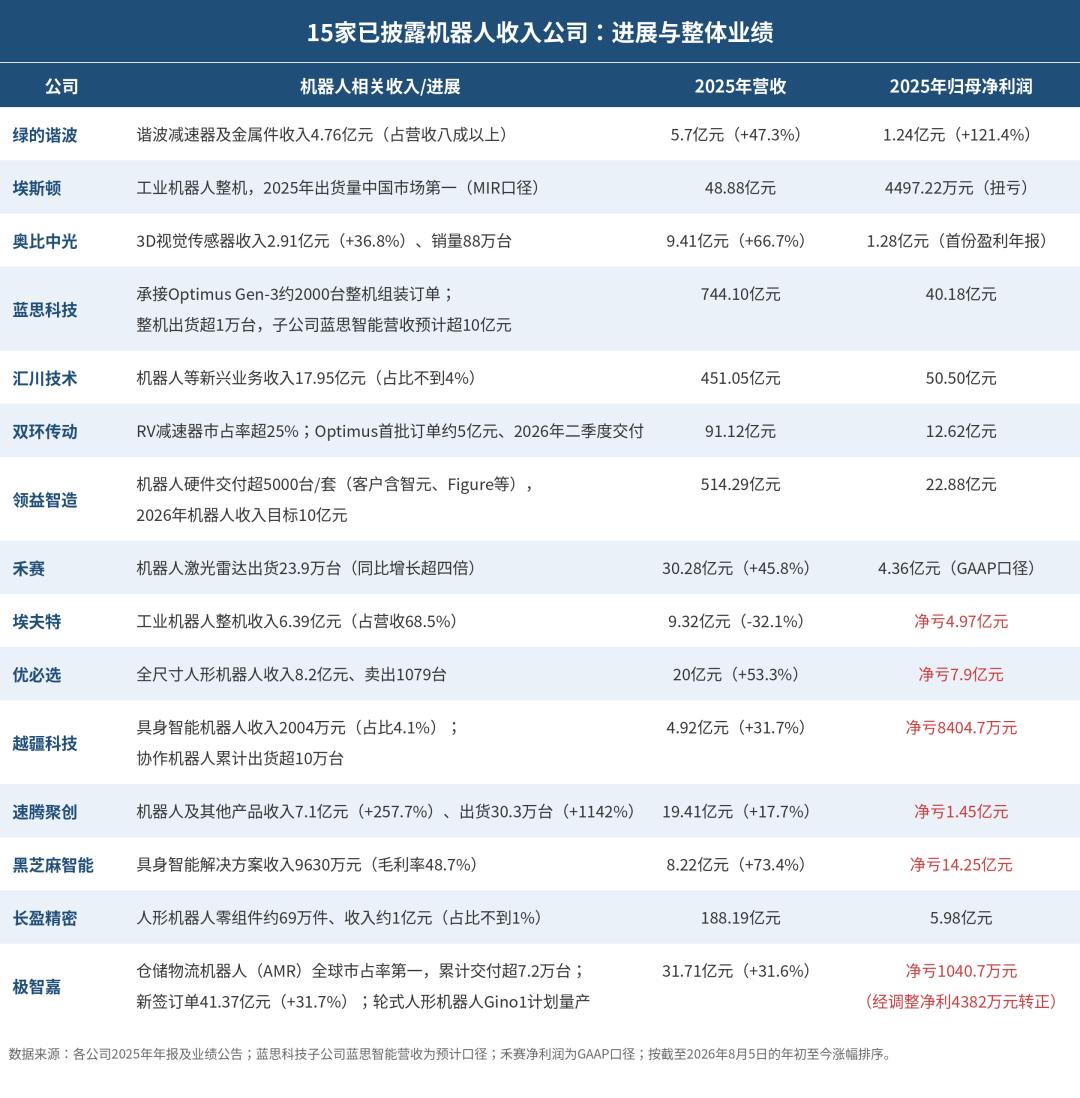
Leader Harmonious Drive Systems, whose increase was surpassed by Xingye Technology and ranked second (up 77.4% year-to-date), is a leading domestic enterprise in the harmonic reducer sector, selling reducers/joint modules to embodied AI companies. In 2025, its revenue from harmonic reducers and metal parts reached 476 million yuan, accounting for more than 80% of total revenue; the attributable net profit was 124 million yuan, doubling year-on-year (+121.4%). Unitree hit a new high for the year the day after its approval, and the only hidden concern lies in the production schedule: the 1.413 billion yuan raised from the private placement completed in January 2025 was only 4% invested by the end of the year.
The rise of Estun (up 44.6%) is driven not only by domestic substitution and humanoid robot expectations, but also by performance recovery: it ranks first in China's industrial robot shipment market in 2025 (MIR standard), once rose by 106.8% in the interval, and its mid-year report forecast on July 15 (attributable net profit of 150 million to 180 million yuan, an increase of more than 21 times year-on-year; non-recurring profit and loss deducted net profit of 60 million to 75 million yuan, turning losses into profits) pushed the stock price to rise again.
Orbbec (up 21.6%) and Lens Technology (up 16.9%) are the other two companies in the "revenue-generating" group with rising stock prices: Orbbec's 3D vision sensor revenue reached 291 million yuan, supplying Agibot and UBTECH, but it fell by 26% in the last month, with its increase significantly narrowing; Lens Technology's subsidiary Lens Intelligent is expected to achieve revenue of over 1 billion yuan and deliver over 10,000 complete units in 2025, but its year-to-date increase has fallen from the peak of 84.2% to 16.9%.
The remaining 11 companies have seen their stock prices fall since the beginning of the year. They all have revenue, and the reasons for the decline are concentrated in four types:
The first type is dragged down by payment collection. UBTECH (down 29.6% year-to-date) is a humanoid robot OEM with considerable revenue scale, but the difficulty lies in payment collection: in 2025, its revenue reached 2 billion yuan (up 53.3% year-on-year), among which 1079 full-size humanoid robots were sold, generating revenue of 820 million yuan; the net loss was 790 million yuan; accounts receivable with a term of more than 3 years amounted to 342 million yuan, with 151 million yuan of credit impairment already accrued.
The second situation is that the basic business is stable, but the proportion of new business is too small. Inovance, Dobot and Shuanghuan Transmission all fall into this category: they have solid foundations in their main businesses of industrial control, collaborative robots or reducers, but their robot-related revenue accounts for less than 5% of the overall business volume. Inovance's revenue from emerging businesses such as robots in 2025 was about 1.8 billion yuan, accounting for less than 4% of the 45.1 billion yuan total revenue; Dobot's embodied AI robot revenue was 20.04 million yuan, accounting for 4.1%; although Shuanghuan has received Optimus orders and its robot reducer revenue is growing rapidly, the bulk of its revenue still comes from vehicle and industrial gears. The new business is not enough to rewrite the financial statements, and the stock price mainly follows the trend of the main business, all three have fallen since the beginning of the year.
The third type is trapped in price cuts. Hesai and Robosense have moved vehicle-mounted LiDAR into robots, while Black Sesame Technologies has extended vehicle-mounted computing chips to this field, all three have shipments or revenue. But the robot business is not enough to hedge the price war in the vehicle market: whether low-price volume expansion will continue to squeeze gross margins is the issue the market cares more about. The three companies rose along with the concept at the beginning of the year, then slid all the way. Since the beginning of the year, Hesai has fallen by nearly 20%, while Robosense and Black Sesame Technologies have fallen by more than 30%.
The fourth type is still in the investment period. The common point of Luxshare Precision, Changying Precision, Effort and Geek+ is that they have made progress in hardware delivery, revenue or technical layout, but profits and valuations have not kept up. The Tesla orders of Luxshare Precision and Changying Precision have not really landed yet; Effort is still losing money in the industrial robot price war; although Geek+'s adjusted net profit has turned positive, the embodied AI story cannot support its valuation, and it has the largest decline since the beginning of the year.
It can be seen that the market is no longer satisfied with "having revenue", but also pays attention to the quality of revenue, payment collection cycle and the balance between input and output. With solid performance, companies are more resilient during pullbacks; but as long as revenue quality, profit structure or commercialization fails to meet expectations, stock prices will still fall rapidly.
02. Concept stocks rise fast and fall fast
Next look at the second group of companies, their robot business in financial reports has not formed scaled revenue, either not listed separately or accounting for less than 1% of the total, and their stock price rise relies on the expected tie-in with the industrial chain. According to the tie-in objects, they can be divided into three types: those deeply tied to Tesla, those tied to domestic OEMs or with capital moves, and those waiting for orders for core components.
The first type is deeply tied to Tesla. As suppliers of Tesla's automotive business, Sanhua Intelligent Controls and Tuopu Group bet on robot actuators very early. At first, capital was indeed willing to pay for this relationship, hyping the possibility of them entering the Optimus supply chain.
But in fact, the actuators mentioned in Sanhua's annual report are still in the sample delivery stage, not mass-produced and generating no revenue; Tuopu Group planned to invest 5 billion yuan to build a robot R&D and production base, but the separately listed "robot actuator" revenue in its annual report was only 13.59 million yuan, a slight year-on-year increase of 1.2%, while the gross profit margin even dropped by 23 percentage points. The robot business of both companies is not enough to support long-term premium, and both have fallen by about 30% since the beginning of the year.

Source / pexels
The second type is tied to popular domestic OEMs or with capital moves. Fenglong saw 14 consecutive daily limit ups due to UBTECH's equity participation, Xingye Technology once surged due to electronic skin cooperation, and Changsheng also hit daily limit up due to small-batch orders from Unitree.
The common point of this type of market trend is "fast news, slow business": announcements can push up stock prices first, but if there is no substantial synergy, continuous progress or scaled revenue afterwards, the pullback will also be fast. As a contrast, Hanwei's electronic skin has been supplied in small batches with more than 30 partners, but the robot business is not listed separately, and its stock price still mainly follows the trend of its main business.
The third type are the "backups" that produce core components. Six-axis force sensors, lead screws, and dexterous hands are regarded as key links of humanoid robots, so companies such as Ampereon, Keli Sensing, Wuzhou Xinchun, and Hengli Hydraulic are mentioned repeatedly.
Their progress seems very lively: Ampereon and Keli Sensing have completed sample delivery tests or small-batch deliveries; Wuzhou Xinchun obtained a 1 billion yuan private placement to bet on lead screw production capacity, and Hengli Hydraulic invested in a linear drive project earlier. But these sample deliveries, factory audits, and capacity expansion are still one step away, and the scaled orders that truly determine valuation have not yet arrived. Therefore, except for a few staged rises, the stock price ultimately depends on the profit of the main business.
The logic of this batch of concept stocks is not complicated: a cooperation or acquisition rumor can bring several consecutive daily limit ups; if there is no substantial progress afterwards, capital will withdraw quickly and turn to chase the next target that can tell a good story.
03. Not listed yet, valuations are surging wildly
Finally, there is another group of companies: native embodied AI companies that are not listed yet, in the stage of financing or IPO pricing.
First look at the general background. For the whole year of 2025, there were only 6 embodied AI companies with valuations exceeding 10 billion yuan; by the end of June 2026, there are at least 18, 8 of which have reached 20 billion yuan: Unitree, Agibot, Galaxy Universal, Star Map, Qianxun Intelligence, Zizhangliang, Zhipingfang, Lingxin Qiaoshou. According to statistics from IT Juzi, from July 2025 to June 2026, 503 financing events occurred in China's embodied AI field, with a total amount exceeding 96 billion yuan. Listing channels such as the Hong Kong Stock Exchange Chapter 18C and the GEM Fourth Set of Standards have been opened one after another, making the financing and listing paths wider, and valuations have been pushed up all the way.
From the perspective of different technical routes, companies betting on the ontology (Unitree, Leju, Deep Robotics, PX Robotics, Pashini, Qianglang) focus on shipment volume and cost, companies betting on the "brain" (Galaxy Universal, Star Map, Qianxun Intelligence, Zizhangliang, Zhipingfang) focus on data and models, Agibot, Tushi ZhiHang, Xingdong Jiyuan do both, and Lingxin Qiaoshou bets on key components.
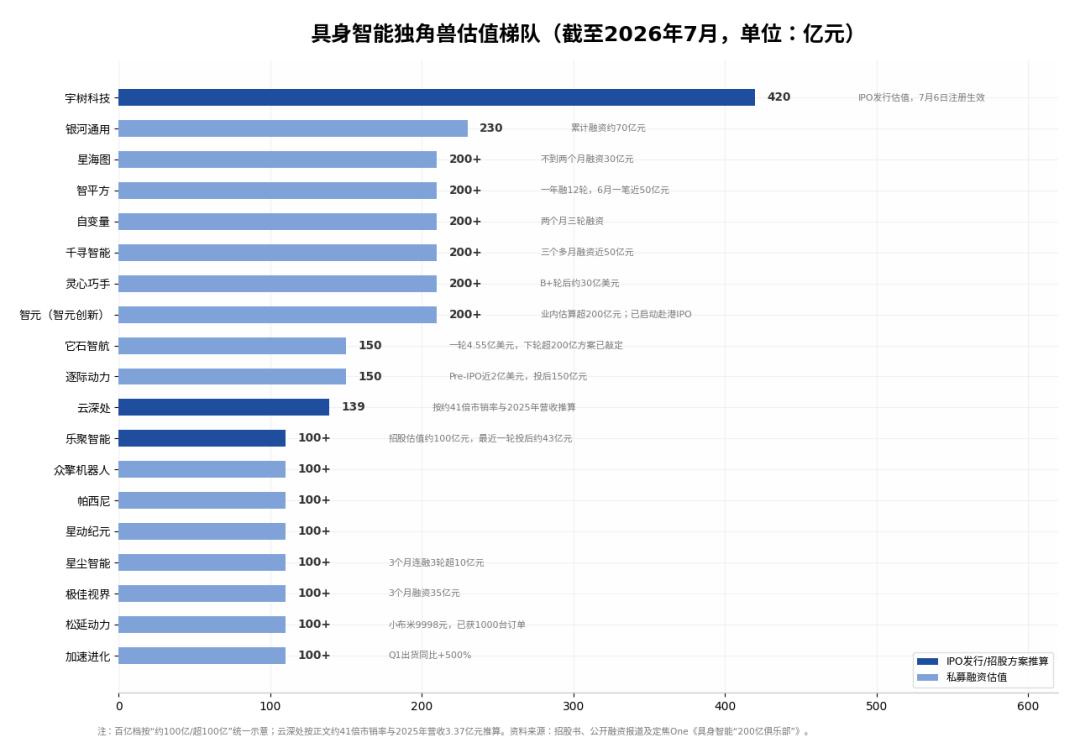
According to the listing process, these companies can be divided into four categories: those that have submitted listing applications, those that have clear listing plans but have not submitted applications, those that focus on primary market financing, and those that have fallen behind.