Led by Cambridge PhD Liu Zhenyu, the "dark horse" in the new energy materials industry has secured funding.
A dark horse in the new energy materials sector has emerged.
On August 3, ChinaVenture exclusively learned that MatraVolt Limited has completed an angel round financing of tens of millions of Hong Kong dollars, jointly led by CAS Star and K2VC, with its post-money valuation reaching hundreds of millions of Hong Kong dollars.
The company, whose core technology originates from the team led by Professor Zizi ZHENG of the Hong Kong Polytechnic University, was co-founded in Hong Kong by Zhenyu LIU and Zizi ZHENG, both of whom graduated from Tsinghua University for their bachelor's degrees and hold doctoral degrees from the University of Cambridge.
After the production process has been fully verified, the core challenge facing them now is how to convert the process into production capacity that can achieve continuous stable supply. This is also the key investment direction of this round of financing: to scale up the mass production process and upgrade equipment, so as to realize continuous production as soon as possible.
Cambridge PhDs Co-found a Startup, A New Energy Materials "Dark Horse" Born in Hong Kong
The story of MatraVolt Limited starts with two alumni from top universities.
Back when Zhenyu LIU and Zizi ZHENG were pursuing their doctoral degrees at the University of Cambridge, the two, who both graduated from Tsinghua University for their undergraduate studies, became friends, and they have known each other for nearly 20 years. Although their research fields are similar, the paths they took later were different.
Before finishing his doctoral degree, Zhenyu LIU, who majored in materials, had already started his entrepreneurial journey. After successfully selling his previous company, he joined IP Group, a firm focused on the commercialization of scientific and technological achievements, to engage in early-stage tech investment, and later became the Managing Director for Greater China. In 2024, he was elected as a Young Academician of the Hong Kong Academy of Engineering Sciences.
Zizi ZHENG took another path. After obtaining his doctorate in chemistry, he went to the United States to conduct post-doctoral research, and joined The Hong Kong Polytechnic University in 2009, rising from Assistant Professor to Chair Professor step by step. Today, he is not only the Vice President (Knowledge Transfer) of The Hong Kong Polytechnic University, but also a Founding Academician of the Hong Kong Young Academy of Sciences and a Founding Young Academician of the Hong Kong Academy of Engineering Sciences.
Years later, the two reunited in Hong Kong. Zizi ZHENG, who has long been engaged in frontline scientific research, and Zhenyu LIU, who is very familiar with the venture capital industry, gradually developed the idea of starting a business together. "We have always wanted to do something together. The most critical thing is to make excellent scientific research results truly influence and change the world," Zhenyu LIU added.
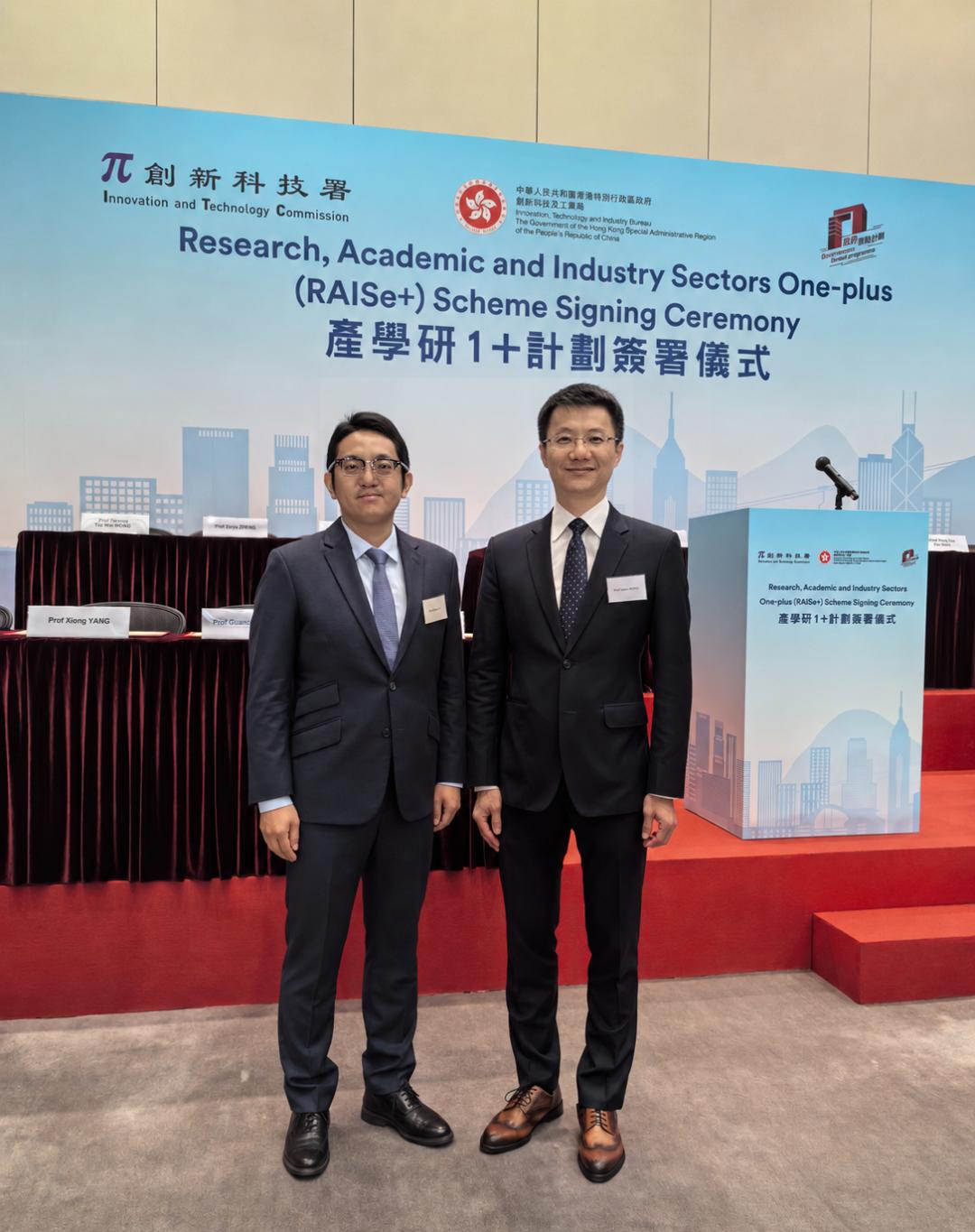
Zhenyu LIU (left) and Zizi ZHENG
As time went by, the entrepreneurial conditions including technology, industry and policy gradually matured.
In 2022, the Hong Kong Special Administrative Region Government put forward the proposition of "No Innovation, No Future", elevating scientific and technological innovation to the core strategy for Hong Kong's future development. The following year, the local government launched the "Industry-University-Research 1+ Plan" with a total amount of 10 billion Hong Kong dollars, specially supporting the industrialization of scientific research achievements of Hong Kong's universities.
In May 2024, Zhenyu LIU and Zizi ZHENG officially established MatraVolt Limited in Hong Kong, serving as the company's CEO and CSO respectively. The company is committed to converting carbon nanotube material technology into products and solutions that can be delivered on a large scale, and has become one of the first batch of projects under the "Industry-University-Research 1+ Plan".
According to Zizi ZHENG, after years of technical tackling, this technology has entered a stage of commercialization. "We aim to develop an ultra-thin, ultra-light, highly electrically and thermally conductive, flexible and tough composite material to replace traditional pure metal foil, and develop a fully automated roll-to-roll manufacturing process to achieve large-scale mass production, which can be applied in fields such as power batteries, energy storage batteries and supercapacitors."
Behind this choice lies the long-standing unsolved core pain point in the lithium battery materials sector.
Since the commercialization of lithium batteries, main materials including cathode, anode, electrolyte and separator have all gone through multiple rounds of technological iteration. Only the current collector that carries the cathode and anode materials, collects and transmits electrons has always adopted the pure metal foil solution, and the industry can only achieve lightweighting and energy density improvement by continuously thinning copper foil and aluminum foil.
However, when the foil is thinned to a certain extent, problems follow. The strength, breakage rate, yield rate and production stability of pure metal foil begin to face greater pressure. Although the industry has tried polymer-based composite current collectors that use polymer film as the core material and are plated with metal on both sides, this solution also has problems such as insufficient electrical and thermal conductivity, and weak mechanical strength.
MatraVolt Limited's idea is to use carbon nanotube materials to create a new type of composite current collector - carbon nanotube composite current collector. Simply put, they will replace the plastic skeleton in the middle of the current collector with a macroscopic film formed by carbon nanotubes, which retains the advantage of lightweighting while improving the mechanical, thermal and electrical properties of the material.
Out of recognition for the team, technology, products and other aspects, CAS Star, K2VC, BOC Investment and other institutions took the initiative to contact MatraVolt Limited, and finally jointly invested tens of millions of Hong Kong dollars to become the angel round investors. According to Zhenyu LIU, the company's current post-money valuation has reached hundreds of millions of Hong Kong dollars.
"MatraVolt is the core achievement transformation project of Professor Zizi ZHENG, and it is also the first industrial application of the world-leading flexible composite material technology developed by him." According to CAS Star, the carbon nanotube composite current collector developed based on this technology solves the problems of strength, electrical conductivity and low-cost mass production at the same time, which can minimize the use of copper and is very likely to become the mainstream material in the future. "In the future, this technology is also expected to be used in solid-state batteries and supercapacitors, with broad room for imagination."
With the completion of the angel round financing, MatraVolt Limited has started to advance multiple business lines including materials, batteries and data centers simultaneously. Since the team needs to be distributed in cities such as Hong Kong, Shenzhen, Huizhou and Shanghai, they quickly expanded the team size with the help of K2VC's post-investment team, laying a foundation for the company's rapid early development.
Promote Pilot Test and Mass Production, With Dozens of Intended Customers
Since the products replace copper foil and aluminum foil, it means that MatraVolt Limited's products are closer to bulk commodities.
The advantage of such product attribute is that there is no need to do a lot of customized work for different downstream applications. "Our focus is to make the base film well, and the adjustment for different scenarios can be realized relatively easily later," Zhenyu LIU added.
Since its establishment, MatraVolt Limited has only spent about 2 years to achieve a series of progress. Relying on the complete industrial chain and policy support of the Guangdong-Hong Kong-Macao Greater Bay Area, it is currently advancing pilot test and mass production, and has realized "the world's first high-speed and low-cost continuous production of macroscopic carbon nanomaterial bodies".
According to the company, it can already continuously and high-speed produce nano-scale carbon material films with a low-cost process, which is the first of its kind in the world. "After the equipment is upgraded, the production speed of a single production line can reach 10 square meters per minute, and is expected to be increased to 100 square meters per minute."
While improving the preparation efficiency, its carbon nanotube composite current collector also retains compatibility, with the interface and usage method completely consistent with traditional copper foil and aluminum foil. This means that customers do not need to replace production lines or adjust core processes, and can directly switch to using the current collector with better electrical conductivity, thermal conductivity and mechanical properties.
"Compared with traditional lithium batteries, the copper foil used in our products is 70% lighter, and at the same time 30% thinner than traditional current collectors." According to Zizi ZHENG, such features not only increase the battery energy density by more than 10%, but also greatly reduce the mass production cost of the product.
A set of data shows that based on the production capacity of 10 million square meters, the product cost of MatraVolt Limited is about 3 yuan per square meter. For a new energy vehicle, replacing only the current collector material can reduce the cost by about 2000 yuan; if indirect benefits such as vehicle weight reduction and battery consumption optimization brought by the increase of energy density are added, the comprehensive cost will drop even more.
Different from the conventional path of traditional material enterprises that supply cell manufacturers first and then penetrate the end market, they have chosen a differentiated commercialization route: skipping the cell manufacturer link and directly connecting with end customers.
In Zhenyu LIU's view, although direct connection with end customers requires more energy input in the early stage, as long as the product value is recognized, it can attract cell manufacturers to actively adapt to the material solution. "The base of end customers is much larger than that of cell manufacturers, with richer scenarios, which can tap more segmented application opportunities."
The reason why this model works is also highly related to the team's university background. "As a technical team from The Hong Kong Polytechnic University, it is relatively more credible for us to explain the material principle and performance value to end enterprises," Zizi ZHENG said frankly, which can also make end customers more receptive to new technologies.
At present, MatraVolt Limited is rapidly advancing commercialization, and prioritizes its focus on power battery and data center energy storage scenarios. According to Zhenyu LIU, in addition to signing a cooperation memorandum of advanced composite current collectors with NIO, the company is also in contact with dozens of customers with preliminary intentions, and is expected to generate market revenue within the next year.
In the three-year target they set, the company plans to capture about 1% of the market share in the fields related to batteries and supercapacitors. In the longer term, this high-performance composite material can also be used in scenarios such as space, which means that MatraVolt Limited's market space will be even larger.
This article is from the WeChat official account "ChinaVenture", author: Zhigao LU, editor: Qingwu WANG, published with authorization from 36Kr.