How difficult is it for Tilovi to evolve from a "Douyin-native brand" into a formal established brand?
In 2025, the top spot on Douyin's cosmetics ranking was taken by Tilovi, a makeup brand founded only four years ago.
Similar to the development experience of many no-name beauty brands, Tilovi rose rapidly and secured a foothold relying on the Douyin ecosystem. The difference is that in 2026, the no-name beauty track is gradually receding, while Tilovi is still surviving.
Can Tilovi break the "curse" of no-name beauty brands and survive in the fiercely competitive beauty market?
For Tilovi, the most urgent issue at present is to get rid of the past reliance on traffic boosts, and seize market share in the beauty industry with its established brand image.
In other words, removing the "Douyin viral hit" label and truly transforming into a formal beauty brand may be the only way out for no-name beauty brands represented by Tilovi.
Plagued by "short lifespan" after the traffic dividend fades
Public information shows that Tilovi was founded in 2021, focusing on "creating base makeup with skincare concepts" and targeting the niche "skincare-integrated base makeup" track. Its earliest launched products included crystal air cushions, loose water powders, cream compacts, and plain skin essence creams, priced in the range of 100 to 200 yuan.
Douyin is Tilovi's core sales position, and its skilled use of influencer matrix and brand live streaming has become the key to leveraging traffic. This set of operational strategies can largely be attributed to Zhang Yue, the founder of Tilovi.
Before founding Tilovi, Zhang Yue had accumulated considerable experience in the beauty market. She once served as the omni-channel agent for South Korean brand Aekyung in the Chinese market, building up Aekyung's brand reputation across the country, which also provided valuable reference for her to establish and operate Tilovi.
With the founder's rich operational experience combined with Douyin's traffic-driven strategies, Tilovi's rapid rise is far from unexpected.
According to the annual Douyin cosmetics rankings released by Feigua, Chanmama and Qinyan, Tilovi achieved an annual growth rate of 360% in 2025, with total omni-channel GMV exceeding 20 billion yuan. Among its products, the cumulative sales of the crystal air cushion exceeded 20 million units, and the repurchase rate of the loose water powder surpassed 40%.
However, this traffic-driven model is extremely "capital-consuming": while it can bring high sales volume, profits are diluted, and the brand also faces problems such as rising traffic acquisition costs and fierce competition from similar brands.
A very typical example is Ji Xianshi. In 2022, Ji Xianshi thrived on Douyin, generating 200 million yuan in sales in April alone. But its highlight period was very short, and problems gradually emerged starting from 2023: once a brand focuses all its resources on traffic acquisition, it will easily neglect R&D and product innovation, which is essentially regressive in the consumer market. Reducing ad investment will directly lead to a drop in product sales, and later Ji Xianshi was almost nowhere to be found in the beauty market. The latest news shows that its parent company has been listed as a person subject to execution, and multiple natural persons have filed applications for bankruptcy liquidation against it.
Urgent need to enhance brand power
When you open Tilovi's live stream room, you can see the host teaching viewers how to choose the right shade number step by step, focusing on pain points that consumers care about, such as makeup lasting effect and suitable user groups, which can arouse the interest of consumers who occasionally enter the live room. After all, for female consumers, who wouldn't want to buy an affordable and high-quality beauty product? What's more, this brand seems to have considered many usage pain points for "me", and the price is not too high to try out.
In this way, although Tilovi does not have a very rich product line, it has reached the top of the cosmetics sales list with several star products.
One problem facing Tilovi is that most consumers choose Tilovi for a specific product, rather than purchasing its products out of recognition for "the brand plus its overall product system".
In other words, consumers only remember that a certain product of Tilovi is good, but the brand's core proposition and unique tone can hardly be truly established. Once new products with similar operational strategies appear in the market, consumers' purchase decisions will be easily changed.
Tilovi also lacks a truly exclusive brand positioning. The "skincare-integrated makeup" concept is very common in the current market and is one of the trends in the cosmetics industry, which increases the possibility of it being replaced by competing products of the same type.
As for the founder's personal IP, although it can cultivate a trust foundation for Tilovi, it cannot become the brand's unbreakable "moat".
As a beauty brand with a short history, it is not easy for Tilovi to convince consumers to make purchases. At this time, founder Zhang Yue began to be active on social media, acting as a product model and conveying lifestyle concepts to build more trust for Tilovi.
In addition, the brand uses celebrity resources to reach audiences from different circles, represented by Li Yunrui, Ren Jialun, Wen Zhengrong and others, leveraging their fan base and influence to improve Tilovi's brand exposure.
But in the final analysis, these are still part of the traffic-driven strategies. After the initial development stage, what Tilovi needs is far more than just traffic.
At present, consumer reviews for Tilovi's products are highly polarized:
Some consumers think Tilovi's products are cost-effective, and their moisturizing effect and fit on the skin are no worse than big-name luxury cosmetics;
Other consumers argue that there is a gap between the brand's publicity and the actual user experience.
On the Black Cat Complaint platform, some consumers reported that Tilovi's puff and air cushion products cannot achieve the effects advertised, and even cause skin allergies, and allergy issues appear frequently in the complaints against Tilovi.
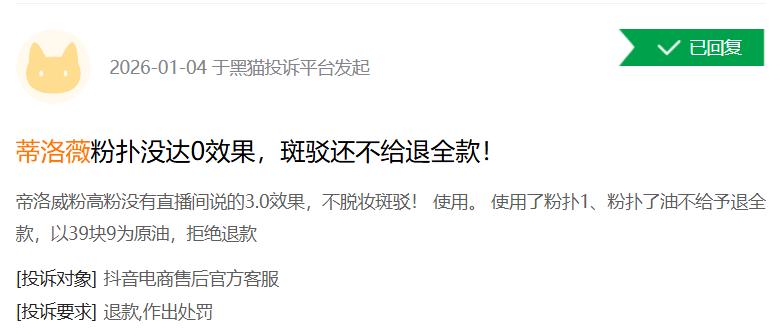
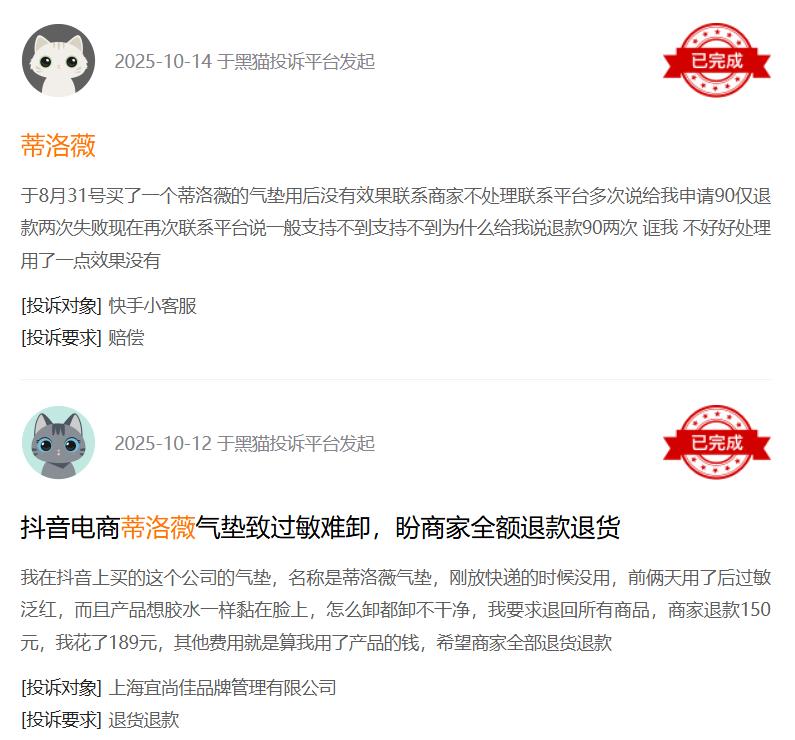
(Source: Black Cat Complaint)
New requirements for omni-channel expansion
The Douyin platform has made Tilovi what it is today, but focusing only on this single channel is too limited. Therefore, outside Douyin, Tilovi has also carried out omni-channel layout, and set different functions for different channels.
For example, Douyin and Xiaohongshu are mainly responsible for content display and product seeding, Tmall and JD meet consumers' active purchase demands, and offline stores play the role of experience and repurchase.
Public reports show that Tilovi has now settled in more than 13,000 offline retail stores, including mainstream offline chain retail channels such as Watsons, Sanfu, and The Colorist, and it is expected to expand to 30,000 stores by the end of 2026.
However, operating channels other than Douyin puts forward new requirements for Tilovi, which needs to adapt to the characteristics of different channels to attract more consumers.
Under the broader omni-channel layout, if the brand still attracts the same group of consumers, the help and promotion it can bring to Tilovi will be very limited. In offline channels, Tilovi faces direct competition from similar brands.
Another realistic problem is whether consumers can accept the matching degree between the brand and the channel when the brand enters offline channels. Take Sephora as an example, when it announced the introduction of domestic brands such as Santsang, Joocyee, and Joyson, it caused considerable controversy.
Some consumers believe that the positioning of these domestic brands cannot match Sephora's high-end image, and they cannot accept that these domestic brands are sold on the same shelf as imported high-end brands such as Guerlain and Estée Lauder.
In fact, it can also be seen from consumers' feedback that these domestic brands still have gaps with imported big names in both brand building and product quality. Even if Tilovi ranks at the forefront of Douyin's cosmetics track, it still faces a similar situation, which means that Tilovi needs to evolve from a "Douyin-born brand" to a mature formal brand.
As the beauty track on Douyin enters the stage of value competition, the era of simply relying on traffic dividends and product gimmicks has passed, and emerging brands must seize the opportunity to complete their upgrading.
To stay on the top of the ranking list for a long time amid the constant updates of various rankings, Tilovi has to demonstrate sufficient strength.
This article is from WeChat Official Account "Chief Consumer Officer", written by Duoban, and authorized for release by 36Kr.