Silicon Valley has begun to turn against Anthropic, all of Claude's product lines have been forcibly ordered to be banned, and contractors are carrying out emergency migration.
Recently, an employee of a company revealed that their company, together with other enterprises, has received an instruction from the US government requiring the cessation of the use of products, services and models under Anthropic. In accordance with the notice, the company will complete a full phase-out before August 31, 2026, covering all employees, contractors, applications, development environments, cloud services, and third parties working on behalf of the company.
The company emphasized that this is a mandatory company-wide requirement. From the date of the notice, employees are not allowed to create any new Anthropic accounts, subscriptions, API keys, system integrations or model deployments. Failure to complete the migration on schedule may seriously affect the performance of the company's existing contracts and the acquisition of new projects in the future.
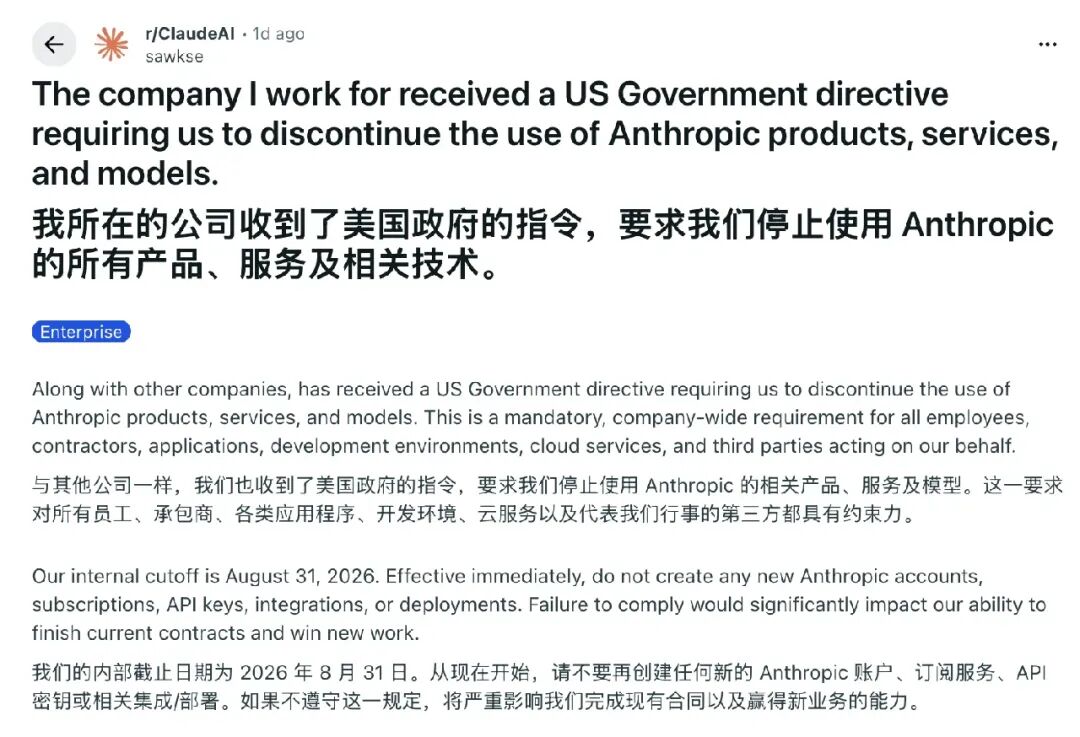
All Claude products are included in the prohibited scope
According to the employee, the company requires an immediate investigation of the current usage of Anthropic and Claude, including direct usage, as well as indirect calls through other tools, platforms or hosting services.
Products that need to be discontinued include Claude web and desktop applications, Claude Code and its CLI tools, Anthropic Console and APIs, as well as models such as Claude Opus, Sonnet, and Haiku. Anthropic models accessed through IDEs, cloud platforms, shared applications or hosting services are also included in the phase-out scope.
All locally installed Anthropic software must be deleted before August 31. If existing applications, development activities or suppliers depend on Anthropic, the relevant responsible person must immediately submit a work order to explain the dependency relationship and initiate migration.
In the engineering R&D scenario, the company allows employees to continue using the Cursor integrated development environment and command-line tools, but the Anthropic models in them must be removed.
For teams that are currently using the Claude Code CLI tool, the company requires migration to the Codex and GPT series models provided through WebAI. Other Anthropic-related workflows also need to be switched to company-approved alternative services.
The company stated that this adjustment does not mean reducing investment in GenAI. The company will continue to provide AI tools for employees, but all workflows must be migrated to approved platforms and models. Next, the company's IT and security teams will uniformly remove centrally managed Anthropic services and deploy technical control measures to restrict access. The notice clearly states that any behavior that bypasses access restrictions and security controls will be prohibited.
For confirmed Anthropic users and application responsible persons, the company will also provide targeted migration guidelines. The internal notice requires all teams to report dependencies as soon as possible to avoid affecting business and project delivery when the deadline is approaching.
After the post was published, multiple users claiming to work for US government contractors said that their companies had also received similar requirements. Some netizens said that all Department of Defense contractors are implementing relevant regulations. One user said his company was required to switch to OpenAI, Nemotron and Grok.
Even though Anthropic still has strong technical advantages, the company is now in a rather precarious situation of being besieged on all sides.
Silicon Valley begins to turn against Anthropic
The Wall Street Journal reported that a backlash against Anthropic is gradually emerging in Silicon Valley.
The controversy mainly stems from two aspects: first, Anthropic continues to launch products that directly compete with existing software vendors; second, the company continuously advocates building a more closed AI ecosystem.
Partners worry about being "eaten in reverse" by Anthropic
Many startup founders, software company executives and AI researchers said that after seeing Anthropic launch tools that compete with existing products of other companies, they began to switch to lower-priced AI models.
For example, in April this year, Anthropic released Claude Design. Some industry insiders believe that this product directly targets the relevant services of design software company Figma, which itself is one of Anthropic's partners.
Some insiders revealed that at an event shortly after the release of Claude Design, Figma CEO Dylan Field said that Anthropic was "not always honest enough" in communication.
Sarah Sachs, head of artificial intelligence at Notion who attended the event, said: "The entire industry has learned a lot of lessons from the development of this partnership. Some companies may have trusted Anthropic too much in the past."
Quinn Slack, co-founder and CEO of Amp, a programming startup that has long purchased Anthropic models, pointed to market concentration. He believes that if there is only one winner left in the model competition, that company may arbitrarily squeeze customers and partners; only when the model market maintains competition among multiple players, basic model vendors cannot abandon ecological partners. Brian Tse, founder of Concordia AI, also said that global developers are increasingly aware that relying entirely on US closed-source APIs is a supply chain risk in itself.
Some investors also put forward more radical doubts. Jason Calacanis, an early investor in Palantir, once claimed that Anthropic might learn about needs from customers such as Cursor and then launch Claude Code to compete with them; Chamath Palihapitiya noticed that after Anthropic cooperated with pharmaceutical companies such as Eli Lilly, it began to discuss independent drug R&D.
Most traditional enterprises do not have to worry that Anthropic will suddenly enter industries such as manufacturing and aviation, but for companies that are in the software and artificial intelligence application layer such as Figma, Cursor, and Palantir, this threat is more realistic, because basic model vendors may indeed use their model, capital and distribution advantages to expand downstream.
This is why the backlash against Anthropic is particularly strong among Silicon Valley software companies. Ordinary enterprises are worried about costs, security and data, while AI-native startups are worried that they are Anthropic's customers and partners today, but may become competitors of Anthropic's new products tomorrow.
In addition, Anthropic's adjustment to the data retention policy has further exacerbated everyone's concerns.
After the launch of the Fable and Mythos series, Anthropic requires that all relevant requests and outputs on the platform be retained for at least 30 days for trust and security review; if the content is judged by the classifier to possibly violate the usage policy, the retention period can be up to two years. This means that even if an enterprise calls the model through a third-party platform, it may not be able to continue to use zero data retention.
Microsoft subsequently restricted employees from using Claude Fable 5 and asked its legal team to re-evaluate Anthropic's data retention requirements. Microsoft's main concern is that employee inputs may involve customer data, source code and company confidential information, which will be stored in Anthropic's systems.
Enterprises in industries such as finance and healthcare that process sensitive data generally expressed dissatisfaction with this change. Some software companies also worry that after model vendors retain more interaction data, they may gain a deeper understanding of customer workflows and develop competing products accordingly. Even though Anthropic responded that company personnel cannot directly read these retained conversations and the relevant data will not be used to train new models, it did not dispel the concerns of enterprises.
In addition, the company's cutting-edge models refusing to answer questions related to artificial intelligence research has also caused dissatisfaction among some researchers who advocate improving the transparency of AI systems.
Besides, ordinary individual users have also shown very high dissatisfaction recently.
A user who purchased the Max 20x package posted a complaint: "Recently, my usage quota seems to have changed significantly. I waited 4 days for the quota to reset, but Claude now consumes the quota much faster than before, especially when using Fable. The same quota used to last for 3 days, but now it is exhausted in just a few hours."
And this is not an isolated case.
"It's only the 2nd day, I have used 80% of my Fable quota, and 50% of the total usage quota. The quota increased extremely exaggeratedly yesterday. I just did ordinary development work according to the previous fixed process, and the working method, task volume and operation process have not changed. But I only assigned one task to Fable, that is, one Sprint, and the usage directly jumped from about 20% to 60%. This situation has never happened before, and I originally expected the maximum increase to be only 10% to 15%," another user said, "Knowing that I am not the only one who feels something is wrong makes me feel a little relieved, because there is obviously something really wrong here."
The user also uses the Claude Max 20x package, and usually hits the upper limit between the 4th and 6th day of the weekly quota cycle. "I even found that Fable 5 performs very poorly when processing some simple tasks in a context of about 200,000 tokens with an upper limit of 1 million tokens. In contrast, previous conversations with a context close to 1 million tokens performed much better. Now it even feels like a Haiku-level model when in use."
"As soon as OpenAI or any other lab develops a smarter model, I will abandon Anthropic immediately. Anthropic has done too many shady things, and we should not support them," a user said.
The "maverick" among top AI labs
At the same time, the public has also begun to question Anthropic executives' warnings about the AI security risks of "open weights", especially after a number of domestic open-weight models are gradually approaching the most cutting-edge AI systems in the United States.
On July 24, NVIDIA, Microsoft, Meta and other companies signed the open letter "Open Weights and US AI Leadership", and then OpenAI, Google and SpaceX joined, with more than 70 enterprises signing in the end. Anthropic became the most conspicuous absentee among the major cutting-edge model labs. This incident quickly transformed the originally scattered dissatisfaction in the industry into public criticism of Anthropic's closed route.
Almost the entire technology industry has supported open weights except Anthropic. Bill Gurley, a partner at Benchmark, believes that what Anthropic is really worried about is that open weights will compete with its business model, and its "safety awareness" reveals the motivation to safeguard the company's economic interests behind it. Li Kaifu, founder of 01.AI, also commented that in this open letter, "who did not sign" is more noteworthy than who signed.
Vishal Misra, associate dean of computing and artificial intelligence at Columbia University's School of Engineering, made more direct criticism. He recognizes that Anthropic's products are excellent, but believes that some of the company's claims about the security risks of open models are untenable, and it is increasing its leverage to push for regulatory policies that are favorable to itself by creating public fear. He also questioned that Anthropic itself benefited from widely open research and technology accumulation in the early days, but now it is trying to prevent other participants from taking a similar route.
"I work on AI-related work at a progressive non-profit organization, so at first we naturally agreed more with Anthropic. But since they began to deliberately block some websites or services in the name of 'safety', I no longer like them. The problem is that there are no decent alternatives at all right now," a netizen said. "Amodei's approach of exaggerating fear will most likely block everyone's way in the end," an ordinary developer said.
Offline protests in support of open weights also appeared in San Francisco, with co-organizers including the CEO of Hugging Face. Mahesh Lambe, an AI researcher who participated in the event, said that cutting-edge labs are "hoarding intelligence", and intelligent capabilities should be democratized.
Anthropic CEO Dario Amodei tried to calm the controversy in person on Monday. In a blog post, he insisted that Anthropic has never called for a ban on open-weight models, but he still did not sign the open letter.
In essence, this conflict is not a simple dispute between "open and closed source", but a dispute over who has the right to decide how model capabilities are released. Critics believe that Anthropic packages commercial interests as security issues; Anthropic believes that the open camp underestimates the irreversible risks of cutting-edge model weights.
Looking back, Anthropic has been "isolated" in almost all major policy games.
In February this year, Anthropic was blacklisted by the Pentagon after fierce debates between the two sides on whether the Claude AI system could be used for large-scale surveillance or autonomous weapons. Senior officials slammed Anthropic, claiming that "no AI company is more hostile to combatants than it."
Among all AI labs, Anthropic is more active than anyone else in promoting regulation. The company supports state-level artificial intelligence legislation and proposes to establish a regulatory agency similar to the US Federal Aviation Administration (FAA) to review advanced models before their release. But this summer, when the White House pointed out that there were security vulnerabilities, Anthropic disputed the severity of the vulnerabilities, which triggered export controls and forced its Fable and Mythos models to be taken offline for nearly three weeks.
"I am still a die-hard fan of Claude"
"I have always believed that AI is essentially the product of the spirit of this era developing to the extreme, and Anthropic's position is precisely suppressing this trend. So I completely oppose them," a netizen said.
The moral credit that Anthropic used to obtain by relying on its identity as a "safety company" is being continuously consumed by partner conflicts, closed ecology and communication problems, but its technical advantages are still strong and it has a large number of loyal users. One of the users said:
Many of the things Anthropic has done recently actually make me very uncomfortable. But among all the cutting-edge model companies, it still seems to be the only one that takes the issues I care about seriously and is willing to invest in real research. It is said that they have always adhered to the "Claude Constitution", and the basic classical liberalism and democratic values embodied in it are increasingly becoming a scarcity nowadays. So so far, I am still on Anthropic's side.
Besides, it did say "no", and is now bearing the consequences of that refusal.
"But having said that, when Dario talks about the United States, it feels like he is still living in the past. I also strongly disagree with his one-sided attacks on China," the netizen said, "All in all, I am still a die-hard fan of Claude, except for Sonnet 5."
This article is from the WeChat Official Account "InfoQ" (ID: infoqchina), author: Chu Xingjuan, published with authorization from 36Kr.