From glasses to guitars, AI hardware is no longer obsessed with "new species"
In the AI era, hardware manufacturers are all competing for the next entry point.
At present, mobile phones and computers are still important traffic entrances. However, it is clear that the rapid iteration of large models is pushing AI into a broader physical world. From smart glasses and AI earphones to smart rings and AI guitars, hardware manufacturers are eager to move AI away from mobile phones, and even get rid of the high dependence on apps formed in the mobile Internet era.
From this, we find an interesting pattern: even if the carrier of AI is changing, the appearance of hardware still adopts forms familiar to people. Manufacturers are beginning to try to use familiar products to meet brand-new smart demands. Behind this is not a simple choice of appearance, but a carefully weighed business calculation. Only when technological innovation enters real scenarios and forms the most direct connection with users' lives, can it evolve from a technical demo in the laboratory to a truly viable business.
So what kind of AI hardware can truly meet the market demand?
Familiar scenarios are the business foundation with the lowest education cost
In the AI era, creating an unprecedented new "species" of hardware seems more imaginative, but it also means higher market education costs.
A device that has never existed before needs to constantly answer questions such as "What is it? What can it do? Why not use a mobile phone instead?" The more questions there are, the higher the cost for users to understand, and the greater the business uncertainty will be.
Humane AI Pin once tried to create a brand-new entry point beyond mobile phones, but due to unclear usage scenarios, the product was eventually discontinued. Another notable wearable device, Looki L1, has verified its early sales of nearly 10,000 units through scenarios such as automatically recording life, generating Vlogs and life memories. However, compared with mature consumer electronics categories, it still needs to answer a long-term question: besides geek users who are willing to try new things, how many ordinary consumers are willing to wear a camera device on their chest for a long time?
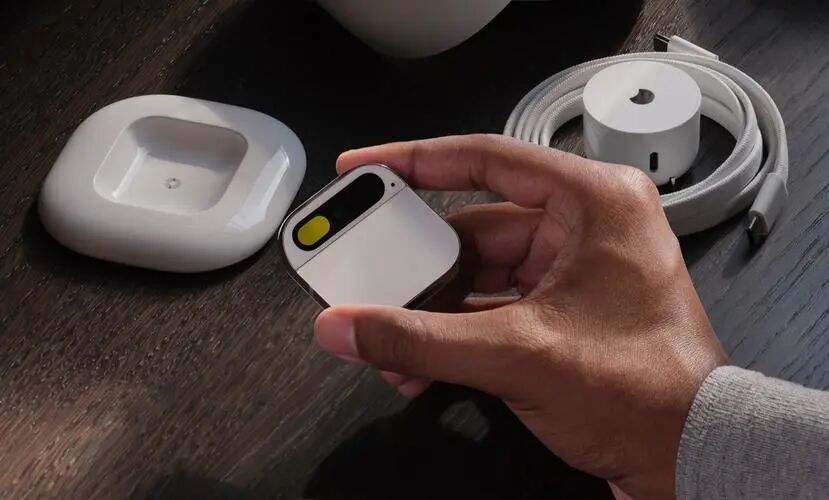
In contrast, mature categories such as glasses, earphones, cameras and guitars already have relatively clear usage scenarios. Users know that glasses are meant to be worn on the face, earphones are suitable for listening to music and making calls, cameras are used for recording and creation, and guitars are closely related to playing and singing, entertainment and social expression.
The market has given feedback on AI glasses first.
Data from Omdia shows that the global shipment of AI glasses reached 8.7 million units in 2025, and is expected to exceed 15 million units in 2026. China has become the fastest-growing AI glasses market in the world, with shipment second only to the United States.
Whether it is Ray-Ban Meta, which occupies the main share of the global market, or Rokid and Quark AI Glasses in the Chinese market, the products first need to be a pair of glasses that consumers are willing to wear daily.
The business foundation of AI earphones is even more mature. Earphones themselves already occupy high-frequency scenarios such as listening to music and commuting, and voice is the most natural AI interaction method. At the 2026 World Artificial Intelligence Conference, Qwen's first AI earphone made its official debut, integrating capabilities such as simultaneous interpretation and meeting minutes into the device that users already wear.
In more vertical categories such as cameras and musical instruments, the frequency of user usage may not be equally high, but the corresponding interest demands, usage scenarios and payment habits have long existed.
Music is a typical scenario.
Consumers have long been willing to pay for devices such as earphones, speakers and musical instruments. Although musical instruments are not hardware that everyone uses every day, the demand for playing and singing, entertainment and social expression has been repeatedly verified by the market. The Tianpule AI Guitar released last year also unveiled its annual updated version at this year's World Artificial Intelligence Conference. According to previously disclosed data, the GMV of the product exceeded 10 million yuan in less than three months after its launch. This achievement is not enough to prove that AI guitar has become a mass category, but it shows that users are willing to pay for a new music interaction experience.
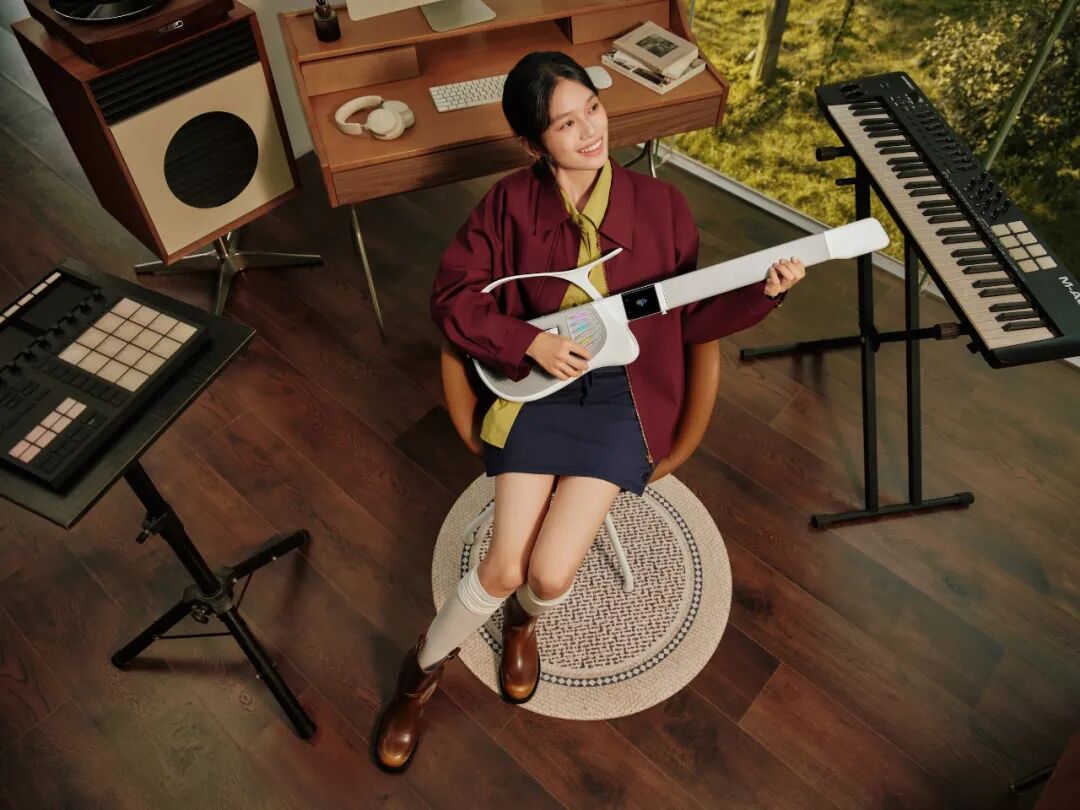
At first glance, it looks like a stringless guitar with a screen added. Jia Shuo, Vice President of Qutun Technology, does not intend to correct consumers' understanding of this. In his view, if consumers think a product is significantly different from what they have seen before and belongs to a brand-new category or species, it often means very high market education costs and will bring great business uncertainty. "Consumers are always right. If they think it is something at first glance, then it is probably that thing," Jia Shuo said.
However, from the product perspective, the internal logic of this product has gone beyond the traditional stringless guitar. To embed the large music generation model into it, Tianpule has made a lot of modifications at the hardware and software levels, integrating a screen, a speaker, an interaction system and AI music generation capabilities. To a certain extent, it is more like an "all-in-one machine for AI large music model", but the first product adopts the familiar guitar shape that people are used to.
Nevertheless, familiar scenarios and forms only lower the first threshold for AI hardware to enter the market. The next step to determine the value of AI hardware is whether AI can enter the core usage process of the product.
Connected to AI does not mean being AI hardware
In the boom of AI hardware, accessing a large model, adding voice Q&A, or making hardware connect to mobile apps is no longer a difficult task. But if AI only exists outside the hardware and the original product logic has not changed, it is still difficult to form a new reason for purchase.
The evolution of smart guitars provides an intuitive sample.
Most of the early smart guitars adopted the mode of "traditional guitar plus external accessory": adding a third-party auxiliary key accessory to the guitar to help users quickly master guitar chords, which is more like a set of auxiliary teaching tools.
The subsequent stringless guitars made drastic changes to the inherent form of guitars. They removed the traditional strings and realized interaction through buttons, touch and other methods. Stringless guitars are more like a guitar-shaped audio sampling player. After users connect to the mobile app, they can press the keys according to the light prompts to quickly complete playing and singing.
These attempts lower the learning threshold of musical instruments and encourage more novice users to pick up a guitar. However, mobile phones still undertake core functions such as content selection, music score display and interactive control, and the hardware is more of an extension of the app in the physical world.
Similar problems also exist in other AI hardware.
If AI glasses only move the voice assistant in the mobile phone to the temple of the glasses, they are still more like a hands-free mobile phone accessory; if AI earphones are only responsible for receiving and playing audio, their AI attributes mainly stay at the interface level.
The real watershed lies in whether AI has changed the core experience of users.
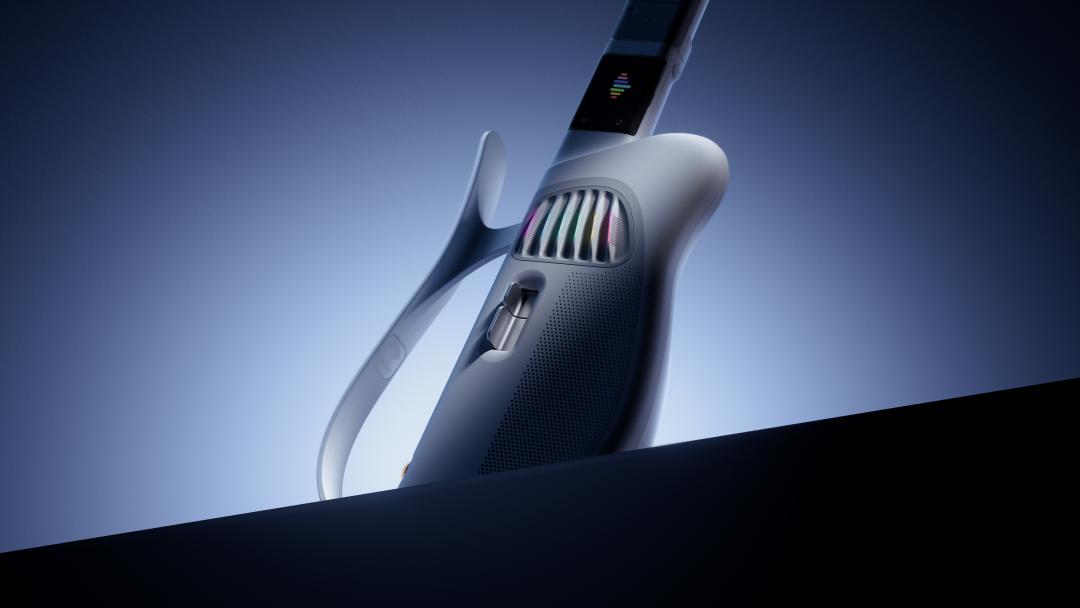
A key change of Tianpule AI Guitar is that the screen, software and music model are all built into the guitar body, so that music scores, lyrics, accompaniment and AI creation no longer rely heavily on mobile phones. When playing, users do not need to look at the guitar neck while looking for the mobile phone placed next to them, nor do they need to switch back and forth between multiple devices.
"The process of playing music requires more immersion and concentration," Jia Shuo said. If a device can fully present all the information users need for operation, it can reduce the interruption of the mobile phone to the playing process, making the product closer to a smart musical instrument that can be used independently.
This is also one of his criteria for judging AI hardware: "A real smart hardware in the AI era should be able to deliver a complete intelligent experience even without relying on apps."
The hardware is no longer just a remote control for mobile apps, but begins to become a terminal that can independently deliver core experiences.
At this point, the changes brought by AI are no longer limited to efficiency improvement, but advance the creation and positive feedback.
AI guitars not only help users "play a song by someone else", but also allow users to generate music according to their own emotions and preferences, and then participate in performance and expression. From "quickly learning a song" to "quickly getting a complete music experience", what AI really lowers is not only the technical threshold of playing music, but also the threshold for ordinary people to gain a sense of achievement through music.
This change is not exclusive to musical instruments. In imaging devices, DJI and Insta360 use capabilities such as automatic tracking, image stabilization and intelligent camera movement to allow ordinary users to obtain high-quality images faster without mastering professional shooting skills first.
However, lowering the threshold does not mean simplifying the product infinitely.
In Jia Shuo's view, if a music hardware only allows users to press a few buttons and play fixed accompaniment, although it is easy to get started, it may quickly lose its appeal due to lack of challenge and sense of participation.
This is the balance that he has repeatedly mentioned for consumer-grade AI hardware: the first use should be simple enough, and users can still obtain higher-quality results and room for further exploration after they are familiar with the product.
The product logic of DJI Pocket is a typical example. Its power-on, shooting and zooming are intuitive enough for novices to use quickly, but its output quality can also be accepted by professional studios. The product does not stack complex operations for professional capabilities, nor does it sacrifice the final result for simplicity.
AI is rewriting the product cycle of hardware
Over the past decade, "software-defined hardware" has become an important paradigm in the consumer electronics industry. From small devices such as Bluetooth speakers to large products such as new energy vehicles, software is continuously changing the functional boundaries and interactive experience of hardware. Nowadays, traditional software is being swallowed and reconstructed by AI, and large models have begun to participate in the product definition of hardware. Jia Shuo summarized this change as "model-defined hardware" at the Yunqi Conference last year.
When models begin to participate in product definition, the life cycle of hardware will change accordingly.
In the past, when traditional consumer hardware was launched on the market, its product capabilities were basically fixed, and new functions that really affect the experience often had to wait for the next generation of products. AI hardware is more like a terminal that can grow continuously.
After the Tianpule AI Guitar was launched, it basically maintained an update rhythm of once every two to three weeks; for more than half a year since its launch, the core gameplay has been adjusted for two or three rounds. The newly added "AI improvisation" function this year was officially opened to all users for free through firmware upgrade.
"This is a muscle memory formed by mobile Internet teams in the development process," Jia Shuo joked.
This iteration is also extending from software to hardware. To reduce the toy-like feeling of the product and reserve room for advanced users to further explore, the 2026 annual updated version redesigned the rainbow string component to further improve the sensitivity and playing experience.
The competition mode of AI hardware companies is also changing accordingly.
Tianpule's development path from apps, large models, Agents to hardware did not happen overnight. As early as 2019, the team first defined the interactive mode of indicator light "playing and singing" through the Changya App, which to some extent inspired the smart musical instrument products on the market in recent years. After that, the team began to independently develop the Tianpule large music model, and incubated China's first conversational music creation Agent "Tunee". On this basis, the team further thought: how can the music generated in mobile phones and computers truly enter users' daily life and social scenarios? Finally, hardware has become a centralized outlet connecting models, software capabilities and existing demands for playing and singing.
This path may not be applicable to all companies, but it reveals an increasingly clear trend in AI hardware competition: whether the product can continue to evolve after its launch, and turn the temporary sense of freshness into long-term value in repeated real usage.
The integration of AI and hardware is still in its early stage. AI itself is still iterating rapidly. How to stably convert the ever-changing model capabilities into hardware experience will be a long-term subject.
From glasses and earphones to guitars, AI hardware is no longer obsessed with "new species", but re-enters those existing scenarios, solves problems that have not been properly solved in the past, and creates new experiences.
In the future, what determines the success or failure of the industry will not be who first installs AI on a product, but who can truly connect models, software and hardware, and turn technology into a natural, stable and long-lasting experience worth using.
When the sense of freshness fades away, users are still willing to continue using it, which is the real beginning of a viable AI hardware product.