The three giants of DingTalk, Feishu and WeCom have all completed their full AI layout, what then?
Throughout July, the AI competition in the enterprise collaborative office track among major internet giants continued to heat up.
On July 27, Dayuan, the AI assistant of WeCom that had been developed in secret for more than a year, launched its internal test.
Earlier on July 2, DingTalk announced the integration of three Agent product lines, with its new head Chen Yusen taking full charge. On July 23, Feishu aily also announced a full upgrade, highlighting the "multi-agent collaboration" concept in a high-profile manner.
Within a single month, the moves were frequent and the competition was intensely fierce. However, the existing market pattern has been solidified, with the three platforms accounting for over 90% of the total market share. Is this round of AI offensive just a repetition of adding new functions to old products, or a reshuffle of the market?
The deeper question is, does the ultimate value of AI office stop at reducing the workload of employees, or truly empower business operations and drive revenue growth? Obviously, the market is waiting for more answers.
01 The AI Fierce Competition Among DingTalk, Feishu and WeCom
In the enterprise collaborative office track, the competition among giants has never stopped, and they naturally do not show any weakness in the advancement of AI functions.
On July 27, Tencent released an article on its official WeChat public account titled "New AI capabilities of WeCom are here", officially announcing that Dayuan, the AI intelligent assistant of WeCom, has launched internal testing.
According to the introduction, users can swipe left on any interface of WeCom, or click the "Intelligent Assistant" on the left sidebar on the PC side to evoke it.
In terms of functions, Dayuan can automatically retrieve work information such as chat records and documents, and generate the first draft of structured weekly reports. It supports scrolling through long group chat messages, extracting key points from voice messages, and automatically generating to-do items. It can also call dozens of capabilities such as intelligent documents, intelligent spreadsheets, meetings, and schedules.
One internal test user commented, "It's very user-friendly for beginners, you can evoke it just by swiping left, and the functions are embedded in the daily interface, so it's easy to get started." "It works really well, I've already used it to run scheduled tasks."
Of course, some other internal test users said, "It feels that the functions tested so far are limited to simple tasks such as information summarization and content generation, and cannot perform complex cross-system automated processes like DingTalk."
From the perspective of industry insider Lin Ge, WeCom's AI assistant "is late in arrival but finally comes out". "In terms of the AI assistant function, WeCom is the last one of the three platforms to launch such a product, but WeCom covers more than 14 million real enterprises and organizations. This huge private domain connection pool is its biggest confidence."
Certainly, Lin Ge also pointed out that WeCom itself is relatively closed. Compared with DingTalk and Feishu, "WeCom's assistant was launched much later, and we can only know how much of a bonus it can bring after its official release."
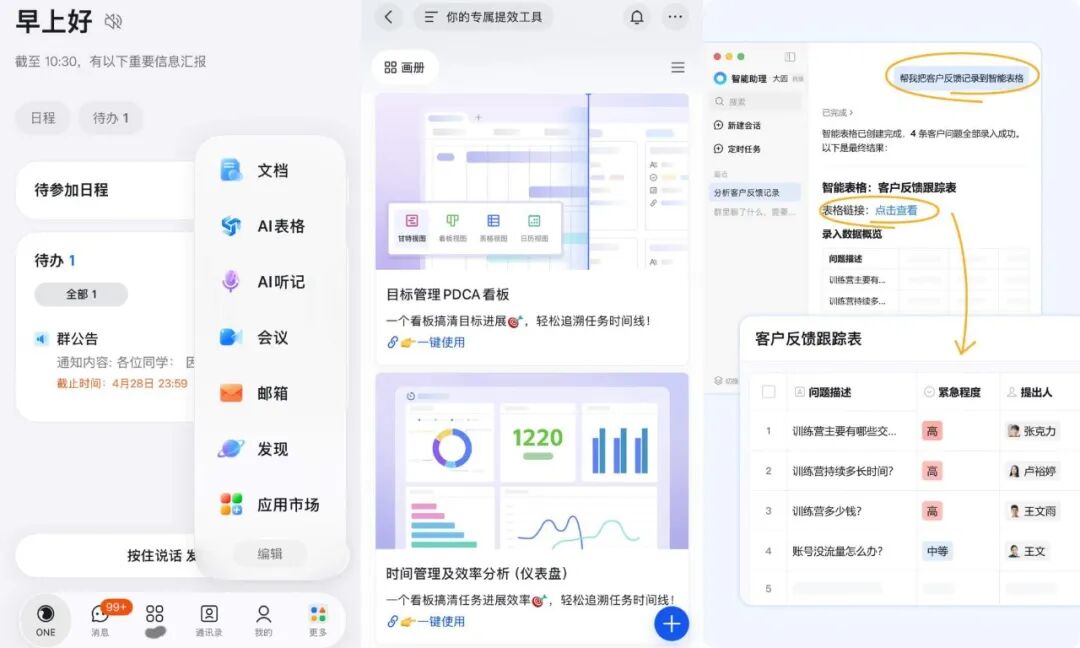
Figure: The upgraded workbenches of DingTalk, Feishu and WeCom Source: Screenshots from DingTalk, Feishu and WeCom, *Tingtong Tech*
On the same day when Dayuan was unveiled, Alibaba also launched the internal test of its "Qianwen Office" product, which integrates three Agent products: QoderWork, Wukong and MuleRun, and is likely to be built into DingTalk in the future. According to sources, Qianwen Office will be Alibaba's flagship product targeting the Agent office market.
Market analysis points out that Alibaba's move is intended to realize the transformation of "concentrating all resources" in the office track through "Qianwen Office".
In fact, back in 2023, DingTalk connected to Tongyi Qianwen and launched the "Magic Wand" function; in 2024, DingTalk launched the "AI Assistant" in the full version 7.5; in August 2025, DingTalk released the AI 1.0 version; in March 2026, it even high-profilely released the AI native platform "Wukong"; and in July, it directly integrated the three product lines, which are under the unified charge of Chen Yusen, CEO of DingTalk.
Feishu also did not stay idle.
On July 1, Feishu released the multidimensional spreadsheet intelligent agent. Users can configure an intelligent agent with just a few clicks based on a customer follow-up sheet, which will appear in the message list as a colleague alongside real human users. By directly @mentioning it in the group chat, users can query data, fill in progress, and write reports.
Many netizens said, "The highlight of this move is that AI is no longer just a tool in the question-and-answer box, but a team member living in the data."
On July 23, Feishu aily was upgraded again. The new version of aily can work actively 7*24 hours on the cloud, and can also call Feishu tools and browsers to generate documents, spreadsheets and presentations. More importantly, it supports multi-agent collaboration, with hundreds of pre-configured professional Agents that can work in teams with clear division of labor.
According to media reports, Feishu's revenue exceeded 3 billion yuan in 2025, and its growth rate in the second quarter of this year exceeded 100%, making it the most dynamic one among the three platforms.
Lin Ge summed it up like this: "All three platforms are taking actions, but in different ways. Overall, DingTalk is stacking up functions, Feishu is embedding data, and WeCom is focusing on connecting customers."
02 Three Applications, Three Logics
It is undoubted that no matter DingTalk, Feishu or WeCom, all have attached great importance to AI development.
But the three platforms adopt completely different strategies. To sort out the logic behind the offensive of DingTalk, Feishu and WeCom, we need to start from their respective genes and underlying architectures.
"WeCom's strategy is very clear, which is to focus on the private domain scenario with all efforts." Lin Ge said.
For a long time, the efficiency improvement battlefield has been the domain of DingTalk and Feishu. WeCom's impression to the public is not "making office more efficient", but connecting private domain value.
This can be seen from WeCom's product design: Dayuan is positioned as "a native intelligent assistant embedded in the WeCom workflow", rather than a new independent entry.
On this basis, Dayuan is connected to the data in WeCom's ecosystem, including group chats, documents, meetings, emails and schedules. Its most unique function lies in the customer-facing scenarios: it can analyze customer demands, extract key concerns, identify high-intent customers and generate customer portraits based on the chat records between employees and WeChat customers.
"Tencent's thinking is very clear." Lin Ge said, "Instead of competing for internal office efficiency, it directly cuts into the revenue-generating link, helping sales staff sort out customer demands and identify transaction bottlenecks. All businesses that operate through WeChat, whether in the retail, manufacturing or service industry, are Tencent's target customers."
Different from WeCom, DingTalk takes a full-coverage path: it not only aims to build an AI operating system, but also wants to "control the whole scenario".
"With 200 million monthly active users and more than 20 million enterprise organizations, such a scale determines that it cannot take a narrow path. Therefore, DingTalk's AI strategy needs to cover almost all industries, including manufacturing, government affairs, education and retail." Lin Ge said frankly.
This requires DingTalk to build an AI operating system, embedding all the organizational structures, permission systems and approval processes it has accumulated over 11 years. This also clearly shows DingTalk's intention of industry-oriented layout.
For example, it takes the industry-specific Agent route, opens up intelligent agent capabilities for enterprises to connect to their internal business systems independently, and focuses on building a "AI command system" with strong control and full coverage.
Lin Ge said frankly, "DingTalk serves all kinds of enterprises, especially medium and large organizations and traditional industries that require strong control, standardized processes and standardization. For it, AI is not an optional bonus, but an inevitable path for intelligent transformation."
Compared with WeCom and DingTalk, Feishu's user profile has always been very clear, mainly focusing on internet companies, creative teams and knowledge-intensive organizations.
For a long time, the biggest pain point of Feishu is scattered information: discussions are in group chats, conclusions are in documents, and status updates are in spreadsheets. Feishu's AI strategy is to let Agents connect all these scattered information.
The multidimensional spreadsheet intelligent agent is a typical embodiment, which allows Agents to work on business data, query and write data, and even trigger tasks automatically.
The upgrade of Feishu aily also pushes the concept of AI colleagues to a new level, upgrading from a personal assistant to a team role that can complete tasks independently.
"There is no absolute saying that one strategy is better than the others, they are just different in corporate genes and strategic bets. But it is certain that after this round of AI upgrades, their future development paths will become more and more distinct." Lin Ge said.
03 Reshaping the Market Pattern?
However, behind this seemingly bustling competition, it seems difficult to shake the existing pattern of the collaborative office track.
In fact, the pattern of the stock market cannot be reshaped only by function upgrades.
According to data from QuestMobile, the combined market coverage of DingTalk, WeCom and Feishu has reached 92%. DingTalk ranks first with about 200 million monthly active users, WeCom ranks second with about 100 million, and Feishu ranks third with about 30 million. This means that the market ranking of the traditional collaborative office field will not change much in the short term, and the incremental space is also limited.
The real question worth exploring is what exactly this round of AI upgrades will reshape?
From WeCom's perspective, Dayuan is the last-to-launch AI assistant, and its private domain connection capability based on massive real enterprise organizations and 750 million WeChat users is a moat that DingTalk and Feishu can hardly break through.
But its hidden risks are also obvious. For example, WeCom's AI capabilities are built on "chat records + customer portraits", which involves extremely high data privacy sensitivity.
"Once a user data leakage or misuse incident occurs, the entire private domain ecosystem may face the dual collapse of regulatory compliance and user trust. Tencent must balance the relationship between AI empowerment and data security." Lin Ge said frankly.

Then look at DingTalk. No matter Chen Yusen taking charge, integrating the three Agent product lines, or promoting "Qianwen Office", all these moves send a clear signal: DingTalk is no longer satisfied with being a tool for attendance check-in and approval processes. It wants to become the operating system for enterprises' AI transformation.
This also determines that it must take the "large and comprehensive" path, covering all aspects including MES connection, security compliance, home-school interaction and even inventory management. Therefore, the essence of DingTalk's AI strategy is to use AI to make this huge service network more solid.
But the dilemma faced by DingTalk is also obvious.
For example, the more functions it has, the heavier the user experience will be. Lin Ge explained, "In fact, an intelligent operating system that requires two weeks of training for users to get started is not an efficiency improvement tool for small and medium-sized enterprises, but a learning burden."
If the problem of cognitive overload caused by function stacking is not solved, DingTalk's AI transformation may fall into the awkward situation of "being well received but not widely used". Large enterprises are willing to pay for it, but small and medium-sized enterprises can hardly make good use of it.
As for Feishu, although it has strong momentum and excellent product experience, its core weakness has never changed.
In front of DingTalk, which has 200 million monthly active users, and WeCom, which connects 750 million WeChat users, it is not easy for Feishu to catch up with their performance. More importantly, the customers Feishu serves, the internet and creative teams, are exactly the groups that are most sensitive to economic cycles.
What is more worthy of vigilance is not the customer grabbing among the three platforms, but the sudden attack from cross-domain players.
Many analyses point out that although general large model products such as Doubao, Kimi and DeepSeek do not focus on collaborative office, their dialogue capability and information processing capability are rapidly approaching the core demands of office scenarios.
"If one day, an ordinary employee can complete all cross-application information integration and task execution just by @mentioning in Doubao, the moats of DingTalk, Feishu and WeCom will be broken from the outside." Lin Ge said.
However, industry insiders still believe that AI office should not be limited to collaborative office. Its ultimate value is not only to reduce the workload of employees, but to truly empower enterprises and drive revenue growth.
"Whoever can make AI truly help enterprises make more profits rather than just cut costs will win in the next stage." In Lin Ge's view, this point is very critical.
"But increasing revenue is far more difficult than improving efficiency. Because it does not only test the number of functions and product experience, but also the understanding of industry know-how, the ability to penetrate into business scenarios, and the real empathy for the pain points of enterprises."
Lin Ge believes, "From this perspective, none of DingTalk, WeCom or Feishu has reached the final winning point yet."
This article is from the WeChat public account "Tingtong Tech", author: Tingtong Tech Studio, authorized for release by 36Kr.