How does Changsha stimulate service consumption?
Previously, it was once a model city for the new consumption trend.
In the proposition of "finding new increments for the service consumption market" that almost all cities need to answer, compared with Beijing, Shanghai, Guangzhou and Shenzhen, Changsha is a more referable sample for the majority of cities: it has no scarce policy resources, and its economic volume ranks in the middle among the 29 cities with a trillion-yuan GDP; its service consumption is more daily and affordable, but pervasive and constantly making micro-innovations, which is a form more suitable for ordinary cities to refer to and achieve.
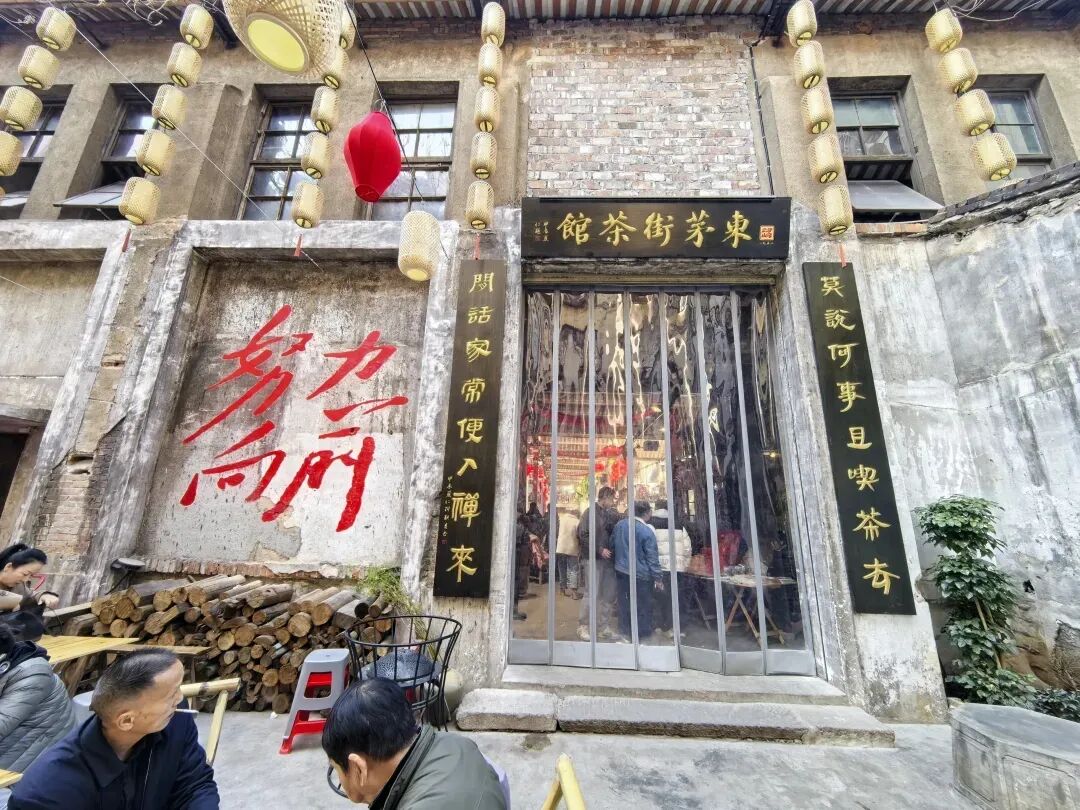
The Dongma Street Teahouse, which has become popular in the past two years, is a place for local residents to drink tea and have breakfast in the early morning, and is crowded with young people coming to check in in the afternoon and at night, with a peak daily passenger flow of more than 15,000 person-times;
After the bathing industry was transformed into a micro-vacation complex integrating food, entertainment and leisure, it has been included in the category of "night economy" in the past two years, and the local authority even put forward the concept of "night wellness";
In the Internet cafe and billiard industries, Changsha's chain brands no longer highlight equipment and environment, but add emotional value and focus on service: network administrators and waiters will do anime-style makeup or wear two-dimensional style costumes at work.
Bars are the new breakout category in Changsha in the past two years. Since 2023, in the minds of young tourists, the new "5A-level scenic spot" in Changsha is the bar "Hib Hub Commune" located on Jiefang West Road. People do not go there for creative cocktails, but to watch a boy group dance performance with friends. Homebars, which only emerged in first-tier cities such as Beijing and Shanghai in the past two years, have sprung up rapidly in Changsha with more than 100 stores at the same time.
All of the above can be classified into the field of "service consumption" as we mentioned. The essence of service consumption is to buy time, experience, emotion and scene, rather than physical goods. In the past few years, the efforts of various regions to develop cultural tourism are also one of the forms to expand service consumption.
Macroscopically, service consumption has become an increasingly important source driving consumption. According to data from the National Bureau of Statistics, in the first half of 2026, the total retail sales of consumer goods and services increased by 2.7% year on year, of which the retail sales of services increased by 5.3%, and the retail sales of physical goods only increased by 1.1%; in mid-July, the State Council approved the "15th Five-Year Plan for Expanding Consumption", placing service consumption at the core of expanding consumption. The public's consumption habits are shifting from buying physical goods to buying services.
However, expanding the scale of service consumption cannot be achieved simply by issuing consumption vouchers. Fundamentally, it requires a change in the city's development thinking: shifting from the model driven by investment attraction, land selling and building construction to a consumption-driven model.
The value of Changsha lies not in providing the most cutting-edge service consumption trends — in terms of the scale of service consumption, it cannot compare with first-tier cities — but in verifying the possibility of another operation mode. The vast majority of second- and third-tier cities in China neither have the resources and policies of Beijing, Shanghai and Guangzhou, nor have they caught the time window to become industrial hubs. How Changsha activates service consumption is of more reference significance for them.
Extensive Micro-innovation
Back to the examples at the beginning: teahouses, bathing, Internet cafes, billiards, bars, these unrelated old businesses that have hardly changed for decades have basically been dismantled and reorganized one by one by Changsha entrepreneurs in the past two years.
These transformations have two characteristics: first, they are extensive enough; second, they do not pursue subversion — the old shell remains, but the internal operation logic is replaced, thus revitalizing the old business form.
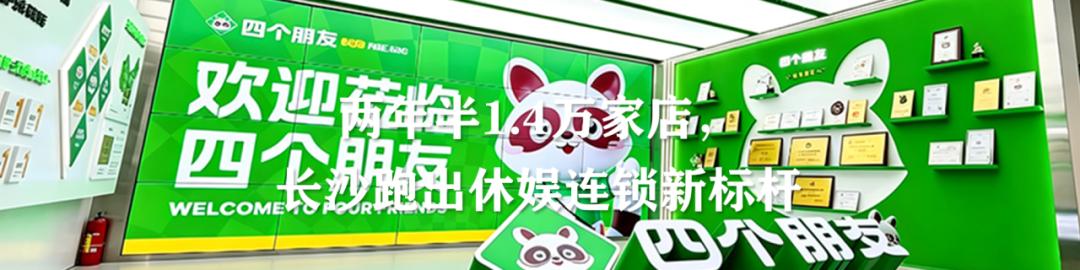
The 24-hour self-service chess and card brand "Four Friends" that we have communicated with before was born in Changsha — in May 2025, it announced that the number of its stores exceeded 10,000, becoming the first 10,000-store brand in the self-service chess and card track. This is a typical innovation of old business forms: traditional mahjong parlors are highly dependent on manpower and regular customer relationships, and it is difficult for them to expand beyond the regular customer circle of the owner. Four Friends dismantled this logic, reduced the number of waiters, adopted functions such as scanning codes to open doors, self-service timing and remote operation and maintenance to assist manpower, and turned it into a store model that can be standardized and replicated.
Dongma Street Teahouse is not a chain store, but it also follows a similar transformation path. Traditional teahouses have no more than two operation modes: either high-end business-oriented, or old-style community teahouses whose customer groups are only the elderly. Dongma Street retains the style and affordable price of old teahouses, and reorganizes the operation logic — its founder Jian Ming once said that teahouses represent the "early rising culture". Tourists cannot get up early, so it first serves the middle-aged and elderly people in the surrounding old communities who come to have breakfast, drink tea and listen to operas, consolidates the daily market life, and then young people come following the taste of "old Changsha", forming a unique phenomenon of "young people and the elderly sharing a table to drink tea". Jian Ming also once managed Super Wenheyou, which is a continuation of this model.
The update logic of other business forms is similar: by integrating food, drink and entertainment, bathing has changed from "taking a bath" to a micro-vacation; Internet cafes and billiards rooms have shifted from competing for equipment to competing for emotional value; bars have shifted from competing for cocktail mixing to competing for content and social interaction.
Moreover, the transformation does not only happen to leading brands. From large stores to small shops, being good at micro-innovation has almost become a common trait of Changsha entrepreneurs.
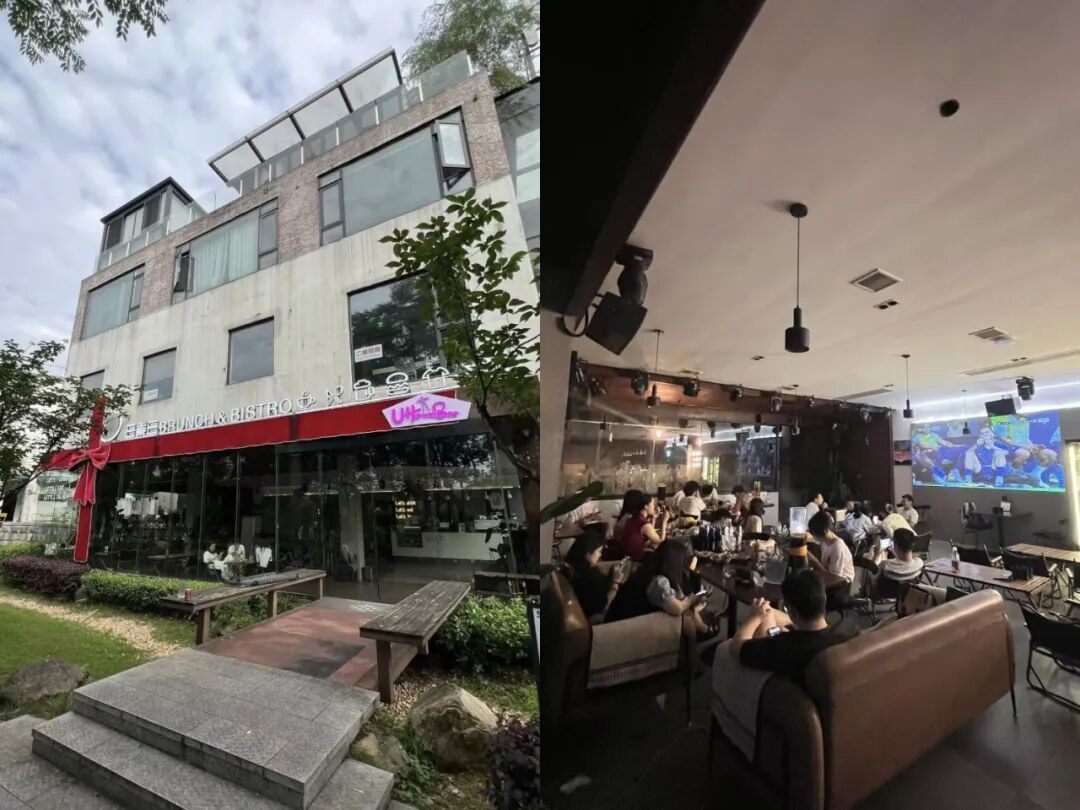
U HomeBar is one of the few chain homebars in Changsha, focusing on stranger socialization. Relying on the model of "unlimited cocktails + operation activities", it has opened 5 stores in Changsha and 15 stores nationwide in two years. Zhang Qiwei, the founder, told us that the bar itself has been iterating continuously in the past two years. One manifestation is that the proportion of unlimited cocktail revenue in the total revenue is decreasing — customers are increasingly not paying simply for "unlimited drinking".
Penghua, the head of the brand department of Four Friends, also mentioned that most of the brands that emerged in Changsha after 2023 are not completely innovative, but "re-cover traditional industries with more innovative thinking".
This idea did not emerge in the past two years. Ten years ago, the last round of Changsha's breakout brands, Cha Yan Yue Se and Wenheyou, adopted the same strategy — milk tea and food stalls are the most traditional business forms, but they bring new experiences to people.
This is exactly the most universal part of the Changsha model. It does not rely on special resources, nor does it require the city to have irreplaceable endowments, but continuously adds emotion and experience to traditional business forms to make micro-innovations.
Prioritize Serving Local Residents Rather Than Tourists
The question is, why can this kind of micro-innovation occur widely and continuously in Changsha?
A special factor driving continuous micro-innovation — which also distinguishes Changsha from other internet-famous cities — is that its service consumption first serves local residents, rather than being specially designed for tourists. Many cities become popular driven by tourists, and their popularity fluctuates with the flow of passengers, but Changsha's service consumption is first rooted in the daily life of local residents.
At the end of last month, "TX Changsha", an exhibition-oriented commercial space transformed from the established shopping mall Lehe City, opened in the Wuyi Business District. One detail is that it postponed the usual closing time of 22:00 to 23:00. Similarly, the daily business hours of "Snack Kingdom" launched by Mingming Henmang last from early morning to late at night; an entrepreneur who runs a perler bead shop in the Wuyi Business District also observed that half of the perler bead shops in the office building where she is located adopt a 24-hour operation mode — which is rare in other cities.
Extending business hours adapts to Changsha people's famous "love for staying up late", which is the work and rest habit of local residents, rather than the movement path of tourists.
Then look at the bathing industry. Experiencing bathing has long been a standard activity for foreign tourists visiting Changsha, but in fact, it is first the daily life of Changsha people — among the customer groups of local bathing brand Yierkang, foreign tourists only account for 25%. Last century, one of the classic works of the famous cross-talk pair Qi Zhi and Da Bing was named "Foot Bath City".
The reason why merchants dare to meet the needs of local residents first is that Changsha's local consumer demand is strong enough to form a local "demand-supply" iteration cycle.
This prosperity comes from several interrelated historical conditions.
First, Changsha people are inherently fond of consumption and life. "After opening the bar, I have hardly ever met Changsha people in their twenties around me whose families do not allocate a suite to them." Zhang Qiwei, the founder of U HomeBar, shared his insight with us. In his view, the life pressure of young people in Changsha is generally not high, coupled with their inherent characteristics of daring to consume and loving consumption, "There is a word in Changsha called 'delicate poverty'. Even if you only have 100 yuan in your pocket, you have to have fun and spend it on entertainment." This is also the reason why U HomeBar, a new social space focusing on stranger socialization and relying on organizing activities to survive, can quickly become popular in Changsha.
Second, low housing prices allow Changsha people to "consume freely". Changsha, whose GDP volume ranks high among the six provincial capitals in central China, has kept its housing prices at the bottom for many years. Even in 2021, when the national property market was the hottest, the average housing price in Changsha was only more than 9,700 yuan per square meter; by 2025, according to the 100-city price data from the China Index Academy, the average price of new houses in Changsha is still only 9,691 yuan — calculated by the per capita disposable income of local residents, it only takes 1.8 months to save enough money for one square meter, which is one of the few provincial capitals with data that takes less than two months.
U HomeBar
The direct result of low housing prices is that consumers have more money available for consumption. According to the 2025 Changsha National Economic and Social Development Statistical Bulletin, in 2025, the per capita consumption of urban residents in Changsha on education, culture and entertainment was 10,497 yuan, while the housing expenditure was only 7,953 yuan — people spend more on "entertainment" than on "housing".
And as mentioned above, this cycle has spread from physical goods consumption to service consumption.
The other side of this small cycle is forcing merchants to roll out better products, prices and services.
A Changsha consumer industry practitioner told us: In Changsha, it is common for a batch of brands to be replaced every three months. Zhang Qiwei counted that 150-180 homebars sprung up rapidly in Changsha in the past two years, and only two brands survived in the end.
Changsha people use the local dialect to describe this kind of competition — "qi bud de zi", which means "I can make no money myself, but I can't stand seeing you make money". Competition forces entrepreneurs to continuously improve their products, models and expressions, and attach great importance to user experience — right after the May Day holiday this year, Zhang Qiwei visited 10 bars of peers in two days to learn from them.
An interesting phenomenon is that many consumer entrepreneurs in Changsha come from Hunan TV, such as Li Weisheng, the founder of Xiaoma Comedy, and Liu Zhuoran, the founder of escape room brand Mr. Question Mark. After the genes of the "TV Hunan Army" spill over to the "Entrepreneur Hunan Army", it raises the overall level of content and operation in the whole market.
Therefore, the brands born in Changsha have experienced rounds of "life-and-death tests" since their birth — which is also why foreign brands that want to enter Changsha have to open a store first in the Wuyi Business District, the must-contend place, to compete with local brands.
Because of this, Changsha has become a source that continuously exports consumption models to the whole country: ten years ago they were Cha Yan Yue Se and Wenheyou, and now they are Four Friends, Dongma Street and a number of homebars.
Changsha Represents the Greatest Common Divisor
At this point, the service consumption chain of Changsha is basically clear: low-cost, high-frequency iterative living facilities plus low housing prices attract young people, the change of population structure gives rise to stronger demand, low entrepreneurial cost allows rapid response of supply, competition forces iteration, and the overflow of supply attracts more people.
Economist Edward Glaeser once wrote in his 2001 paper "Consumer City": The prosperity of the life service industry essentially depends on whether the city can continuously gather "people" and "activities".
Changsha happens to be one of the cities that are best at "gathering people" in the past ten years: its permanent resident population has increased by about 3.3 million in ten years, 80% of whom are young groups; in 2025, when the natural population growth rate has turned negative, it still saw a net increase of 104,900, ranking fourth in China, and it is the only city in central China that enters the top ten of population increment. What attracts them is not so much more employment opportunities or better climate, but the living experience: low housing prices, low pressure, and "fun".
Pan Pan, former managing partner of Tencent Tiantu Capital VC Fund and current head of brand strategy of Cha Yan Yue Se, once said that "Changsha represents the greatest common divisor in China's urban development". The overall per capita income and consumption level of Changsha represent the largest consumer group in China: the general public class who has stable income and consumption desire, and is also sensitive to price.
This makes Changsha's consumption-driven model universal — in 2021, the Ministry of Commerce established the first batch of 5 international consumption center cities. Beijing, Shanghai, Guangzhou, Tianjin and Chongqing took the "large and comprehensive" high-end and international route; Changsha, which is not on the list, explored a differentiated positioning on its own, and became the innovation source of new consumer brands in China. In the "2035 Master Plan" recently approved by the State Council, Changsha's functional positioning is "central modern service industry center".
Of course, the Changsha sample is not without thresholds.