Luo Yonghao launched a scathing attack on TV manufacturers, and Hisense, Skyworth and other related enterprises have all responded.
After launching a "curse-style" tirade against TV manufacturers, Luo Yonghao, the first-generation controversial internet celebrity, has received what is likely the only overwhelming wave of public support in his life so far!
Behind this rare full-network endorsement for Luo Yonghao lies a harsh truth: netizens (and their elders) have long suffered from the annoying, convoluted operations of modern TVs!
Why Did Luo Yonghao's Outburst Strike a Chord With the Public?
On the evening of July 25 (last Saturday), Luo Yonghao, in a rare moment of intense emotion and sharp wording, vented his strong dissatisfaction with TV manufacturers. His social media post included remarks such as "the 'Elderly Mode' made by idiotic product managers" and "it's obviously too harsh to say that TV product managers will go to hell after death, but they really don't deserve to go to heaven."
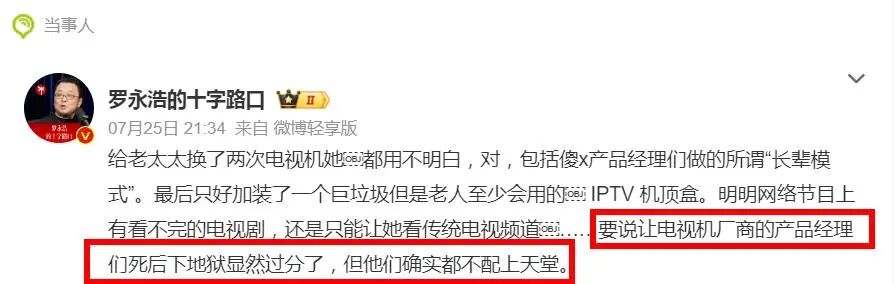
True to expectations, this Weibo post caused a huge stir, drawing widespread attention and heated discussions from media outlets, influencers, and ordinary netizens. The next morning (July 26), the related topic shot straight to the top of the trending search list. Among the massive support group were even former well-known anti-Luo influencers, and even Wang Ziru, who once had a legendary public showdown with Luo Yonghao on Youku, came out to back him up...
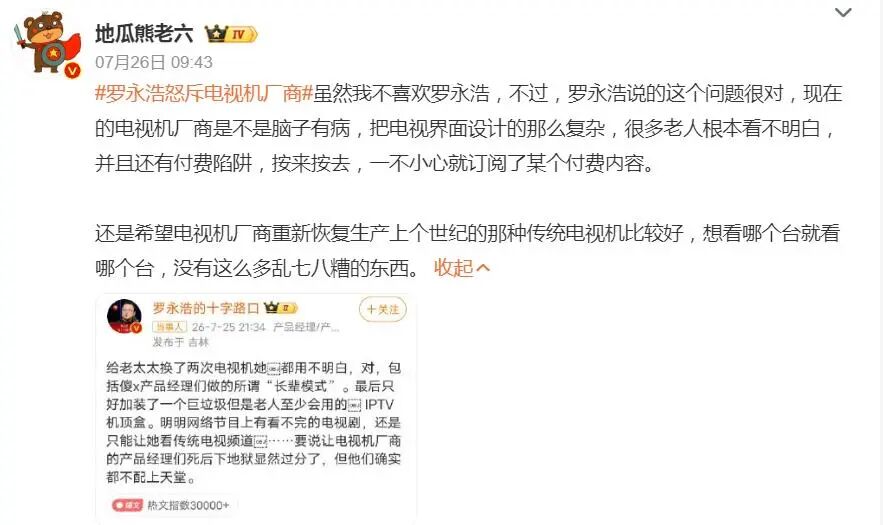
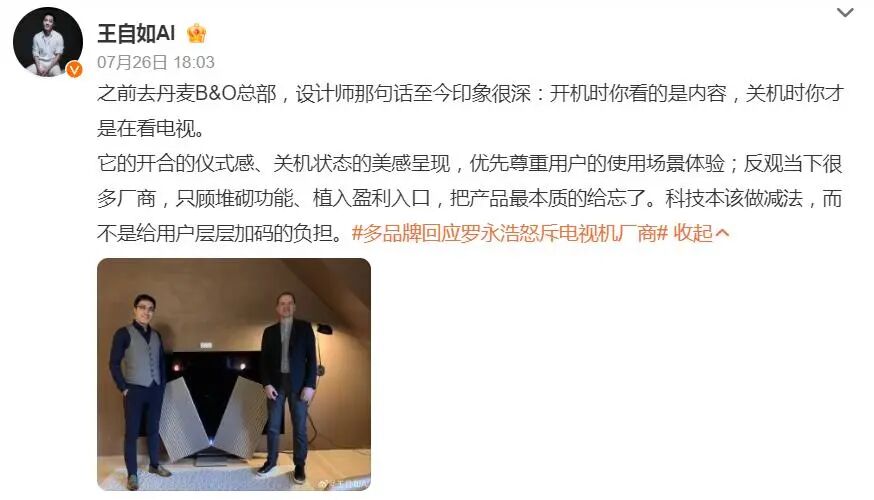
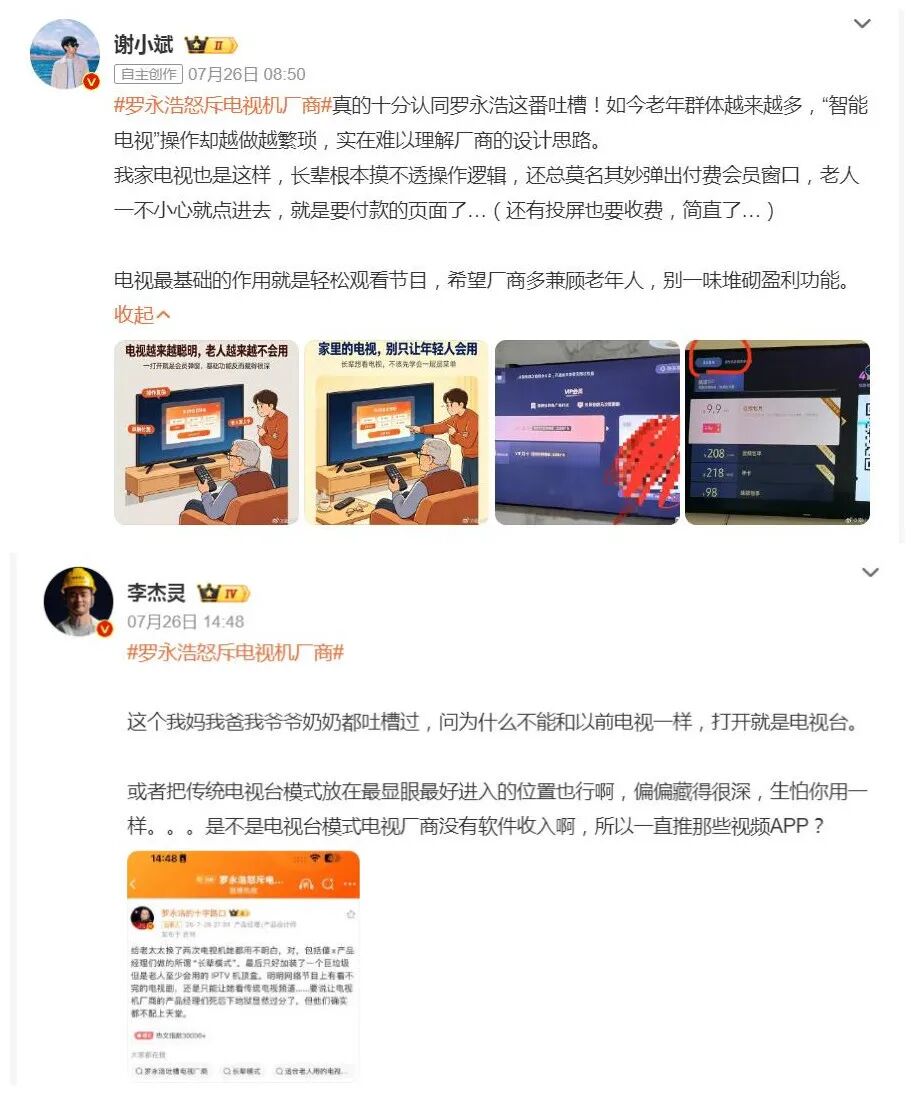
Aside from influencers competing to air their grievances, countless ordinary netizens across major online platforms actively left comments to express their support for Luo Yonghao and their deep frustration with the tricky, anti-user operations of TV manufacturers (as they see them). Due to space limitations, the author only selects a portion of netizens' voices to showcase: it is less that they are backing Luo Yonghao specifically, and more that they are supporting a public figure who dares to speak up for users!
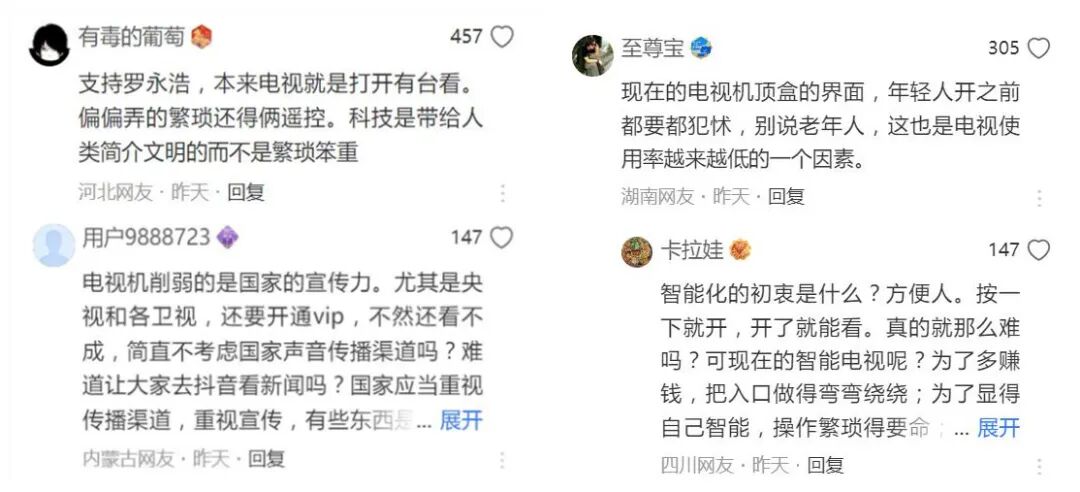
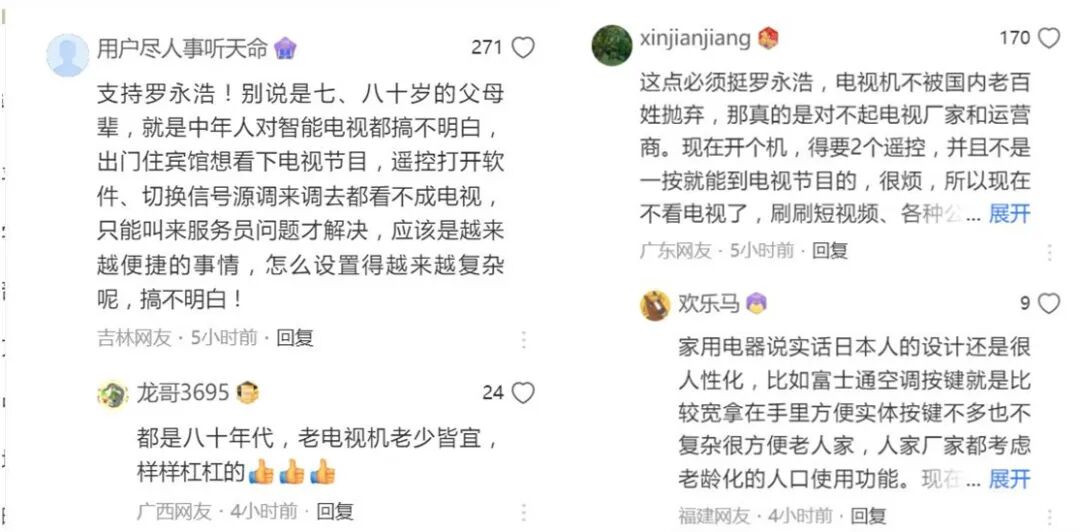
In addition, more than 60 media outlets including Red Star News, Shanghai Observer, China Blue News, and Phoenix Network have followed up with reports. It is no exaggeration to say that Luo Yonghao's tirade has escalated from an influencer's rant to a widespread public issue.
Veteran industrial economy observer Liang Zhenpeng pointed out bluntly that the "Elderly Mode" offered by most TV manufacturers today only makes superficial adjustments like enlarging fonts and changing interface skins. The nested menus in the underlying operating system remain complicated, and the operation logic has not been fully simplified. Elderly users still have to rummage through multiple layers of settings repeatedly to find the live TV entry. This mode is nothing more than a superficial makeover, a typical fake age-friendly design.
On July 26, Red Star Capital Bureau consulted customer service teams of multiple brands including Xiaomi, Huawei, Hisense, Skyworth, Changhong, and learned that most current smart TVs support "Elderly Mode" or "Simple Mode". In this mode, the overall interface is relatively streamlined, but to directly access the regular live TV broadcast interface after booting requires separate manual setup, and remote control functionality is not yet supported.
Reporters from Qianjiang Channel also obtained more detailed responses from customer service teams of TV manufacturers such as Hisense and Skyworth, as follows:
Hisense TV customer service responded that the Elderly Mode on Hisense TVs can be enabled via "All Settings - AI Options" or by long-pressing the up key to access the corresponding page. After enabling, the home page interface is simpler than the standard mode, but this mode only optimizes home page operations: you can directly open online film and television content on the home page, while watching cable TV live broadcasts still requires manually switching the signal source, a step that cannot be omitted...
Skyworth TV customer service responded that the Elderly Mode is not standard on all Skyworth TVs, only supported by certain models. Moreover, this mode can only simplify the TV home page operation interface, and cannot change the core step of manually switching signal sources on smart TVs... Even with Elderly Mode enabled, elderly users still have to complete the switching manually...
...
After sorting out and analyzing all this, the core reason why Luo Yonghao's angry denunciation of TV manufacturers received such unanimous support is that it is based on real facts, directly targeting user pain points (especially for the elderly group), which is why media, influencers, and netizens all stand on his side.
Secondly, what Luo Yonghao ranted about is actually a long-standing "chronic illness" in the industry. Because it has not been effectively resolved for a long time, this dissatisfaction has accumulated like a festering grudge. Taking advantage of Luo Yonghao's outburst, all the pent-up frustration of consumers erupted completely.
We previously detailed the many flaws that make TVs unsellable in our article *Facing an Epic Winter! Why Are Domestic TVs Not Selling Well?*, including but not limited to the plummeting TV activation rate corresponding to the ever-increasing complexity of operation logic. Even more frustrating for users than the convoluted operations are the endless advertisements and nested "matryoshka-style" VIP payment traps...
However, analyzing problems, pointing them out, and taking a stance is easy (though for a public figure, speaking out with such intensity is still quite rare). So why is it so hard to achieve fundamental change? Will Luo Yonghao's outburst this time prompt the TV industry to rein in its long-standing bad practices?
In a Downward Industry Cycle, Sincerity in User Experience Matters Even More!
On July 26, while continuing to rant against TV manufacturers, Luo Yonghao also lashed out at scam apps targeting the elderly. He said bluntly, "...Because TV manufacturers make such garbage products, they have actually created business opportunities for scammers who specifically prey on elderly people. I take back my previous statement: I think the people who make TVs and the people who make scam apps for the elderly will go to hell together."
Similarly, although this almost "curse-style" rant uses sharp wording, it did not arouse any resentment from netizens. Moreover, since Luo Yonghao once founded Smartisan Technology and has always been proud to call himself a product manager, he not only criticized the problems but also proposed solutions.
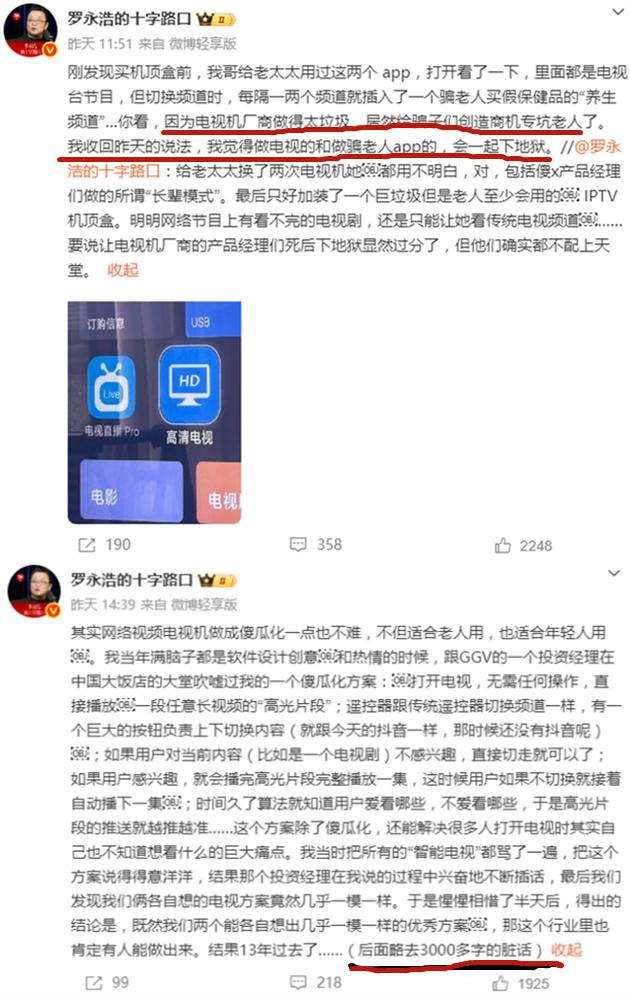
In Luo Yonghao's view, the foolproof, user-friendly solution he promoted back then is essentially the same as the interest recommendation mechanism of Toutiao/Douyin this year: that is, using algorithms combined with simple operations on the user's remote control to identify the user's content preferences. This design is friendly to the elderly group, and also solves the pain point that many people do not know what to watch after turning on the TV.
However, pain points such as cumbersome signal source switching, excessive boot-up advertisements, and various VIP payment traps in sub-sections are not entirely the fault of hardware manufacturers (TV OEMs). In other words, the one-size-fits-all, foolproof operation that Luo Yonghao envisions is not realistic.
For example, mainstream video streaming platforms such as Youku, iQiyi, and Tencent Video need to partner with licensed operators to set up joint ventures and launch exclusive TV applications to broadcast content on TV terminals, so as to meet the regulatory licensing requirements. Obtaining such licenses means these platforms have to bear much higher operating costs, so their mobile apps generally cannot be used directly on TV (if they were, the huge operating costs would be impossible to amortize).
As 21ic Electronics summarizes, from the moment a TV is turned on to the moment a program plays, there are multiple intermediate links: license holders, broadcast control platforms, and content applications. The parts that hardware manufacturers can control are limited, and the complexity of smart TVs is the inevitable price to pay for their expanded capabilities.
This is very easy to understand: why was the first-generation Doubao assistant phone that became a hit last year besieged by a coalition of App giants? And why do those App giants have to cater to the demands of mobile phone giants? Fundamentally, it is all due to the power game driven by the interests of different ecological niches.
Another example: recently the AI Agent concept has exploded in popularity. At the just-concluded WAIC, many manufacturers rushed to release the world's first Agentic smartphone, but at the same time we noticed an important signal.
On July 15, the national regulatory authority publicized the first batch of generative AI filing lists for mobile end-side devices. Seven mainstream mobile phone manufacturers all obtained compliance licenses: Apple Intelligence, Huawei Xiaoyi AI Large Model, OPPO AndesGPT, vivo Blueheart End-side Large Model, Xiaomi Surge AI, Samsung Galaxy AI, and Nubia Doubao Mobile Large Model.
This is the first time China has released a dedicated filing list for end-side generative AI on mobile phones, whose significance goes far beyond a simple qualification certificate. In short: in the future, to launch system-level local AI capabilities on Chinese domestic smartphones, filing must be completed first. No license means no commercial operation. For AI giants without independent licenses, the only way to implement AI capabilities on mobile terminals is to partner with these mobile phone giants (for example, ByteDance's Doubao cooperates with ZTE).
It is worth mentioning that to thoroughly implement the National Radio and Television Administration's work plan to solve the problem of complicated TV operations and improve users' TV viewing experience, on August 28, 2025, the Academy of Broadcasting Planning officially released the *Certification Scheme for Easy TV Viewing Products*. This initiative is an important measure to improve the user experience of convenient TV use.

Picture above: "Easy TV Viewing" certification mark
According to statistics, as of the end of June 2026, there are about 8 to 10 TV models that have obtained the "Easy TV Viewing" certification, mainly covering brands such as Konka, Huawei, Hisense, TCL, and Skyworth. However, this certification is not mandatory, nor has it formed sufficient public awareness among consumers, so the proportion of TVs currently on sale that meet the standards is very low.
If in the future, this certification has the potential to become a "new national standard" for the TV industry, it will fundamentally benefit the age-friendly design of smart TVs, and those cumbersome operations and annoying ads may be greatly reduced. But before substantial policy support is introduced, all of this is just wishful thinking.
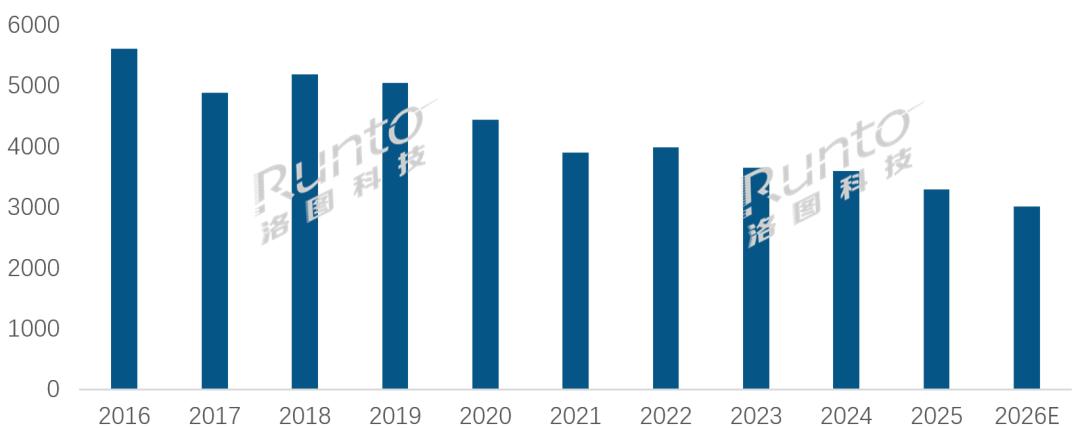
According to the latest data from RUNTO's *China TV Market Brand Sell-in Monthly Tracker*, in the first half of 2026, the total shipment volume of branded complete TV sets in China's mainland market reached 14.947 million units, down 10.1% year-on-year compared with the same period in 2025.
In the first half of 2026, the total shipment volume of the top 8 brands in the Chinese TV market — Hisense, TCL, Xiaomi, Skyworth, Changhong, Haier, Konka, and Huawei (including its sub-brands) — reached approximately 14.26 million units, accounting for 95.4% of the entire market, an increase of about 1.9 percentage points compared to the same period in 2025.
The RUNTO report also shows that as the World Cup officially concluded this month, the home appliance sales boom driven by sports events is coming to an end, and the overall sales pressure on the TV market is likely to continue.
Combined with the new retail market monitoring data for China's home appliance market in June recently released by Ove Cloud, the sales revenue of China's color TV market that month fell by 19.1% year-on-year, but the overall average selling price of new retail channels increased by 8.9% year-on-year.
The *2025 White Paper on the Development of China's Household Smart Large Screen Industry* released by Gouzheng Technology in April 2026 shows that the number of smart TV terminals has reached 439 million units, covering 70% of Chinese households, with daily average viewing time exceeding 5.6 hours.
Multiple sets of data seem to depict a portrait of the TV industry where challenges and opportunities coexist:
Even if the industry is in a downward cycle, the group of people who watch TV remains huge. Similar to the smartphone industry, the overall market shipment volume is declining, but the overall ASP (Average Selling Price) keeps rising (which is conducive to gross margin optimization). In other words, whether it is TV OEMs, license holders, or broadcast control platforms... the entire TV industry ecosystem still represents a huge market cake!
All players in the industry are well aware of the core pain points that currently affect TV activation rates and even purchase rates. How to balance short-term commercial interests and long-term healthy development?
We will just have to wait and see how things unfold!
References:
Facing an Epic Winter! Why Are Domestic TVs Not Selling Well? - Huxiu
Luo Yonghao Is Furious: TV Product Managers Don't Deserve to Go to Heaven? - Phoenix Network
Luo Yonghao Lashes Out! TV Manufacturers Are Being Unfairly Targeted? - 21ic Electronics
Multiple Brands Respond to Luo Yonghao's Denunciation of TV Manufacturers - Qianjiang Channel