Alibaba may launch a standalone APP named "Xiangzao", as 1688 competes in the 100-billion-yuan commodity customization market.
Exclusive learned that Alibaba 1688 is currently promoting "XiangZao", an AI Agent product for C-end users' custom merchandise, which is currently embedded in the main 1688 platform. Users can complete the full-link operations independently through AI, including design creation, finished product preview, quotation acquisition, and one-click order placement. After the order is generated, the system will automatically distribute it to the production line for processing through AI intelligent parsing, based on core factors such as the factory's production materials, processes, and die-cutting plates, without requiring secondary processing by the factory. This significantly improves production efficiency while effectively reducing production costs. In addition, Exclusive has learned that XiangZao may launch an independent APP later.
In simple terms, the core logic of XiangZao is: Users put forward product ideas in natural language, the AI Agent takes over the complete requirements, and independently completes creative generation, solution screening, intelligent quotation, factory matching, proofing scheduling, and order fulfillment follow-up, greatly cutting down the labor cost of repeated communication between purchasers and factories.
What is XiangZao?
Open the XiangZao page through 1688, and the homepage slogan directly points out its positioning: XiangZao, your AI custom assistant. The biggest difference from 1688's past custom tools is that it places natural language interaction at the core. Users do not need to understand design or master printing process knowledge. They can generate physical renderings by directly entering text requirements.
In terms of the usage process, users can input text to describe their requirements, or upload existing brand logos and reference images; merchants with offline stores can also enter their store names, and the AI will directly generate a complete set of supporting packaging materials for the store. After selecting the substrate template, the system quickly renders a 3D physical preview, and at the same time directly provides the quotation from the source factory. After completing the design, you can jump to place an order for production with one click.
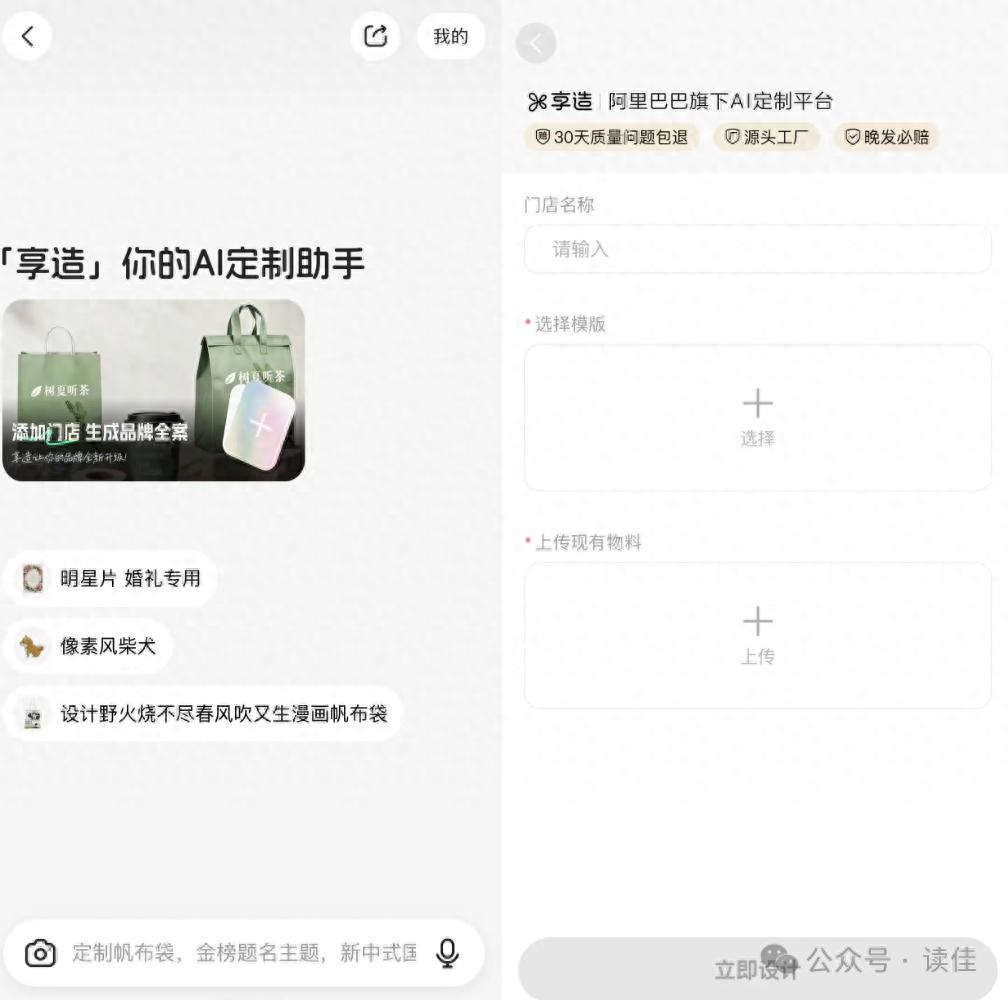
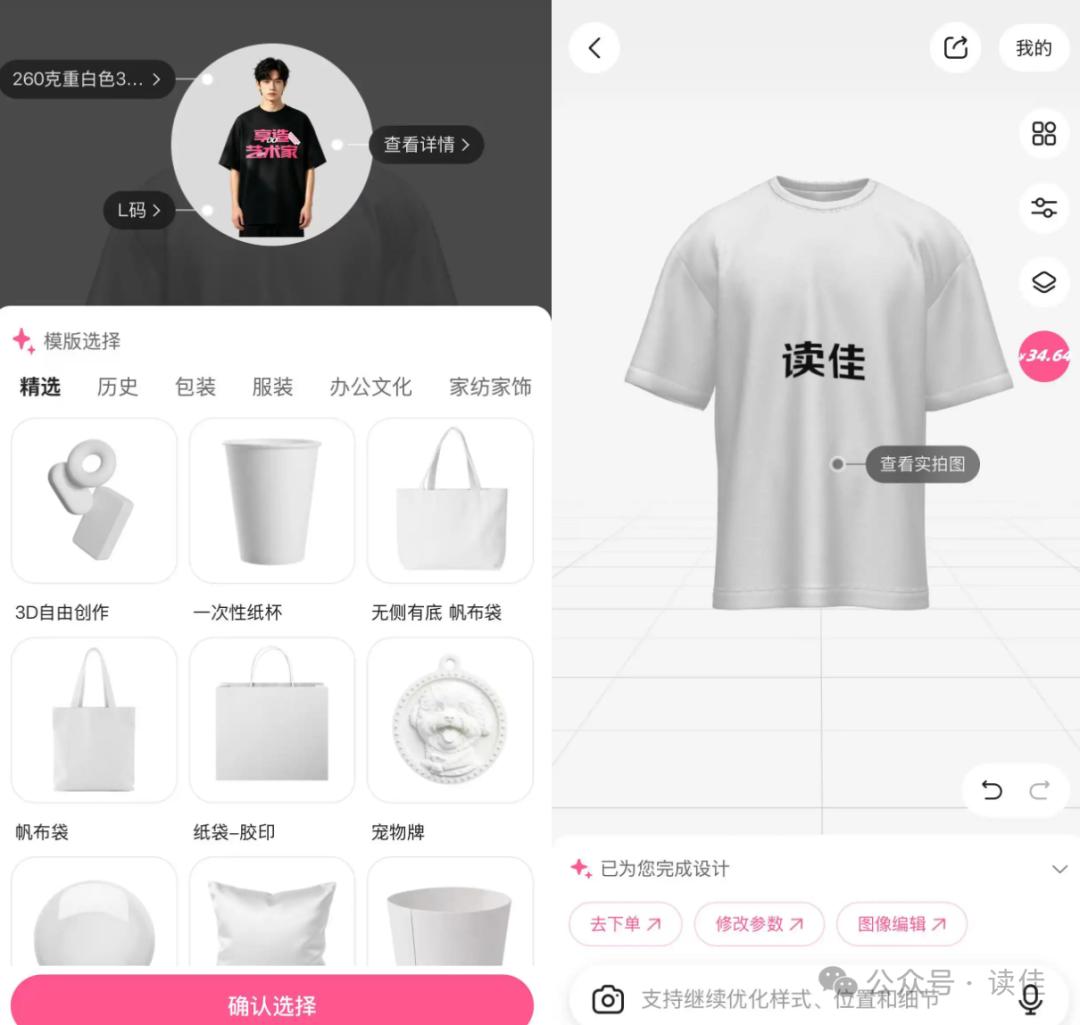
From the interface template library, it can be seen that the categories covered by XiangZao are very pragmatic at present: canvas bags, paper bags, T-shirts, disposable paper cups, throw pillows, pet nameplates, cultural and creative peripherals, covering mainstream needs such as tea shop materials, personal cultural creations, small corporate gifts, and IP peripherals. These categories share a common feature: standardized base materials are mature, and the threshold for flexible small-batch production is low.
Take a straightforward example. Enter the simple instruction "Customize a white T-shirt with the text 'Exclusive' printed on it", and a rendering will be generated within tens of seconds. The price of the single product will be displayed synchronously on the right side of the interface. Click the price to jump to the order page, fill in the size, address and other information, and pay for the order.
In addition, on the rendering interface, you can also adjust the fabric weight, size, and pattern position at any time. If you are not satisfied, you can continuously issue modification instructions and fine-tune the design details repeatedly, without needing to communicate with a designer throughout the process.
At present, XiangZao complements the upstream creative link, relying on the AI Agent to take over the design needs from scratch, targeting buyers who do not have design capabilities.
AI Empowers the Small Commodity Customization Market
For a long time, the small commodity customization industry has been stuck in several pain points.
In the traditional model, if a buyer wants to customize peripherals, they first need to find a designer to produce drawings, and then take the drawings to inquire with factories everywhere; most factories are averse to small orders of dozens or hundreds of pieces, communication goes back and forth, quotations are not transparent, and the cost of revising drafts is extremely high. A large number of Xiaohongshu and Douyin store owners, startup offline stores, and self-media bloggers generally have small-batch, high-frequency, and creatively diverse customization needs.
This may be exactly the market that XiangZao aims to capture.
However, XiangZao has no shortage of competitors. External competitors are divided into multiple tiers: vertical AI design SaaS tools such as Style3D and Kujiale focus on a single category, with digital collaboration capabilities for AI design and connecting design files to factories, but they do not undertake production and fulfillment through self-operation; e-commerce supporting tools such as the custom zones of Taofactory, Douyin, and Pinduoduo rely on their own traffic to meet the light customization needs of small and medium sellers...
Overall, most of the current players are limited to a single vertical track, or only cover a single design link. The market lacks a one-stop platform that can cover multiple industries and aggregate a large number of cross-category industrial belt factories, which is also the core differentiated opportunity for this 1688 product.
Moreover, the size of this personalized customization market should not be underestimated. A 2022 report from CCTV.com mentioned that the domestic custom clothing market has reached nearly 200 billion yuan. The track targeted by XiangZao is not limited to clothing. From packaging paper bags, canvas bags, cultural and creative cups, throw pillows, anime peripherals, to pet nameplates and office cultural materials, it covers multiple scenarios such as personal cultural creations, which is equivalent to incorporating the vast demand for small commodity customization beyond clothing into the system.
Of course, whether XiangZao can stand out in the future depends on how many resources Alibaba is willing to invest, as well as market competition and market acceptance.