The more prices fall and competition intensifies, the "Matthew Effect" in China's TV market has only just begun.
How long has it been since you last turned on your TV at home?
"When was the last time you turned on the TV at home?"
When you see this question, do you have to think back to figure out when you last powered on your television?
This question would have been almost unthinkable 10 years ago. Back then, watching TV was one of the main home entertainment activities for most people. Today, however, televisions have mostly become "art pieces" that decorate living rooms.
Data from Luo Tu Technology shows that in the first half of this year, the total shipment volume of TV brand sets in mainland China reached 14.947 million units, a year-on-year decline of 10.1%. The full-year shipment volume is expected to drop to 30.12 million units, hitting the lowest market size in 17 years since 2010.
In 2016, the annual shipment volume of the Chinese TV market reached a historical peak of 50.89 million units. Ten years later, the market size has shrunk by 40%.
But if we simply define the current TV industry with terms like "shrinking" or "declining", we might miss the true picture of this ongoing transformation.
"TMT Planet" observes that beneath the apparent continuous decline in TV shipments, drastic structural reshaping is taking place in the market. Consumers have not stopped buying TVs, but are reselecting televisions with a completely different logic.
During this year's 618 shopping festival, the average online retail price of TVs reached 3,568 yuan, up 121 yuan year-on-year, representing a 3.5% increase. Meanwhile, the average online screen size jumped to 66.4 inches, with products of 75 inches and above accounting for nearly half of total sales, and the sales growth rate of products around 100 inches reaching as high as 43.3%.
Sales volumes are falling, prices are rising, and screen sizes are getting bigger. This seemingly contradictory set of data reveals a clear trend: the TV industry is bidding farewell to the old logic of "winning by volume" and shifting to a new cycle of "pricing by quality".
A new landscape of "reduced quantity but increased value" with intensifying Matthew effect is taking shape at an accelerated pace.
Sales Have Declined for 5 Consecutive Quarters
The TV market in the first half of 2026 continued the downward momentum of previous years, but the speed and magnitude of the decline exceeded many people's expectations.
According to data released by Luo Tu Technology, the shipment volume of TV brand sets in mainland China in the first half of the year was 14.947 million units, down 10.1% year-on-year.
By quarter, the decline in the first quarter was 8.8%, which expanded to 11.6% in the second quarter. Calculated from the second quarter of 2025, this marks five consecutive quarters of year-on-year shipment decline.
This continuous contraction is not an unexpected event, but the cumulative result of a long-term trend. China's TV market has long fully entered the era of stock replacement.
The ownership of large household screens has become saturated, the supporting demand for new homes continues to weaken, consumers' replacement cycles are getting longer, product power-on rates remain at a low level for a long time, and coupled with the increasingly conservative consumer sentiment, the overall industry under pressure has become a medium- and long-term norm.
Especially after 2016, market shipments have fallen year by year, dropping from a high of over 50 million units to the current level of around 30 million units.
Against the backdrop of overall industry pressure, the differentiation between brands has become increasingly obvious.
The three traditional leading players, Hisense, TCL, and Skyworth, have demonstrated stronger resilience to pressure. In the first half of the year, the total shipments of the three major brands and their sub-brands reached about 9.22 million units, with a year-on-year decline of only 4.3%, far better than the industry-wide 10.1% drop, and their combined market share remained stable at 61.7%.
Xiaomi, relying on the channel advantages of REDMI in the online retail market, shipped over 2.6 million units in the first half of the year, with a market share of about 18%.
The gap has widened in the second tier of brands. Data shows that the shipments of Changhong, Haier, and Konka in the first half of this year all failed to exceed 1 million units, and the total shipments of the three companies amounted to about 2.02 million units, even lower than the shipment scale of any single brand in the first tier.
Among the eight major brands, only Skyworth and Changhong maintained roughly the same shipment volume as the same period last year, while the rest of the brands experienced declines of varying degrees.
Compared with domestic TV brands, foreign brands are in a more difficult situation. Among them, Samsung officially withdrew from the Chinese market in May this year, and the presence of the three major foreign brands, Sony, Philips, and Sharp, continues to weaken.
The total shipments of the four aforementioned foreign brands in the Chinese market in the first half of this year were less than 500,000 units, with a year-on-year decline of over 20%, and their combined market share is less than 4%.
From these changing data, we can clearly see the profound transformation taking place in China's TV industry:
The overall market is contracting, the Matthew effect is intensifying, the market share of leading brands is expanding, industry concentration is further increasing, and the living space for small and medium-sized TV brands is being further compressed.
Luo Tu Technology predicts that the total shipment volume of China's TV market for the whole year will reach 30.12 million units, down 8.4% year-on-year, which will hit the lowest market scale since 2010.
The annual shipment threshold of 30 million units has become the bottom line that the industry is struggling to hold on to.
As Sales Decline, the Industry Is Competing More Fiercely in the High-End Segment
Against the backdrop of continuous decline in TV market sales, mainstream brands have accelerated their pace of entering the high-end market to cope with changing market trends.
In the first half of 2026, all major brands completed the layout of their new generation of flagship products, trying to avoid price cutthroat competition through technological differentiation. Mini LED has become the core battlefield in this high-end competition.
"TMT Planet" notes that Hisense's multi-color backlight RGB-Mini LED and TCL's super quantum dot SQD-Mini LED, the two leading enterprises, almost simultaneously shifted their entire flagship product lines to this technology route.
Hisense is deeply engaged in the laser display and RGB-Mini LED tracks, while TCL relies on quantum dot light control solutions to build a full-size high-end flagship matrix.
Skyworth has taken a different approach, laying out differentiated categories such as wallpaper TVs and art TVs, equipped with self-developed Chameleon AI chips to enhance audio-visual capabilities. Xiaomi, Changhong, Haier, and Konka are also continuously launching Mini LED products.
On the foreign brand side, LG Electronics has launched multiple cost-effective entry-level OLED TVs, lowering the consumption threshold of the OLED category; Samsung has adopted a more aggressive price tiering strategy.
In early June this year, the organizational structure construction of the TCL and Sony joint venture project was officially launched, and the new company is scheduled to start operations in April 2027. This cooperation is regarded by the industry as an important signal that Chinese brands are further penetrating the global high-end TV market.
Why are mainstream brands collectively "charging into" the high-end market when sales are declining? Behind this, there are both passive helplessness and active choices.
First of all, the market structure has undergone drastic changes. The model of simply relying on "small profits but quick turnover" is no longer sustainable. The price war in the low-end market has become white-hot, leaving very little profit margin. High-end products can not only significantly increase the unit price per customer, but also offset part of the pressure from declining sales.
In addition, after decades of development, mainstream domestic TV brands have accumulated profound technologies in high-end development, laying a foundation for launching high-end products.
Secondly, on the consumer side, consumers have not stopped buying TVs, but have put forward higher requirements for TV products. They are more willing to pay for better display effects, requiring TVs with higher picture quality, larger screens, and richer functions. This demand-side upgrade has provided a market foundation for TV brands to focus on the high-end segment.
Thirdly, in terms of technology, 2026 is regarded by the industry as the first year of commercialization for RGB-Mini LED technology. The maturity of the new generation of display technology has provided brands with a window of opportunity to redefine products and delineate price ranges.
According to forecasts from Omdia, China's Mini LED TV shipment volume is expected to reach 13.2 million units in 2026, with the penetration rate rising sharply from 27.5% in 2025 to 43.8%. Whoever seizes the initiative in this technological wave will gain a say in the future high-end market.
In addition, foreign brands such as Samsung are facing competition from domestic brands, and their market share is accelerating to lose. Their withdrawal from the market has further provided opportunities for domestic TV brands to enter the high-end segment.
At the same time, capturing the market share left by foreign brands is not only a way for mainstream domestic TV brands to dig deeper into the value of the stock market, but also an inevitable path for brand building.
What Users Want Is Not Just Clearer Picture Quality
For many users, there must be a TV in the living room. Even if they don't watch it, they have to have one, "otherwise the living room will feel empty".
There are also many users who turn on the TV even if no one is watching it, using it as a music player, a picture frame display device, and more.
This is a habit, a habit formed over many years. As a netizen put it: "A TV makes a home feel like home".

Figure / Xiaohongshu
This group of people forms a solid foundation of the TV market. They are not only willing to buy TVs, but even willing to spend more money on better ones.
In January this year, the research results released by the Jingdong Institute of Consumer and Industrial Development showed that 37.4% of households still maintain the habit of using TV frequently every day, and 79.4% of users have expressed clear purchase intentions. The functional scenarios of TV are becoming increasingly diverse, with an average of 2.7 usage scenarios per household, covering movie watching, live sports events, home fitness, game screen casting, and home education.
"TMT Planet" notes that with changing demands, users' needs for TVs are no longer limited to the single function of watching TV. Of course, this does not mean that picture quality and screen size are unimportant. On the contrary, many of users' demands are based on these basic conditions.
The above survey shows that the core factors affecting consumers' purchases mainly include picture quality, screen size, system fluency, and built-in free resources, while the price factor ranks last. TVs are still mainly for viewing, so it is beyond doubt that requirements for picture quality and screen size are top priorities.
According to data from AVC, in the first quarter of 2026, the share of small-screen entry-level products continued to decline, while the share of large-size products such as 98-inch and 100-inch TVs rose across the board, with a penetration rate far exceeding market expectations. More than 50% of consumers regard TVs larger than 85 inches as their "preferred large screen", and 24.1% set their sights on 100-inch TVs.
On this basis, users' TV usage scenarios have become more diverse, especially in gaming and event viewing, which have become important reasons for users to buy TVs.
According to the survey, 45.3% of console game players most often use TVs as display devices, a proportion much higher than that of monitors and projectors. Enhancing the experience of specific entertainment scenarios such as gaming and home theaters has become the core reason for young consumer groups to buy TVs in recent years.
Emotional value and home aesthetics are also becoming a new driving force for users to buy TVs. During the 2026 618 shopping festival, "emotional cost-performance ratio" surpassed the traditional cost-performance ratio and became the new core of users' home appliance selection. People are more willing to pay for emotional value, home atmosphere, and a sense of comfort.
Clearly, these changes have pointed out the direction for product iteration of domestic TV enterprises: on the basis of improving picture quality and screen size, they should add more intelligent and feature-rich products to attract users to buy.
In other words, give users more reasons to buy a TV.
In this process, we need to be wary of enriching features for the sake of enrichment, which deviates from users' real needs, and simply piling up technologies and functions to make products that could have been very simple overly complicated. This is pushing users away in a disguised form.
On social platforms, users can be seen from time to time complaining that TVs are getting more and more complicated, and they don't even know how to turn on a TV to watch content.
On July 26th, well-known internet figure Luo Yonghao posted an article denouncing the overly complicated product design of current TVs, which became a trending topic on social platforms and resonated with many netizens.
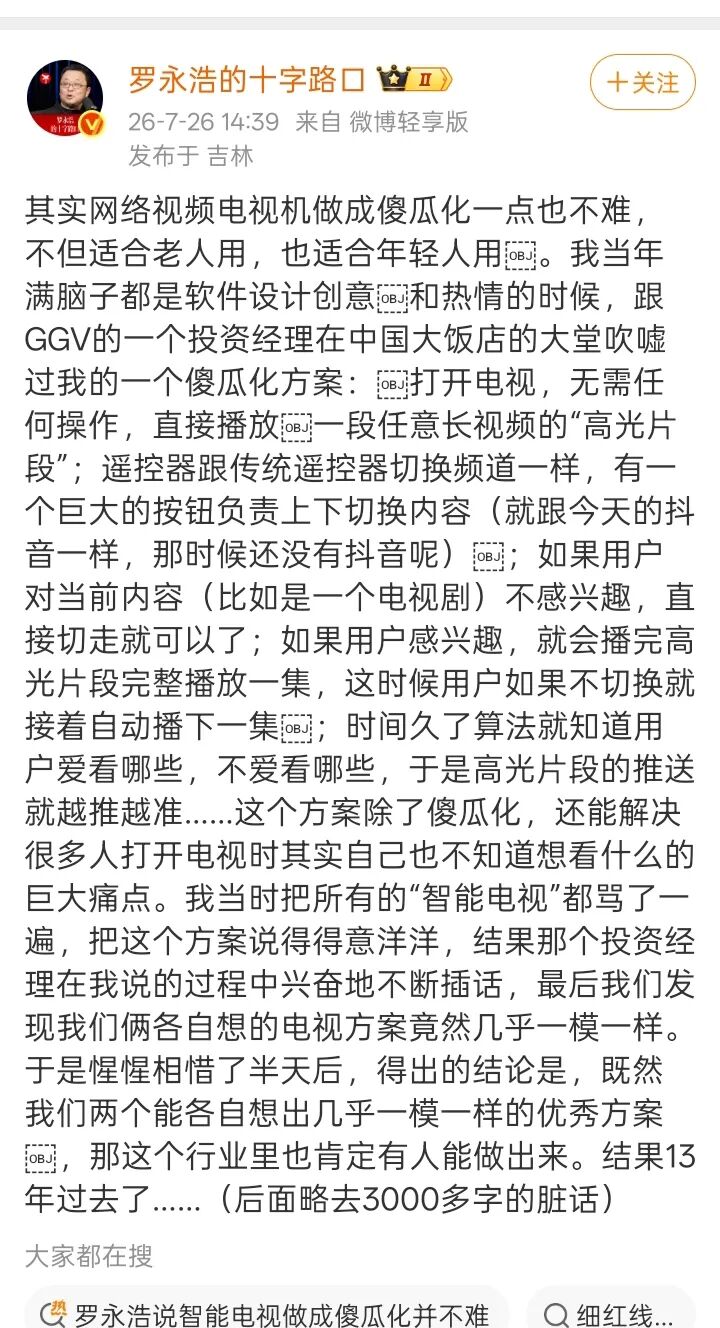
Figure / Weibo
Problems such as too many boot ads and long waiting times are the most dissatisfied points for consumers when using TVs. The system is complex and content is scattered, requiring users to jump repeatedly between multiple platforms to find the content they want.
For elderly users, TVs have complicated operations, complex systems, and poor content adaptability, resulting in extremely poor daily usage experience.
One netizen put it bluntly: "What people lack is not that screen, but a simple and user-respecting experience."
Conclusion
With shipments falling from 50 million units to 30 million units, behind the digital changes, China's TV industry is not just going through a simple recession, but a profound value restructuring.
For leading brands, this is a battle that must be won. High-end transformation is not only a way to achieve profitability, but also a required answer for brand survival.
In a stock game market, whoever can build high-end barriers in the three dimensions of technology, product, and brand will take the initiative in future competition.
For consumers, TV is not "dead". Instead, it needs to be redefined to prove that TV is no longer a mandatory "living room standard", but a carrier or platform that can bring users a variety of different experiences.
More importantly, in this changing process, what TV products need to improve is not only to be larger and clearer, but also to be smarter, more user-friendly, and as simple as turning on and watching.
This article is from the WeChat official account "TMT Planet", author Huang Yanhua, and published with authorization from 36Kr.