Three changes of the helmsman of Greentown, what kind of signal is this?
Last night, Greentown China suddenly announced a high-level personnel reshuffle: Liu Chengyun has stepped down as Chairman of the Board; Geng Zhongqiang has resigned as Acting Chief Executive Officer.
The new appointment names Zhao Hui as Chairman of the Board and Chief Executive Officer, while Jiang Feng is appointed as Executive Director and Executive President. The adjustments take effect immediately.
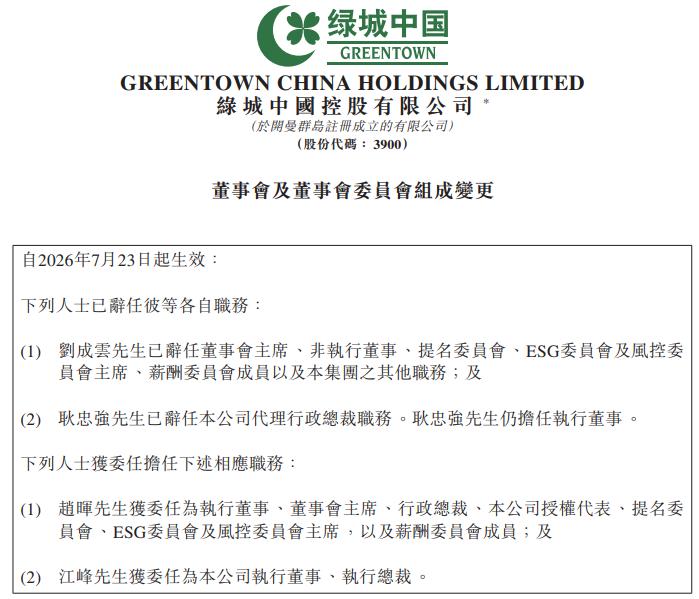
Since taking office in March 2025, Liu Chengyun has only been at the helm for 16 months. What is even more surprising is that from 2025 to 2026, Greentown has seen three top leaders change in just two years, from Zhang Yadong to Liu Chengyun, and now to Zhao Hui.
During the industry's bottoming-out phase, why has Greentown changed its top leader so frequently? Why did Liu Chengyun resign after only 16 months at the helm? In the upcoming industry reshuffle period, how will Zhao Hui reshape a new Greentown?
1. Review of Liu Chengyun's Tenure
A Qualified Transitional Steward, Unable to Break Through Operational Dilemmas
Liu Chengyun was previously a member of the Party Committee Standing Committee and Deputy General Manager of China Communications Construction Group (CCCC), and was a Non-Executive Director dispatched by the major shareholder. When he first took office, the market had already reached a consensus: he was a transitional leader whose core mission was to smoothly complete the management transition, straighten out corporate governance relationships, rather than lead in-depth operational reforms over the long term.
Looking objectively at this 16-month tenure, both achievements and shortcomings are prominent.
On the stability front, he delivered a qualified performance.
On the governance front, he accelerated the transition between old and new management teams, promoted the orderly exit of long-serving Greentown professional managers, reclaimed core authority over personnel and investment at the headquarters, and weakened the previous highly autonomous regional management model;
During Zhang Yadong's tenure, Greentown expanded aggressively across the country, growing its sales from 100 billion to 300 billion yuan, and the company developed a governance model characterized by "empowered professional managers". This left major shareholder CCCC in the awkward position of "holding controlling shares but not full operational control" — a situation it tacitly accepted. This contradiction could remain hidden during the industry's upward cycle, but as the market entered a downward phase and profits shrank to nearly zero, CCCC's demands for "risk control, investment strategy, and operational decision-making authority" over Greentown rose sharply. Liu Chengyun completed the initial transition for CCCC to move from "controlling shares without full authority" to "controlling both shares and authority", which represents a major breakthrough in corporate governance.
On the operational front, he recognized that the industry had entered a phase of "stock competition where quality prevails", emphasizing that "stability is more important than speed". As a result, Greentown maintained a solid sales base, with 2025 sales of 251.9 billion yuan keeping it firmly among the top players in the industry, and its product brand reputation remained strong.
On the financial front, he prioritized liquidity, continuously reduced interest-bearing liabilities, and optimized the debt structure, raising the cash-to-short-term-debt ratio to 2.6 times and lowering financing costs to 3.3%. Greentown never fell into the crisis zone that troubled many financially distressed real estate enterprises.
However, unavoidable fundamental flaws have always loomed large over the company.
Financial statements do not lie: Greentown's attributable net profit in 2023 was 3.09 billion yuan, which halved to 1.59 billion yuan in 2024, and plummeted to only 71 million yuan in 2025, a year-on-year collapse of 95.8%.
Industry insiders know that for listed real estate companies, single-digit net profit figures almost always come from financial window-dressing, and the underlying fundamentals are already loss-making. For a massive real estate enterprise like Greentown with annual sales exceeding 200 billion yuan, posting single-digit net profit is indeed a critical flaw.
Not only is there a profit crisis, but it is also difficult to resolve in the short term — Greentown's large inventory of high-cost land parcels acquired in earlier years is being recognized in accounts in concentrated fashion, combined with asset impairment provisions and sustained losses from joint venture projects, which are eroding profits heavily. Some argue that the root of the losses lies in historical legacy burdens from Greentown's aggressive high-price land acquisitions during the industry boom, which cannot be blamed on the new top leader. Others counter: over his full 16-month tenure, did he put forward a systematic solution that genuinely halted the downward trend in profitability?
A deeper constraint comes from the management structure.
Greentown has long adopted a dual governance model where "the chairman oversees strategy and the president manages operations". As a non-executive director, Liu Chengyun did not directly intervene in frontline daily operations, which created a natural gap in the transmission of strategic directives and operational execution, separating the strategic layer from the operational layer.
This structure could maintain stability, but could it deliver a full breakthrough in profitability and quickly strengthen the company? The answer is definitely no.
2
Three Underlying Rationales Behind the Sudden Top-Level Leadership Change
Many public opinions attribute this personnel change solely to performance pressure, which is a rather one-sided view.
Overall, this leadership adjustment at Greentown is a choice driven by the triple superposition of "industry cycle, shareholder demands, and governance contradictions".
Factor 1 Dramatic Shift in Shareholder Demands: From Financial Investment to Full Operational Control
Since taking a controlling stake in 2014, CCCC has long maintained a moderate holding model, leaving operations to a market-oriented team. During the industry's upward cycle, this model combined the credit advantages of a central state-owned enterprise with the flexibility of a market-oriented operation. In the downward cycle, priorities have completely reversed. Compared to sales rankings, the major shareholder now values real profitability, cash flow security, and closed-loop risk management far more.
Therefore, decentralizing authority in boom times and reclaiming control in downturns is a normal practice, but reclaiming authority is only a means. The core goal is still to ensure Greentown "earns healthy profits, maintains safe cash flow, and leads in industry competitiveness", which represents the new demand in the current era. The era of CCCC exercising comprehensive and in-depth control over Greentown has arrived.
Factor 2 Resolving Governance Contradictions: Merging the Roles of Chairman and CEO
In the brutal knockout phase of the real estate industry downturn, who can afford prolonged decision-making inefficiency? When market opportunities are fleeting, who can tolerate unnecessary internal friction and low corporate efficiency?
The biggest change in this reshuffle is that Zhao Hui now holds both the positions of Chairman of the Board and Chief Executive Officer, breaking Greentown's nearly 20-year convention of separating the two roles.
After 2026, Greentown's strategic decision-making and daily operational authority will be consolidated in one person, significantly shortening the decision-making chain. In the past, the strategic and operational lines were often out of sync; now the major shareholder's strategic intentions can be directly implemented at the front line.
Factor 3 Competitive Landscape Forcing Change: The Top 10 Players Face Another Round of Elimination — Where Will Greentown Stand in the Next 5 Years?
The positioning of a transitional leader is destined to cap out at "maintaining the status quo" rather than "aggressively expanding".
Some say Liu Chengyun was always meant to be the leader who stopped the bleeding and stabilized Greentown after Zhang Yadong oversaw its rapid scale expansion, not a profit-generating breakthrough leader. Aligned with CCCC's talent development goals of "streamlining control, ensuring a smooth leadership transition, and building a solid financial foundation", Liu Chengyun as a transitional helmsman can be regarded as having handed in a qualified report card.
But in the new era, as the industry continues to bottom out and leading central state-owned real estate enterprises like China Overseas Land & Investment and China Resources Land become increasingly oligopolistic, Greentown's shareholders are no longer satisfied with the bottom-line goal of simply "avoiding financial distress". Instead, they are striving for the "upward mobility" goal of better competitive advantages, stronger profit performance, and a higher industry position. At this moment, leveraging CCCC's unique strengths to launch transformative operational reforms, shifting Greentown from Liu Chengyun's "defensive warfare" to Zhao Hui's "offensive warfare", has become extremely urgent.
As a previous article by veteran property analyst Pan Yongtang titled *The Top 10 Real Estate Firms Face Another Round of Elimination* pointed out, in the next five years from 2026 to 2030, China's real estate industry will complete a transformation from "dominance by the top 10 leading players" to a new landscape led by 3 to 5 oligopolistic giants. In the next five years of industry transformation, a new round of major reshuffling will unfold among the top 10 players, determining who rises, who falls, who grows stronger, and who weakens.
At present, Greentown may look strong in sales and product quality, but it still faces many problems. For example, a large amount of low-efficiency inventory needs to be revitalized, loss-making cooperative projects need to be cleared, and many other top 10 real estate enterprises hold smaller and higher-quality legacy inventory than Greentown. On the other hand, Greentown's proud leading edge in product quality is shrinking. In the past two years, the product capabilities of other top 10 competitors have improved at an accelerated pace, and the gap between Greentown and its peers in product strength has narrowed significantly. Therefore, Greentown now needs to resolve long-standing historical issues while facing fierce head-to-head competition from stronger rivals in the new era. It will be no easy task for Greentown to reinvent itself and break through the encirclement.
3
The New Management Team Takes the Stage
After only 16 months, why is Greentown in such a hurry to change its top leader?
First, the industry may not have truly hit rock bottom yet. Uncertainty remains extremely high, and Greentown does not have much time left to proactively implement reforms;
Second, it is far better to carry out reforms when the company is still financially healthy. Taking action before Greentown encounters liquidity crises and sustained losses ensures greater foresight and twice the result with half the effort. In the current industry climate, no real estate enterprise can withstand a prolonged market downturn.
Therefore, CCCC has taken urgent action! The leadership line has now shifted from Zhang Yadong, to Liu Chengyun, and now to Zhao Hui.
New helmsman Zhao Hui, 59, holds a Doctor of Engineering degree from Tsinghua University, and is a long-serving veteran of the CCCC system. He previously served as Chairman of CCCC Real Estate and Director of Market Development at CCCC Group. He joined Greentown back in June 2025 as Party Secretary and Executive President, so this is not a last-minute external appointment — he is very familiar with the company's internal operations. The concurrently appointed Executive President Jiang Feng is a seasoned veteran of CCCC's capital and financial system, with deep expertise in capital control and risk auditing.
One leader focuses on operational strategy, the other on capital and finance — their pairing has a very clear strategic direction.
Granting more authority: Combining the roles of chairman and CEO allows the previously separated strategic and operational sides under CCCC to connect seamlessly, collaborate efficiently as one integrated unit, and unlock new competitive strengths.
Providing more resources: As former Chairman of CCCC Real Estate, Zhao Hui can more easily leverage CCCC's strengths in infrastructure construction and urban renewal to focus on affordable housing projects and comprehensive development initiatives, continuously enhance the value of Greentown Management's asset-light construction management business, and maximize synergies between Greentown and CCCC.
Offering more financial support: Jiang Feng previously oversaw capital management for CCCC, a central state-owned enterprise. As the new Executive President, he is better positioned to empower Greentown with stronger financial resources.
The management team CCCC has deployed to Greentown this time demonstrates strong commitment and support.
Conclusion
In just two years, Greentown has replaced its Chairman of the Board twice — a transition that not only bears witness to the real estate industry's sharp downturn, but also reflects CCCC's management evolution over Greentown, shifting from "controlling shares without full authority" to "controlling both shares and authority", and from the bottom-line goal of "avoiding distress" to the growth goal of "profit recovery and expansion".
However, high-level personnel reform is only a mirror and a means. Hybrid real estate enterprises that once thrived on the strengths of "central state-owned enterprise ownership plus market-oriented professional managers" are now re-evaluating their development priorities for the new era.
Looking at Greentown today, its scale remains, but profitability is bleeding out. This shows that even with the advantages of state-owned enterprise backing, strong credit support, and industry-leading product capabilities, Greentown is still not sufficiently resilient. Moving forward, only a strategy that prioritizes "strong profits, robust cash flow, rigorous risk control, a high-performing team, and strong core competitiveness" will be the solid path for Greentown to achieve its next breakthrough."
The latter is precisely the underlying goal behind this rapid change in top leadership.
For the ongoing transformation of Greentown, Liu Chengyun has successfully completed his transitional mission. Zhao Hui, now holding both the chairman and president positions, will lead Greentown's transformation in the next development phase!
This article is from the WeChat public account "Real Estate Executive Reference", authored by Pan Yongtang, and published by 36Kr with authorization.