It is not that easy to get access to the funds from insurance capital.
Insurance capital is becoming increasingly selective with its investments.
Following the peak of capital contributions in 2021, the number of deals completed by insurance capital LPs has been on a steady decline. According to data from ChinaVenture CVSource, in the first half of this year, insurance capital LPs only made 66 investments, with a total subscribed capital of 37.7 billion yuan, accounting for merely 22.61% of the peak figure recorded in 2021. If we exclude the investments directed at state-backed GPs and GPs within the insurance capital system, less than 40% of the actual capital flows to market-oriented institutions.
Behind the shrinking investment scope of insurance capital LPs, it is not a matter of unwillingness, but of actual inability.
On the capital side, the incremental funds from new premium income and the recycled funds from the exit of existing assets have both decreased simultaneously. Constrained by the rigid requirement of long-term asset-liability matching, insurance capital naturally makes fewer investments. On the product side, the insufficient supply of products such as buyout funds and S funds that meet the certainty demands of insurance capital further reduces their willingness to contribute capital.
In short, whether viewed from statistical data or our research findings, it is no easy task to secure funding from insurance capital that prioritizes "stability" above all else.
This article is part of ChinaVenture's first-half review series. We focus on the investment behaviors and structural changes of insurance capital LPs to complete another segment of the LP landscape map.
01. 66 Deals Totaling 37 Billion Yuan: The Shrinking Footprint of Insurance Capital LPs
In 2021, insurance capital completed 279 external fund investments for the entire year, with a subscribed amount of 166.8 billion yuan. Since then, this figure has never rebounded: 244 deals totaling 140.2 billion yuan in 2022; 182 deals totaling 114.1 billion yuan in 2023; 147 deals totaling 139.6 billion yuan in 2024; 169 deals totaling 134.7 billion yuan in 2025.
In the first half of this year, there were only 66 deals totaling 37.7 billion yuan.
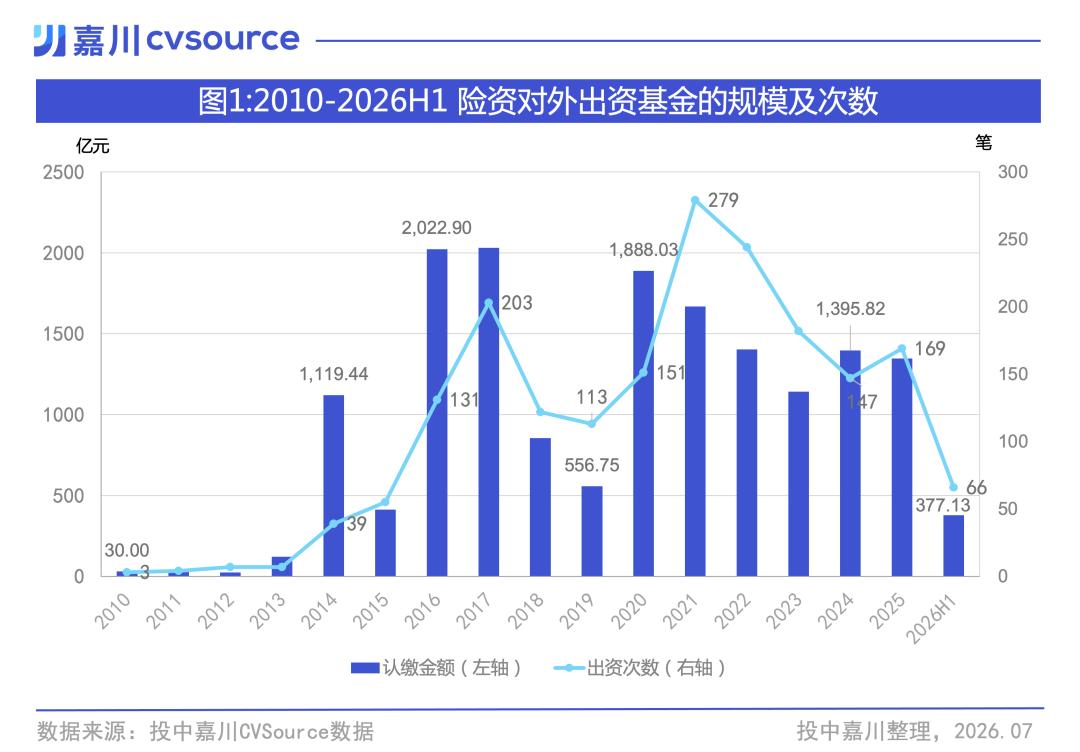
The above statistics include:
- The scale and number of external fund investments made by insurance companies and insurance asset management firms
- The scale and number of sub-fund investments made by the parent funds under the management of private equity subsidiaries of insurance firms
Thus, it is not difficult to see that the above statistics also cover many cases of [insurance capital investing in national-level funds] and [insurance companies investing in their own private equity subsidiaries or other insurance-backed private equity firms]. However, the market is more concerned about how much capital actually flows to market-oriented fund managers.
Excluding the investments in national-level funds and internal private equity entities, the shrinkage of insurance capital's market-oriented investments is even more pronounced.
In 2021, insurance capital completed 234 external investments totaling 82.2 billion yuan, marking the peak in recent years. After that, the number kept declining: 207 deals (68.15 billion yuan) in 2022, 152 deals (51.24 billion yuan) in 2023, 132 deals (56.66 billion yuan) in 2024, and 135 deals (53.84 billion yuan) in 2025.
In the first half of 2026, there were only 49 deals totaling 14.77 billion yuan.
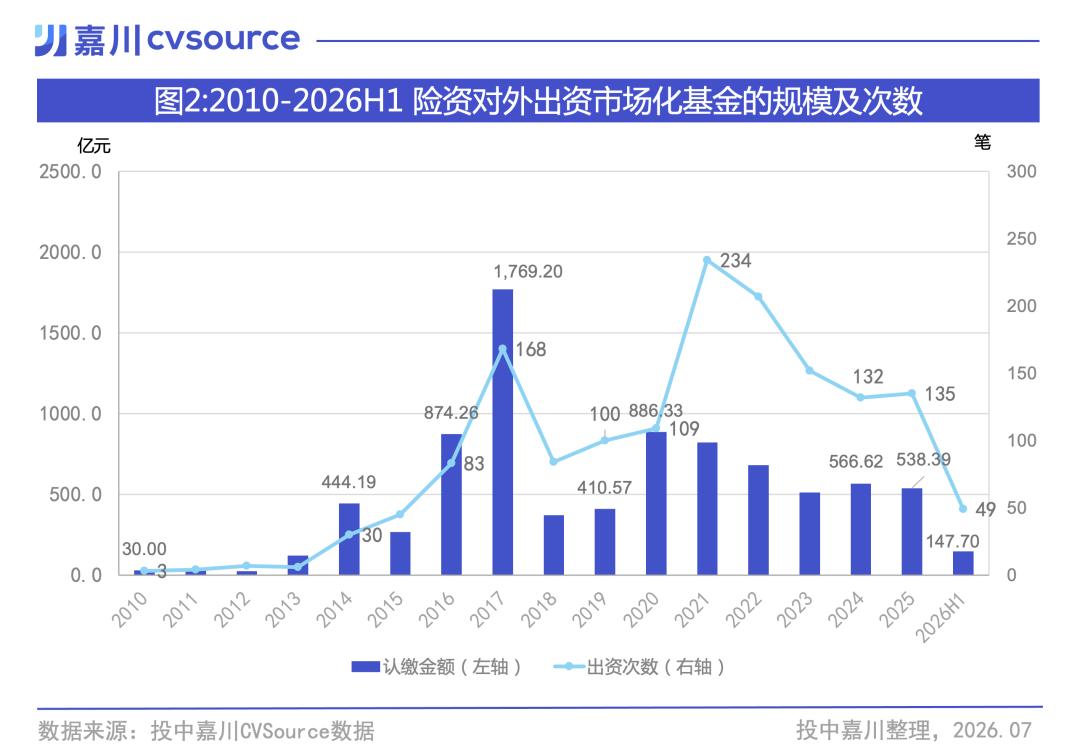
The continuous downward trend of the investment curve is not because insurance capital is unwilling to invest in private equity funds, but due to practical constraints.
The capital that insurance capital can allocate to private equity essentially comes from two sources:
- Incremental funds generated by new premium income
- Recycled funds from the exit of existing assets
In 2025, China's original insurance premium income reached approximately 6.12 trillion yuan, representing a year-on-year increase of 7.4%, marking the first time the industry's premium income has exceeded the 6 trillion yuan threshold. However, this growth rate has slowed down significantly compared to previous years. As the growth rate decelerates, the increment of newly available investable funds is naturally shrinking.
As for existing assets, the duration of private equity funds generally ranges from 7 to 10 years or even longer. Coupled with the poor exit channels in the market in recent years, the exit and recycling of existing assets have inherently slowed down. The capital that can be reinvested is naturally not as abundant as people might imagine.
Moreover, from the perspective of asset-liability matching, the high rigidity of insurance liabilities means that high-risk assets such as private equity inherently account for a small proportion of insurance capital's asset allocation (roughly around 3% overall, with variations across different insurance companies). This is reflected in the data showing that the total amount of capital contributed by insurance capital LPs to market-oriented GPs is only about half of the figure recorded in 2021.
02. Declining External Investments, Postponed Investment Timing
The shrinking investment scale is not the only trend among insurance capital LPs. In the first half of this year, the proportion of insurance capital allocated to external investments also decreased.
From 2010 to 2012, almost all insurance capital investments were directed at external institutions, reaching a proportion of 100%. After 2013, this proportion began to decline significantly, with several rebounds in between. It stood at 87% in 2017 and 74% in 2019. However, the overall trend has been downward.
After 2021, this proportion has basically stabilized between 40% and 49%, without significant fluctuations. The figure for the first half of 2026 is 39%.
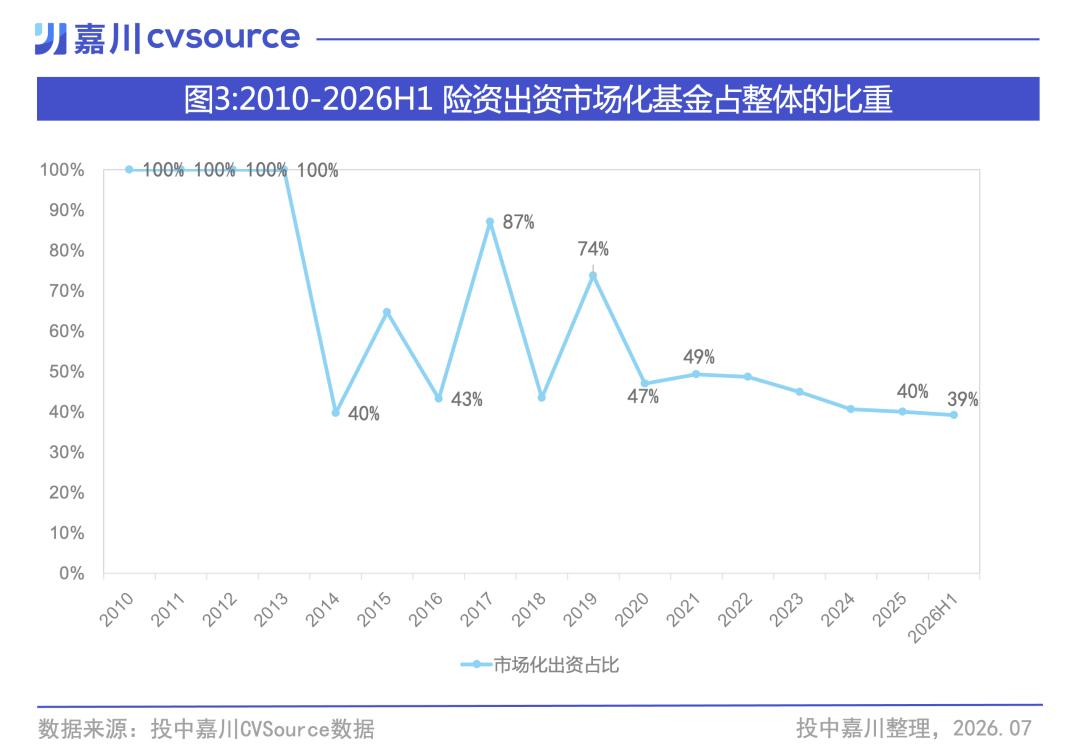
On one hand, this situation may be the result of specialized management, where insurance companies increasingly adopt the method of pooling capital in their own or in-system platforms to complete investments. On the other hand, it may also indicate that insurance capital's preference for market-oriented investments is itself declining.
The curve representing investments in external institutions is on the decline, while another curve is generally trending upward, which is the "age of the fund at the time of investment".
The age of the fund when insurance capital invests has increased from 0.24 years in 2012 to a peak of 2.58 years in 2024, remaining at 2.0 years in the first half of 2026. Over more than a decade, this figure has increased by approximately 8 times overall. This shows that insurance capital's external investment model has shifted from co-investing immediately after a fund is established in the early days, to preferring to wait until the fund has operated for a period of time before making an investment.
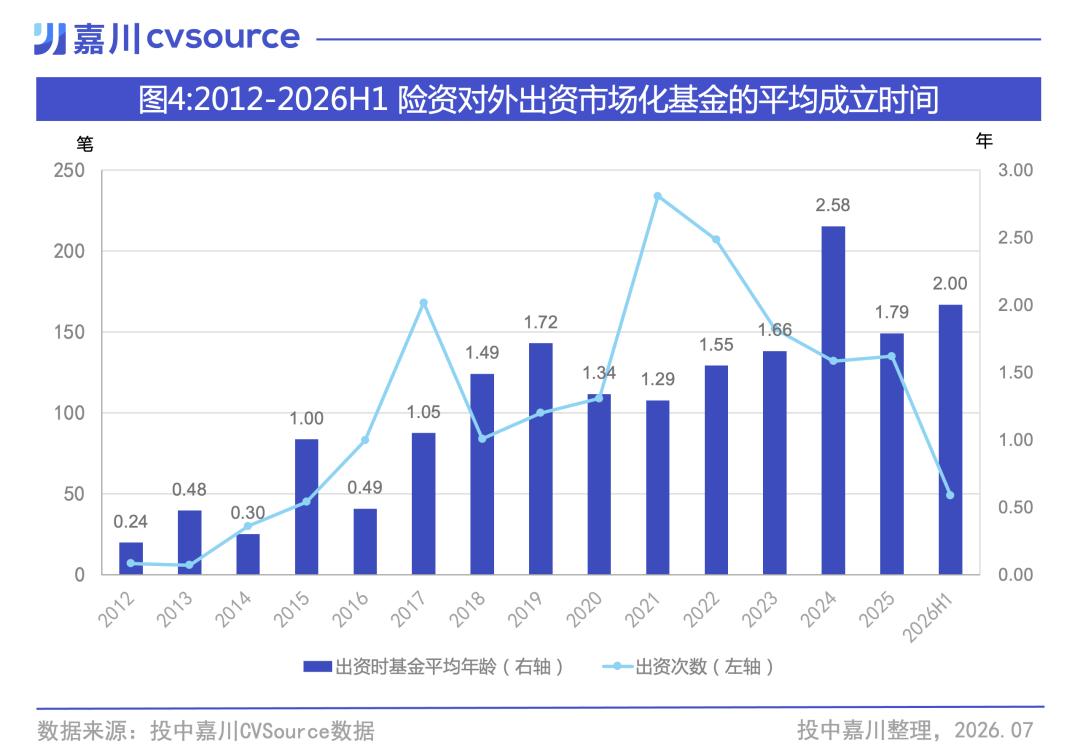
The postponement of investment timing is essentially a choice to trade time for certainty.
The longer a fund has been established, the clearer the performance of its underlying projects can be observed, and the fund's underlying assets will become closer to a transparent pool. This aligns perfectly with the positioning that "insurance capital is patient capital pursuing stable returns" — it would rather sacrifice part of the price advantage of early entry (which may not even be sacrificed in most cases) in exchange for higher decision-making certainty.
This is consistent with our research findings over the past year: very few insurance companies in the market are still considering investing in blind-pool funds.
03. Who Is Making Investments, and Who Is Receiving Insurance Capital?
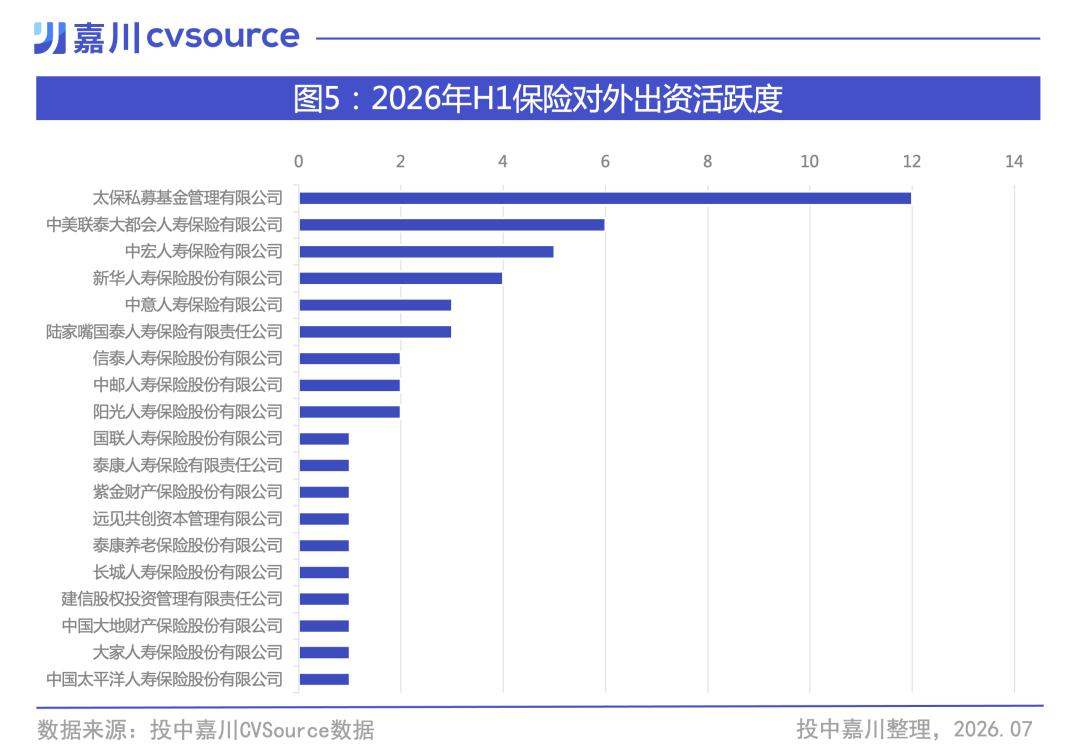
So which insurance capital LPs made investments in the first half of this year, and which fund managers secured the funding? Data from ChinaVenture CVSource shows that CPIC Private Equity Fund Management Co., Ltd. is the most active insurance capital entity in the first half of this year (also the most active entity from 2023 to 2025), completing 12 deals, which is far ahead of other institutions.
Following closely are MetLife China (6 deals), Manulife-Sinochem Life (5 deals), and New China Life (4 deals). Generali China Life and Cigna & CMB Life each completed 3 deals; Xintai Life, Sunshine Life, and China Post Life each completed 2 deals; most of the remaining institutions made sporadic single-deal investments.
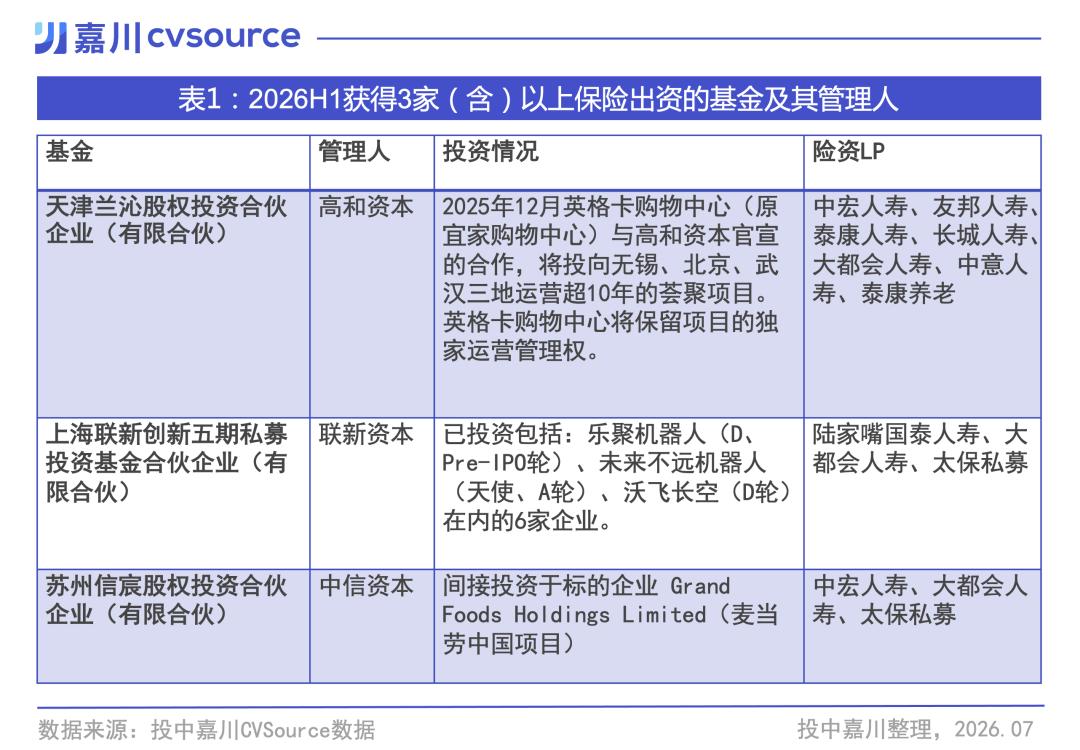
Looking at the specific list of investees in the first half of this year: Gaohui Capital received 7 investments, ranking first; New Alliance Capital received 4 deals; Taifu Capital, GL Ventures, and CITIC Capital each received 3 deals, tying for the next spot. Hua Control Fund, Kunxin Investment, D&F Capital, Cathay Capital, Yuexiu Industrial Fund, Boyu Capital, and CITIC Private Equity each received 2 deals.
Since institutional fundraising is cyclical, with a new fund typically raised every 3 years or so, we extended the time horizon to analyze the number of investments received by institutions from 2023 to H1 2026. This makes the profile of institutions favored by insurance capital even clearer: assets such as buyout funds, real estate funds, and S funds that can provide stable returns and clear time expectations are the most preferred types for insurance capital. In short, "stability" defines the institutional profile favored by insurance capital.
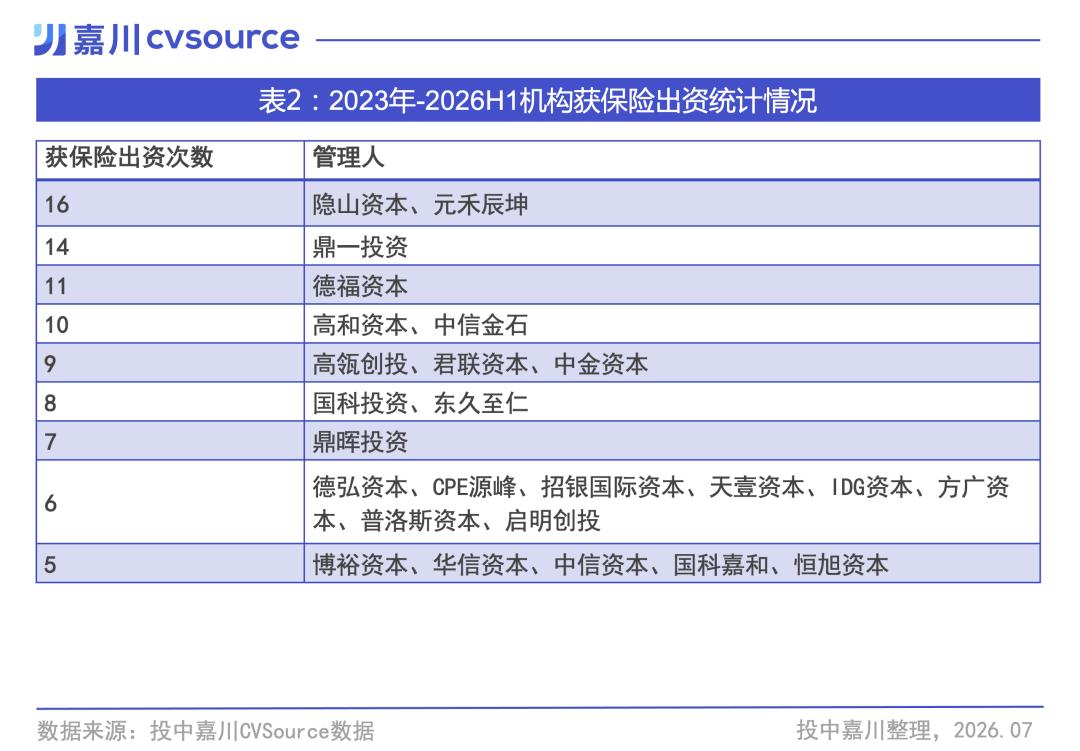
However, such products are not very common in China. The number of fund managers that possess both investment capabilities and asset management operation capabilities, with proven historical performance, is inherently very limited. This is also why some institutions can continuously secure large-scale capital commitments from insurance capital, while some traditional growth-oriented VC/PE institutions, despite their good performance, find it difficult to obtain insurance capital investments of the same scale.
This scarcity on the supply side, to some extent, may also be one of the reasons for the low activity of insurance capital in external investments.
Nevertheless, the national level is currently encouraging the development of buyout funds and S funds. Many venture capital fund managers in vertical tracks are also improving their buyout capabilities. In the future, the supply of products that meet the preferences of insurance capital should be richer than it is now.
At the same time, most domestic insurance capital has a state-owned background, and their investments must also meet the requirement of supporting national strategies. Currently, many popular tracks are overheated. At this juncture, achieving both compliance with strategic requirements and security of returns also imposes higher demands on the investment capabilities of insurance companies themselves.
This article is from the WeChat official account "ChinaVenture", author: Sissi, published with authorization from 36Kr.