Uncovering Xiaohongshu's World Cup Campaign: Copyright Turning Point, 20 Days of Sprint, and How a Community Scales Up
Text by|ZHONG Yixuan
Edited by|QIAO Qian
At 6 a.m. Beijing Time, the final whistle blew at New York's MetLife Stadium. After 16 years, Spain lifted the FIFA World Cup Trophy once again, and the 2026 FIFA World Cup finally came to a close.
In China, for Xiaohongshu, which secured live streaming rights for the first time, its World Cup mission has come to an end, but the story behind the scenes is far from over.
Let's rewind two months back. In late May, the day Xiaohongshu officially secured the World Cup broadcasting rights, it caused a stir almost immediately inside the company.
Unlike outsiders who were shocked by the stark contrast between the World Cup and the platform, internal employees were astonished that Xiaohongshu actually managed to win the rights. An employee close to Xiaohongshu told 36Kr that Xiaohongshu was the first to enter the World Cup rights negotiation, and the move was by no means a last-minute decision.
However, almost everyone internally deemed the odds slim — Xiaohongshu's competitors boasted richer hosting experience and better preparation. What's more, this World Cup was extremely special: CCTV's distribution rights were not finalized until 28 days before the tournament kicked off, leaving very limited time for new players, with barely any room for extra preparation.
Preparations had to be made well in advance. For a long period, the Xiaohongshu team worked on two parallel product development tracks: one assuming they would obtain full video rights but no live streaming rights, and the other preparing for full live streaming access.
Even during the waiting period, they received almost nothing but negative feedback: at the time, there was widespread speculation about who would secure the rights, but Xiaohongshu was never mentioned anywhere. When the team tried to onboard World Cup creators, rumors spread everywhere, and creators even questioned Xiaohongshu's operations teams, saying they'd heard rivals had already won the rights, leaving Xiaohongshu with no shot.
Disparity often births surprises. The moment the rights deal was finalized, shock, excitement, and even pride became the first reactions of many Xiaohongshu employees.
But the reality was stark: only around 20 days remained before the World Cup kicked off. What they were about to face was Xiaohongshu's first-ever World Cup live broadcast, and the one with the shortest preparation cycle in history.
This meant enormous challenges: for the same platform live broadcasting rights, Douyin signed and announced the deal for the 2022 World Cup back in June, with five full months to prepare. Xiaohongshu only had 20-odd days. Before the rights were confirmed, no one could predict the outcome, meaning most of the original product designs had to be scrapped and restarted.
Not to mention the upfront technical investments. Product designs could be revised, but as long as there was a glimmer of hope for the broadcasting rights, the studio had to be pre-built — an unavoidable fixed cost. There was also a very real problem: live streaming is always the core entry point for audiences. As a first-time World Cup broadcaster, how could Xiaohongshu outperform seasoned sports platforms in terms of equipment and experience?
Thus, in the face of this global, mega World Cup project, all internal departmental barriers were quickly broken down. A race against the clock began.
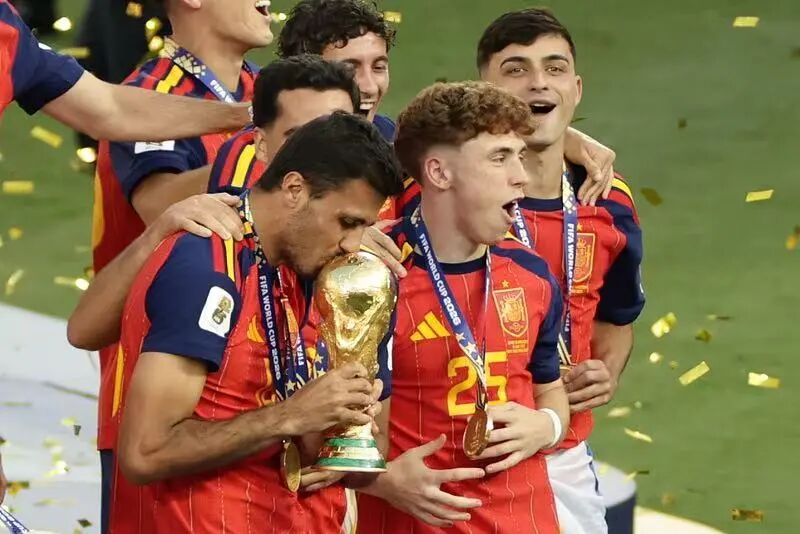
The 2026 FIFA World Cup final, Spain lifts the trophy. Source: Visual China
"Finally, we're at the table"
The day after securing the World Cup live streaming rights, the Xiaohongshu team experienced what was arguably the most dramatic upheaval in their careers.
At first, there was overwhelming excitement — an event of this scale was unprecedented for Xiaohongshu. Winning the rights meant the sunk cost of the pre-built studio was not wasted. But very soon, the team was informed that for this World Cup, all platforms would only receive standard-definition broadcast signals, far lower than professional-grade.
This was a world away from their expectations. For previous World Cups, broadcasters could access large-screen, professional-grade source streams, and all of Xiaohongshu's upfront investments were built around that standard. Even with the studio ready, once the source signal changed, the entire plan fell apart, over half of the equipment needed to be upgraded, and everyone was stunned.
More than that, no one wanted to lose. If they poured in huge efforts only to deliver worse picture quality than the last World Cup, it would surely trigger widespread complaints from online users.
Time did not allow them to dwell on their emotions. Within half a day, the team made a quick internal decision: no matter what, Xiaohongshu had to differentiate itself, and deliver ultra-HD picture quality.
Almost every Xiaohongshu employee mentioned they achieved things they never dared to imagine before —
The team tasked with optimizing the live signal to ultra-HD standards did not receive the actual broadcast signal until June 7, only five days before the tournament kicked off. They ultimately completed the task within a tight 3-day window.
To be fully prepared, Xiaohongshu built complex contingency plans. For example, for power outage scenarios: beyond Stream A, there was a Stream B backup, and beyond Stream B, another backup Stream A, with redundant backups layered on top of each other. The team even prepared for black swan scenarios: under the extremely unlikely circumstance that a partner suffered a power outage, Xiaohongshu's own backup system would go online immediately and take over the broadcast.
All of this was to ensure audiences could watch a smooth, crystal-clear World Cup live stream at the technical level.
In the early hours of June 12 Beijing Time, the opening match of the 2026 FIFA World Cup officially kicked off. Chinese football fans discovered for the first time that they could watch free, high-definition World Cup live streams on Xiaohongshu.
At the same moment in Xiaohongshu's studio, in the final 10 seconds before the opening match went live, several people stared at the go-live button and counted down out loud together. All camera angles were normal, the feed was normal, picture quality was normal, and all parameters were nominal. That moment was described as pressing a "nuclear bomb launch button".
Xiaohongshu's World Cup journey had finally arrived.
During this World Cup, among all domestic live broadcasts, Xiaohongshu delivered ultra-HD live streams with top-tier picture quality and clarity. After the broadcast went live, a flood of users poured into Xiaohongshu, with viewership numbers repeatedly hitting new records, and all the traffic was successfully handled without outages.
The team admitted that delivering industry-leading picture quality and supporting record-breaking concurrent viewers was of huge significance to Xiaohongshu. "The World Cup brought viewership dozens of times higher than normal levels, and it proved that Xiaohongshu not only has the technical infrastructure to support such large-scale events, but also has the capability to become an industry-leading live streaming platform."
Live streaming is the primary window for watching matches, but all discussions and experiences ultimately need to be reflected in the World Cup product design. During the World Cup support period, the product team also went through every day with the intensity of a wartime operation.
With the rights confirmed at the very last minute, almost all initial product designs had to be scrapped and restarted. In the current World Cup hub on Xiaohongshu, aside from the cash quiz game and "My Favorite Team" feature, all other elements were completed urgently within 20 days.
If you look closely, you'll notice that on Xiaohongshu, many users have a small football badge trailing after their usernames. If the team they support keeps winning, the badge will evolve sequentially from a silver ball, to a golden ball, and finally to the FIFA World Cup Trophy.
"Our ability to perform under pressure has improved drastically, and our technical, product, and other capabilities have expanded significantly in a short period of time," multiple participating teams said.
For this World Cup, Xiaohongshu gave it almost the highest level of resource priority — the platform set up a primary Tab entry on the home page; poured massive resources into achieving the ultra-HD effect; and ran no ads before the live streams, a consensus reached very early internally, where commercialization concessions were made entirely to prioritize user experience.

Messi sheds tears while watching Spain's players celebrate during the post-match ceremony. Source: Visual China
Making the World Cup relevant to everyone
The beauty of football transcends differences in race, nationality, and culture. Since its inception in 1930, the World Cup, with its utmost competitiveness, has captivated countless fans and become the most prominent sports IP in the world.
But how could a community with a distinct platform tone, user base, and limited sports heritage make the World Cup resonate with its users?
36Kr learned that Xiaohongshu internally once discussed, compared to other sports platforms, what exactly is Xiaohongshu's unique identity and differentiation? In other words, after spending huge sums to acquire the rights, how should Xiaohongshu define the goals of this World Cup project?
Finally, the team confirmed that regardless of whether they secured the live streaming rights, three core goals would remain unchanged: a space for global fans to chat together, a gathering place for football lovers, and a cradle for football meme culture.
This determined what kind of World Cup experience users would see on Xiaohongshu. Strawberry, Head of World Cup Operations at Xiaohongshu, said that the product and operations teams put a lot of thought into the design of every entry tab, and kept iterating even after the tournament started.
For example, the "Match Highlights" section on the home page was initially defined as content for introducing national teams and player profiles. Later, users feedback that Xiaohongshu lacked a dedicated World Cup highlight reel entry, so the column was revised to focus on real-time content, showcasing the tournament's most exciting moments.
When it came to specific product designs, the team often debated whether to take the perspective of non-professional fans or hardcore fans. A hardcore fan perspective would result in more professional expressions, while a community perspective required designs that everyone could understand.
Even down to the tiny penalty kick icon. In traditional fan culture, when a penalty is scored in a shootout, it is marked with a red football, and if missed, an X is added over it. Some team members pointed out that Xiaohongshu has a large number of casual football fans, and this type of fan icon would create a high barrier to understanding. After iterations, the team reached an agreement: keep the original football icon, but add a tiny "dot" in the center of it.
This small change meant the team hoped ordinary users could easily understand what the icon represented, while avoiding making hardcore fans feel disconnected.
For core football fans, Xiaohongshu wants to feel professional, and for the platform's native users, it wants to help them learn about football.
Therefore, while maintaining professionalism, most internal designs focused on giving ordinary users a sense of participation in the World Cup, even though football itself is a competitive sport with a certain learning curve.
The match between Cape Verde and Argentina is a perfect example. On a calm morning on July 4th, Cape Verde — ranked 67th in the world — faced off against the defending champion Argentina. Given the huge gap in perceived strength, no one expected Cape Verde to stand a chance.
But this match became one of the biggest highlights of the World Cup. Cape Verde, an island nation in the Atlantic with a population of only 540,000, no world-famous star players, and players who mostly compete in lower-tier leagues, managed to draw with Spain in regular time, and then drew with Argentina once again — the two teams that would go on to become the World Cup's champion and runner-up. Although they ultimately lost 2-3 to Argentina, Cape Verde almost pulled off a miracle.
The 40-year-old Cape Verde goalkeeper Vozinha quickly became a viral sensation. He did not sign his first professional contract until age 25, with a market value of only 50,000 euros, yet he repeatedly blocked Argentina's fierce attacks. He was a hero grown from ordinary soil.
This is the charm of football: it has nothing to do with politics, power, or status, and only pursues the fairest glory. It was football that pulled Cape Verde, this small and unknown country, out of obscurity and made the whole world notice it once again.
In the past, the platform only made celebratory posters for winning teams, but that day, Xiaohongshu made an exception for Cape Verde, creating a poster of Vozinha. In the veteran's determined eyes, Xiaohongshu's employees wrote a tender line of copy —
"The Buddha said all beings are equal, and then football was born."
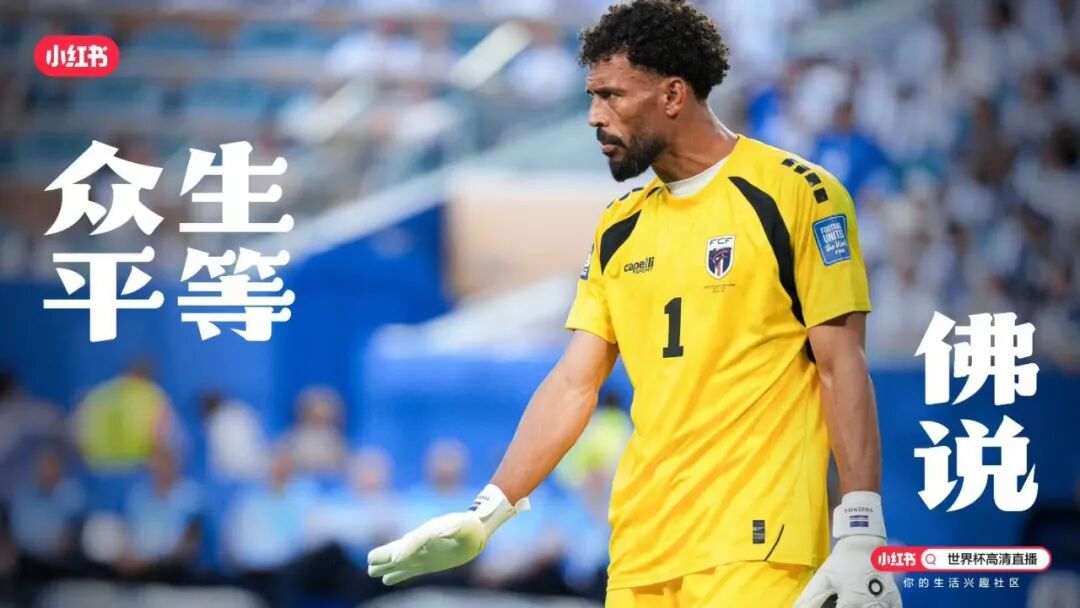
The copywriting Xiaohongshu created for Cape Verde
How a platform sets topics often reflects the community's years of understanding its users and brand tone. This poster quickly broke all performance records for sports-related posters on Xiaohongshu, even outperforming posters of world-famous football stars. Soon, this line of copy was reused by the Xiaohongshu team on the match schedule calendar, and remembered by many fans.
Finding common ground and making the World Cup relevant to everyone is what Xiaohongshu, as a UGC community, hopes to achieve. The logic behind the football player cards and AI grandstand snapshot features follows the same idea. In the past, player cards were reserved for professional athletes, but Xiaohongshu's product managers started thinking: as an ordinary fan, shouldn't you also have moments worth recording? Thus, exclusive custom cards for fans were born.
The grandstand snapshot feature also went viral on Xiaohongshu, with over 200 million exposures. The reason is simple: only a tiny number of people could actually travel to the US, Canada, and Mexico to watch the matches live. In the past, for Chinese audiences, the most common connection to the World Cup was taking a photo next to their TV set, but AI changed all of that.
Xiaohongshu wants to convey the shared spirit of the World Cup to every user, so that both fans and non-fans can engage in discussions in the same shared space.
Come for football, stay for the community
The 2026 FIFA World Cup has ended, with Spain crowned champion. The "Twilight of the Football Gods" story, with all its remaining regrets, has officially become history.
From a data perspective, the World Cup brought significant growth to Xiaohongshu — during the tournament, the number of football-related posts on Xiaohongshu increased by over 10% month-on-month. In July, the average time spent on Xiaohongshu app increased by 200% month-on-month, the number of daily published notes was 3 times that of June, and in interactive live streaming scenarios, the number of users who stayed for long viewing sessions also increased by 500% year-on-year.
Data shows that male users made up a very high proportion of World Cup live viewers. During the group stage, male users accounted for 60% of viewers for most matches, and during the late-night final matches, that proportion reached 80% or even higher.
After taking on the World Cup, as an app that aims to become a community for all people, Xiaohongshu needs more diverse types of content and a broader user base to unlock greater potential for the community.
But there's an age-old problem: football fans may have high loyalty to the World Cup, their teams, and their favorite players, but they are notoriously fickle about platforms — they go wherever the broadcasting rights are. What exactly is Xiaohongshu's user growth strategy here? After the World Cup ends, can it retain these new users?
"We don't want to be just a simple broadcasting platform. We hope users will come for the World Cup